

Read Time :
Table of Contents
Recap
In The Dawn of Conflicting Dreams, set in the still, wind-swept fields of the Golan Heights, two young soldiers—Roei Ben-Levi and Mapal Cohen—first felt the quiet pull between duty and desire. Amid drills, discipline, and long silences, they discovered an unspoken rhythm of connection.
Their bond grew not through words, but through shared exhaustion and quiet understanding. A simple paper bird, folded by Mapal, became their symbol—a promise carried in silence, light as hope, fragile as peace.
They parted as soldiers, not lovers, bound more by service than sentiment. Yet in that restraint, their foundation was born. Eternal love began for them not in confession, but in silence. Beyond the barracks and the northern wind, the echoes of The Dawn of Conflicting Dreams now lead them toward the desert—where destiny and desire will test what love truly means.
Introduction
The greatest distance between two people is not the miles they travel, but the silence they carry.
In Part 1-The Dawn of Conflicting Dreams, two young souls, Roei Ben-Levi and Mapal Cohen, navigated the harsh geography of duty and shared silence in the Golan Heights.
They learned that the promise of eternal love begins not with a bold confession, but with a simple, quiet understanding—an unspoken rhythm found between drills, dawns, and the gentle symbolism of a folded paper bird.
Their path was one of discipline; their parting, an act of faith.
Now, their journey turns from the ordered chaos of the barracks to the boundless chaos of the civilian world.
Separated by cities—Roei in Tel Aviv, Mapal in Haifa—they are reunited by a single, arbitrary decision: a coin toss in sacred Jerusalem that will decide their future.
Will destiny lead them to the concrete ambition of America, or to the ancient, soul-testing heart of India?
This is the story of their Tiyul Gadol (the ‘Great Journey’)—a pilgrimage through noise and stillness, from the thunderous streets of Delhi to the quiet, fateful edge of the Negev Desert.
It is a cinematic meditation on how we heal, how we remember, and how a fragile, wordless connection forged under fire must be tested against the world to see if it truly is eternal love.
Beyond the uniform, beyond the borders, lies the desert. And within the desert, lies the dream.
KEY POINTS: ETERNAL LOVE – PART 2
The Coin Toss & The Eastern Path
Focus: Destiny vs. Choice — initiates the search for self outside the military structure.
The Pilgrimage in India
Focus: Discipline vs. Devotion — transforms their bond into eternal love built on discovery.
The River Confession
Focus: Stillness & Understanding — eternal love is about appreciation, not promises.
The Supernova Festival Invitation
Focus: The Calm Before the Storm — symbolizes the ultimate height of their connection.
The Impending Shadow
Focus: Fragility of Joy — chilling transition to harsh geopolitical reality.
Army Reunion: Tel Aviv & Haifa
After the long, regulated months in uniform, Roei Ben-Levi’s Tel Aviv apartment looked like a half-forgotten barrack trying to find its civilian rhythm. The morning light streamed through the blinds, warming the scattered shirts, half-open duffel bags, and a lonely mug of unfinished coffee. Somewhere, on a chair, a faded olive-green jacket hung—creased but still smelling faintly of desert dust and duty. Roei had tried to “become a civilian” again, but the discipline of the army clung to him like an invisible medal. Even now, he folded his laundry with military precision—except the piles never made it to the closet.
He stood before the mirror, toothbrush in one hand, scrolling through messages from Mapal with the other.
Mapal: “You still iron your T-shirts like field orders?”
Roei: “At least they stand at attention.”
Mapal: “You mean they surrender to chaos.”
The exchange made him laugh—a low, warm sound that filled the small room. He typed back, “Maybe you should come check. Tel Aviv has evolved since Haifa’s last inspection.”
In Haifa, Mapal’s world was quieter but equally restless. Her dorm window opened to the scent of sea and salt—Haifa’s calm rhythm against Tel Aviv’s electric pulse. Books were spread across her desk: sociology notes, a half-read Lonely Planet India, and beside them, her latest obsession—a notepad filled with scribbles from a YouTube channel she had recently subscribed to.
It was called “Moses in Israel”—run by an Indo-Israeli woman who documented her travels through India, weaving stories of spirituality, culture, and the lingering echoes of the Jewish diaspora there. For Mapal, it became a window to something deeper than tourism. Each video was a gentle initiation into another civilization’s rhythm—its festivals, monsoons, kindnesses, and contradictions.
She paused often during the videos, notebook in hand, underlining words like karma, Ganga, and Namaste as if decoding a secret language. In a world that had trained her to read maps and orders, she was now learning to read symbols and silences.
Sometimes, between her studies and the channel’s soft-voiced narrations, she would think of Roei—how impatient he was with slowness, how he needed motion, volume, speed. India, she smiled to herself, would test his patience in every possible way.
That evening, their video call began with bad lighting and better humor. Roei’s camera caught only half his face.
Mapal: “Still bad with angles, Commander?”
Roei: “I specialize in battlefield tactics, not front-facing cameras.”
Mapal: “And yet, your battlefield now includes a frying pan and a vacuum cleaner.”
They both laughed. The laughter was ordinary, yet there was something behind it—an ache wrapped in familiarity. They had faced fear together, exhaustion, even death’s echo—but now, separated by ordinary life, the distance between them felt harder to name.
Roei leaned closer to the screen. “Listen, I’ve been thinking…” His tone had that half-serious spark she recognized from their days in service. “New York.”
She blinked. “New York?”
“Big city, tall glass buildings, music, street lights that never die. The kind of place where nobody salutes anyone.”
Her brow arched. “You mean chaos disguised as freedom.”
“Exactly!” he said, delighted. “You’ll love it. I’ll take you to Dizengoff first—there’s a mall with lights like Times Square, drinks, music, and the fastest cars in Israel.”
Mapal laughed. “So your travel plan is caffeine and combustion?”
“Modern civilization in a cup,” he said. “You’ll thank me.”
Her laughter softened, but her answer came calm and firm. “No, Roei. Not malls, not bars. You’ve seen enough noise.”
He frowned slightly. “Then where? Don’t say Haifa again, please.”
“Jerusalem,” she said simply. “A middle ground. Sacred, neutral. We’ll meet there and decide—India or America. You in Tel Aviv, me in Haifa—we’re both biased by our cities. Let destiny decide.”
Roei tilted his head, half amused. “You’re serious about this coin toss thing?”
“Yes. A coin toss at the Western Wall. Heads for you—America. Tails for me—India.”
He chuckled, rubbing his chin. “And if it stands upright?”
“Then it’s a sign,” she said, eyes glinting. “Maybe an old lady will help us decide. Life has a sense of humor, Roei. It always sends someone when hearts are unsure.”
He watched her quietly. The firm tone in her voice, the serenity in her eyes—it struck him how easily she now commanded the moment.
Once, he had been her officer. Now, she seemed the one leading him—gently, invisibly.
“Jerusalem it is,” he said at last. “A holy duel of destinies.”
“Not duel,” she replied, smiling. “Reunion.”
Outside, the Mediterranean stretched between them—Tel Aviv and Haifa, two cities breathing under one vast sky. The sea shimmered like memory—sometimes calm, sometimes restless—but always reflecting the same sun.
Between them ran not just miles, but an unspoken thread of understanding: that eternal love begins in such quiet convergences, where humor hides longing, and decisions become destiny.
Decision to meet in Jerusalem to “settle their travel plans,” subtly a meeting of hearts.
Their laughter faded into quiet resolve — in Jerusalem, a coin would decide their next journey, and perhaps test the truth of eternal love. Jerusalem Coin Toss: The Fate of Two Roads →
Jerusalem Coin Toss: The Fate of Two Roads
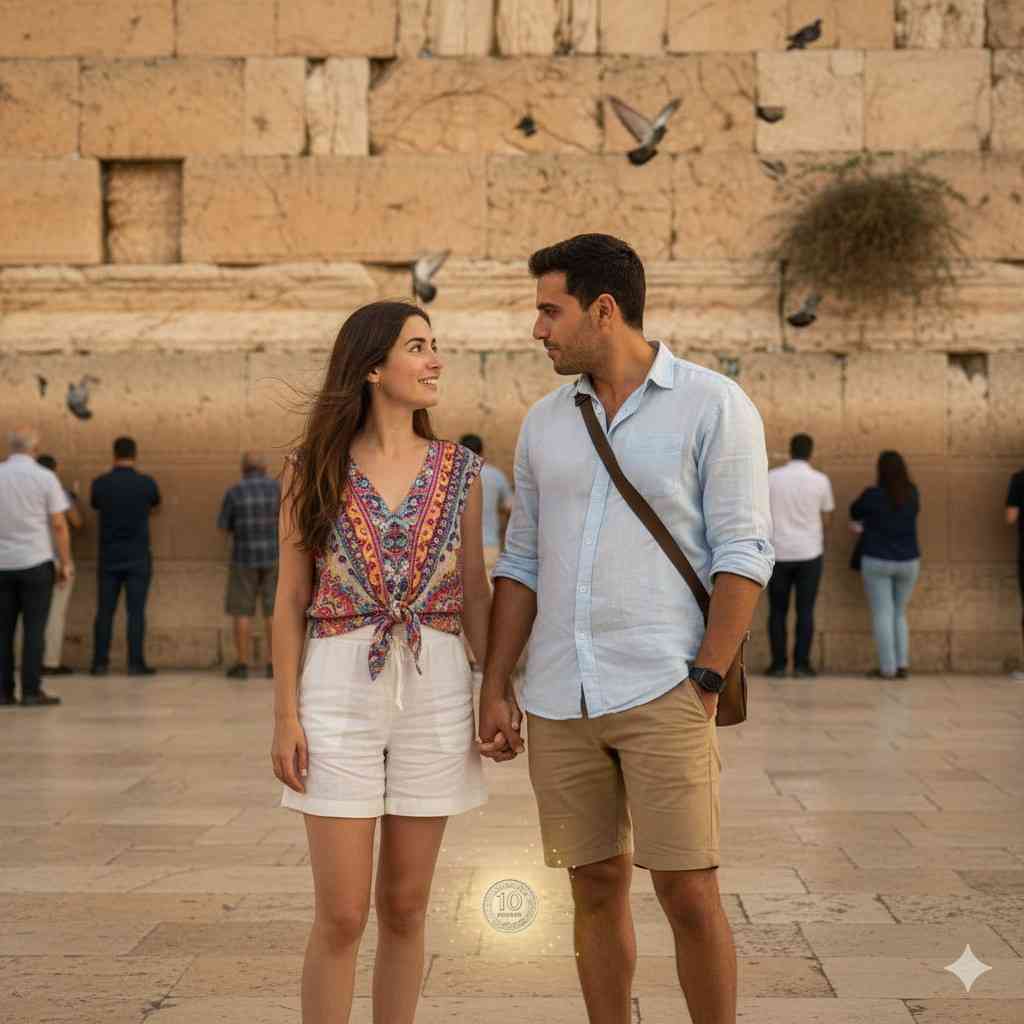
The afternoon light of Jerusalem was soft, filtered through the slow drift of pigeons near the Western Wall.
Tourists murmured prayers, their papers folded like fragile secrets between stone crevices. The air smelled faintly of dust, wax, and eternity.
Roei waited near the shaded corridor, hands in pockets, eyes squinting against the glow.
Mapal arrived in a pale cotton dress, her hair slightly windblown, a small notebook pressed to her chest.
“You really brought a notebook to a coin toss?” Roei teased.
“It’s for recording divine statistics,” she replied with mock solemnity. “I don’t trust your math.”
He laughed — the first genuine laugh since leaving the base.
They walked toward the Wall in silence, letting the hum of prayers wrap around them.
Mapal stopped near a group of elderly women murmuring Psalms. She closed her eyes briefly, touching the stones with reverence.
Roei stood behind, uncertain but respectful.
“You sure this is where we decide our next adventure?” he asked softly.
“Where else?” she smiled.
“If we’re going to choose between your New York skyscrapers and my India temples, we may as well let heaven watch.”
She pulled out a silver coin, glinting in the golden light.
“Best of three?” she said, raising an eyebrow.
“Deal,” Roei nodded, though his grin was half nervous.
“Remember, heads — you win, USA. Tails — I win, India.”
The first toss spun high, catching the sunlight like a small prophecy.
It fell — heads.
Roei raised his fists playfully. “Jerusalem blesses Wall Street!”
Mapal chuckled, shaking her head. “Don’t start celebrating. Love’s math has two more chances.”
The second toss — quick, clean — landed tails. Mapal clapped once, triumphant.
“One all,” she said. “Heaven’s being democratic.”
The third toss was slower, almost reverent. Roei flicked it higher this time — the coin caught a strange updraft, shimmered, and landed on its edge, spinning on the hard stone floor.
It rolled between them, circling once, twice — the sound sharp against the quiet prayers.
Both held their breath as it clattered, wobbled, and finally fell tails — Mapal’s side.
The old woman beside them smiled faintly, whispering, “The heart knows before the coin does.”
Mapal looked at Roei — half laughing, half moved.
“Seems even chance prefers the East.”
Roei sighed in mock defeat. “That coin just cost me my future — and maybe my next salary.”
“You’ll survive,” she smiled. “Eternal love isn’t about winning — it’s about listening.”
They stood by the Wall for a while longer, watching the pigeons lift into the air.
The decision was made — not by fate, but by feeling.
Somewhere beyond reason, both knew: their Tiyul Gadol journey, and their story, would begin in India.
“Love is not a decision we make — it is a decision that makes us.”
— Paulo Coelho
(Paulo Coelho’s words — “Love is not a decision we make; it is a decision that makes us.” — beautifully capture the soul of eternal love. In this story, Roei and Mapal’s bond mirrors his insight: their love isn’t a choice born of reason, but a quiet, unseen force that shapes their journey. It defines their destinies, leading them beyond duty and distance toward something timeless — the kind of eternal love that chooses us long before we understand it.)
The coin came to rest — tails for India, heart for truth. Their laughter lingered like prayer smoke over the Western Wall, sealing their next chapter in the rhythm of eternal love. The Preparation: Airport of Promises →
The Preparation: Airport of Promises

Eternal Love – The Geography of Love
Tel Aviv’s Ben Gurion Airport shimmered under the late-morning haze — a mix of glass, steel, and sunlight moving like a restless sea.
Announcements rolled through the hall like soft waves, each carrying someone’s name, someone’s goodbye.
Roei stood beside a pile of half-zipped luggage, hair slightly messy, muttering a checklist under his breath.
“Passport, wallet, charger, socks… I swear I packed them all.” He opened and closed the same bag twice, as if that might change what was inside.
Mapal leaned against the trolley, watching him with patient amusement — the kind that comes from knowing how soldiers pack and leave. People like her understand that departures happen in stages: first from home, then from peace, then from certainty.
“You’ve checked your toothbrush twice,” she said, slipping a folded itinerary into his hand. “But not your ticket. It’s color-coded. I labeled it for you.”
He looked up, half-offended, half-grateful. “You color-coded our travel plans?”
“It’s how adults survive airports,” she teased. “And how soldiers survive you.”
Their laughter broke through the hum of announcements and suitcase wheels. It was the kind of laughter that made strangers turn and smile — brief, human, and bright against the monotony of waiting.
Around them, families huddled in small circles of farewell. A child tugged at his mother’s sleeve, asking where the sky began. An old man held a bouquet of tired roses, petals already curling. The air smelled faintly of coffee, jet fuel, and moments not yet made.
They found a bench near the wide glass window overlooking the tarmac. Beyond the glass, airplanes crawled across the sunlit runways like patient insects. One blinked with the small red light of their own flight: AI 140 — Tel Aviv to Delhi.
Roei watched the numbers fade in and out. “Tell me,” he said softly, “why travel at all? We could stay in Eilat. The sea’s warm there. We could swim, rest, forget the noise for a while.”
Mapal smiled — not the easy smile she gave others, but a quieter one, meant for truths that hurt. “Because standing still is what war teaches us,” she said. “Travel is how we heal. Every new place is a small rebirth.”
He studied her reflection in the glass — her face overlapping with clouds drifting beyond the runway. For a moment, it looked as if she belonged to both worlds: the grounded and the infinite.
“And if we get lost?” he asked, a trace of worry in his voice.
She turned toward him, eyes calm and kind. “Then we’ll let eternal love be our compass,” she said. The words lingered — simple, honest, and true.
The loudspeaker crackled with the first boarding call. People began to stand, their movements filling the quiet space between them.
Roei reached for her hand — not to hold it in possession, but as two travelers do, seeking the same rhythm of heartbeat through uncertainty. Their fingers met and stayed there, steady and unhurried.
“Promise me something,” he murmured.
“What?”
“That we won’t make this about destinations. I don’t want this to be just another line we cross and forget.”
Mapal nodded. “Then let’s make it about departures that teach us how to return — to ourselves, to what matters.”
The intercom repeated the boarding call in three languages. The sound echoed through the hall like a prayer made of metal and motion.
As they stood, Roei caught their reflection in the tall glass wall: two small figures framed by clouds, backpacks, and light. The reflection trembled as a nearby engine roared, blurring their shapes — as if time itself refused to hold them still.
He smiled faintly. “Look,” he said, “we already look like ghosts.”
Mapal touched his arm gently. “Then let’s be the kind that remember.”
They walked toward the gate, each step a small surrender. The line moved slowly — passports checked, bags lifted, dreams weighed.
At the threshold, Mapal turned once more toward the window. Outside, the plane’s silver body caught the sunlight — a bright glint of promise, half-kept, half-feared.
The engines hummed with that ancient music of parting — the sound that pulls at the heart and asks if love can travel farther than the body.
Roei followed her gaze. “So it begins,” he whispered. “The geography of love.”
She smiled softly, hearing him even through the noise. “No,” she said. “It began long before this flight.”
And as they stepped into the tunnel of light, the world behind them blurred — faces, echoes, and the hum of air. What remained was a quiet truth between them:
Love wasn’t waiting on the other side of the journey.
It was already walking beside them — boarding quietly, carrying nothing but memory and faith.
“Wherever you go becomes a part of you somehow.”
— Anita Desai
(The quote “Wherever you go becomes a part of you somehow” reflects how Roei and Mapal carry their bond wherever they travel. It shows that eternal love isn’t tied to one place — each journey deepens it, making every destination a part of their shared heart.)
As the plane rose over Tel Aviv’s glimmering coast, two reflections merged in the glass — proof that eternal love travels not in distance, but in direction. India: The Call of Chaos and Color →
India: The Call of Chaos and Color
“`htmlIndia greeted them not with silence but with song — a song made of horns, hawkers, incense, and dust that shimmered golden in Delhi’s sunlight.
At Connaught Place, Roei blinked, stunned by the swirl of humanity. “This isn’t a city,” he muttered, “it’s an orchestra warming up.”
Mapal, far less disoriented, smiled as she adjusted her scarf. “Follow the rhythm,” she said. “Don’t fight it.”
They wound through lanes where rickshaws brushed against spice stalls, and temple bells mingled with pop music from passing scooters.
At a crowded gate, Roei paused. “Food stall?” he asked hopefully.
She laughed. “That’s the temple queue, Roei. Not every crowd is for eating.”
Her laughter rang bright as brass, and for a moment, the chaos became choreography.
By noon, they reached India Gate, where the war memorial names shimmered faintly under sunlight. Mapal traced a finger across the carved letters.
“For all who loved,” she whispered, “and still must fight.”
Roei didn’t speak. He only watched her hand — steady, reverent — and realized that this journey was no longer about destinations, but discoveries.
The next stop was Mumbai, where the air smelled of salt and ambition. Bollywood posters glowed like electric prayers, and the streets pulsed with music.
At a roadside stall, Roei bit into a vada pav and froze, eyes watering.
“Spicy?” Mapal asked, laughing uncontrollably.
“Not spicy,” he gasped, “just… emotional.”
Her laughter spilled like sunlight over water — uncontrollable, joyous, contagious.
“Laughter is the shortest distance between two hearts.” — Victor Borge
That night, from the Marine Drive promenade, they watched the city’s skyline shimmer.
Between the sea and the sky, Roei whispered, “Maybe chaos has its own beauty.”
Mapal replied softly, “Or maybe beauty lives inside chaos.”Days later, the world slowed. They floated through the Kerala backwaters, where the horizon blurred into green silence.
Rain tapped the houseboat roof like a heartbeat. Mapal tied tiny ghungroos around her ankles — bells she’d bought in Delhi — and began to dance, not with skill but with sincerity.
Roei sat still, watching her silhouette move in the rainlight — her laughter, her motion, the bells whispering against her skin.
“Maybe,” she said between steps, “eternal love isn’t possession. Just rhythm shared.”
Roei’s voice came soft, almost prayerful. “Then keep dancing — I’ll learn the rhythm.”
Outside, the river curved into darkness, as if time itself had bent to listen.
In the Himalayas, dawn arrived pale and wind-borne. Snow clung to the ridges like forgotten pages.
Roei stood shivering, too proud to admit it. Without a word, Mapal took off her scarf and wrapped it around his neck — gentle, unspoken intimacy.
The scarf carried the scent of rain and sandalwood; it felt like a promise.
He looked at her then — hair tousled by cold, eyes glimmering like faraway stars — and thought, she is a world disguised as one woman.
For a while, neither spoke. The sun broke through the mist, gilding their faces in quiet fire. Birds wheeled high above, vanishing into blue infinity.
In that high silence, Roei finally understood — the journey had never been about countries or maps.
It was a pilgrimage, a geography of emotion — one that began in discipline, wandered through devotion, and found its temple in her smile.
The wind shifted. Bells from a distant monastery rang like blessings.
Mapal whispered, “Home feels closer now.”
Roei nodded. “That’s because we stopped searching for it.”
They walked on — two pilgrims, two wanderers — tracing their way through the great living map of eternal love.
Their footsteps echoed in the silence of the Himalayas — not travelers now, but pilgrims bound by eternal love and memory. The Realization: River Confessions →
The Realization: River Confessions

By a quiet river in Kerala, Roei and Mapal share stories instead of vows, silence instead of promises. Beneath a fading sky, they discover that words can’t contain what flows between them — a fragile, wordless, yet real eternal love.
The evening arrived softly — like a secret shared by the wind.
Kerala’s river shimmered beneath a lilac sky, its slow current catching the last gold of the sun.
Palm leaves whispered, fishermen hummed old tunes, and somewhere in the distance, a temple bell folded the day into memory.
Roei and Mapal sat on the sand, shoes off, silence between them both comfortable and charged.
The air smelled of salt, cardamom, and something untranslatable — maybe belonging.
Mapal set her phone beside her, letting a faint melody float between them — a Hindi song she didn’t fully understand but somehow felt.
Its rhythm mingled with the lap of the river against the shore.
She smiled faintly. “I found this one on that channel — Moses in Israel,” she said. “The singer said love and prayer are the same when sung softly enough.”
Roei looked toward the horizon. “That’s something soldiers never learn — how to sing softly.”
“Then start tonight,” she teased gently.
He hesitated, then began speaking — not loudly, not to impress. “In the Golan Heights,” he said, “nights were long.
Too quiet, sometimes. I used to think silence was just emptiness.
But one night, during patrol, I realized — maybe silence is the only prayer we’re ever sure reaches heaven.”
Mapal turned her head slightly. “You prayed in silence?”
He nodded. “I think so. I didn’t know who I was talking to, but it felt honest.”
The wind shifted, brushing her hair across her face. She didn’t move it aside; she let the moment settle.
“Then maybe,” she whispered, “our silence is our language.”Roei looked at her — really looked. “Maybe this,” he said, gesturing to the water, the fading light, “is what soldiers call home. Even without a building.”
They sat quietly after that, each tracing invisible lines on the sand.
The river glimmered like moving glass. Somewhere a conch blew, echoing across the water — a sound old as prayer.
Mapal broke the silence with a laugh too soft to disturb the dusk. “You realize,” she said, “we’ve been running across countries just to learn how to sit still?”
Roei smiled. “Maybe that’s what travel’s for — to bring us back to stillness.”
The paper bird — the same one she had folded weeks ago in Haifa — rested between them on the sand.
Its wings trembled in the river wind, as if ready to lift but unwilling to leave.
He reached out and steadied it with his finger. “Strange,” he murmured, “how something so light can carry so much.”
“Like feeling,” she said.
“Like eternal love,” he added quietly.The wind paused then, as though listening. Time thinned.
Mapal leaned back on her elbows, gazing at the sky where day and night were still negotiating. “You know what I realized?” she said.
“Every river eventually meets the sea. Maybe we don’t need to decide where we belong — maybe belonging finds us.”
Roei watched the ripples drifting outwards. “And if the sea forgets the river?”
She smiled, not sadly. “Then it’ll rain somewhere else — and start again.”
“Love is not about possession. Love is about appreciation.” — Osho
The tide crept closer, touching the edges of their footprints. Fireflies began to appear, blinking like quiet affirmations.
That night, under the indifferent stars, they felt eternal love — fragile, wordless, but real. It didn’t ask for promises or destinations. It only asked to exist.
Roei picked up the paper bird, now slightly damp from the sea breeze, and set it on his palm. It fluttered once before settling.
“Maybe this is our map,” he said.
Mapal nodded. “Then let’s not fold it away.”For a long moment, they sat without speaking — two silhouettes framed by a restless river, a quiet confession shared in the language of waves.When they finally rose to leave, the bird remained behind — trembling in the soft sea wind, halfway between land and water, halfway between two hearts.
The river kept their secret — a silent witness to eternal love born without words, carried by water, and waiting for the tide to return. Return & Festival Invitation →
Return & Festival Invitation
The flight home felt lighter than clouds. Israel unfolded below them — patchworks of gold sand and blue sea, stitched by memory.
Roei pressed his forehead to the window, smiling. “Back to reality,” he murmured.
Mapal laughed. “If reality is hummus and traffic, I’m ready.”
Tel Aviv greeted them with its usual chaos: scooters, sunlight, and sea salt in the air.
They met Hili Solomon, Mapal’s old friend, at a café near Dizengoff Street. Hili waved two neon wristbands and grinned.
“Guess who has tickets to the Supernova of Light festival?”
Mapal’s eyes widened. “The one in the Negev?”
Hili nodded. “Music, freedom, and stars big enough to make you forget borders.”
Roei raised an eyebrow. “A festival after Golan discipline — I’ll forget how to dance.”
“Then you’ll learn from the stars,” Mapal replied, her tone half-playful, half-prophetic.
They clinked glasses of lemonade, the sound crisp as laughter. Talk drifted from travel memories to melodies yet to come.
The desert, they said, would be their reset — a place to breathe between past and future.
Later, walking by the Tel Aviv promenade, Roei watched the sea stretch endlessly west. “Strange,” he said. “Every road we take bends back to sand.”
Mapal nodded. “Desert means purity. Maybe it’ll test how strong our eternal love really is.”
A siren wailed faintly somewhere inland — routine, distant, almost dismissed. The city kept moving. Music from an open bar swallowed the sound.
They stood for a moment longer, facing the darkening horizon, unaware that the invitation to celebrate light was also the first whisper of shadow.
Roei turned to her, smiling. “Promise me you’ll dance enough for both of us.”
She answered softly, “Only if you remember how to listen.”
“The only love worthy of a name is unconditional and eternal.” — Mahatma Gandhi
(The quote “The only love worthy of a name is unconditional and eternal.” — Mahatma Gandhi perfectly mirrors the soul of the story.
Roei and Mapal’s bond isn’t built on possession or promises — it’s shaped by distance, silence, and understanding. Even when duty, travel, or danger separates them, their connection endures without demand or condition. This quiet persistence reflects eternal love — a love that exists not because of circumstance, but in spite of it. Gandhi’s words echo through their journey, reminding us that true love needs no proof; it simply continues, boundless and faithful, across every border of life.)
Joy returned with the promise of celebration — yet beneath the Negev sky, destiny waited to test the silence of their eternal love. The Supernova Festival: Where Light Meets Shadow →
The Supernova Festival

The Negev Desert glowed under the moon, quiet and alive at once. From far away, it seemed still; up close, it breathed.
Tents shone in soft blues, pinks, and yellows, swaying in the midnight breeze like paper lanterns drifting from the sky. The Supernova Festival had begun.
Music rippled through the sand. Each beat felt like a forgotten heartbeat, free from duty. Roei stood among the crowd, watching Mapal dance with an easy grace. Her white scarf caught the light like a trail of a comet.
“Come on,” she laughed, “you survived Golan; you can survive a little rhythm.”
He smiled, unsure, then stepped forward. His movements were stiff at first — too much soldier, too little boy — but her laughter softened him. Around them, people moved together as if the desert itself had found a pulse.
Mapal pressed her hand to his chest. “Feel that?”
He nodded. “It’s the first time in years my heartbeat isn’t marching.”
The air grew cooler. Someone passed them a shared drink — citrus and spice. They drank, and the taste lingered like memory. Above, stars drifted slowly, patient and ancient.
Roei looked at her then — really looked. The light from glow-sticks shimmered in her eyes, and the reflection of the desert curved in her smile.
“If eternity had a shape,” he said softly, “it would be your smile in this wind.”
She turned toward him. “Then hold it, before it changes shape again.”
They sat on a dune at the festival’s edge. Music faded behind them. The desert stretched out like an ocean of breath and silence. Mapal rested her head on his shoulder.
“Do you think,” she asked, “that all this joy is a kind of rebellion?”
“Maybe joy,” he said, “is what survives the uniform.”
“Love does not claim possession but gives freedom.” — Rabindranath Tagore
He remembered her saying that travel was healing — not escape, but surrender. Around them, nameless strangers danced in rhythm, alive and unbound.
For a while, they forgot everything — the uniforms folded away, the quiet goodbyes, the weight of tomorrow. They were just two shadows moving by firelight, two small flames daring the dark to see them.
Time slipped. The festival dimmed. Dawn began to rise. The sky shifted from indigo to gray. Mapal whispered, “It feels like the world is holding its breath.”
Roei nodded. The wind paused; the music stopped; the desert listened.
In that stillness, eternal love was not a promise — it was a presence. It lived in their silence, in their laughter, in the shared pulse beneath a waking sky.
He wanted to speak but stayed quiet. Words were too heavy. He only reached for her hand. She took it without turning, her fingers cool and sure.
A single guitar note drifted through the air. The first light of dawn brushed the sand — gold and gentle. From somewhere far away came a faint thud — low, distant, unnoticed.
For now, the world still held its breath.
As dawn broke over the Negev, their laughter lingered — unaware that light itself can burn. Eternal love was about to meet its reckoning. The Tragedy: Dawn of Fire →
The Tragedy: Dawn of Fire
Morning began like a slow breath.
The music from the night before still lingered — faint, dreamlike — as if the desert itself was humming. Roei stirred awake, half buried in sand, the taste of dust still on his tongue. Mapal’s head rested on his shoulder; her hair smelled faintly of salt and jasmine.
Then came the first sound — sharp, alien — like thunder tearing through glass.
A shiver passed through the camp.
The music stuttered, then stopped. Someone shouted. Then silence — that strange silence before the world decides to end.
“Fireworks?” Mapal murmured, still half asleep.
Roei’s soldier instincts had already risen. “No,” he said softly, eyes narrowing toward the horizon. “Not fireworks.”
The second sound split the dawn open.
From above the dunes, gliders appeared — dark silhouettes slicing through the pale morning light. The sun caught the metal glint of rifles strapped to the riders — Hamas terrorists descending from the sky, their shadows falling across the festival like a curse.
For a moment, the crowd froze, unable to believe what they were seeing. Then — the first burst of gunfire.
The music collapsed into screams.
Tents flared. Sand lifted in violent spirals.
Roei grabbed Mapal’s hand. “Run!”
They stumbled through smoke and flashing light — barefoot, blinded by chaos. The neon colors from the night blurred into gray; the rhythm of joy shattered into the rhythm of survival.
The air smelled of fire and fear.
He felt her hand slip — just slightly — and turned. Through the haze, she was there — still running, still radiant, a white shape in a world gone dark.
“Mapal!” he shouted.
Her lips moved — his name — a sound too soft to fight the explosions.
Then the sky itself screamed. A rocket struck near the stage, scattering light, metal, and silence.
He hit the ground, instinct dragging him beneath an overturned truck. His ears rang. Smoke poured over the dunes.
Somewhere, amid the chaos, he thought he heard her laugh — faint, impossible, like memory trying to survive fire.
He waited until the gunfire dimmed, until the air turned heavy with dust and disbelief. Crawling out, he stepped into a world he no longer recognized. The Supernova Festival — once a sea of color and sound — was now gray and still, its music replaced by wind and ash.
He moved between broken tents and unmoving forms, calling her name.
No answer. Only the desert breathing through the wreckage.
Then — something white. Half-buried near a charred post.
He knelt.
It was the paper bird.
Edges burned. Wings curled inward, as though still trying to fly.
He held it gently, trembling, as if it still carried her heartbeat. Around him, the wind carried dust, smoke, and the fading hum of what had once been joy.
He whispered, “You said to follow the wings.”
Then, quieter: “We should have held hands, not a coin.”
The desert gave no reply. Only the wind moved — slow, patient, eternal.
He sat there until the sun rose high, until the shadows of the gliders were only ghosts against the sky. When rescue teams found him, he was still clutching the paper bird to his chest.
They asked who he was with.
He looked toward the horizon and said, “She was the wind.”
The Negev lay silent, scorched yet sacred.
And when the breeze returned — faint and forgiving — it brushed across his hair like a memory reborn, a whisper of eternal love that no weapon could destroy.
“Those we love never truly leave us; they live on in the whispers of wind.” — Victor Hugo
(The quote — “Those we love never truly leave us; they live on in the whispers of wind.” — Victor Hugo — perfectly captures the spiritual essence and emotional afterglow of this scene.
In the story, when Mapal is lost in the Hamas terrorist attack, her presence doesn’t vanish; it transforms. The desert wind — once carrying music and laughter — becomes her living voice, echoing through Roei’s grief. Even in devastation, he feels her near him, not as a ghost, but as a breath of memory woven into nature.
The wind becomes the symbol of eternal love — invisible yet ever-present, carrying the soul of one who is gone but never absent. Just as Victor Hugo’s quote suggests, love transcends death’s silence; it becomes part of the air itself — tender, eternal, and unbroken.)
The desert fell silent, but his heart did not. The wind still spoke her name — the language of eternal love. Aftermath: The Desert of Dreams →
Aftermath: The Desert of Dreams
Two years had passed since the Supernova night, yet the Negev still lived inside Roei’s dreams.
He had moved back to Tel Aviv, but the city no longer sang the same rhythm. The apartment was the same — bare walls, folded clothes, the faint smell of instant coffee — but it felt like a museum of unfinished echoes.
On his desk lay three objects he could not throw away:
Mapal’s paper bird, edges still blackened;
her ghungroos, their bells silent now;
and a miniature Taj Mahal, its white dome slightly chipped — bought during their last walk through Delhi’s dusk markets.
He kept them inside a wooden box, wrapped in an army handkerchief. Sometimes he opened it just to breathe the faint scent of sandalwood and dust that clung to the memories.
The rescue unit had taken him back. He drove supply trucks, lifted debris, stood in silence when others cried. When asked how he was, he always smiled a little — the kind of smile that meant, don’t ask again.
He no longer spoke much. The world had become a place of muted colors, like a watercolor washed by rain.
At night, he wrote.
Not letters, not stories — only fragments on small scraps of paper:
“Eternal love is not presence — it’s the ache that refuses to die.”
“When the coin fell, so did certainty.”
“The wind speaks her name when I stop listening.”
Sometimes he tore the pages, sometimes he kept them in drawers. He wasn’t sure for whom he wrote — maybe for her, maybe for himself.
In late winter, he drove north toward the Golan Heights, where everything had first begun.
The fields were pale, the air clean, the wind whistling through abandoned lookout posts.
He stood at the same hilltop where they had once argued about freedom, duty, and cities beyond the horizon.
For a long moment, he just watched the clouds drift over the basalt cliffs. He whispered her name once — not loudly, but with the kind of softness reserved for prayer.
Somewhere in that stillness, the wind carried an echo.
He remembered her words from India — “Maybe eternal love is not possession — just rhythm shared.”
It struck him how rhythm could survive even when melody had vanished. That was grief: the silent beat that refused to stop.
When spring arrived, Roei found himself walking through Jerusalem’s Jaffa Gate, the same path they had taken before the coin toss.
The streets were alive again — merchants shouting, pigeons rising like startled thoughts. Yet amid the noise, he felt something ancient moving quietly beneath the surface — memory disguised as wind.
He paused near a souvenir stall. The old woman was there again — the same one who had smiled at their coin toss two years ago.
She looked at him as if she knew.
“You found your road?” she asked, her accent heavy.
He hesitated. “The road found me.”
The woman nodded, then reached into her pocket.
From her palm, she opened a small silver coin. It wasn’t theirs — yet its worn surface glinted in the same sunlight.
“Keep it,” she said. “For luck — or for remembering.”
He smiled faintly, took it, and placed it inside his jacket.
As he walked away, he imagined the sound of a coin falling on the stone floor again — spinning, rolling, choosing without being told which way to turn.
The sky over Jerusalem glowed faintly pink. Bells rang from a distant tower.
For a fleeting moment, he imagined Mapal walking beside him — same white scarf, same laughter, carrying a paper bird that had learned to fly.
He whispered to the air,
“Maybe love doesn’t end — it just changes its uniform.”
He returned to Tel Aviv that night and placed the silver coin beside the wooden box.
It didn’t belong to her or him, yet somehow it belonged to both.
He poured himself a cup of tea, sat by the window, and watched the city lights flicker like restless stars.
The sound of the sea drifted faintly through the open window — endless, patient, forgiving.
“The heart that truly loves never forgets.” — Thomas Moore
And he didn’t forget. He simply carried her differently now — not as loss, but as breath, as light, as rhythm.
He had once fought wars, crossed oceans, and lost futures. But in the quiet pulse of his heart, he knew:
the desert had not taken her away — it had taught him where love lives when everything else is gone.
That night, he opened the box, touched the ghungroos, and whispered:
“Sleep well, Mapal. The wings are still flying.”
Two years later, Roei drifts between Tel Aviv’s noise and Jerusalem’s silence, carrying Mapal’s relics — a paper bird, a pair of ghungroos, and a miniature Taj Mahal. He learns that grief has its own rhythm, and that eternal love is not about holding on, but remembering without end. Epilogue: The Prayer Unfinished →
Epilogue: The Prayer Unfinished
Gist: Roei travels to Agra to fulfill Mapal’s dream. At the Taj Mahal’s reflecting pool, he releases her paper bird into the water. It floats, then sinks — a quiet surrender. Around him, the world moves on. Yet within him, eternal love still breathes, unfinished, like a prayer that refuses to end.
The air in Agra felt older than time — thick with dust, incense, and stories that refused to die.
Roei arrived in late afternoon, when the sun softened its light and the Taj Mahal shimmered like a mirage born of memory.
For a long time, he just stood before it — the same monument Mapal had dreamed of, the same story she once read aloud, tracing its marble veins with her fingers.
It was not a tourist’s gaze he carried, but a pilgrim’s. Every arch, every echoing corridor was a continuation of her voice. He could almost hear her saying, “Even stone can remember love.”
He walked slowly toward the reflecting pool, its water holding the ghost of the sky. A few pigeons perched on the rim, fluttering when the breeze changed direction. He sat on the marble edge and took out the small paper bird — the one that had survived both fire and silence. Its wings were fragile now, browned at the edges, yet still folded with care.
He remembered her hands folding it — how she pressed the corners, neat and exact, as if geometry itself could preserve tenderness.
He touched the creases gently, then placed the bird upon the still surface of the pool.
For a brief, impossible moment, it floated — a thin symbol between heaven and earth.
Then, slowly, it tilted, filled with water, and sank.
No sound, no ripple — just the faint tremor of release.
Roei whispered, “You are everywhere — the desert, the river, the silence. I could not follow your wings, so you followed the wind instead.”
The sky deepened, turning amber, then violet. The Taj Mahal’s reflection swayed slightly on the water, as if breathing.
Tourists gathered near him, laughing, taking photos. Their voices echoed in fragments — smile, click, move aside.
The world moved on, and that, he thought, was its cruel grace: it never paused long enough for grief to finish its sentence.
He stayed seated even as the guards began closing the gates.
A family nearby was posing for a picture; a little girl tried to touch the water, and her father stopped her, laughing.
It reminded him of Mapal’s laughter — unfiltered, effortless, the kind that could lift a whole room.
And suddenly, for a heartbeat, the noise dissolved.
He saw her beside him, her scarf brushing his arm, her eyes carrying both light and distance.
He smiled faintly, repeating the line like a benediction.
If haunting was all that remained, he would carry it willingly.
As evening descended, the muezzin’s call rose from a nearby mosque, threading through the twilight.
He stood, brushed the dust from his trousers, and turned toward the exit.
Each step felt lighter — not from forgetting, but from understanding that memory was not a burden.
It was, perhaps, another form of presence.
At Agra Cantt Station, he waited for the night train back to Delhi.
Vendors called out — tea, peanuts, postcards. The smell of iron and cardamom filled the platform.
He sat by the window as the train began to move, the wheels grinding into rhythm.
Outside, the Taj Mahal faded into the distance, dissolving into fog and shadow.
He could see its faint outline reflected on the train glass — and then, impossibly, another reflection beside it.
Mapal’s face, soft and smiling, the same as before, looking back at him through time.
He didn’t turn. He only whispered,
“Maybe prayers are just love letters that never reach their address.”
The train rolled on, its lights flickering across fields of sleeping villages.
He rested his head against the window. The coin she had once tossed in Jerusalem was still in his pocket, its edge warm against his palm.
He turned it once, twice — and for a moment, thought he heard it fall again.
Only this time, it didn’t choose sides. It simply rested, as if saying — you’ve already found the road.
He closed his eyes. The hum of the rails became her voice, the night wind her breath.
And somewhere beyond time, Mapal waited — not in life, but in remembrance.
“To love deeply is to be forever haunted.” — Albert Camus
The quote reflects Roei’s journey in Agra — love that lingers beyond life. When he releases the paper bird at the Taj Mahal, he accepts that true love never ends; it transforms into memory and presence. Mapal’s spirit haunts him gently, not as sorrow, but as rhythm — proving that eternal love is remembrance that breathes forever.
Tale Basket
ETERNAL LOVE-BLOSSOMING OF YOUNG LOVE
FAQ
Q1: What is a Tiyul Gadol and how does it relate to the characters?
A: The Tiyul Gadol (the “Great Journey”) is the traditional, extended trip taken by many young Israelis immediately after their mandatory army service. For Roei and Mapal, it is a cinematic meditation on how we heal and how a fragile, wordless connection forged under fire must be tested against the world to see if it truly is eternal love.
Q2: How is the concept of eternal love established between Roei and Mapal in the earlier part of the story?
A: The promise of eternal love begins not with a bold confession, but with a simple, quiet understanding and an unspoken rhythm found between drills, dawns, and the gentle symbolism of a folded paper bird.
Q3: What critical decision about their path do the main characters face in Part 2?
A: They are reunited by a single, arbitrary coin toss in sacred Jerusalem that will decide whether destiny leads them to the concrete ambition of America, or to the ancient, soul-testing heart of India.
Thus fades the desert’s dream, leaving behind only the whisper of footfalls and a name carried upon the wind. Yet from this hush of memory arises a gentler dawn — the beginning of Part III: The Eternal Reunion, where remembrance itself becomes the last and truest tongue of eternal love.

0 Comments