Recap of Part II – The Desert of Dreams / Bloom of Love
In Part II – The Desert of Dreams / Bloom of Love, Roei and Mapal’s friendship ripened into a quiet romance as they stepped beyond the discipline of army life into the hum of civilian Israel.
Their laughter filled cafes and night trains, and their bond deepened through teasing, trust, and small acts of care.
A coin toss at Jerusalem’s Western Wall sent them across continents—to India—where the world opened in color and silence.
From the white marble of the Taj Mahal to the calm backwaters of Kerala, their love became something beyond words—playful, reverent, and quietly eternal.
But joy is often brief. The Supernova Festival in the Negev Desert—meant to be their celebration of freedom—ended in chaos and tragedy.
Mapal was lost in the dust and flame of that desert night, and Roei was left with a heart full of echoes: of her laughter, her scarf, her voice calling his name.
Bridge Summary
Two years have passed since the desert fell silent, yet Roei’s heart still walks among its ashes. The laughter that once carried them—from Jerusalem’s sacred stones to the quiet riverbanks of India—now lingers like an echo folded within his solitude. Eternal love has faded from promise into prayer, from music into silence, from light into memory. And on an October morning heavy with remembrance, Roei begins one final journey—not across lands, but across the fragile border between grief and reunion.
“Though lovers be lost, love shall not; and death shall have no dominion.” — Dylan Thomas A whisper carried through the desert wind — love surviving beyond flame and silence.
Introduction – Part III: The Eternal Reunion
Two years after the fire, Roei walks through Tel Aviv like a man made of echoes.
The world has moved on, but his heart still beats to the rhythm of a vanished song. Every street, every sea breeze carries a fragment of her—Mapal, the woman who taught him how stillness could be infinite.
What follows is not just memory, but return—the long journey of a soul trying to find its other half beyond time, beyond flame.
In the silence between heartbeat and horizon, Roei discovers the truth he once feared: that grief is only the shadow of eternal love.
KEY POINTS
The Ritual at the Gas Station
Roei performs a quiet act of remembrance, turning grief into ritual beneath fading light.
Keyword: eternal love
The Surrender to Eternal Love
In the car’s stillness, he finds peace—realizing love’s truth lies in letting go.
Keyword: eternal love
The Burning Sea
Fire and water merge, symbolizing the purification of sorrow and the threshold between worlds.
Keyword: eternal love
The Shore Beyond Time
Roei and Mapal reunite beyond mortality, walking together on a luminous, timeless shore.
Keyword: eternal love
Two Souls Becoming Light
Their love transcends form, dissolving into light—eternal, unbroken, infinite.
Keyword: eternal love
Eternal Love– The Weight of Two Years
Scene 1 – The Weight of Two Years | Gist Summary:
In this opening scene of Eternal Love – Part III: The Eternal Reunion, Roei wanders Tel Aviv two years after Mapal’s loss, burdened by silence and unhealed grief.
The city’s indifferent rhythm contrasts his aching heart, revealing that eternal love can outlive both time and absence.
Memories of their past resurface like whispers in the wind, setting the stage for a journey from remembrance toward spiritual reunion.
October 7, 2025. Two years since the desert had devoured light and laughter.
Tel Aviv woke under a thin veil of sea fog. The streets were half-asleep, littered with newspapers and old leaves swept by the wind.
Roei walked slowly along the promenade, shoulders bent, his reflection flickering in rain puddles that caught the weak morning light.
He had grown thinner. His once bright eyes, the color of late summer, had dimmed into the gray of early dawn.
The rhythm of his boots against the cobblestones echoed faintly, like the heartbeat of a man who had forgotten why he was still alive.
The city’s pulse went on without him—buses groaned, a child laughed somewhere, lovers sat under umbrellas in cafés—but Roei remained untouched by time.
His apartment had turned into a mausoleum: dust on the bookshelf, a scarf draped across the back of a chair, two unwashed coffee cups on the counter, and a small photograph of Mapal folded neatly on the table.
Every object was a monument. Every silence, a form of prayer.
From a café nearby, an old Bollywood song drifted into the street—soft, nostalgic, the kind Mapal used to hum during their drives in India.
The tune pierced through the air like a blade made of memory.
Roei stopped walking. The words slipped from him, cracked and trembling: “Mapal… I can’t live in half a world without you.”
The sea wind pushed his hair across his face. Somewhere above, a pigeon cooed, and in that sound, for a fleeting instant, he thought he heard her laugh—the same bright, uncontainable laugh that once filled the desert air.
His chest tightened; his breath caught. The world blurred, and the ache that had lived quietly beneath his ribs roared to life again.
That was how every day began—between silence and memory, between the unbearable weight of her absence and the flicker of her presence that refused to die.
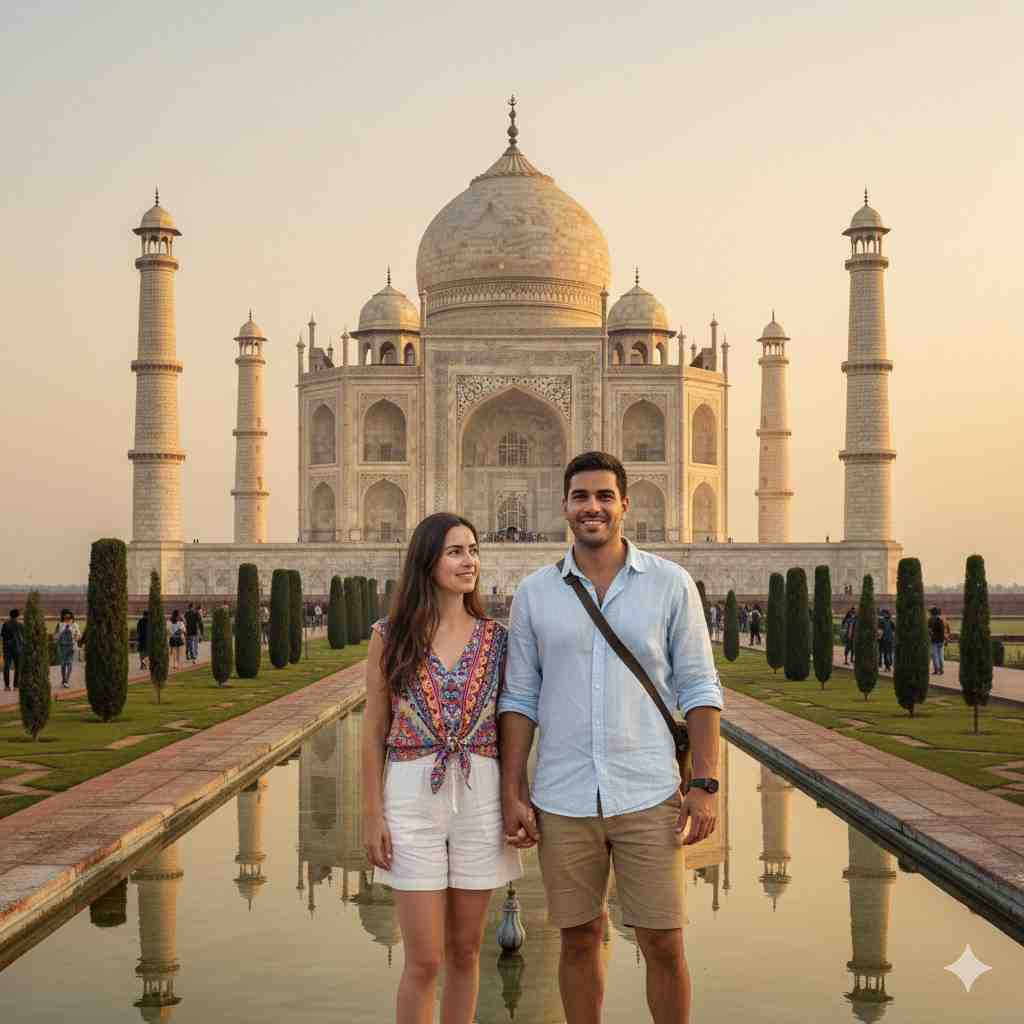
A world away from the Golan Heights: Roei and Mapal, hand-in-hand, share a moment of pure joy and eternal love in front of the magnificent Taj Mahal in Agra, India. The journey continues.
Gist:
Beneath the marble dome of Agra’s monument of love, Roei and Mapal’s silent awe becomes the language of eternal love.
Their first brush of hands mirrors the timeless union the Taj symbolizes — pure, wordless, and unforgettable.
The road unwound before him like an old film reel as Roei drove north toward the cliffs overlooking the sea.
The steering wheel was warm under his palms, but his mind was far away—in India, in Agra, beneath a dome of white marble and sky.
He had never wanted to go. “It’s a tourist trap,” he had complained.
But Mapal, stubborn and radiant, had insisted: “You don’t understand, Roei. It’s not about marble—it’s about love that survived death.”
Now those words haunted him.
He remembered standing beside her at the reflecting pool, their shadows long in the afternoon light.
Crowds buzzed behind them, the hum of foreign tongues blending with the rustle of trees, yet for a moment, the world had fallen silent.
Mapal’s scarf had brushed his arm, and he had felt that inexplicable jolt—half electricity, half peace.
He had fumbled with his camera, trying to capture the scene, and nearly dropped it into the water.
Mapal had laughed—her laughter echoing through the marble courtyard like a promise of eternity.
He remembered the reflection of the dome rippling across the pool, the faint smell of sandalwood, the press of her hand against his shoulder. Everything then had felt infinite.
Now, as he drove through Tel Aviv, that memory burned like sunlight through fog. His eyes stung. He blinked, but tears came anyway—slow, steady, unashamed.
In that instant, the Taj Mahal wasn’t a monument of stone. It was a mirror, reflecting his own unfinished story of eternal love.
Eternal Love – India Trip Flashback 2: Kerala Backwaters
They traveled across continents just to learn how to sit still. Roei and Mapal share a moment of profound peace by the Kerala backwaters, confirming their eternal love. The journey’s destination was simply finding a quiet place for their hearts to belong.
div style=”
background: linear-gradient(90deg, #1e3a8a, #3b82f6);
color: #ffffff;
padding: 16px;
border-radius: 10px;
font-family: ‘Georgia’, serif;
font-size: 15px;
line-height: 1.6;
box-shadow: 0 2px 6px rgba(0,0,0,0.25);
margin-top: 20px;
margin-bottom: 20px;
“>
Gist:
Amid tranquil canals and golden light, laughter ripples between Roei and Mapal.
The serenity of nature mirrors their hearts — a fleeting yet enduring proof that eternal love breathes through still waters and shared silence.
He remembered Kerala as if it were yesterday.
The boat had glided through narrow canals lined with palms, the water a moving mirror of clouds.
Mapal had sat near the edge, trailing her fingers across the surface. Roei, ever clumsy, had stood up too quickly to take a selfie and nearly tipped the boat.
The guide had shouted something in Malayalam; Mapal had laughed so hard she could barely breathe.
“You’re impossible, Roei!” she had managed between giggles. “And you love it,” he had said, grinning like a fool.
He could still see the heron that had startled into flight behind them, its wings flashing silver in the sunlight.
He had snapped the photo at that exact moment—Mapal laughing, the bird rising—a perfect accident of joy and movement.
Now, the picture was gone, lost along with her phone that night in the desert. But the image lived inside him, vivid and painful.
The boat’s rhythm, the quiet slap of water against wood, had lulled them into silence later that evening. The air had smelled of salt and wet leaves.
Mapal’s hand had brushed his—tentative, unspoken. They had sat that way for a long time, watching the sky melt into the water.
It was there, in that gentle dusk, that Roei had felt it for the first time—not desire, not excitement, but something softer, deeper, nameless. Eternal love. A feeling that required no promise, no confession, only presence.
Now that presence was gone, but the love endured, stubborn and luminous as the Kerala moon.
(This quote reflects how love leaves an imprint that time or distance cannot erase. For Roei, his memories of Mapal in Kerala — her laughter, the quiet touch, the shared silence — have shaped who he has become. Even in her absence, that bond endures as eternal love, a force that continues to define his being and guide his heart through grief and remembrance.)
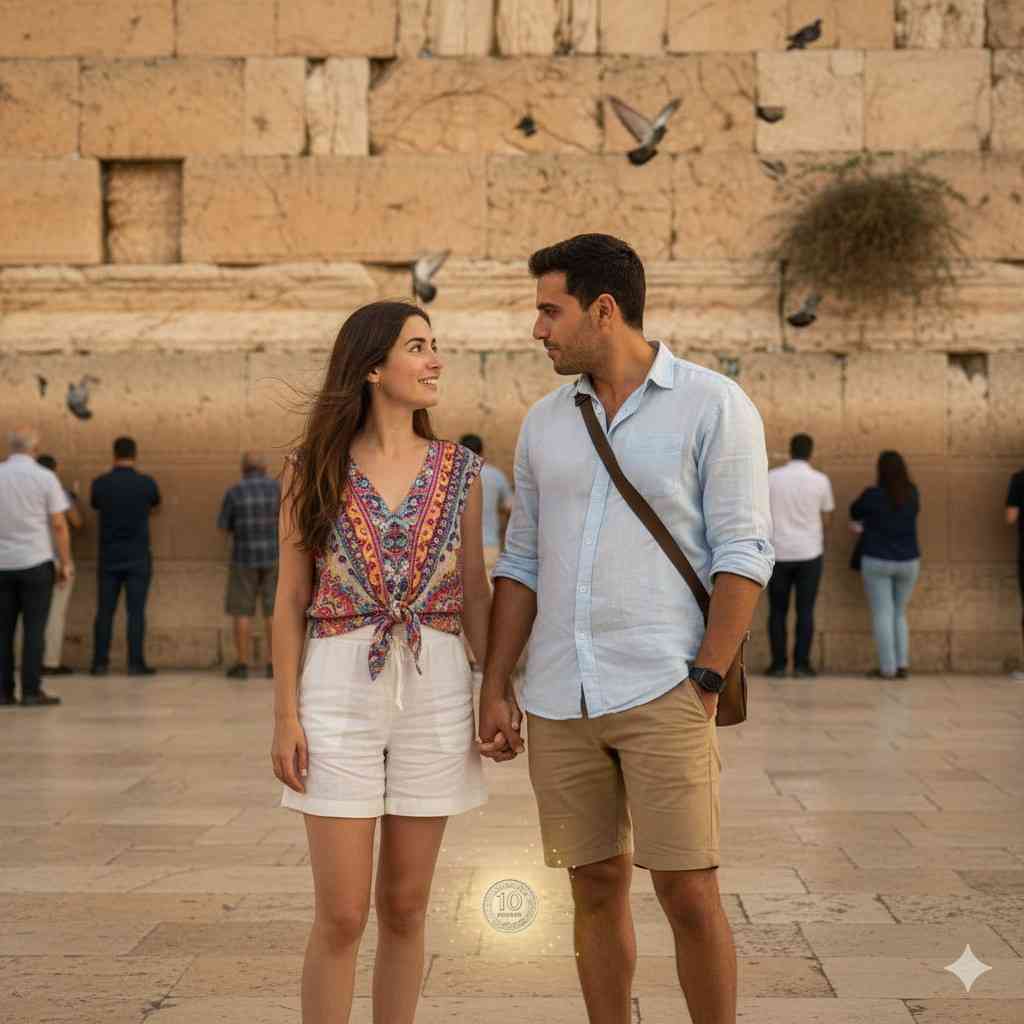
Roei and Mapal, now travelers, pause at the Western Wall to let a coin toss decide their next adventure. Even fate seems to favor their journey. A moment of quiet connection in Jerusalem, confirming their eternal love.
Gist:
At the Western Wall, a single coin decides their path to India.
Faith, chance, and eternal love merge in one luminous instant, binding two souls beneath the ancient stones of Jerusalem.
The wind from the sea brought with it the smell of stone and incense—the same scent that had filled the alleys of Jerusalem the day of their coin toss.
He remembered that day too clearly. The Western Wall had been crowded, yet still, the air carried a hush.
Pilgrims wept, soldiers prayed, and doves wheeled above the plaza.
Mapal had pressed a folded note into the crevice of the wall and whispered a few words he couldn’t hear.
Then she had turned to him, holding a shekel coin in her palm.
“Let fate decide our next journey,” she had said.
“Heads for India. Tails for New York.”
Roei had laughed nervously, rubbing the back of his neck.
“Are we really leaving it to chance?”
“Love is always a chance,” she had said, her tone half-teasing, half solemn.
The coin spun in the air, catching the sun, flashing once before landing on the ground—heads. Mapal’s eyes had lit up. India it would be.
The sound of that coin hitting stone still echoed in his dreams.
A metallic chime that had sealed their destiny, the sound of joy and surrender all at once.
Now, when Roei walked past the old streets of Jaffa, the smell of spices from the market sometimes made him pause, heart clenching.
Every scent, every glint of gold light on the sea reminded him of that afternoon in Jerusalem—of a choice that led to both wonder and ruin.
He touched the coin that still hung from a string around his neck. It was worn now, its edges smooth. “You chose for us, didn’t you?” he whispered. “You always did.”
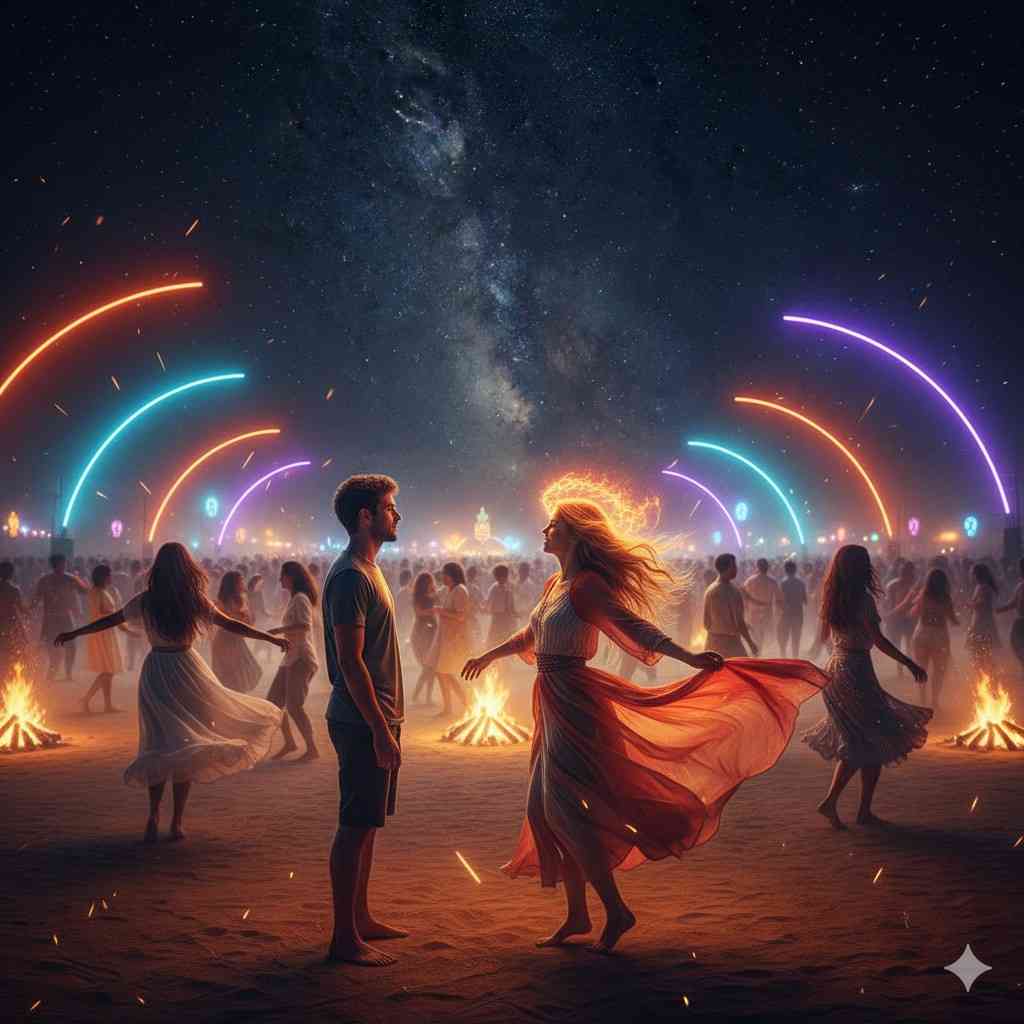
The desert sleeps beneath the ashes of sound.
He stands alone, holding the scarf that once danced in light —a quiet witness to all that was lost, and all that endures.
In this stillness, eternal love breathes, unseen but unbroken.
Gist:
Music and desert winds cradle their joy until tragedy strikes.
In the final flash of light, Roei sees how fragile and fierce eternal love can be — a heartbeat caught between music and dust.
The memory of the Negev came without warning—brutal, radiant, alive.
Music. Dust. Light. The desert transformed into a galaxy of sound.
Roei could still feel the vibration of drums beneath his feet, the pulse of thousands moving as one.
Mapal had been dancing barefoot, her scarf catching the wind like a small, bright flame.
She had laughed, spinning under neon lights, her joy untamed, her hair glinting gold in the starlight.
He had stood apart for a moment, mesmerized, watching her.
“You’re my whole universe, Mapal,” he had whispered.
She had leaned close, her voice barely audible over the music. “Then don’t ever lose me.”
And then—chaos.
Sitting on the edge of the Negev, the music fading into dawn. Roei and Mapal find stillness amidst the Supernova Festival’s chaos. “Joy is the only thing that survives the uniform.” This is their peace.
The gunfire had torn through the rhythm like a scream through a lullaby.
The music had stopped. The crowd had broken into waves of panic.
He remembered grabbing her hand, running, the air thick with dust and terror.
Then—darkness.
The echo of her voice, calling his name.
A flash of light. Silence.
He had searched for days, weeks, through lists and shelters and endless lines of photographs.
Nothing. Only a scarf—hers—found half-buried in the sand.
He carried that scarf now, folded carefully in the glove compartment.
The smell of desert and perfume lingered faintly on it still.
Every night since, he dreamed of that moment—her face turned toward him, her lips forming his name, the sound swallowed by the storm.
He would wake trembling, heart pounding, reaching for a hand that was no longer there.
And each time, the same whisper returned to him, from somewhere beyond reason:
“Love never ends, Roei. Not even in fire.”
He didn’t know if it was memory or madness. But it was enough to keep him breathing.
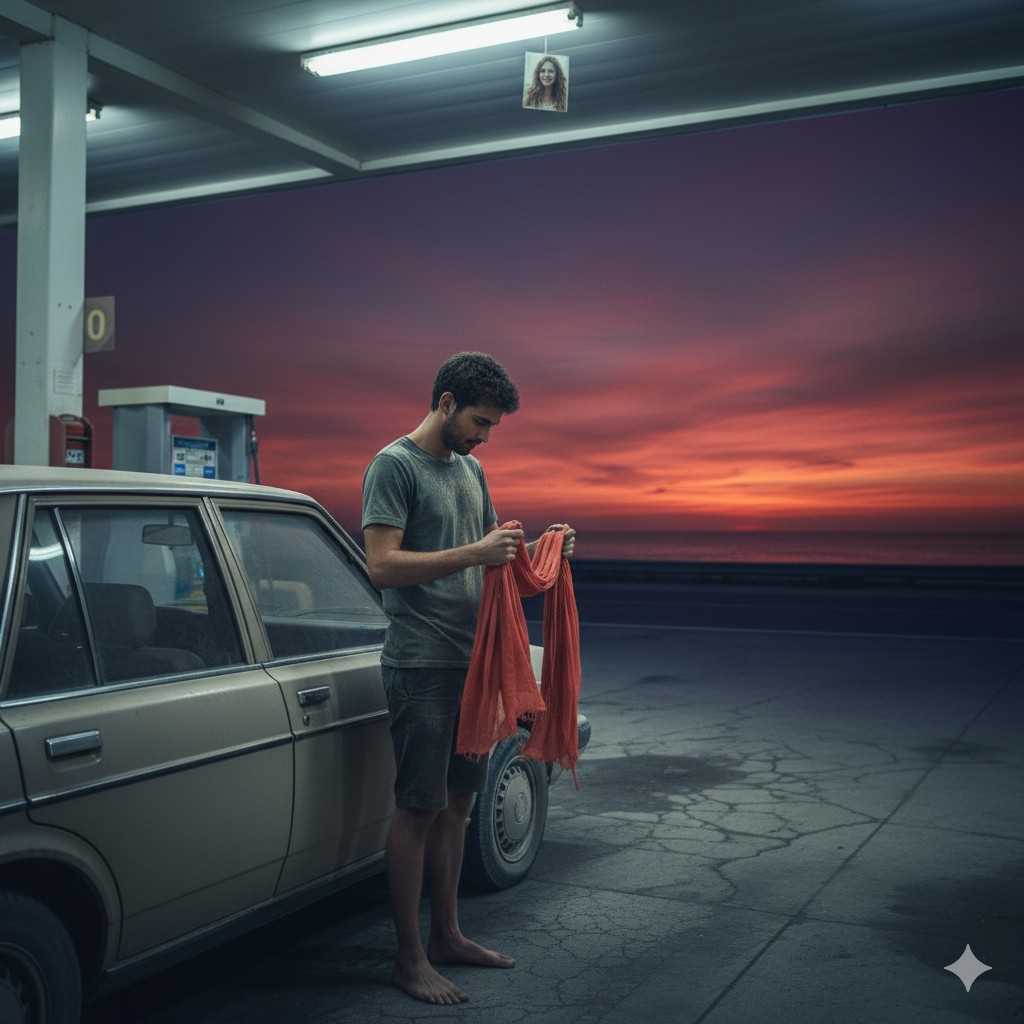
Under the flicker of a dying light, he folds her scarf as if smoothing time itself.
The fuel hums, the sea burns on the horizon, and memory becomes prayer.
In this stillness between journeys, eternal love waits — quiet, patient, and whole.
“Love is stronger than death, even though it can’t stop death from happening. But no matter how hard death tries, it cannot separate people from love.” — Anonymous (often attributed to unknown Jewish proverb)
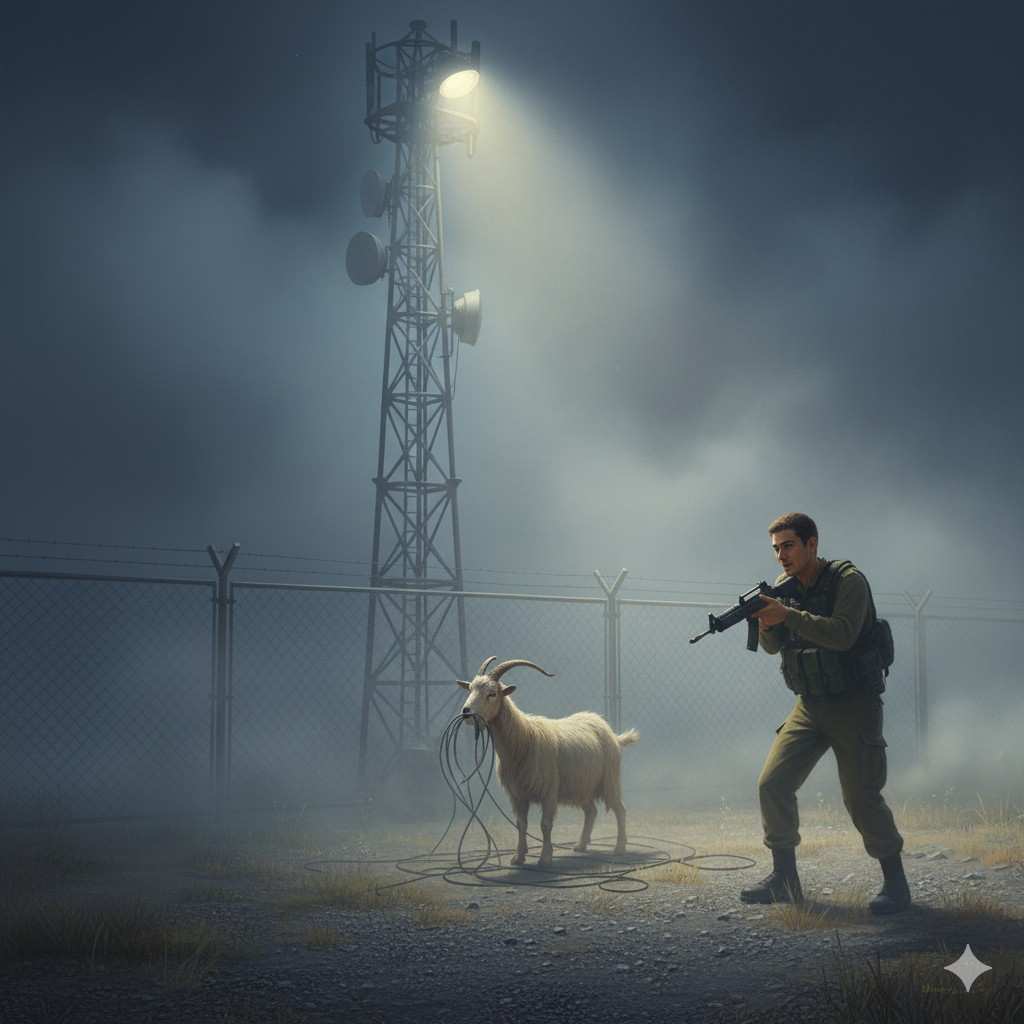
Roei and Mapal discovering a goat at the border fence, sharing a moment of restrained humor and eternal love.
Gist:
On fog-laden borders, laughter and quiet courage knit their bond.
The night watch becomes a vow — that eternal love endures even under the shadow of war.
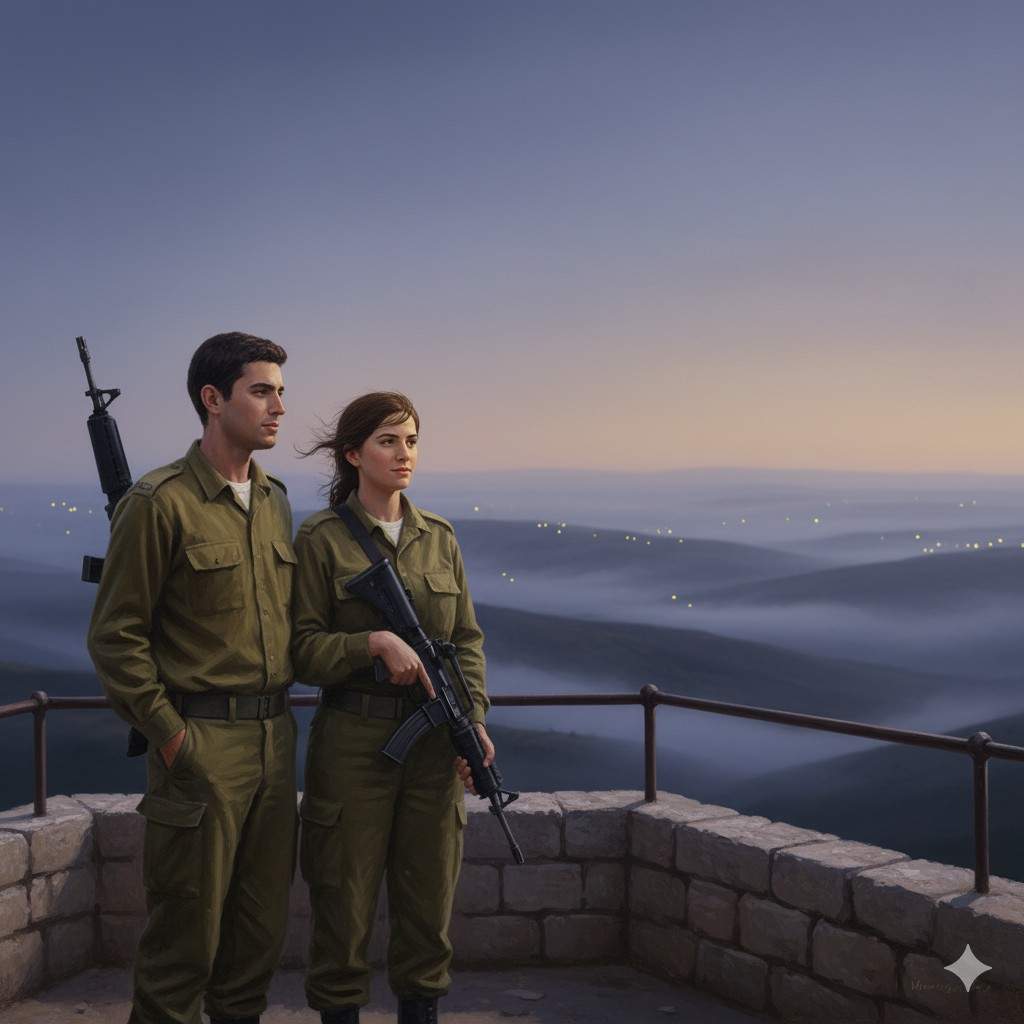
The wind along Tel Aviv’s promenade whistled like the Golan nights of long ago—sharp, cold, yet strangely intimate.
Roei stood before the water, lost in thought, the horizon bending like memory itself.
A faint mist rose from the sea, and in its veiled reflection, he saw a ghostly shimmer—two soldiers beneath a canvas of stars, their laughter the only warmth in the winter stillness.
The watch-post had been nothing more than a concrete box by the border, but to Roei and Mapal, it had felt like a small world stitched from duty, boredom, and quiet dreams.
He remembered the thermos that steamed between them, the bitter army coffee they had shared at 3 a.m., and how Mapal would tap her fingers on the metal cup, a little rhythm to break the monotony.
“You’re too loud,” she had whispered once, eyes flicking toward the silent hills. “The enemy could hear us before sunrise.”
Roei had grinned in the dark. “Better they hear us laugh than cry alone.”
That small defiance—the courage to laugh in the cold—had bound them in a way words never could.
Even now, the wind carried her laughter, fragile yet alive, threading through the trees along the boulevard.
The city lights below seemed to flicker in rhythm with her memory.
Sometimes he wondered if the night remembered too—the way she had tucked a lock of hair beneath her beret, the way she looked when dawn broke, when the first light fell on her eyes and she said softly, “Roei, one day we’ll travel, not patrol. We’ll walk somewhere free.”
And he, half-drowsy from the watch, had murmured back, “Then promise me—wherever we go, you’ll be the one to choose.”
She had smiled. “Then I choose the world.”
The sea breeze stung his eyes. He blinked, but the tears came anyway. Even time, it seemed, bowed before her memory.
Inside the quiet car, the world dissolves into gold and violet light.
His reflection blends with the sky, as memory softens into grace.
In this final stillness, he no longer searches — he simply becomes.
For eternal love is not an ending, but a return to peace.
Gist:
Two years later, Roei stands on the cliff of remembrance.
His grief finds voice in the wind, calling Mapal’s name — a raw hymn to eternal love that refuses to fade.
The city had begun to darken. Street lamps flared to life, casting golden halos on the pavement as Roei drove toward the cliffside overlooking the Mediterranean.
The radio played softly—some nostalgic love song that seemed to understand his silence.
The photograph of Mapal rested on the dashboard beside her folded scarf, its lavender faint but enduring.
Two years. Two endless years since the Supernova night, and yet, to him, time had stood still. Every clock ticked her name. Every breath felt borrowed.
He pulled over near the cliff’s edge, the engine idling in a rhythmic murmur.
The horizon stretched before him, vast and indifferent, a line between earth and eternity.
The waves crashed far below, their echoes rising like distant voices—her voice among them.
He ran his hand over the dashboard, over her photograph. Her eyes—bright, defiant, full of life—stared back at him from the frame.
“Mapal…” His voice broke. “It’s been too long. I tried to move on, I swear.
I tried to forget the sound of your laugh, the touch of your hand, the way you used to look at the world as if it could still be healed. But I can’t.”
He pressed the photograph to his chest. “I can’t live in half a world anymore. I can’t live where you don’t.”
The silence that followed was not empty—it was full of her.
The sea wind brushed his cheek like a touch. Somewhere, a gull cried, a solitary note that trembled in the dusk.
He closed his eyes and saw her dancing barefoot in the Negev, the scarf fluttering against the desert wind.
That image had burned into him—light against darkness, love against chaos. Now, it was all he had left to guide him.
Under the flicker of a dying light, he folds her scarf as if smoothing time itself.
The fuel hums, the sea burns on the horizon, and memory becomes prayer.
In this stillness between journeys, eternal love waits — quiet, patient, and whole.
Gist:
Every folded scarf and filled tank becomes a ritual of devotion.
In the dying sunset, Roei prepares his final act — a surrender to the pull of eternal love.
At the gas station, under flickering fluorescent light, Roei moved with deliberate calm.
The world had slowed into ritual. He folded her scarf, smoothing its frayed edges as though it were her hair.
He tucked her photograph into the visor, aligning it carefully with the stars above.
He filled the tank to the brim. Each drop of fuel felt like a heartbeat.
In his mind, he replayed everything—the train rides through India, her teasing laughter on the houseboat in Kerala, the Taj Mahal shimmering like a frozen tear, the coin toss in Jerusalem that had sealed their fate.
Every scene lived inside him, like a film that refused to end.
He leaned against the car, looking at the horizon one last time.
The sunset bled into the sea—crimson, gold, and fading violet. It looked like a wound the sky could never heal.
He whispered, “Eternal love is not a promise, it’s a surrender.”
Then, almost unconsciously, he smiled.
There was peace in that truth. For the first time in two years, he felt closer to her than to the world around him.
As he slid into the driver’s seat, he reached for the photograph and kissed it gently. “Let’s go home, Mapal.”
Upon the endless sea of light, they walk hand in hand — shadows no more, but memory turned to flame.
The horizon dissolves, the sky becomes home, and the waves sing of all that endures.
Here, beyond sorrow and return, eternal love finds its true shore.
Gist:
As the car speeds along the cliffs, memories ignite like stars.
Flames become a passage, transforming sorrow into union — the road to eternal love beyond life itself.
The road wound along the cliffs, the sea to his left, the darkness gathering on his right.
The car engine hummed like an old lullaby, and the world seemed to dissolve around him.
Every turn brought flashes of memory—her laughter echoing from the hills of Galilee, her song from the boat on the backwaters, her dance beneath desert stars.
Each moment returned not as memory, but as presence.
He whispered, “Do you hear me, Mapal?”
And the wind whispered back, Always.
Tears blurred the lights ahead. The road shimmered like water.
He pressed the accelerator gently, feeling the car surge forward.
The horizon opened before him—a widening flame of dusk and destiny.
He could almost feel her beside him now, her fingers brushing his, her scent mingling with the salt air.
The world tilted, time thinned, and then—suddenly—it was all fire.
A roar, a flash, a shattering brilliance. The car erupted into flame, an inferno blooming like a star fallen to earth.
Yet within that light, Roei felt no pain. Only warmth. Only release.
Through the flames, she came.
Barefoot, radiant, her hair loose in the wind, eyes filled with the calm of galaxies. She reached out her hand, and the inferno bowed away from her touch.
“Roei,” she whispered, voice clear through the blaze, “you came.”
He smiled through the light. “You waited.”
They stood together in the fire, untouched. The wind carried her laughter, and it no longer hurt. It was the sound of home
Where the sea meets the sky, their forms begin to fade —
not into absence, but into a boundless glow.
The world falls silent as love turns to light,
and eternal love becomes the language of the stars.
Gist:
The sea mirrors the flames as Roei and Mapal reunite beyond mortal limits.
Their souls walk together along the horizon, embodying the undying radiance of eternal love.
The sea reflected the flames like stars scattered on dark silk.
The wind carried the scent of burning salt, but above it was something purer—jasmine, the scent she once wore in Kerala, soft and eternal.
As the fire dimmed, the world grew silent.
The car no longer existed. The cliff no longer existed. Only the endless blue beyond time.
And there they were—walking along the shore that wasn’t a shore, hand in hand.
The sky above them shimmered like dawn breaking after centuries of night.
The sea glowed faintly with light that came not from the sun, but from within them.
“Is this real?” Roei asked, though he already knew the answer.
“It’s more than real,” she said, smiling. “It’s everything we ever wanted to believe.”
He looked at her—the same warmth in her eyes, the same gentle defiance, the same life that no death could take. “I thought I lost you.”
“You never did,” she whispered. “You only carried me until you could find the way.”
They walked on, silent except for the rhythm of waves lapping at their feet.
Each step erased a little more of their sorrow. Each heartbeat wove them tighter into the same eternal thread.
Behind them, the horizon of the mortal world faded. Ahead of them, only light remained.
As they reached the edge of the infinite, Roei turned once more, as if to see the world he had left behind—the photographs, the streets, the quiet Tel Aviv dawn.
It seemed small now, tender, and far away.
He murmured, “For those who love, there is no death. Only return.”
Mapal leaned against him, her voice soft as the sea breeze. “And for us, eternal love is not a memory. It’s forever.”
The light enveloped them. The sea sang its endless hymn. And where the waves met the sky, two souls walked into eternity—together, unbroken, unforgotten.
It represents the aftermath of loss — the haunting calm that follows destruction, where memory and love quietly endure even when everything else fades.
Q: Why is the gas station scene called “The Ritual”?
Because Roei’s actions — folding the scarf, aligning the photograph — are small acts of devotion that turn grief into sacred remembrance, expressing his eternal love through ritual.
Q: What is the meaning of “The Shore Beyond Time”?
It is the symbolic meeting place between life and eternity, where Roei and Mapal reunite beyond death, walking hand in hand as souls released from sorrow.
Q: How does the story portray eternal love?
Through Roei’s surrender — his realization that eternal love is not possession but presence, a light that continues even after physical separation.
Q: What is the spiritual meaning of “Two Souls Becoming Light”?
It signifies the final transformation — love transcending the mortal world and merging with the infinite, where two souls dissolve into light and peace.
Q: Why does the story end with “The Festival of Light”?
Because it mirrors the idea that love, once freed from loss, becomes celebration — the soul’s reunion with divine radiance, the joy of eternal love fulfilled.









0 Comments