
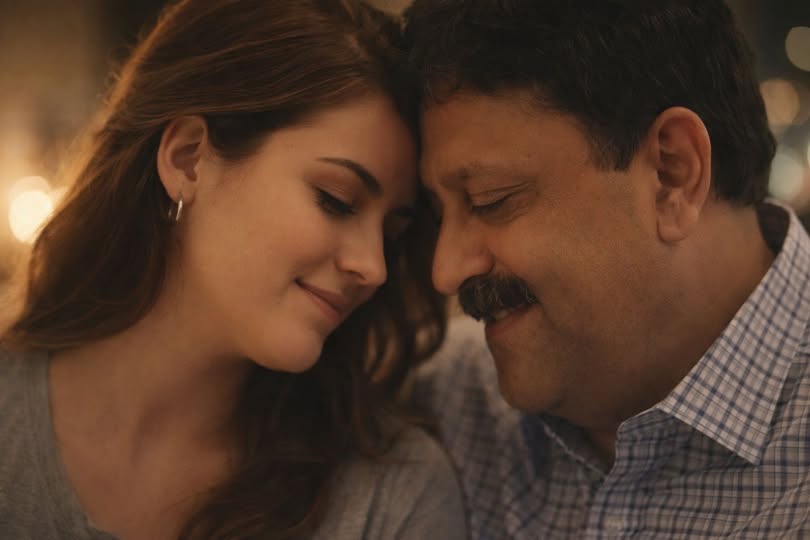
By: Ranjan Sarkhel
Table of Contents
Introduction
Heartbeat Protocol
This is not a love story that arrives all at once.
It begins quietly—in a hospital ward where machines speak more than people. A cardiac surgeon who understands every rhythm of the human heart, except her own. A music composer who hears emotion inside silence.
What grows between them is a slow burn romance—shaped by patience, observation, and the courage to listen when the heart finally chooses to be heard.
Keypoints
Story Highlights
A cardiac surgeon and a music composer connect through the language of heartbeats.
Their bond grows through observation, pauses, and unspoken understanding.
Medical rhythms transform into music, turning data into emotion.
She heals hearts for a living—except her own, until he listens.
No rush. No instant love. Just trust, time, and emotional courage.
“Music is the shorthand of emotion.” — Leo Tolstoy
【 This captures the moment our music composer translates the Cardiac Surgeon’s rigid medical world into a shared feeling. For a Sound Designer, every pulse and Waveform is a word in a language that medicine alone cannot speak. It establishes the SlowBurn by showing that while they may lack the words to communicate, the music is already telling their story.
The Conclusion: Honoring the Journey】
A Slow Burn Romance That Begins in Silence
The hospital ward where machines speak louder than people
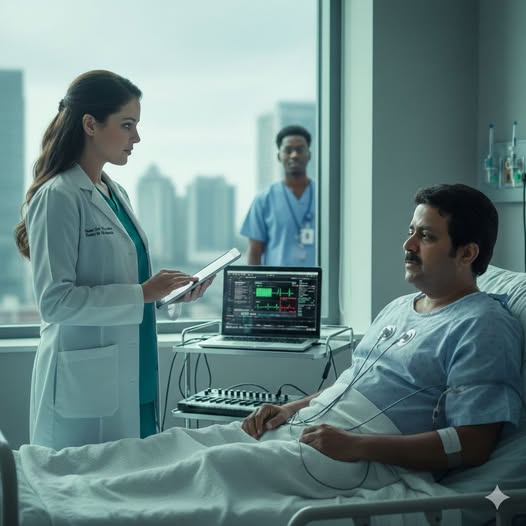
The ward had its own language.
It spoke in measured beeps, in soft alarms that rose and fell like restrained breath.
Light reflected off glass screens and stainless steel, turning everything pale, almost unreal.
Here, silence was never empty—it was regulated, monitored, allowed only in intervals.
Dr. Sofi stood near the bedside, her posture composed, her gaze steady on the monitor rather than the man lying beneath it.
The green line moved with reassuring discipline.
Each rise and fall confirmed what she trusted most: rhythm, consistency, control.
Karan lay still, recovering, listening.
He had spent his life surrounded by sound—layers of it, manipulated, filtered, rearranged—but this was different.
These sounds were not meant to be beautiful.
They were meant to be accurate. Honest. Unemotional.
Yet, to him, they felt intimate.
He watched the doctor as she adjusted settings and made notes.
She did not rush. She did not waste movement.
Even her pauses seemed deliberate, as if she understood that stillness could be as informative as motion.
“You’re stable,” she said without ceremony.
“No abnormal patterns so far. We’ll continue observation.”
Observation ! The word lingered.
Karan nodded. “So… I stay and listen.”
She glanced at him briefly, surprised by the phrasing, then returned her attention to the screen.
“You stay and heal.”
But healing, he thought, sounded suspiciously like listening.
Two experts trained to listen—yet afraid to feel
Over the next few days, Sofi’s presence became familiar—not warm, not distant, but precise.
She came during rounds, during teaching sessions, sometimes late in the evening when the ward was quieter and the machines seemed to lower their voices out of respect.
She spoke to students with clarity, explaining cardiac rhythms as if they were sentences that needed proper punctuation.
“This pause,” she said once, pointing to a dip on the ECG, “is as important as the beat. Ignore it, and you misunderstand the whole story.”
Karan felt that sentence settle somewhere deeper than it should have.
He had built his career on the same belief.
That sound was not only about what was heard—but about what was withheld.
During one such session, he found himself asking questions. Not personal ones. Never personal.
About instruments. About how data became meaning.
“How do you know,” he asked one afternoon, “when a rhythm is dangerous and when it’s just… different?”
Sofi considered him for a moment. “Experience,” she said. “And restraint. Not every irregularity needs intervention.”
Restraint.
Another shared language.
Later, when the ward had emptied and the lights dimmed slightly, he asked something simpler.
“Does a heartbeat always sound like that?” he asked, gesturing vaguely toward the monitor.
She followed his hand. “Like what?”
“Like it’s trying not to be noticed.”
For the first time, she smiled—not professionally, not politely, but briefly, as if caught off guard by a thought she hadn’t planned to have.
“You hear too much,” she said.
“And you feel too little,” he almost replied.
But he didn’t.
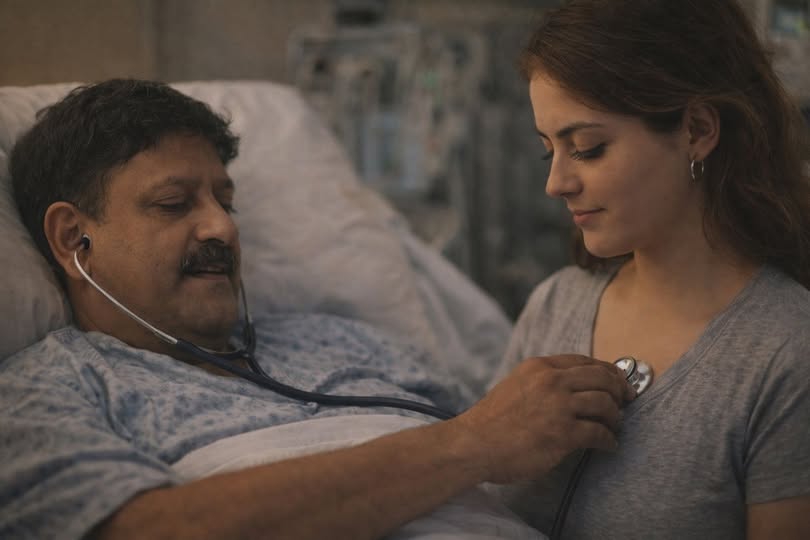
Instead, he listened as she lifted her stethoscope and, after a pause that felt longer than it was, placed the earpieces into his ears.
“Here,” she said. “This is easier.”
She leaned forward, rested the diaphragm against her own chest.
There was no drama in the gesture. No awareness of consequence.
The sound reached him instantly.
Steady. Alive. Unedited.
For a moment, nothing else existed—not the ward, not the machines, not the distance they both maintained so carefully.
Just that rhythm. Human. Unrecorded.
Sofi pulled back first.
“That’s enough,” she said lightly.
“You’re here to recover, not analyze your doctor.”
But something had already shifted—not in her, perhaps, but in the space between them.
A slow burn romance does not begin with attraction.
It begins with attention.
With noticing the pause between beats.
With two people trained to listen—realizing, quietly, that they have been avoiding their own hearts all along.
Next Movement
Chapter 2: When Medicine Meets Music
When Medicine Meets Music
A cardiac surgeon who understands every rhythm but her own
Dr. Sofi had learned early in her career that emotions could interfere with precision.
So she kept hers neatly folded, like reports filed away after rounds.
In the operating room, there was no space for hesitation.
A fraction of a second mattered. A misread rhythm could cost a life.
She trusted data. She trusted patterns.She trusted machines that never asked her how she felt.
Among colleagues, she was known for her sharp observation and calm authority.
Among patients, she was respected—but distant.
She healed hearts daily, corrected irregular rhythms, restored circulation.
Yet when it came to her own life, she avoided diagnosis.
Her smartwatch vibrated softly now and then, updating her pulse, reminding her that her own heart was also working—quietly, obediently.
She rarely looked at it. Numbers were easier when they belonged to others.
During teaching rounds, she spoke with ease about heart rhythms, ECG patterns, and the fragile balance between order and chaos.
She could explain why a beat skipped, why another raced, why some hearts refused to return to normal even after surgery.
But no one taught her how to treat a heart that had learned to withdraw.
This was not a sudden emptiness.
It had grown slowly—like a slow burn romance that never reached its promise, only its ending.
A music composer who turns sound beats into emotion
Karan’s world was built from sound, but not the kind people hummed or sang along to.
He worked with digital beats, electronic rhythms, and fragments of noise most listeners never noticed.
His studio had no traditional instruments—only screens, controllers, and quiet patience.
To him, every sound carried emotion if one listened long enough.
While recovering in the hospital, he found himself listening differently.
The machines around him did not produce music, yet they followed rules he understood instinctively.
Repetition. Variation. Pause.
Especially the heartbeat monitor.
Its beeps were not random.
They followed a structure—firm, restrained, honest.
Lying there, he began to imagine what it would sound like if translated into music.
Not dramatized. Not exaggerated. Just… felt.
He had enough recordings of his own heart. Enough data to work with.
But something held him back.
His own rhythm felt familiar. Predictable.
It was her rhythm that stayed with him.
The way Dr. Sofi moved through the ward, the way she paused before speaking, the way silence never made her uncomfortable—everything about her suggested control.
And yet, he sensed something unresolved beneath that calm.
He did not think of it as attraction.
Not yet.
It was curiosity. Respect. Attention.
The kind that grows quietly.
The kind that defines a slow burn romance, long before either person dares to name it.
As days passed, an idea began to form—not as a plan, but as an instinct.
If sound could carry emotion, then perhaps a heartbeat could carry a story.
And perhaps, without knowing it, he was already listening to hers.
The Rhythm Evolves
Chapter 3: Observation Turns Into Connection
Observation Turns Into Connection
Teaching rounds, ECG screens, and unspoken curiosity
Observation was meant to be temporary.
A precaution. A formality.
Yet the days stretched, and with them, a quiet familiarity settled into the ward.
Every morning, Dr. Sofi arrived with a small group of residents.
She stood beside glowing screens, pointing out lines and intervals, translating raw data into meaning.
Her voice remained steady, professional, untouched by the emotions the numbers often represented.
“This pattern,” she explained, tracing a waveform on the ECG screen, “may look normal at first glance.
But look closer. The variation matters.”
Karan listened from his bed, pretending to rest.
The students saw charts and clinical lessons.
He saw rhythm. He saw structure.
He saw the same care he applied while arranging sound layers in his studio.
Sometimes their eyes met briefly—not long enough to be personal, not short enough to be accidental.
Between lectures and checkups, Sofi asked routine questions. Sleep. Pain. Appetite.
Her tone never changed, yet she lingered a second longer each time, as if confirming something unspoken.
Karan began asking questions too. About monitors. About how data was stored.
About whether heartbeats could be saved, transferred, or replayed.
“Medical data isn’t music,” she said once, almost smiling.
“No,” he agreed. “But both depend on timing.”
That answer stayed with her longer than she expected.
What formed between them was not conversation—it was awareness.
A growing sense that they were up listening to the same thing from different sides.
Hearing a heartbeat without meaning to hear it
One afternoon, during a quieter teaching session, a student asked how a heartbeat actually sounded without filters or displays.
Sofi reached for her stethoscope, explaining the mechanics with practiced ease.
“Machines help us interpret,” she said, “but this is where it begins.”
Without thinking too much about it, she placed the earpieces into Karan’s ears.
It felt simpler than calling a student forward. More efficient.
She rested the diaphragm against her own chest.
The sound reached him instantly.
Not amplified. Not dramatic.
Just present.
For a moment, Karan forgot where he was.
The rhythm was different from the monitors—softer, closer, human. He did not analyze it.
He did not count. He only listened.
Sofi noticed the stillness in him and pulled back gently.
“That’s enough,” she said. “You don’t need more than that.”
But she was wrong.
He didn’t need more sound.
He needed time.
Later that day, during another demonstration, Sofi lay briefly on the bed while ECG electrodes were placed for the students.
Lines appeared on the screen, translating her heartbeat into light and motion.
Karan watched quietly. He did not ask permission. He did not take notes.
He memorized the rhythm.
Not as data.
As possibility.
This was how connection formed—not through intention, but through repeated moments that felt too small to matter.
A glance held half a second longer.
A question asked without purpose.
A heartbeat heard without meaning to hear it.
Hand somewhere within that silence, a slow burn romance continued to take shape—patient, unannounced, and impossible to rush.
Deepening the Pulse
Chapter 4: The Anatomy of a Slow Burn Relationship
The Anatomy of a Slow Burn Relationship
Why nothing happens quickly between them
Nothing changed suddenly
That was the point.
There was no moment they could later point to and say, this is where it began.
What grew between Sofi and Karan did so quietly, without urgency, without demand.
The hospital ward remained the same—sterile, controlled, predictable. Only their attention shifted.
Sofi kept her distance, as she always did.
Experience had taught her that closeness could blur judgment.
She had built her life on discipline, on keeping emotions outside the operating room and, eventually, outside her personal life as well.
Karan sensed this without her ever saying it. He did not press. He did not flirt.
He understood timing—understood that some rhythms could not be forced without breaking the composition.
Their conversations stayed safe. Technical. Observational.
Yet within those limits, something deepened.
He asked about cardiac rhythms and monitoring patterns.
She asked about sound design and how music could exist without instruments.
They shared knowledge, not feelings.
And yet, every shared explanation felt like a step closer—measured, deliberate, necessary.
A slow burn romance survives on patience.
On the understanding that some connections lose meaning if they arrive too quickly.
Friendship, restraint, and the comfort of quiet presence
By the end of the observation period, Karan no longer felt like a patient.
And Sofi no longer treated him like one.
She still checked the monitors. Still reviewed the reports.
But she also stayed a little longer after rounds, standing by the window, speaking about neutral things—the hospital schedule, a lecture she had postponed, the exhaustion that followed long surgeries.
These were not confessions.
They were permissions.
Sometimes they sat in silence. Sofi reviewing data on her tablet.
Karan listening to the soft chorus of machines.
The silence did not feel awkward. It felt shared.
That surprised her more than anything.
She had always believed that quiet meant distance. But here, quiet meant ease.
Karan noticed the small things. The way her shoulders relaxed when she stood still.
The way she exhaled slowly after checking a report, as if releasing tension she never acknowledged aloud.
He did not comment on any of it.
Restraint, he knew, was its own form of care.
When discharge was finally discussed, neither of them said much.
The decision was medical. The reason was logical.
But the space between them felt suddenly fragile, as if the ward had been holding something together that might loosen once they left.
“This was… helpful,” Sofi said finally, referring to the observation period.
“Yes,” Karan replied. “It was.”
Neither explained what they meant.
That was the nature of what had formed between them.
Not desire. Not promise. Just presence.
A quiet understanding.
A connection built slowly, carefully—like the early anatomy of a slow burn relationship, still unnamed, still unfolding, and already difficult to ignore.
The Echo of Absence
Chapter 5: Distance That Deepens the Slow Burn
Distance That Deepens the Slow Burn
Discharge from the hospital and return to separate lives
The day of discharge arrived without ceremony.
Forms were signed. Instructions were repeated.
Medications were listed with careful emphasis.
Everything followed protocol—clean, efficient, final.
Sofi reviewed the last report, her expression unchanged, as if this moment were no different from dozens before it.
“You’re fit to go home,” she said.
“Avoid stress. Follow the schedule. And… listen to your body.”
Karan nodded. He thanked her, formally this time. As a patient should.
The ward felt larger once he stood up. Quieter.
The machines that had once surrounded him now belonged to someone else.
As he left, he turned back once, unsure why.
Sofi was already at the desk, reading another file.
They did not say goodbye the way people do when they expect something more.
They said it the way professionals do—briefly, without looking back.
Outside, life resumed too easily.
Karan returned to his studio, to screens and cables and familiar silence.
The city moved as it always had, loud and indifferent. Yet something was missing.
The controlled rhythm of the ward.
The calm pauses. The sense of being observed without being judged.
Sofi returned to the hospital before sunrise the next morning.
Surgeries. Rounds. Teaching. Her days filled quickly, efficiently.
Still, she caught herself glancing at empty beds during observation rounds, her mind supplying a presence that was no longer there.
Distance, she realized, did not erase connection.
It clarified it.
Late-night calls, missed words, and growing awareness
Their first 📲 call was practical.
A question about medication timing.
A clarification about recovery.
Sofi answered professionally, as expected.
But when the call ended, neither hung up immediately.
“So,” Karan said, after a pause, “how long do people usually stay under observation?”
“As long as necessary,” she replied.
“Sometimes longer than required.”
He understood the meaning beneath the words.
She heard it too.
The calls became occasional, then regular. Always brief.
Always respectful. Often late at night, when exhaustion made honesty easier to manage.
They spoke about work. About rhythm and recovery. About how silence felt different depending on where you were standing.
There were moments when something almost slipped out—something personal, unguarded.
Each time, restraint pulled it back.
A sentence left unfinished.
A thought changed midway.
Sofi told herself it was friendship.
That conversation did not equal attachment. That comfort did not mean longing.
Karan told himself he was only listening.
That inspiration did not require explanation.
Yet slowly, awareness grew.
She noticed the absence when the phone didn’t ring.
He replayed conversations, not for words, but for tone.
This was not longing yet.
It was recognition.
A realization that the quiet they shared in the ward had followed them home.
That distance had not cooled it—it had given it space.
This was how a slow burn romance deepened.
Not through proximity, but through the gentle pull of what remained unspoken.
And somewhere between missed calls and unfinished sentences, both began to understand that what they were avoiding had already begun.
From Heartbeat to Score
Chapter 6: Composing Love From a Heartbeat
Composing Love From a Heartbeat
Turning medical rhythm into music
Karan began with a sound he was never meant to keep.
An old ECG recording lay forgotten in his files—saved once for reference, never deleted.
It was clean, steady, clinical.
A heart doing exactly what it was trained to do.
To anyone else, it was data. To him, it was timing.
He isolated the rhythm. Slowed it down. Listened again.
There was no melody yet. Only repetition. Rise and fall.
The quiet pause between certainty and return.
He adjusted the tempo, letting the space between beats stretch just enough to breathe.
This was not music. Not yet.
But the rhythm 🎶 carried something familiar.
The same calm he had felt in the ward.
The same unspoken assurance in Sofi’s voice when she explained things without rushing.
The same controlled gentleness.
He layered soft tones over the pulse—nothing dramatic.
No crescendos. Just restraint.
Letting the beat lead, not dominate.
What emerged was subtle.Almost invisible.
A composition shaped by medical rhythm, yet softened by human intention.
A heart translated into sound without being asked what it meant.
Creating a composition without confessing its meaning
Karan never named the piece.
Naming, he knew, would give it away.
He told himself it was an experiment—an exercise in translating biological rhythm into sound. Something academic. Something neutral.
Yet every choice betrayed intention. The pauses. The warmth.
The refusal to rush toward resolution.
He played it late at night, when explanation felt unnecessary.
There were no lyrics. No dramatic progression. Just continuity. Presence. A sense of listening rather than speaking.
He imagined Sofi hearing it—not as dedication, not as confession, but as recognition.
A familiarity she couldn’t immediately place.
He did not send it to her.
Not yet.
Some things, he understood now, carried more truth when left unnamed.
When allowed to exist without demand or declaration.
This was how love formed here—not in grand statements, but in careful translation.
In turning a heartbeat into music and letting it speak on its own.
A composition that said everything.
By saying nothing at all.
The Crescendo
Chapter 7: Valentine’s Day and the Moment of Truth
Valentine’s Day and the Moment of Truth
An invitation meant as friendship
The message was simple.
No hearts. No implications.
Just a time, a place, and a line that could be read many ways.
Karan is performing tonight. If you’re free, you could come.
Sofi stared at her phone longer than she meant to.
Valentine’s Day was not something she marked.
The hospital calendar mattered more—rotations, procedures, outcomes.
Romance had always felt like a distraction she learned to manage by ignoring.
Yet the timing unsettled her.
She told herself it was professional curiosity.
Music had always been theory to her, something she respected without engaging.
And this invitation—carefully neutral—gave her an exit if she wanted one.
She went anyway.
The venue was small. Dimly lit.
Nothing like the controlled brightness of a hospital ward.
She sat near the back, unnoticed, grateful for the anonymity.
Karan did not look for her. He did not need to.
This, she realized, was what made it safe.
An invitation framed as friendship, where expectation stayed unspoken and choice remained hers.
Music that reveals what words never did
The piece came near the end.
Sofi did not know what she was listening for.
Only that something in the rhythm felt familiar. Too familiar.
A measured rise and fall. A pause she had learned to recognize without looking at a screen.
Her body responded before her mind did.
It was a heartbeat.
Not abstract. Not symbolic. Real.
Slowed just enough to notice. Layered gently with sound that refused to overwhelm it.
The music did not perform. It listened.
Her breath caught.
She understood then—not in language, but in sensation.
The ward. The silence. The presence that had followed her long after discharge.
All of it was here, translated into sound.
Karan never looked at her while the piece played. He didn’t have to.
This was not a confession. It was an offering.
Music revealing what words never did.
A slow burn reaching recognition without crossing into demand.
When the final note 🎵 faded, Sofi remained still.
She did not applaud immediately.
Some things felt wrong to interrupt.
For the first time, she allowed herself to feel what she had avoided naming.
This was not coincidence.
This was connection—patient, restrained, undeniable.
And in that quiet room, on a day built around declarations, truth arrived in the softest possible way.
The Friction of Truth
Chapter 8: When Science Feels Offended but the Heart Understands
When Science Feels Offended but the Heart Understands
Public revelation and private conflict
The recognition did not stay private for long.
Colleagues spoke casually after the performance—about innovation, about the unusual structure of the composition, about how science and music had merged in a way that felt intimate.
Someone mentioned the ECG source openly, with admiration rather than discretion.
Sofi listened, her expression unchanged.
Inside, something tightened.
She was trained to separate data from emotion.
A heartbeat was not poetry. It was function. Measurement. Evidence.
And yet, hearing her professional world discussed in the language of feeling unsettled her more than she expected.
She felt exposed—not personally, but philosophically.
Science, to her, demanded distance. Objectivity. Control. And here it was, translated into something people felt instead of analyzed.
Later that night, alone, the conflict sharpened.
If a heartbeat could become music, where did that leave her certainty?
If precision could coexist with vulnerability, what had she been protecting all this time?
The revelation was public. The unease was entirely her own.
Letting go of control to feel again
Sofi did not call him immediately.
She returned to routine instead—schedules, procedures, clinical notes.
But the rhythm followed her. Not audibly. Internally.
A soft reminder that control was not the same as safety.
She realized she had spent years mastering how not to feel.
Not because she lacked emotion—but because she feared what feeling might compromise.
Karan had never asked her to change.
Never asked for clarity or reassurance.
He had simply shown her what happened when restraint was used not to suppress, but to honor timing.
That difference mattered.
When she finally reached out, it was not to analyze the music or discuss ethics.
It was to acknowledge what had shifted.
“I heard it,” she said simply.
He did not ask her to explain.
For the first time, Sofi allowed herself to remain in uncertainty—to accept that some truths did not need validation through data.
That the heart, when listened to carefully, could be trusted.
Letting go of control was not loss.
It was return.
And in that quiet decision, the slow burn deepened—no longer hidden behind discipline, but still moving forward with care, patience, and understanding.
Synchronizing Beats
Chapter 9: Naming the Music, Naming the Feeling
Naming the Music, Naming the Feeling
What the composition truly represents
What the composition truly represents
The name came later.
Not during a performance. Not in conversation.
But in a moment of stillness, when the need to explain finally outweighed the comfort of silence.
Karan told her how the piece began—not as intention, but as listening.
A rhythm recorded for science, carried forward by attention.
He admitted that he never meant to turn it into meaning. It had simply become one.
“This isn’t about the heart as an organ,” he said quietly. “It’s about what stays steady when everything else asks for certainty.”
Sofi understood.
The composition was not hers alone. It was not his either. It belonged to the space between them—the ward, the quiet conversations, the restraint that had allowed something honest to form.
It represented attention without demand.
Presence without ownership.
Connection without urgency.
When he finally named it, the title was simple. Almost plain.
No metaphor. No flourish.
Just enough to acknowledge what it had always been.
Accepting love that arrives slowly
Sofi did not respond the way she once might have—with caution or analysis.
She did not measure the risk or outline the boundaries.
She sat with the feeling instead.
For years, she had believed that love, if it arrived at all, would be disruptive. Loud. Compromising.
Something that required surrender she could not afford. But this was different.
This was love that arrived slowly.
Without invasion. Without pressure.
A slow burn that respected who she was before asking her to become more.
Accepting it did not mean losing control. It meant choosing trust over avoidance. Letting the heart participate without overthrowing the mind.
She did not promise permanence.
She did not define the future.
She simply stayed.
And in staying—in naming the music and allowing the feeling to be named as well—their connection settled into something real.
Not dramatic.
Not rushed.
Just steady.
Like a heartbeat finally heard for what it was.
The Final Resolution
Chapter 10: A Commitment That Honors the Slow Burn
A Commitment That Honors the Slow Burn
Love as a choice, not an impulse
What followed was not a sudden shift into certainty.
There was no declaration meant to seal things forever.
No dramatic turning point that erased hesitation. Instead, there were conversations—measured, honest, sometimes incomplete.
They spoke about work. About time.
About the reality of two demanding lives that did not bend easily around emotion.
And still, they chose each other.
Not because the feeling was overwhelming, but because it was consistent.
Sofi understood this kind of commitment. In surgery, precision mattered more than speed.
Outcomes depended on patience, not impulse. Love, she realized, followed the same principle.
This was love as a choice—renewed quietly, without spectacle. A decision to show up. To listen.
To allow space for growth without demanding acceleration.
Karan did not romanticize it. He respected it.
He knew that the deepest connections were not sparked by intensity, but sustained by intention.
A slow burn does not rush toward certainty.
It earns it.
Two lives ready to listen together
Their lives did not merge overnight.
They remained themselves—separate routines, separate responsibilities.
But something fundamental had shifted. Listening was no longer solitary.
Sofi learned to speak when she once stayed silent.
Karan learned when silence was enough.
They shared moments that required no translation—walking without destination, sitting without agenda, listening without trying to fix or explain.
The music continued. So did the science.
Neither competed anymore.
Two disciplines. Two lives.
Ready to listen together.
This was not the end of the story. It was the beginning of something sustainable—built not on urgency, but on understanding.
A commitment that honored the slow burn,
and allowed love to remain exactly what it had always been:
Steady. Intentional. Alive.
After the Last Note
Chapter 11: Why Slow Burn Romance Stays With the Reader
Why Slow Burn Romance Stays With the Reader
The power of patience in modern love
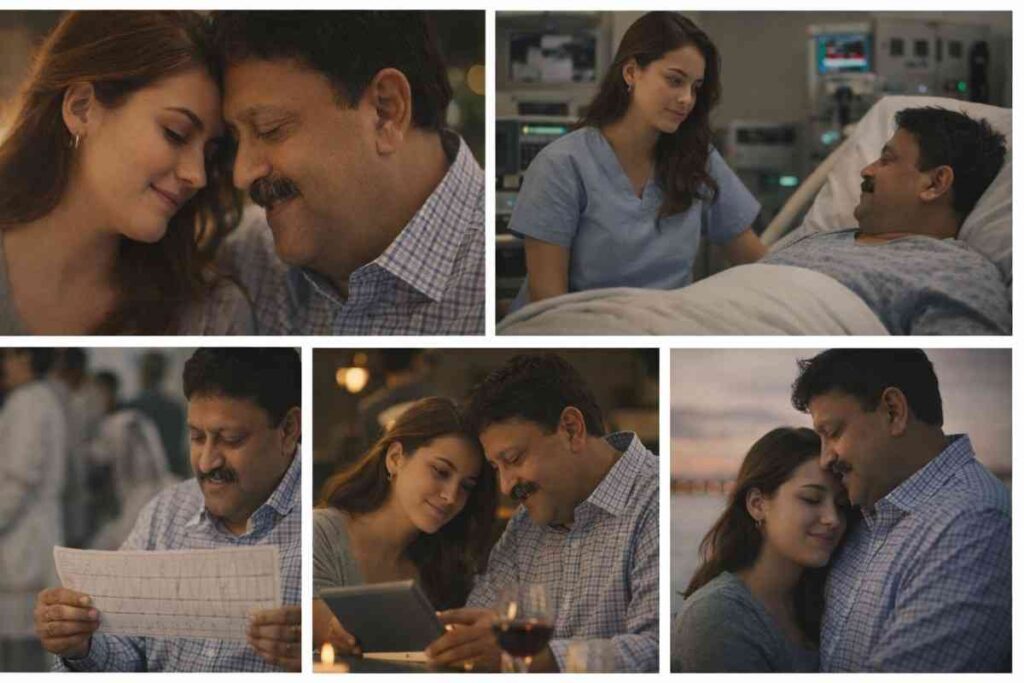
In a world that celebrates instant attraction and fast resolutions, a slow burn romance feels different.
It asks the reader to wait. To notice the small shifts. To trust what grows quietly instead of what announces itself loudly.
Sofi and Karan’s story does not rely on grand gestures or dramatic turns. It unfolds through restraint, routine, and moments that almost pass unnoticed.
That patience mirrors real modern love—where people carry history, caution, and unfinished healing.
The power lies in delay.
Each unsaid word carries weight.
Each pause builds meaning.
The reader stays not because something happens quickly, but because something real is forming underneath.
A slow burn respects time.
And time, in return, deepens emotion.
Healing hearts beyond medicine and music
Neither medicine nor music alone could heal what was broken.
Sofi knew how to repair damaged hearts, but not how to protect her own from memory.
Karan could turn rhythm into emotion, yet lived quietly apart from it. Healing began only when both allowed themselves to be seen—not as experts, but as people.
Their connection did not cure pain.
It softened it.
Through shared listening, they learned that healing does not always arrive as treatment or art.
Sometimes, it arrives as presence.
As someone staying long enough to understand the silence.
This is why the story lingers.
Because beyond medicine and music, it speaks to a universal truth:
hearts heal best when they are not rushed.
And love, when allowed to grow slowly, stays long after the final page.
“The two most powerful warriors are patience and time.” — Leo Tolstoy
【A Slow Burn romance is defined by the restraint shown between the doctor and her patient. This quote validates their choice to let the relationship evolve naturally from a clinical Cardiac Signature into a deep, lasting commitment. It reminds the reader that healing—both physical and emotional—requires the steady, rhythmic passage of time.】
Tale Basket
Pil Slow Burn- Authentic Vs Synthetic
Critical Reading Report: Silence, Rhythm, and Emotional Restraint
FAQ
Frequently Asked Questions: The Heartbeat Protocol
Q: What exactly is a Cardiac Signature?
A: It is the unique rhythmic and electrical pattern of an individual’s heart, captured via ECG/EKG and interpreted through Sound Design.
Q: How does Karen use a DAW in a clinical setting?
A: He maps the live Waveform from the heart monitors into his software to create a bio-rhythmic soundscape.
Q: Is the “Ice Queen” persona based on medical reality?
A: It represents the professional detachment often required of a Cardiac Surgeon, which melts during this Slow Burn romance.
Q: Why is the stethoscope swap significant?
A: It symbolizes a total Reverse of power and intimacy, moving from clinical observation to shared vulnerability.

0 Comments