

Table of Contents
–
Story Brief
Adrian, a corporate professional working late nights, falls alone on a dark road with a dying phone and a sprained ankle. A stranger named Elon stops to help her. What begins as an act of kindness becomes a haunting journey of guilt, atonement, and an unspoken bond. But the same words that once saved her eventually become a curse she cannot escape.
–
Five Key Points
1. “Text me when you get home” – A simple phrase that carries the weight of loss, love, and a promise that breaks.
2. A stranger’s kindness – Elon finds Adrian on a dark road and chooses to stay.
3. A sister’s last words – The same phrase was once sent by Elon’s dying sister, Era.
4. Healing through helping – Elon builds a volunteer network to save others from his sister’s fate.
5. The slow burn romance – Trust grows not through words, but through silent presence and shared pain.
–
“The willingness to show up changes us. It makes us a little braver each time.” … Brené Brown (Researcher & Author)
( This quote captures the core theme of the story: Elon’s journey from a boy who hid in fear to a man who constantly shows up for others, and Adrian’s final lesson that simply being present matters more than perfection. The phrase “makes us a little braver each time” mirrors how every rescue helps Elon heal his own guilt.)
–
PART 1- “Text me when you get home” is spoken for the first time
–
1.The corporate employee who stayed too late at office on a rainy night
Adrian worked in a high-rise glass building in the center of a fast-moving city. Her desk was on the fourteenth floor.
The view from her window showed endless traffic, glowing billboards, and people rushing like ants.
But inside, everything was quiet now. The office had emptied hours ago. Only her desk lamp was still on.
She had been working since eight in the morning. It was now past ten at night.
Her eyes were tired. Her neck was stiff. She had skipped dinner again.
The report on her screen was finally complete, but the cost of finishing it was another evening stolen from her life.
She packed her bag slowly. Her movements were heavy. The elevator ride down was silent.
When the glass doors of the building opened, the night air hit her face.
It was cold. And wet. Rain had started falling. Not heavy. But enough to make the roads slick and the wind sharper.
She checked her phone. The battery was at four percent. A red bar. A warning she had ignored all day.
She had meant to charge it at the office. But there was always one more email, one more call, one more task.
Now she was walking out with a phone that could die any moment.
The weather was bad. Light rain turned her hair damp. Strong wind pushed against her as she walked. The streets were dark.
Some streetlights were flickering. Some were completely dead. The city looked beautiful from a distance.
But up close, at night, alone, it felt like a different place.
Adrian pulled her coat tighter and started walking toward the metro station. It was far.
Too far for a night like this. But taxis were expensive, and ride-sharing apps took too long to arrive in this part of the city. Walking was her only option.
She did not know that this walk would change everything.
—
2.The dangerous poorly lit road with broken pavements and no people
The road between Adrian’s office and the metro station was not meant for night travel.
During the day, it was crowded. Street vendors shouted over each other. Office workers walked in groups.
Children ran home from school. But at night, the same road became a different creature.
The streetlights were old. Half of them did not work. The ones that did gave off a weak yellow glow that barely reached the ground.
Shadows moved in strange ways. A broken pavement forced her to walk close to the road.
Her heels clicked against uneven stones. Some slabs were missing completely, leaving holes filled with rainwater.
There were no shops open at this hour. The small stores that lined the road had pulled down their metal shutters hours ago.
The windows of the upper floors were dark. No one looked out. No one watched.
Adrian had walked this road a hundred times. But always during the day.
Always with other people around. Tonight, she was the only person on the street. Or so she thought.
Every few minutes, a car passed. Their headlights blinded her for a second, then disappeared.
The drivers did not slow down. They did not look at her. She was just a shape on the side of the road. Not their problem.
She remembered what her office friend Rachel had told her that afternoon.
They were standing near the coffee machine. Rachel had looked out the window at the darkening sky and said, “Don’t walk alone tonight. That road isn’t safe. Take a cab.”
Adrian had laughed. “I walk there every day. Nothing happens.”
Rachel had not laughed back. “Every day during the day. Not at midnight. Just because nothing has happened yet does not mean nothing will happen.”
Adrian had poured her coffee and changed the topic. Now, walking alone in the dark, she wished she had listened.
The memory of Rachel’s worried face felt like a warning she had ignored.
The wind picked up again. A loose signboard somewhere creaked and banged against its frame. Adrian walked faster.
Her heels clicked louder. Her breath was shallow. She just wanted to reach the metro station.
She just wanted to sit in a brightly lit train with other people around her.
But the metro station was still fifteen minutes away. And the road ahead was getting darker.
—
3.The sudden fall that broke her sandal and twisted her ankle badly
It happened in a single second.
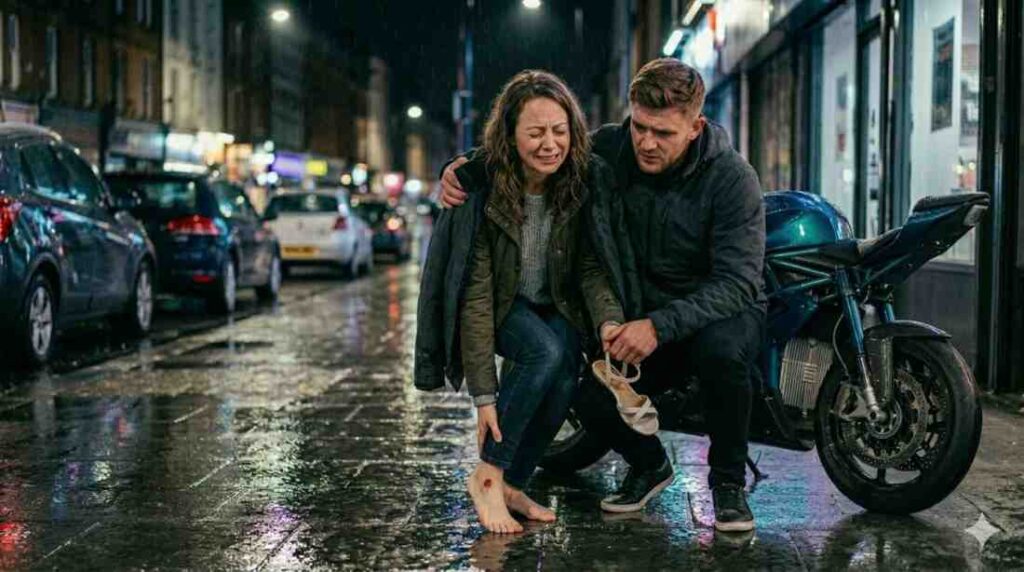
Adrian was walking quickly. Her eyes were fixed on the metro station sign in the distance. She was not looking at the ground. She had walked this path so many times that her feet knew where to step. Or so she believed.
Her right foot came down on a loose stone. The stone shifted under her weight.
Her high-heel sandal twisted sideways. The heel snapped with a sharp crack. Then her ankle turned. Then the ground came up.
She fell hard.
Her left palm hit the pavement first. The skin tore immediately. Small sharp pieces of broken stone dug into her flesh. Her right knee followed. Then her elbow. Then her chin scraped against the rough surface.
For a moment, there was no pain. Only shock. Only the sound of her own body hitting the ground. Then the pain arrived. All at once. A wave of it.
Her ankle was the worst. It was already swelling. A hot, throbbing pain that pulsed with her heartbeat. She tried to move her foot. A sharp stab of agony stopped her. She could not put weight on it. Not even a little.
Her sandal was completely broken. The heel had snapped off and rolled somewhere into the darkness. The straps had torn. It was useless now.
She sat on the cold, wet pavement. Her hands were bleeding. Her chin stung. Her ankle was screaming. And her phone was still in her bag with only four percent battery left.
She looked around. The street was empty. The wind blew rain into her face. She was alone.
She tried to stand. She pushed herself up with her good hand. She put her weight on her left foot. The right foot touched the ground. Pain shot up her leg like fire. She gasped and fell back down.
She tried again. Same result.
She could not stand. She could not walk. She was trapped on a dark road with a dying phone and a broken body.
The fear started creeping in then. Not the fear of pain. Something worse. The fear of being seen. The fear of being found. The fear of the stories she read in newspapers every morning over breakfast. Stories about women who walked alone at night and were never seen again.
She pushed those thoughts away. She told herself to stay calm. But her hands were shaking. And the rain was getting heavier.
—
4.The strangers who looked at her but never stopped to help
Ten minutes passed. Maybe fifteen. Adrian had lost track of time.
She heard footsteps. Someone was coming. A man in a cheap suit, probably returning from a late shift somewhere. He was walking fast, his head down, his hands in his pockets.
He saw her. She was sitting on the pavement, bleeding, her broken sandal lying nearby. He slowed down for a moment. Their eyes met. Adrian’s face said everything: help me, please help me.
The man looked away. He walked past her. His footsteps grew quieter. Then they were gone.
Adrian sat in silence. The rain fell on her hair. The wind blew through her torn clothes. She felt something collapse inside her. Not her body. Her belief. The belief that if she ever needed help, someone would stop. Someone would care. Someone would be human.
More footsteps. A group of three young men. They were laughing about something. One of them noticed her. He pointed. The others looked. They stopped walking.
Adrian’s heart jumped. Maybe they would help. Maybe they would call an ambulance. Maybe they would at least ask if she was okay.
One of the men said something to his friends. She could not hear the words. But she heard the tone. It was not concern. It was amusement. They were laughing at her. Not with her. At her.
The tallest one took a step toward her. Then his friend pulled his arm. “Don’t,” she heard him say. “Not our problem.”
They walked away. Their laughter faded into the night.
An elderly couple came next. A man and a woman, both in their sixties, holding hands. They saw her. The woman stopped. She looked at Adrian. Her face showed confusion. Maybe pity. But also fear. The kind of fear that says “I want to help but I am also scared.”
The husband pulled her gently. “Come on,” he said. “Someone else will help her.”
They walked away. Two steps. Then four. Then ten. They never looked back.
Adrian stopped hoping after that. She stopped counting the people who passed. She stopped expecting anything from anyone. She sat on the cold ground, hugged her knees, and waited. For what, she did not know.
Her phone battery was down to two percent. She could make one call. Maybe two. But who would she call? Rachel lived on the other side of the city.
Her family was in another state. The police? What would she say? “I fell and cannot get up”? They would come. Eventually. But how long would she wait?
She decided to save the battery. Just in case. Just for an emergency.
She did not know that the emergency was already here.
—
5.The expensive bike that stopped and the stranger named Elon
She saw the headlight first.
It was different from the other cars that had passed. Those lights were white and harsh. This one was warm. Yellow. And it was not moving fast. It was slowing down.
The bike came to a stop a few feet away from her. It was an expensive machine. Polished metal. Dark paint. The kind of bike that cost more than her monthly rent.
The rider killed the engine. He removed his helmet.
He was young. Maybe late twenties. Handsome in a way that was not trying too hard. His hair was messy from the helmet. His jaw was sharp. His eyes were dark and calm.
He looked at her. Then at her broken sandal. Then at her bleeding hands. Then back at her face.
Adrian’s heart raced. Not with hope. With fear. She had heard stories about bike gangs. About men on expensive machines who hunted at night. About women who accepted help from strangers and were never seen again.
Her hand moved toward her bag. Toward her phone. One percent battery. Useless.
The young man did not come closer. He stayed where he was. A few feet away. A safe distance.
“My name is Elon,” he said. His voice was steady. Not loud. Not soft. Just… normal. Like they were meeting at a coffee shop, not on a dark road at midnight.
Adrian did not answer. She just stared at him.
He did not push. He did not step closer. He sat on his bike and waited.
“I saw you from far away,” he said. “You are sitting on the ground. In the rain. At midnight. That is not normal. So I stopped.”
Still, Adrian did not speak.
He nodded toward her foot. “Is it broken?”
She finally found her voice. “I don’t know. I can’t stand.”
He looked at her ankle. Even in the dim light, he could see the swelling. “That is a bad sprain. Maybe worse.”
He did not move. Did not reach for her. Did not try to touch her.
“I am not going to hurt you,” he said. “I am just a person who stopped. That is all.”
Adrian wanted to believe him. But she had been taught her whole life not to trust strangers. Especially at night. Especially men on bikes.
And yet. What choice did she have? She could not walk. Her phone was dead. The metro station was far. The road was empty.
She looked at his face again. There was something in his eyes. Not danger. Not desire. Something else. Something she could not name.
“Adrian,” she said. Her name. That was all she gave him.
He smiled. Just a little. Just enough.
“Okay, Adrian,” he said. “Let me help you.”
—
6.The first aid, the joke about the sandal, and the first smile
Elon moved slowly. He did not rush toward her. He first took off his jacket and placed it on the bike seat. Then he opened the storage compartment under the seat.
He pulled out a small first aid kit. Red box. White cross. It looked old but well-used. Like he had opened it many times before.
He walked toward her. Not fast. Not slow. Just steadily. He stopped when he was close enough to kneel beside her. Then he knelt.
“I am going to clean your hands first,” he said. “Is that okay?”
She nodded.
He opened the kit. Took out antiseptic wipes. Alcohol swabs. Gauze. He worked quickly but gently. He cleaned the dirt and small stones from her palm. She winced when the alcohol touched the raw skin.
“Sorry,” he said. “Almost done.”
He wrapped her palm with gauze. Then her other hand. Then he looked at her knee.
“That will bruise,” he said. “But nothing serious.”
He checked her chin. A small cut. He cleaned it and put a small bandage on it.
Then he looked at her ankle.
“This is the problem,” he said. “I cannot fix this here. You need a doctor.”
He sat back on his heels. He looked at her broken sandal lying nearby. He picked it up. The heel was completely gone. The straps were torn.
He turned it over in his hands. Then he looked at her. “This is the most expensive sandal I have ever seen,” he said. “Very high fashion. Very rare. Very… broken.”
Adrian stared at him.
“I think,” he continued, completely serious, “that you have started a new trend. The one-sandal look. Very bold. Very brave. I could never pull it off.”
She did not mean to laugh. But it came out anyway. A small, surprised sound. Then another. Then a full smile. The first smile since she had fallen.
Elon smiled back. “There,” he said. “That is better.”
He put the broken sandal down. “Okay. Two options. I call an ambulance. It will take at least forty-five minutes to get here. Or I take you to the hospital on my bike. It will take fifteen minutes.”
He stood up. He gave her space again.
“Your choice, Adrian.”
She looked at the dark road. At the empty street. At the rain that was still falling. Then at him.
“You,” she said. “I choose you.”
—
7.The mystery of how he knew her name and the ID card answer
Elon helped her stand. He put one arm around her waist. She put one arm around his shoulder. Together, they limped toward the bike.
He supported her weight easily. Like she was light. Like he had done this before.
He helped her sit on the bike. She was sideways because of her ankle. He adjusted her position until she was stable.
Then he stopped. He looked at her face.
“Adrian,” he said.
She looked at him.
“I am going to put the helmet on you now. Okay?”
She nodded.
He placed the helmet over her head. Buckled the strap under her chin. His fingers were careful. They did not linger.
Then he got on the bike in front of her. He started the engine.
“Hold onto me,” he said. “Not tight. Just enough to stay steady.”
She placed her hands on his shoulders. Then, as the bike moved, around his waist.
The rain was still falling. The wind was still blowing. But she was no longer alone.
They drove for a few minutes in silence. Then a question came to her mind. A question that had been hiding behind the pain and the fear.
She leaned closer to his ear. “How did you know my name?”
The bike did not slow down. But she felt him stiffen just a little.
“What?” he said.
“When you first spoke to me. You said ‘My name is Elon.’ But then you said ‘Adrian.’ You called me by my name. I never told you my name.”
He was quiet for a moment. Then he reached up with one hand and tapped his own chest.
“Your ID card,” he said. “It was hanging from your neck. I saw it when I knelt down to clean your hands.”
Adrian looked down. Her office ID card was still around her neck. It had flipped over during the fall. Her name was printed in large letters.
She felt heat rise to her cheeks. Embarrassment. Not fear. She had been so scared of him. And all along, her own ID card had told him everything.
“Oh,” she said.
He laughed. A real laugh. Not mocking. Warm.
“Yes, oh,” he said. “Next time someone saves your life, maybe hide your ID card first. Keep the mystery alive.”
She smiled against his back. The rain was still cold. Her ankle still hurt. But something inside her had started to warm up.
—
8.The decision to go to the hospital on the bike instead of waiting for ambulance
The hospital was a fifteen-minute ride. Every bump on the road sent a small jolt of pain through Adrian’s ankle. But Elon drove carefully. He slowed down for every pothole. He avoided the worst patches of road.
When they arrived, he parked near the emergency entrance. He helped her off the bike. He supported her as they walked inside.
The emergency room was brightly lit. Too bright after the darkness outside. A nurse saw them immediately and brought a wheelchair. Adrian sat down. The nurse looked at Elon.
“Are you family?”
“No,” he said. “I found her on the road.”
The nurse looked at him strangely. Then at Adrian. “Do you want him to stay?”
Adrian looked at Elon. He was standing near the wheelchair. His clothes were wet. His hands had small stains of her blood. He looked tired. But he was still there.
“Yes,” she said. “I want him to stay.”
The nurse nodded and pushed the wheelchair toward the examination room. Elon walked beside them.
The doctor came after ten minutes. He examined her ankle. He pressed certain spots. He asked her to move her toes. She could. But when he tried to rotate her foot, she gasped.
“No fracture,” the doctor said. “But a severe sprain. You need rest. You need ice. You need to keep the foot elevated.”
He wrote a prescription. A painkiller. An anti-inflammatory cream. A bandage for support.
The nurse helped her to a bed. She lay down. Her ankle was now wrapped in a compression bandage. It looked like a white balloon.
Elon sat in a plastic chair next to her bed. He did not say anything. He just sat there. Waiting.
The discharge process took another thirty minutes. Paperwork. Insurance details. Instructions for follow-up.
Through all of it, Elon stayed. He did not leave to make a phone call. He did not check his watch. He just sat in the plastic chair and waited.
When the nurse finally handed Adrian her discharge papers, it was two in the morning.
“You need to rest for at least a week,” the nurse said. “No walking on that foot. Use crutches if you have them.”
Adrian looked at Elon. “You have already done so much. I can go home alone now.”
Elon stood up. He took the discharge papers from her hand. He folded them and put them in his pocket.
“No,” he said. “I am taking you home.”
It was not a question. It was not an argument. It was a statement. Firm. Quiet. Final.
Adrian did not argue back.
—
9.The ride home through dark roads and then brightly lit highways
The ride from the hospital to Adrian’s apartment was different from the ride to the hospital.
The roads were wider now. The streetlights worked. Other cars passed them every few minutes. The city felt normal again. Safe. Boring.
But Adrian was not looking at the city. She was looking at the back of Elon’s head. At the way his shoulders moved when he shifted gears. At the way he leaned into turns.
She did not know his last name. She did not know what he did for work. She did not know why he had stopped for her. She knew nothing about him except that he had a first aid kit in his bike and he knew how to use it.
And yet. She felt safe.
It made no sense. Everything she had been taught told her that a stranger on a bike at midnight was danger. Everything her parents had warned her about. Every news story she had ever read. They all said the same thing: do not trust strange men. Do not get on their bikes. Do not go anywhere with them.
But here she was. On a stranger’s bike. At two in the morning. Going to her apartment. And she was not scared.
She was tired. She was in pain. But she was not scared.
That thought stayed with her for the rest of the ride. She turned it over in her mind. She examined it from every angle. It did not make sense. But it was true.
He stopped the bike outside her apartment gate. The building was dark. Most of the lights were off. Only a few windows glowed in the distance.
He helped her off the bike. He supported her as they walked to the gate. She pressed the buzzer. The watchman opened the gate from inside.
“Which floor?” Elon asked.
“Fourth.”
He looked at the stairs. Then at the elevator. There was an elevator. Old. Slow. But working.
He helped her inside. Pressed the button for the fourth floor. The elevator groaned and started moving.
They stood side by side in the small metal box. Neither spoke. The elevator stopped. The door opened.
They walked to her door. She took out her keys. Her hands were still shaky. She dropped them once. He picked them up. He opened the door.
Her apartment was small. A studio. One room. A kitchen in the corner. A bed against the wall. A window that faced the street.
She limped inside. He followed. He closed the door behind him.
—
10.The coffee made together in her kitchen and the feeling of being safe with a stranger
Elon looked around her apartment. His eyes moved slowly. Taking everything in. The books on the shelf. The plants on the windowsill. The photos on the wall.
“Small,” he said. “But nice.”
Adrian sat on the edge of her bed. Her ankle was throbbing again. The painkiller the hospital had given her was still in her bag.
“Do you have food?” Elon asked.
She thought about it. She had not eaten since lunch. That was almost twelve hours ago.
“No,” she said.
He nodded. He took out his phone. He ordered something. She did not ask what.
Then he walked to her kitchen. He opened her cabinets. He found coffee. He found two mugs. He found sugar but no milk.
“You drink black coffee?” he asked.
“Yes.”
He made the coffee. She watched him from the bed. He moved around her kitchen like he had been there before. Like he knew where everything was. But he had never been here. Neither of them had ever been in each other’s homes before tonight.
He brought two mugs to the bed. He sat on the floor. His back against the wall. Her bed was low. Their eyes were almost level.
They drank coffee in silence. The rain had stopped outside. The wind had calmed down. The apartment was quiet.
“You never told me,” Adrian said, “why you stopped.”
He looked at his mug. He turned it in his hands.
“I stop,” he said. “That is what I do.”
“That is not an answer.”
He was quiet for a long time. Then he looked at her.
“I have a sister,” he said. “She walked alone at night once. No one stopped for her.”
He did not say anything else. He did not need to. The weight of those words filled the room.
Adrian did not ask more questions. She understood that some stories are not told in one night. Some stories take time.
They finished their coffee. He put the mugs in the sink. He walked to the door. He opened it. Then he stopped. He turned back.
“Adrian.”
She looked at him from the bed.
“Text me when you get home,” she said.
He stood in the doorway for a moment. Then he nodded.
“I will,” he said.
He stepped out. The door closed behind him.
She waited. Ten minutes later, her phone buzzed.
Elon: “I am home. Sleep well.”
She smiled. She put her phone down. She looked at the ceiling. The pain in her ankle was still there. The exhaustion was still there. But something else was also there. Something she had not felt in a long time.
She felt safe.
With a stranger.
And for the first time that night, she closed her eyes and slept.
—
Part 2 – “Text me when you get home” is found on a poster
–
1.The stranger who kept visiting but never talked about himself
The next morning, Adrian woke up to the sound of her phone buzzing. The screen showed a message from an unknown number. She had saved Elon’s number the night before, but in her exhaustion, she had forgotten to name the contact.
The message read: “Good morning. How is your ankle?”
She smiled. She typed back: “Swollen. But better than last night.”
He replied within seconds: “I am bringing breakfast. Do not get up.”
Before she could protest, another message arrived: “Which doorbell?”
She sent him the apartment number. Twenty minutes later, a knock on the door.
She limped to open it. Elon stood there holding a paper bag. The smell of fresh bread and coffee filled the hallway.
He walked in without waiting for an invitation. He set the bag on her small kitchen counter. He took out two containers. Eggs. Toast. Fruit. Two coffees.
“You did not have to do this,” Adrian said.
“I know,” he said. He handed her a coffee. “Eat.”
That was the beginning of a pattern.
Every morning for the next two weeks, Elon arrived with food. Sometimes breakfast. Sometimes lunch if she had no meetings. Sometimes dinner if he knew she had worked late from home.
He helped her change the bandage on her ankle. He picked up her prescription from the pharmacy.
He carried her groceries up four flights of stairs because the elevator had broken twice.
But he never talked about himself.
Adrian learned nothing about him. Not his last name. Not where he lived. Not what he did for work. Not why he had a first aid kit on his bike. Not why he stopped for strangers on dark roads.
Whenever she asked, he changed the topic. “How is work?” “Did you finish that report?” “Have you tried this coffee brand?”
He was kind. Attentive. Present. But he was also a wall. A kind wall. A wall that smiled and brought breakfast. But still a wall.
One evening, after he had cleaned her kitchen and stacked her dishes, Adrian sat on her bed and watched him.
“Elon,” she said.
He looked up.
“Why do you do this?”
He did not pretend to misunderstand. He stood still for a moment. Then he picked up his jacket from the chair.
“Because someone has to,” he said. And then he left.
Adrian stared at the closed door. She realized she knew nothing about the man who had been in her home every day for two weeks. Nothing at all.
—
2.The hospital visit where she saw the poster on the notice board
Three weeks after the fall, Adrian went to the hospital for her follow-up appointment. The doctor examined her ankle. He pressed the swollen areas. He asked her to walk a few steps.
“Much better,” he said. “No more bandage needed. But take it slow for another week. No running. No heels.”
Adrian thanked him and walked out of the examination room. Her ankle was still stiff, but she could walk without limping now.
The freedom felt strange after weeks of depending on crutches and Elon.
She walked down the long hospital corridor toward the exit. Fluorescent lights buzzed above her.
The smell of antiseptic filled the air. A few patients sat on plastic chairs, waiting for their names to be called.
Near the main entrance, she stopped. There was a notice board on the wall. It was covered with flyers and posters.
Blood donation drives. Health camps. A lost cat. And then, one poster that made her stop breathing.
It was a simple design. Dark background. White text. No images. No graphics. Just words.
At the top, in large bold letters:
“TEXT ME WHEN YOU GET HOME”
Below that, in smaller text:
A volunteer network that helps women, elderly people, and accident victims stranded at night. Free service. Available 24/7. Call or text the number below.
At the very bottom, in even smaller text:
Founder – Elon Henry
Adrian read the poster three times. Her eyes kept returning to the name at the bottom. Elon Henry.
The man who made her coffee. Who changed her bandages. Who carried her groceries. Who never talked about himself.
The man who had stopped for her on a dark road.
She pulled out her phone. She typed the name into a search engine. Her thumb hovered over the search button.
Then she put the phone back in her pocket. She walked out of the hospital.
She wanted to ask him first. She wanted to hear it from him.
That night, when he came to check on her, she did not mention the poster. She made him coffee.
They sat on the floor. They talked about nothing. And she watched him, wondering who he really was.
—
3.The late night search on her phone that revealed the organization
But curiosity is a difficult thing to ignore.
That night, after Elon left, Adrian lay in bed. The ceiling fan spun slowly above her.
Her phone lay on the pillow next to her face. The name echoed in her head. Elon Henry.
She picked up the phone. She opened the search engine. She typed: “Elon Henry volunteer network”
The first result was a news article. The headline read:
“How One Man Turned His Sister’s Tragedy into a Lifeline for Strangers”
She clicked. She read.
The article told the story of an organization called “TEXT ME WHEN YOU GET HOME.” It was founded four years ago. It had over two hundred volunteers across the city.
They operated every night from 8 PM to 6 AM. Anyone stranded at night could call or text. A volunteer would reach them. Help them get home safely.
The article mentioned Elon by name. It called him “a quiet hero who refuses to be photographed or interviewed.”
There was a photo of the organization’s office instead. A small room with a few desks.
A whiteboard covered with routes and phone numbers. A map on the wall with pins marking locations.
Adrian scrolled further. She found the organization’s website. It was simple. Almost bare.
A home page with the same dark background and white text. An “About Us” page. A “Contact” page. A “Join Us” page.
On the “About Us” page, she found a single paragraph:
“We are a group of volunteers who believe that no one should walk alone at night. If you are stranded, scared, or hurt, text us. We will come. We will wait. We will take you home. No questions asked. No payment expected. Just text: ‘Text me when you get home.'”
Below the paragraph, in small gray text:
Founded by Elon Henry in memory of Era Henry.
Adrian stared at the name. Era Henry. Elon’s sister. The sister he had mentioned only once, in a single sentence: “She walked alone at night once. No one stopped for her.”
She put the phone down. The room felt colder. She pulled the blanket up to her chin.
She understood now why he had stopped for her❓
Why he carried a first aid kit❓
Why he knew how to clean wounds❓ Why he stayed at the hospital❓
Why he brought her breakfast every morning❓
He was not just a stranger who stopped. He was a man on a mission.
A mission born from a loss she did not yet understand.
But she wanted to understand. She wanted to know everything.
—
4.The personal website link she found inside the organization profile
The next day, Adrian skipped her morning meetings. She sat on her bed with her laptop. The organization’s website was still open on her screen. She clicked through every page. Read every word.
On the “Contact” page, she found something unexpected. At the very bottom, in tiny font, almost invisible, was a link. It said: “Founder’s personal site (archived)”
She clicked.
The page loaded slowly. It was an old website. The design was dated. The colors were faded.
It looked like something from ten years ago. Photos were small. Text was plain. No styling. No polish.
At the top of the page was a photograph of Elon. Younger. Thinner. No beard.
His eyes looked different. Lighter. Less tired. He was smiling in the photo. A real smile. Not the small, controlled smile he wore now.
Below the photo, a caption: “Elon Henry – Software Engineer. Cyclist. Coffee addict.”
Adrian scrolled down.
There were photos of a city she did not recognize. Photos of mountains. Photos of a bicycle leaning against a tree. Photos of books stacked on a desk.
And then, halfway down the page, a photograph of a girl.
She was beautiful. Long dark hair. Big eyes. A smile that seemed to take up her whole face. She was standing in front of a library. Her arm was around a younger boy. The boy was Elon. Much younger. Maybe twelve or thirteen.
Below the photo, a caption:
“A picture in memory of Era Henry. 1990 – 2014.”
Adrian’s hand went to her mouth. The dates. Born 1990. Died 2014. Era was only twenty-four years old.
She scrolled further. There was no more information. No explanation of what happened. Just the photo. Just the dates. Just the silence.
Adrian closed the laptop. She sat in the darkening room. The afternoon light was fading. She had been searching for hours.
She now knew three things:
One: Elon had a sister named Era.
Two: Era died in 2014. She was twenty-four.
Three: Elon started the organization in her memory.
But she did not know how Era died. And she did not know why Elon never spoke of her.
She decided to find out.
—
5.The old newspaper article that explained everything about Era
It took her three more hours of searching.
She searched for “Era Henry death” – nothing. “Era Henry obituary” – nothing. “Era Henry accident” – nothing.
Then she remembered the old website. The archived link. She went back. She looked at the page source code. Buried in the code, she found a reference to a news article. The link was broken. But the headline was still visible in the code.
She copied the headline into a fresh search. A newspaper archive website returned one result. A scanned image of a newspaper from 2014. The print was faded. But she could read it.
The headline: “24-Year-Old Woman Missing After Night Attack, Brother Escapes”
Adrian’s hands trembled as she read.
The article was short. Just a few paragraphs. But every word landed like a stone.
“Era Henry, 24, was returning home from a library with her younger brother, Elon Henry (12), when they were approached by three unidentified men. According to police reports, the men attacked Era while the brother hid nearby. Era was dragged into a vehicle and driven away. She has not been seen since. The brother was found wandering on the same road hours later, in a state of shock. He told police he could not identify the attackers. No arrests have been made. The search continues.”
Adrian read the article again. Then again.
Era was twenty-four. Elon was twelve. A child. He hid. He survived. His sister did not.
She put the laptop down. She walked to the window. The street below was empty. The streetlights were on. The same kind of darkness she had fallen in.
Now she understood.
The first aid kit. The bike. The organization. The way he stopped for strangers. The way he never left her side at the hospital. The way he brought her breakfast every morning.
It was not kindness. Not just kindness. It was atonement.
He was trying to save every person he could not save that night twelve years ago.
Adrian sat on the floor. She leaned against the wall. She closed her eyes. And for the first time, she cried for a woman she had never met.
And for the man who had been carrying her memory alone for twelve years.
—
6.The final message Era sent that became the name of the organization
Buried at the very bottom of the newspaper article, in the smallest print, was a final detail. A detail the reporter had added as an afterthought. A detail that changed everything.
“According to phone records, Era Henry sent a text message approximately twelve minutes after the attack. The message was addressed to her brother’s phone. It read: ‘Text me when you get home.’ The message was never delivered. The brother’s phone was later found on the road, undamaged, with the message still pending.”
Adrian read those lines seven times.
“Text me when you get home.”
The same words she had said to Elon on the night he left her apartment. The same words she had seen on the poster. The same words that named the organization.
They were not just words. They were Era’s last message. Sent from darkness. From fear. From a vehicle that was taking her away forever.
And she had not sent it for herself. She had sent it for her brother. Her twelve-year-old brother who was alone on a dark road. Who was scared. Who was hiding.
Even while being kidnapped, Era thought of Elon. Even in her last moments, she wanted him to reach home safely.
Adrian closed the laptop. She lay down on the floor. The ceiling was white. The fan was still spinning. The room was silent.
She thought about Elon. About the weight he carried. About the guilt of a twelve-year-old who hid while his sister was taken. About the man who spent twelve years trying to save strangers because he could not save her.
She thought about the phrase. “Text me when you get home.”
It was a plea. A prayer. A curse. And now, a promise.
She picked up her phone. She opened Elon’s contact. She typed a message. Then deleted it. Then typed again. Then deleted again.
Finally, she wrote:
“I know about Era.”
She stared at the words for a long time. Then she deleted them.
Not tonight, she decided. Not over text.
Tomorrow, she would go to his office. She would look him in the eye. She would tell him she knew. And she would ask him the question that had been forming in her mind since she read the article:
“How do you keep going?”
She put the phone down. She turned off the light. The room went dark. Outside, the city hummed. Inside, Adrian lay awake, thinking about a woman she would never meet and a man she was only beginning to understand.
—
Part 3 – “Text me when you get home” becomes a curse
–
1.The morning after she discovered everything about Era and Elon
Adrian did not sleep well.
She lay awake until three in the morning, staring at the ceiling. The newspaper article was burned into her memory. Era’s face. The dates. The final message. The twelve-year-old boy hiding in the dark while his sister was dragged away.
Every time she closed her eyes, she saw Elon’s face. The way he looked when he said “I have a sister. She walked alone at night once. No one stopped for her.” He had said those words without emotion. Flat. Dead. Like he was reading a grocery list.
But now Adrian understood. That flatness was not coldness. It was survival. The only way he could keep going was to bury the pain so deep that even he could not find it.
She finally fell asleep around four. Her phone buzzed at seven.
Elon: “Breakfast in twenty minutes. Do not get up. I have a key.”
She smiled despite herself. He had made a copy of her apartment key last week. For emergencies, he had said. She had agreed without hesitation. That felt strange now. She knew so much about him. And he did not know that she knew.
She sat up. Her ankle was almost normal now. Just a slight stiffness when she put weight on it. She walked to the bathroom. She looked at herself in the mirror. Dark circles under her eyes. Messy hair. But something else was different. Her eyes looked older. Heavier.
She brushed her hair. She splashed water on her face. She put on a clean shirt.
Then she heard the key in the lock.
Elon walked in carrying two paper bags. He set them on the counter. He looked at her. “You look tired.”
“Did not sleep well.”
“Ankle?”
“No. Just… thinking.”
He did not ask what about. He never asked. He just started unpacking the bags. Eggs. Croissant. Two coffees. A small container of fruit.
They ate in silence. The same silence that had become comfortable over the past weeks. But today, the silence felt different. Heavier. Adrian kept looking at him. At his hands. At the way he held his coffee cup. At the small scar on his left eyebrow.
She wanted to tell him. She wanted to say “I know about Era.” But the words would not come.
Instead, she said: “I want to see your organization.”
He looked up. His eyes narrowed slightly. “Why?”
“Because I want to understand what you do.”
He was quiet for a long time. Then he nodded. “Okay. Tonight. I will pick you up at eight.”
He finished his coffee. He stood up. He walked to the door.
“Elon,” she said.
He turned.
“Thank you. For breakfast. For everything.”
He nodded. He left.
Adrian sat alone in her apartment. Tonight, she would see his world. Tonight, she would understand.
—
2. The slow burn romance that grew through silence and presence not words
That evening, Elon arrived at exactly eight o’clock.
He was wearing a black jacket. Dark jeans. His bike was polished. The engine purred when he started it. Adrian climbed on behind him. She held his waist. Not tight. Just enough.
They drove through the city. The streets were crowded. Friday night traffic. People going to dinners. Movies. Dates. Normal lives. Adrian watched them pass. She wondered if any of them knew about the man on the bike in front of her. About the sister he lost. About the strangers he saved.
The organization’s office was in a small building on the edge of the city. Not the fancy part. The real part. The part where rent was cheap and nobody asked questions.
Elon parked the bike. He led her inside.
The office was small. One room. Four desks. A whiteboard covered with handwritten notes. A map of the city on the wall with colored pins marking locations. A shelf filled with first aid kits. Blankets. Bottled water.
Three volunteers were working. Two young men. One woman. They looked up when Elon walked in. They nodded at him. No smiles. No greetings. Just nods. Like soldiers acknowledging their commander.
Elon walked to the whiteboard. He pointed at the map.
“This is our territory,” he said. “Every night, we cover this area. If someone texts, we go. No questions. No judgment. We just go.”
Adrian looked at the map. Hundreds of pins. Red for calls. Green for rescues. Blue for repeat locations.
“How many calls do you get?”
“On a slow night? Ten. On a bad night? Thirty or more.”
“All from women?”
“No. Elderly. Children. Men who are lost or hurt. Anyone who needs help.”
Adrian walked to the desk. She saw a logbook. Open pages. Handwritten entries. Each entry had a time, a location, a brief description, and a signature.
She read a few entries:
*”11:45 PM – Woman, 34, car broke down on highway. Dropped home. Signature: E.H.”*
*”1:20 AM – Elderly man, 72, fell near bus stop. Taken to hospital. Signature: E.H.”*
*”3:00 AM – Girl, 19, stranded after last train. Dropped to dormitory. Signature: E.H.”*
She looked at Elon. “You go on almost every call.”
He did not answer.
“Why?”
He looked at the map. At the pins. At the logbook. Then he looked at her.
“Because I was not there for her,” he said. “So I have to be there for everyone else.”
The room was silent. The volunteers had stopped working. They were watching. Listening.
Adrian walked to Elon. She stood in front of him. She did not say anything. She just stood there. Close enough to touch. Close enough to breathe.
He did not step back.
This was the slow burn romance. Not words. Not declarations. Not dramatic confessions. Just two people standing close in a small room full of maps and first aid kits. Just silence. Just presence. Just the understanding that something had shifted between them.
The slow burn romance did not need fireworks. It needed this. A man who saved strangers. A woman who wanted to save him.
—
3. She joined the organization and used her expertise to fix their logistics
The next morning, Adrian resigned from her corporate job.
Not immediately. But the thought had been growing for weeks. Her fourteen-floor office. Her endless reports. Her late nights that meant nothing. She had spent years building a career that felt empty.
The organization had four desks. No proper database. No tracking system. No way to measure response times. They were saving lives with paper logbooks and prayer.
Adrian could fix that.
She walked into the organization’s office at noon. Elon was not there. The volunteers looked surprised to see her.
“I want to help,” she said.
The young woman volunteer looked at her. “You have to ask Elon.”
“When will he be back?”
“He is on a call. A woman stranded near the industrial area. Should be back in an hour.”
Adrian waited.
Elon returned at one-thirty. His clothes were wet. It had rained again. He looked tired. His hands had small cuts. He saw Adrian sitting at one of the desks. He stopped.
“What are you doing here?”
“I want to join.”
He looked at her for a long time. Then he walked to the whiteboard. He erased something. He wrote something else. He did not look at her.
“You have a job,” he said.
“I quit.”
He stopped writing. He turned around.
“You quit your job. To sit in this room. With no salary. No recognition. No guarantee that anyone will even say thank you.”
“Yes.”
“Why?”
Adrian stood up. She walked to him. She looked at his face. At the tired eyes. At the small scar. At the man who had been carrying his sister’s memory for twelve years.
“Because you need someone to make sure you do not burn out,” she said. “Because your logbook is a disaster. Because your response times are inconsistent. Because you are saving lives with paper and hope. And because…”
She stopped.
“Because what?”
She wanted to say because I care about you. But the words felt too small. Too simple.
“Because someone has to,” she said. Repeating his own words back to him.
He stared at her. Then he laughed. A real laugh. The first real laugh she had heard from him.
“Okay,” he said. “You are hired.”
Adrian smiled. She walked to the desk. She opened her laptop. She started working.
—
4. The emergency call that came on a night when everything went wrong
Three months passed.
Adrian transformed the organization. She built a database. She mapped response times. She created a system that assigned the nearest volunteer to every call. She introduced shift schedules so no one burned out. She even convinced a small tech company to donate tablets for the volunteers.
The number of calls they could handle doubled. Response times dropped by forty percent.
Elon watched her work. He did not say much. But he started staying later. Started sitting at the desk next to hers. Started bringing her coffee without being asked.
They worked side by side every night. The slow burn romance grew in the spaces between calls. In the quiet moments after a rescue. In the shared exhaustion at four in the morning.
But neither of them named it. Neither of them spoke about what was happening between them.
And then the call came.
It was a Tuesday. Eleven-thirty at night. The rain was heavy. The wind was strong. Adrian was alone in the office. Elon was out on a call. The other volunteers were on their routes.
The phone rang. A woman’s voice. Young. Shaking.
“Please. I am at the old bus depot. There are men following me. Please send someone.”
Adrian pulled up the map. The old bus depot was on the edge of the city. The same road where Adrian had fallen. The same dark road with no lights. No people. No help.
She marked the shortest route. The GPS showed fifteen minutes. She assigned the nearest volunteer. But that volunteer was on another call. She reassigned to the next nearest. Elon. He was ten minutes away.
She called him.
“Elon. Emergency. Old bus depot. Young woman. Men following her. You are the closest.”
“I am on my way.”
She texted him the route. The same route she had driven a hundred times. The route she knew by heart.
Then she waited.
—
5. The old GPS data she forgot to update and the traffic jam that changed everything
Twenty minutes passed.
Adrian called Elon. No answer.
Twenty-five minutes. She called again. No answer.
Thirty minutes. The phone rang. Elon.
“I am stuck,” he said. His voice was tight. “The road you marked. It is blocked. They diverted all traffic because of the President’s convoy. I have been sitting here for fifteen minutes. I have not moved.”
Adrian’s blood went cold.
“What do you mean blocked? I checked the route. It was clear.”
“It is not clear. There are barricades. Police everywhere. I cannot get through.”
Adrian pulled up the GPS. She refreshed. The road was red. Jammed. Diverted.
She checked the data source. It was old. A month old. She had forgotten to update it. She had been so busy building the new system that she had let the old data sit. Unchecked. Unverified.
And now a young woman was alone at the old bus depot. And Elon was stuck in traffic. And there was no one else close enough.
“Find another route,” she said. Her voice was shaking.
“There is no other route. The diversion sends everyone around the long way. It will take another twenty minutes.”
“Go. As fast as you can.”
The line went dead.
Adrian sat in the empty office. The rain hammered on the roof. The wind rattled the windows. She stared at the map on her screen. The red pin marking the woman’s location. The blue pin marking Elon’s location. The distance between them. Growing. Shrinking. Growing again.
She called the woman back. No answer.
She called again. No answer.
She called a third time. The phone rang four times. Then a voice. Not the woman’s. A man’s voice. Deep. Calm.
“Hello?”
Adrian’s heart stopped.
“Who is this?”
The line went dead.
—
6. The girl who survived but the man who broke down completely
Elon reached the old bus depot at 12:47 AM.
Forty-seven minutes after the call.
He found the woman behind a broken wall. She was curled into a small ball. Her clothes were torn. Her face was bruised. Her left eye was swollen shut. She was crying silently. She had stopped screaming hours ago.
The men were gone.
Elon carried her to his bike. He wrapped her in his jacket. He drove her to the hospital. He stayed with her until the doctors took her inside. He gave his statement to the police. He answered their questions. He did not cry. He did not scream. He did not break.
Not yet.
He drove back to the office. The rain had stopped. The roads were empty. He walked through the door at 3:15 AM.
Adrian was sitting at her desk. Her face was pale. Her eyes were red. She had been crying.
When she saw him, she stood up.
“Elon…”
He walked past her. He stood in front of the whiteboard. He looked at the map. At the pins. At the routes. At the system she had built. The system that had failed.
“Her name is Sarah,” he said. “She is nineteen years old. She was coming home from a friend’s house. Her phone was dying. She did not know who to call. She found our number online. She trusted us. She trusted me.”
Adrian walked toward him.
“I was stuck in traffic,” he said. “Forty-seven minutes. She was alone for forty-seven minutes.”
“Elon, it was not your fault. The road was blocked. The convoy—”
“I know about the convoy,” he said. His voice was flat. Dead. Like the night he told her about his sister. “I know about the old GPS data. I know you forgot to update it.”
Adrian stopped walking.
“It was not your fault either,” he said. “It was just… a mistake. A mistake that cost a nineteen-year-old girl her safety. Maybe her sanity. Maybe her life.”
He turned around. His face was not angry. It was worse. It was empty.
“I cannot do this anymore,” he said.
He walked to the door. He opened it. He left.
Adrian stood alone in the office. The whiteboard. The map. The pins. The empty desk where he had sat every night for three months.
She wanted to run after him. But her legs would not move.
She had made a mistake. A small mistake. Old data. An update she forgot. And now a girl was in the hospital. And Elon was gone.
She sat down at her desk. She put her head in her hands. And she waited for morning.
—
7. The day Elon disappeared from the organization and from her life
He did not come to the office the next day.
Or the day after.
Or the week after.
Adrian called him. Fifty times. Maybe more. He did not answer. She texted him. *”Elon, please talk to me.” “Elon, it was not your fault.” “Elon, I am sorry.” “Elon, please.”*
He did not reply.
She went to his house. The address was in the organization’s files. She had never been there before. He had never invited her.
The building was old. The stairs were cracked. The paint was peeling. She climbed to the third floor. She knocked on his door. No answer. She knocked again. Harder. Nothing.
She pressed her ear to the door. She heard nothing. No footsteps. No voice. No sign of life.
She sat outside his door for two hours. Then she left.
She went back the next day. And the day after. And the day after that.
The door never opened.
The volunteers kept working. Adrian kept the organization running. But everyone felt the absence. The empty desk. The calls that Elon used to take. The routes he used to drive. The quiet authority he carried into every room.
He was gone.
And Adrian could not stop thinking about the last thing he had said to her: *”I cannot do this anymore.”*
She did not know if he meant the organization. Or her. Or himself.
She was afraid to find out.
—
8. The night she broke into his house and found him in the dark
On the twelfth day, Adrian stopped knocking.
She called a locksmith. She showed him the organization’s ID. She said she was a social worker and she was worried about a missing person. The locksmith believed her. Or maybe he did not care. He opened the door in thirty seconds.
The apartment was dark. The curtains were drawn. The air was stale. Dishes were piled in the sink. Clothes were scattered on the floor. The bed was unmade.
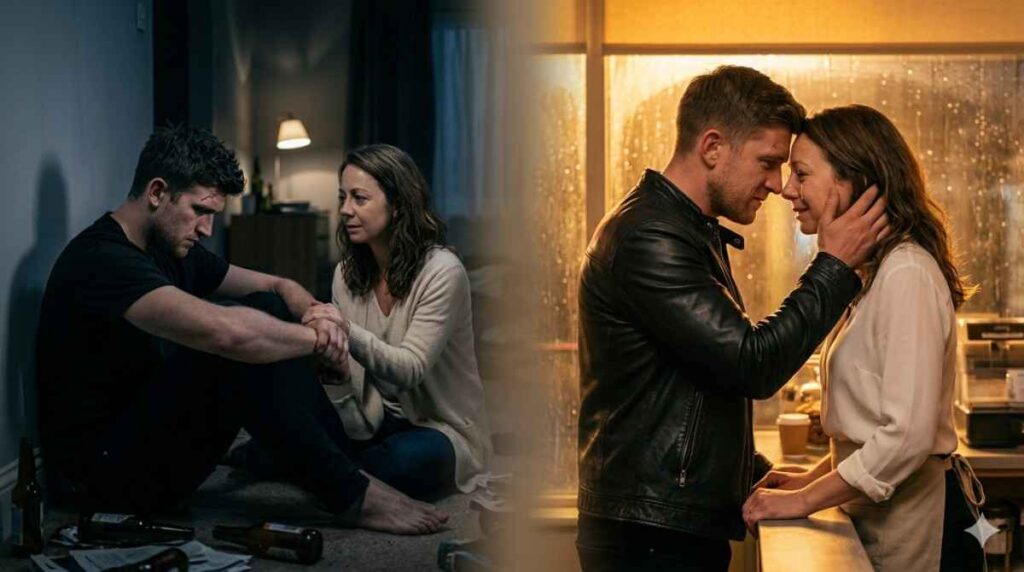
And Elon was sitting on the floor in the corner. His back against the wall. His knees pulled to his chest. His eyes were open but empty. He was not looking at anything.
He had not shaved in days. His clothes were wrinkled. His face was thin. He looked like a man who had stopped living.
Adrian closed the door behind her. She walked slowly. She sat on the floor next to him. Not touching. Just close.
“Elon.”
No response.
“I am here.”
Nothing.
“I am not leaving.”
She sat with him for an hour. Then two. The room grew darker. The sun set outside. Neither of them moved.
Finally, he spoke. His voice was a whisper. Broken.
“She was nineteen.”
“I know.”
“She trusted us. She trusted me.”
“I know.”
“I was stuck in traffic. Forty-seven minutes. I kept looking at the clock. I kept thinking about Era. About how I hid. About how I did nothing.”
He turned his head. He looked at Adrian. His eyes were wet.
“I am still that boy,” he said. “The one who hides. The one who does nothing. I have not changed. I just found better ways to pretend.”
Adrian reached out. She took his hand. He did not pull away.
“You are not that boy,” she said. “You are a man who has saved hundreds of people. You are a man who stopped for a stranger on a dark road. You are a man who made coffee in my kitchen at two in the morning.”
“I could not save her.”
“Sarah is alive. Because of you.”
“Barely.”
“Alive. Because you reached. Because you did not stop trying. Because you carried her to your bike. Because you took her to the hospital. Because you stayed.”
He closed his eyes. A tear slid down his cheek.
“I cannot lose anyone else,” he said. “I cannot.”
Adrian moved closer. She put her arm around his shoulders. She pulled him toward her. He resisted for a moment. Then he did not.
He leaned into her. His head fell against her shoulder. His body started shaking. Silent sobs. Years of guilt. Years of pain. Years of pretending he was fine.
Adrian held him. She did not speak. She did not offer advice. She did not try to fix him.
She just held him.
And in the dark room, on the floor of his empty apartment, the man who had saved so many strangers finally let himself be saved.
—
9. The words that lifted him from the darkness and guilt inside
They sat like that for a long time.
The room was completely dark now. No lights. No sounds from outside. Just two people breathing.
Elon’s tears had stopped. His body was still. But he did not move away from her. He stayed with his head on her shoulder. His hand loosely holding hers.
Adrian spoke. Her voice was soft. Low. Not a lecture. Not a speech. Just words.
“You could not save your sister,” she said. “That is true. You were twelve years old. You were scared. You hid. That is what children do. That is not a crime. That is survival.”
He did not respond.
“But for twelve years,” she continued, “you have been paying for that night. Every stranger you helped. Every road you drove. Every call you answered. You have been trying to bring her back. But she is not coming back, Elon. She is gone.”
His hand tightened around hers.
“Sarah is not Era,” Adrian said. “You could not save Era. But you reached Sarah. You were late. Yes. But you reached. You showed up. And showing up… that is the biggest thing. That is the only thing.”
She paused.
“The old GPS data was my mistake. I forgot to update it. The traffic jam was not your fault. The diversion was not your fault. But I need you to know something.”
She turned her head. She looked at his face in the darkness.
“Even with the mistake. Even with the delay. Even with everything that went wrong… Sarah is alive because of you. Because you did not stop. Because you kept driving. Because you found her. Because you carried her.”
He lifted his head. He looked at her.
“Do you believe that?” he asked.
“I believe that you are not the boy who hid. You are the man who stopped. For me. For Sarah. For hundreds of strangers whose names you will never know.”
She took his face in her hands.
“You showed up, Elon. That is who you are. Not the boy who hid. The man who shows up.”
He stared at her. His eyes were red. His face was broken. But something was shifting behind his eyes. Something was waking up.
He leaned forward. His forehead touched hers.
“Thank you,” he whispered.
She closed her eyes.
They stayed like that. In the dark. On the floor. Two people who had saved each other in different ways.
The slow burn romance had no climax. No kiss. No confession. Just this. Just two foreheads touching. Just two people breathing the same air. Just the quiet understanding that they would never be the same again.
—
10. The guilt she could not escape even after saving him
Weeks passed.
Elon returned to the organization. He did not talk about what had happened. He did not need to. Adrian was there. That was enough.
They worked together. They rebuilt the system. They updated every map. Every route. Every database. They made sure no old data would ever fail them again.
Elon was healing. He smiled more. He laughed sometimes. He started sleeping again. He started eating again. He was becoming the man he used to be.
And Adrian watched him. She was happy for him. She was proud of herself for helping him. But something was growing inside her. Something dark. Something heavy.
The guilt.
She had told Elon that the GPS mistake was hers. She had said the words out loud. But she had not truly faced them. Not in her own heart.
She replayed the night over and over. Sarah’s voice on the phone. The fear in her voice. The men following her. The forty-seven minutes. The old data. The update she forgot.
She had been so busy building the new system. So proud of her work. So sure of herself. And she had let the old data sit. Unchecked. Unverified.
She had messed up Elon’s operation. His life’s work. His atonement for Era. His reason for existing.
And now Sarah had scars. Physical. Mental. Maybe permanent. All because Adrian forgot to update a file.
Elon did not blame her. He never said a word. He had even thanked her for saving him.
But that made it worse. If he had been angry, she could have borne it. If he had shouted, she could have accepted it. But his forgiveness. His kindness. His gratitude. They were unbearable.
Then she saw it. One evening, Elon was laughing at something one of the volunteers said. His eyes were bright. His shoulders were relaxed. He was alive again.
But Adrian saw something else. She saw the scar on his left eyebrow. The same scar she had noticed on their first night. The scar he had gotten when he was twelve. The night Era was taken. The night he hid.
She realized: she had not saved him from his guilt. She had only pulled him out of the darkness. But the guilt was still there. Buried. Waiting.
And she had made it worse. Because she had reminded him of Era. She had made him relive that night. She had dragged him back into the darkness she found him in.
She could not forgive herself.
She looked at Elon across the office. He was laughing. He was alive. Because of her.
But also… broken. Because of her.
She could not stay.
—
11. The decision to punish herself by walking away from his work and his life
She left on a Sunday.
No note. No goodbye. No explanation.
She packed her bags. She left her keys on the kitchen counter. She turned off her phone. She walked out of her apartment at 6:00 AM. The watchman saw her leave. He assumed she was going for a walk. He did not ask questions.
She did not look back.
She went to a small town three hundred miles away. No one knew her there. She found a room to rent. She found a job at a small café. She told herself this was her punishment.
She had messed up Elon’s operation. She had hurt Sarah. She had nearly destroyed the organization. And she had walked away without facing the consequences.
But that was not the real reason. The real reason was worse.
She had made Elon remember Era. She had brought back the night he had spent twelve years trying to forget. She had seen him broken on the floor of his apartment. And she knew: it was because of her.
She was the one who forgot to update the data. She was the one who sent him into that traffic jam. She was the one who made him relive the worst moment of his life.
She could not stay. She could not face him. She could not face herself.
So she ran.
She did not tell anyone where she was going. She did not call Elon. She did not check her messages. She deleted her social media. She erased herself from his world.
Let him think she had vanished. Let him think she had disappeared like Era. Let him grieve. Let him move on.
He would be better without her.
She sat in her small room. The walls were bare. The window faced a parking lot. The air smelled of old carpet and loneliness.
She looked at her phone. The screen was dark. She had not turned it on in weeks.
She thought about the last thing she had said to Elon. The words she had spoken in his dark apartment.
“You showed up, Elon. That is who you are.”
She had meant it. She still meant it.
But she also knew: she had shown up for him. And in showing up, she had broken him.
—
12. The lost and found report that brought him to her door
Two years passed.
Two years of waiting. Two years of silence. Two years of waking up every morning and checking his phone for a message that never came.
Elon had not stopped looking. He had not stopped hoping. But the search had become quieter. Less frantic. More like breathing. A habit he could not break.
He still ran the organization. Still took calls. Still drove strangers home at night. But the heart of it was gone. The desk next to his stayed empty. The coffee she used to make stayed unmade.
He did not date. He did not move on. He just existed. Waiting.
Sarah had recovered after six months of therapy and physical rehabilitation. She had no permanent physical damage, but the emotional scars remained. She joined the organization as a volunteer. She wanted to help others the way Elon had helped her.
Elon had not told her about Adrian. He did not need to. Sarah saw the empty desk. She saw the way he looked at it every night. She did not ask questions. She just showed up and helped.
One Tuesday afternoon, his phone rang.
Not a message. A call. From a number he did not recognize.
“Mr. Henry?”
“Yes.”
“This is Officer Reynolds from the Missing Persons Unit. We have a match on your report. Adrian Walsh. She is alive. She is safe. She is living in a small town called Millbrook, about three hundred miles north.”
Elon’s hand tightened around the phone. “Is she… is she okay?”
“She is working at a small café. She is using her own name. She is not hiding from the law. She is just… living. We have the address if you want it.”
“Yes,” he said. “Please.”
—
Three days later, Elon stood outside a small café in Millbrook.
The town was quiet. Old buildings. Wide streets. Few cars. It smelled of pine trees and rain. The café had a faded sign that read “Morning Brew.”
He looked through the window.
And there she was.
Adrian. Older. Thinner. Her hair was shorter. Her face was tired. But she was alive. She was pouring coffee for a customer. She was smiling. A small smile. A careful smile. The kind of smile that does not reach the eyes.
He stood there for a long time.
Then he pushed the door open.
—
The bell above the door chimed.
Adrian looked up. Her smile froze. The coffee pot in her hand tilted. A few drops spilled onto the counter.
She did not speak.
Elon walked toward her. Slowly. Carefully. Like she was a bird that might fly away.
“Hello, Adrian.”
She stared at him. Her face went pale. Her hands were shaking. She set the coffee pot down.
“Elon…”
She did not finish the sentence.
The café was quiet. The other customers looked up, then looked away. They knew not to interrupt.
Elon stopped in front of her. He did not touch her. He just stood there. Close enough to breathe. Close enough to break.
“Two years,” he said.
“I know.”
“You could have called.”
“I know.”
“You could have told me you were alive.”
“I know.”
He was quiet for a moment. Then he said: “I thought you were dead. I thought you had disappeared like Era. I thought I had lost another person. I thought I was cursed.”
Adrian’s eyes filled with tears. They fell silently. One after another. She did not wipe them away.
“Elon, I am so sorry. I am so sorry.”
He did not move. He did not speak. He just looked at her.
“I left because of you,” she said. Her voice was raw. “Because of what I did. The GPS data. Sarah. The forty-seven minutes. I saw you break. I saw you drown. I saw you become that twelve-year-old boy again. And I knew. I knew it was because of me.”
“No—”
“Let me finish,” she said. “I have been saying this to myself for two years. Let me say it to you.”
He nodded.
“I left because I could not live with what I did to you. You had spent twelve years trying to forget Era. Trying to move on. And then I came. And I made you remember. I made you relive it. I dragged you back into that darkness. And I could not forgive myself for that.”
She stopped. Her shoulders were shaking.
“I did not leave because of the GPS mistake. I left because I saw you broken on the floor of your apartment. And I knew. I knew it was my fault. I knew I had to go. For your sake.”
She finally looked up at him.
“I thought if I disappeared, you would heal. I thought if I was not there, you would forget. I thought you would be better without me.”
Elon let out a breath. A long, slow breath.
“Adrian,” he said. “I have been searching for you for two years.”
“I know.”
“Two years. Every night I sat in that office. Every night I waited for your message.”
“I know.”
“And I want you to hear me now. Just once. Then I will leave.”
She nodded.
“You made a mistake,” he said. “You forgot to update a file. That is not a crime. That is being human. You did not make me remember Era. I never forgot Era. I have carried her with me every single day since I was twelve years old.”
He stepped closer.
“You did not drag me into darkness. You came into my darkness. You sat on the floor with me. You held me while I cried. You told me I was not the boy who hid. You told me I was the man who shows up.”
He reached out. He took her hand.
“You did not break me, Adrian. You saved me. And then you walked away because you thought you were protecting me. But you were wrong.”
She was crying openly now. Her hand was trembling in his.
“I was never afraid of the pain,” he said. “I was afraid of being alone. And you left me alone.”
Adrian broke.
She fell against him. Her arms went around his neck. Her face buried in his shoulder. Her body shook with sobs. Years of guilt. Years of running. Years of punishing herself.
Elon held her.
Not tight. Not desperate. Just firmly. Just enough. Like she was finally home.
“You are not alone,” she whispered into his shoulder. “I am here now.”
“I know,” he said. “I know.”
—
They sat in the café for three hours.
The owner brought them coffee without being asked. He knew Adrian. He saw the way she looked at this stranger. He saw the way the stranger looked at her.
They talked. Not about the past. Not about the guilt. Just about the small things.
The organization. The volunteers. The new system she had built. Sarah, who had recovered and was now a volunteer herself.
Adrian told him about Millbrook. About the quiet life. About the mornings at the café. About the nights she sat alone in her small room and thought about him.
Elon listened. He did not judge. He did not ask why. He just listened.
Then he said: “I need you to know something.”
“What?”
“What you did was not a crime. It was a mistake. And mistakes are part of life. But what you did after… that was something else.”
She looked down.
“You punished yourself more than anyone ever could. You ran away. You erased yourself. You gave up everything because you thought you were protecting me.”
He took her face in his hands. Gently. Like she was made of glass.
“But you were not protecting me, Adrian. You were protecting yourself. You were running from the guilt. And I understand that. I have run from guilt my whole life.”
Her eyes were wet again.
“But I am not running anymore,” he said. “And I do not want you to run either. I want you to come home.”
She looked at him. Her voice was a whisper. “Is there still a home?”
He smiled. A real smile. The first real smile in two years.
“There has always been a home,” he said. “You just forgot to come back.”
She left the café that night.
She left with him. On his bike. The same bike that had stopped for her on a dark road two years ago.
They drove through the night. The roads were empty. The stars were out. She held his waist. Not tight. Just enough.
When they reached his apartment, he stopped. He turned to her.
“Adrian.”
“Yes?”
“I need you to promise me something.”
“What?”
“If you ever feel that guilt again. If you ever think you are a burden. If you ever think you are breaking me. Promise me you will talk to me. You will not run. You will not disappear. You will just talk to me.”
She looked at him. The man who had waited two years. The man who had searched for her when everyone else had given up. The man who had sat beside her in a café and told her she was not a criminal.
She nodded.
“I promise.”
“Okay,” he said. “That is all I need.”
That night, as he was leaving her apartment door, he turned back.
“Adrian.”
“Yes?”
“Text me when you get home,” he said.
She smiled. A real smile. The kind that reached her eyes.
“I am already home,” she said.
He looked at her. His eyes were wet. So were hers.
Then he nodded. He turned. He walked away.
But this time, he knew she would stay.
And this time, the words no longer haunted.
They healed.
“That’s life for you… Someone always waiting for someone who never comes home. Always someone loving some thing more than that thing loves them.” … Ray Bradbury (Author)
(This quote reflects the haunting loneliness of your story’s ending: Elon waiting forever for Adrian, mirroring Era’s disappearance. It captures the “curse” of the key phrase “Text me when you get home“ —the pain of waiting for someone who never comes home.)
THE END.
Tale Basket
“Text Me When You Get Home” – A Slow Burn Romance That Stays with You
FAQ
“Text me when you get home” is about in a broader, universal way?
In general, “Text me when you get home” is about:
– Care – It means “I am thinking about you” and “I want to know you are safe.”
– Safety – It is a quiet reminder that someone is waiting for you.
– Connection – In a world of distance and busy lives, it is a small act of love.
– Vulnerability – It says “I worry about you” without being dramatic.
– Presence – It turns a simple goodbye into a promise.
It is not about control. It is not about checking up. It is about saying:
“You matter to me. Please let me know you made it. I will not sleep until I hear your voice.”
“Text Me When You Get Home” Hoodie Meaning ?
The hoodie is more than just clothing. It is a cultural statement.
– A love language – It means “I care about you” and “I want to know you are safe.” It is a quiet, modern way to say “I love you” without being dramatic.
– A symbol of safety and solidarity – Especially for women, it represents the shared experience of walking alone at night and worrying about reaching home safely. It gained widespread recognition after the Sarah Everard case in 2021, when women globally shared the phrase to highlight daily safety concerns.
– A fashion trend – The hoodie was popularized by the streetwear brand Lonely Ghost, turning the phrase into a stylish, meaningful piece of loungewear.
—

0 Comments