

By: Ranjan Sarkhel
Table of Contents
–
Introduction: Live-in Relationships and Situationships Essay
Two people wake up in the same apartment every morning.
They split the rent, cook dinner for each other, bicker over who has to do the dishes, and spend their weekends binge-watching their favorite TV show.
Friends think they are a couple. Family members start asking when they are getting married. Even neighbors begin to believe that the two live together.
But then somebody asks the question that has never been asked before:
“So… are you two dating?”
And then, the most uncomfortable silence of all time.
The situation described above is all too familiar for many couples. As people begin to realize the importance of getting to know somebody well before getting married, the number of live-in relationships keeps increasing.
Modern people strive for certainty and transparency in all areas of life, and dating is not an exception.
Living together gives partners an opportunity to assess their compatibility before making the big step.
But what is a situationship, anyway?
Both situationships and live-in relationships involve people who are romantically and sexually involved and share a meaningful part of their lives.
However, there are striking differences between the two types of unions.
Because of the similarities between situationships and live-in relationships, these two notions are often confused with each other.
In some cases, people even use the two terms interchangeably.
Moreover, people can live together while being in a situationship.
Therefore, it is important to distinguish between the two concepts and highlight their differences.
Can people live together while being in a situationship? Is a situationship the same as dating? Can a situationship become a relationship? This guide will tell you all about it!
We will discuss what a situationship is, what makes it different from a relationship, and much more.
By the end of this article, you will clearly understand whether you and your partner are in a situationship or a relationship.
You will also discover why society has mixed views about couples who choose to live together and gain valuable insights about the benefits and drawbacks of such relationships.
Living together describes a living arrangement. A situationship describes the emotional status of a relationship. One is about sharing a home; the other is about defining—or avoiding defining—the relationship itself.
–
What Is Living Together?
Living together, sometimes called cohabitation or just a live-in relationship, is when a couple lives together in the same house but aren’t necessarily married.
For some people, it’s the next step prior to marriage, while for others, it’s simply an option based on a choice they have personally made.
A live-in relationship, or co-habitation, is a lifestyle that some people choose due to their own personal reasons
Living with someone else does not necessarily mean that those people are or intend to be in a romantic relationship however, many people choose to live together for this reason.
A situationship is different from living together in that a couple living together may or may not be serious about each other.
People choosing to live together often have drastically different expectations of a romantic relationship than most couples.
This is especially true when comparing a situationship to a permanent romantic relationship that includes living together.
The concept of co-habitation, or simply living together, is rapidly spreading throughout the world. With evolving social norms, city living, and delayed marriages all contributing to a culture in which people feel more and more comfortable living together rather than getting married first.
However, the reasoning behind such choices varies drastically from couple to couple.
Why Do Couples Choose to Live Together?
Every relationship has its own story. While no two couples move in together for exactly the same reasons, several common factors influence this decision.
Financial Practicality
One of the easiest reasons why couples choose to live together is they are living together to save money. Couples save money by being able to split the cost of rent, power and water, food, internet, and other things that make up an expensive bill, especially in big cities where rent prices only go up.
Some couples also like the convenience of splitting chores, and making meals together can sometimes be fun
Understanding Emotional Compatibility
Love can bring two people together, but it is only when they are living together that they learn to grow together
Living together enables a couple to see the other in all their routines and quirks, to adjust to the same pace, the same rhythms, to experience the other’s strengths and weaknesses, to share the burdens of life. It is not just the holidays and vacations together that make a relationship last. It is also the everyday living and sharing that takes place in ordinary conditions. The ability to deal with day-to-day annoyances and to share joys and problems helps couples realize how good or bad their match is. They see if they are emotionally connected enough to adjust to each other, to overcome misunderstandings and disappointments, and to cope with crises.
–
“The meeting of two personalities is like the contact of two chemical substances: if there is any reaction, both are transformed.”
— Carl Jung
(Jung’s words beautifully capture the essence of living together. Sharing a home is not merely about occupying the same space; it is about two individuals gradually influencing each other’s perspectives, routines, and personal growth. When a relationship is healthy, both partners evolve together rather than simply coexist.)
–
Testing Long-Term Compatibility Before Marriage
For many couples, co-habiting can be a good way to test if they are compatible enough to make a lifelong commitment. Marriage is a long-term endeavor that involves sharing duties, finances, families, and futures. By living together first, couples can get a good look at their compatibility and how they handle each other. They can see how each one reacts and responds to their partner.While it cannot guarantee happiness, it can give the couple a good idea of what married life will be like outside the dating “bubble.”
Cultural Differences and Changing Social Attitudes
Attitudes towards living together can vary across the world.
In many Western societies, it has become socially acceptable to be living together without getting married. Some couples may decide to live together for a period of time to test if the relationship is lasting, and then move on and get married if it works out, or some may never get married at all.
In more traditional societies, they may see the idea of living together outside of marriage as something disgraceful, and parents or religion may frown upon the idea.
There may be different ideas on what is right or wrong, but in most cases it is becoming more acceptable for people to live together if they feel like it. People also still value getting married and seeing it as commitment to another person, so it is hard to say which is right or wrong in any situation. It boils down to what each individual couple wants and how they feel about each other.
Living together is a lifestyle choice, not a relationship status. While cohabitation can be an important step in a relationship, it is not a guarantee of commitment or partnership. Trust, communication, and a shared vision for the future are what truly bind relationships together, not a shared address.
–
What Is a Situationship?
A situationship is a romantic relationship that falls between dating and marriage. Two people involved in this union can communicate deeply, be physically intimate, spend a lot of time together, but still have ambiguity about their relationship status.
Unlike a standard relationship, which clearly defines the status of both sides, a situationship leaves everything open. There is an emotional connection and sexual interaction, but no commitment, responsibility, or even a clear definition of what exactly is going on between two people. This uncertainty is the situationship meaning, and it can be stressful for people involved due to the constant need to deal with the uncertainty and confusion of their love life.
The term itself came up recently, as dating became more complicated than before. People now use dating apps and social networks to find partners, so they have many options and face new challenges. Some of them opt to remain in a situationship because they do not want to commit to marriage right away. Others, however, are unable to realize that they are in a situationship until it becomes too late and they need to figure out their relationship.
Common Characteristics of a Situationship
Every situationship is unique but they all have some common characteristics
There is an element of physical and emotional intimacy. You spend time with the other person, go out on weekends, celebrate holidays or birthdays, exchange text messages throughout the day and rely on each other for emotional support. You look like a couple in the eyes of everyone around you.
There is no definitive answer when it comes to defining your relationship. The conversation, which should take place to determine the details of your relationship, is postponed or held back with ambiguous statements or responses such as Let’s not make it too complicated” or “Let’s see where things are going.” There is no clear commitment.
The future is put on hold. It can last for several months or several years, but neither one of you wants to talk about marriage, home, future life together or any of the traditional milestones of a stable relationship. You are comfortable staying in the present but you are not sure how to move toward the future.
The rules are not set. Questions like “Are you and him official?” “Can I see other people?” “Are you telling anyone?” and “What’s our story?” are left unanswered, creating misunderstandings and unfulfilled expectations.
Living with Emotional Uncertainty
One of the most common traits of a situationship is the degree of uncertainty it creates.
One minute, things are going great. The two are communicating openly and showing affection. The next, one’s getting the cold shoulder. It’s all very up-and-down.
If you’re in a situationship, you’ve probably wondered at some point if there’s even a future with your partner.
After all, you might feel like you’re walking on eggshells around them.
When are you going to spend more time together?
What does it mean if you’re still seeing each other after X amount of time?
Are you both sure that this is what you want?
Asking yourself these questions can leave you emotionally drained.
It’s understandable if you start feeling anxious or insecure if you can’t get definite answers from your partner.
It’s also completely normal to feel frustrated if you’re spending so much time on someone who isn’t going to be your future.
The Difference Between Affection and Commitment
Perhaps the most common misconception about situationships is that affection and feelings of love are enough.
A situationship can involve a healthy relationship based on care and compassion. But when it comes to commitment, it is not about the level of affection or love but rather about the actions and expectations of both sides. Commitment is demonstrated through actions, such as defining the relationship and its prospects. In cases when one side does not intend to commit fully, a situationship may fail to bring a feeling of emotional fulfillment.
A situationship is not determined by the level of affection between the two people, but rather by the lack of information as to what the relationship entails and where it is headed. Though love may be present, the ambiguity of the bond between the two people makes commitment difficult, and often leads to misunderstanding.
–
Situationship vs Living Together: Understanding the Real Difference
At first glance, a situationship and living together seem to be the same thing. In both cases, two people who spend a lot of their time and energy on each other. In many ways, the relationships are intertwined and inseparable.
This is probably why some people tend to confuse them.
However, they only seem similar because they describe different aspects of a relationship.
Living together describes where a couple resides, whereas a situationship defines the status of the relationship.
Moreover, it is possible for a couple to live together but be in a situationship and have no plans for the future.
On the other hand, a couple can also be living together and have a very clear vision of their relationship’s future.
All in all, it is possible for two people to share an apartment but be uncertain of their relationship status and future.
Conversely, a couple can share an apartment and be very certain and clear about their relationship’s status and future. In any case, people should remember that situationships describe a relationship status, whereas living together describes where the people reside.
Situationship vs Living Together: Comparison Table
| Living Together | Situationship |
| Describes a shared living arrangement. | Describes an undefined romantic relationship. |
| Partners share the same home. | Partners may or may not live together. |
| Often includes shared financial responsibilities like rent and household expenses. | Financial responsibilities depend on the individuals and are usually informal. |
| Daily routines and household responsibilities are commonly shared. | Time together varies and daily routines may not be consistent. |
| Can exist in dating, engagement, or marriage. | Exists without a clearly defined relationship status. |
| May involve clear discussions about the future, marriage, or famil | Conversations about commitment or the future are often avoided. |
| Family and friends usually know the nature of the relationship. | Relationship status is often unclear to others—and sometimes even to the partners themselves. |
| Commitment depends on the couple, not the living arrangement itself. | The defining feature is the lack of commitment or relationship clarity. |
Living together does not necessarily mean that the couple is in a committed relationship. In the same way, a situation ship does not mean that they have to be living separately from each other. They can be both or neither.
–
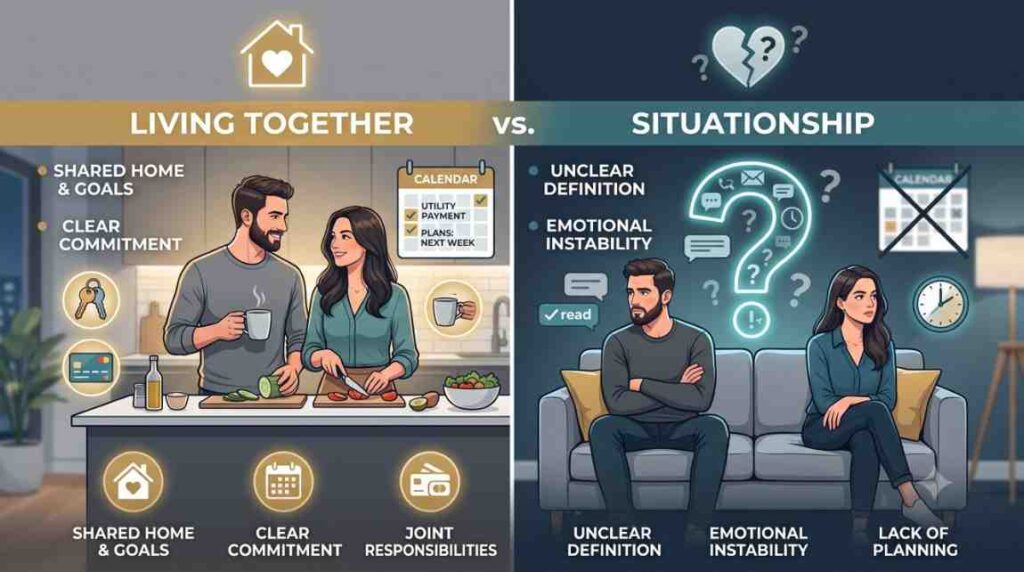
Infographic : Living Together vs Situationship at a Glance
–
Living Together vs Situationship: Spot the Difference
| Living Together | Situationship |
| 🛏️ Share a Home | ❤️ Emotional Connection |
| 💰 Share Expenses | ❓ Undefined Commitment |
| 🍳 Daily Routines Together | 🔄 Mixed Signals |
| 📦 Shared Responsibilities | 🚫 Avoid Relationship Labels |
| 📅 May Plan the Future Together | ⏳ Future Remains Uncertain |
Bottom Line
🏡 Living together answers: “Where do we live?”
❤️ A situationship answers: “What exactly are we?”
One is about sharing a home.
The other is about defining a relationship.
Understanding this distinction can prevent months—or even years—of confusion, unmet expectations, and emotional uncertainty.
–
Imagine two couples living in the same building. They both pay the same rent, cook the same dinners, and sit on their sofas every weekend. From the outside, it is difficult to tell any difference between the two. However, a simple question could expose their hidden conflict.
“Where do you see this relationship in five years?”
If each person answers the question with the same vision of the future, the couple most likely has a healthy, long-term bond. If one partner begins to steer the conversation to some other topic, he or she may be hiding something from his or her partner.
–
Can You Live Together in a Situationship?
Yes, you can. After all, there are plenty of situationships nowadays where the involved parties are roommates, or, rather, people that share the same residence. While this may sound odd, the very fact of living together does not necessarily imply the presence of a committed relationship.
Judging from their interactions alone, one would think that these couples are just like any other. They cook for each other, shower together, go on dates and get married, split the bills, adopt cats, etc. In short, they behave precisely like any other couple would. However, there is still that one, lingering detail that makes them not a real couple, at least from the standpoint of their own definitions.
They do not know “what they are.” And that, essentially, is the key difference between a committed, live-in relationship and a situationship.
Rising Living Costs and Financial Practicality
One of the most common reasons for couples to decide to move in together is economic.
The prices of rent and living in general are getting higher and higher every day in most places around the world.
Two people can share the rent, the utilities, the food, the internet and many more expenses that would be too high for one person alone.
This is why many students or people entering the workforce decide to do so.
Nevertheless, economic convenience is rarely the only reason for a couple to move in together.
While sharing expenses is usually a plus, it cannot be the sole reason for entering into such an arrangement.
Many people forget that you cannot share an apartment and split the bills and expect everything to be convenient and fair if one of the two people is not fully committed to the relationship.
Convenience Becomes Comfort
Living together also makes things easier.
No more worrying about dates, packing bags, catching the bus or subway across town to see each other. You see each other everyday.
You can make coffee for each other in the morning, or cook dinner for each other in the evening. You can even go to the store together and get snacks for dinner.
It’s easy to think that everything is going great when you fall into this pattern of living, but the routine isn’t everything. It’s easy to become housemates without ever discussing the future.
Physical Intimacy Can Blur Emotional Boundaries
Physical intimacy is a big part of living together. Sharing a room, showing affection, and being with someone practically 24/7 can lead to a deep emotional connection.
However,
physical intimacy and commitment are not mutually exclusive. A situationship (which many people may mistakenly assume to be a healthy alternative) can include feelings of love and affection for another but neither partner is willing to define the relationship as something more.
While one person may think of an intimate (yet uncommitted) relationship as an indicator of progress, another person my view it as an expression of current feelings but with no expectations for the future
Because of differences in expectations, situationships can often lead to hurt feelings.
Emotional Dependency Can Develop Quietly
Living together tends to lead to emotional reliance.
When a day is bad, the first one to turn to is your partner. You share successes, as well as provide comfort when the other is down, and you start to become a bigger and bigger part of eachother’s lives.
Emotional reliance is fine in committed relationships where both parties expect something long term, however it can cause issues in situationships,
One person could start to think that they’re in it for the long term while the other shows no such intentions.
This can make one person feel secure in the relationship while the other is sort of floating around without any real expectations.
Fear of Loneliness
Not every situationship goes on because both sides are perfectly fine with it.
Sometimes, being single scares people.
They rather be with someone, even if they are not sure about their relationship. Loneliness may blind them so that they cannot see they miss out on something better. They rather have an average, boring life full of routines instead of taking risks and losing a friend they care about. I think that although being with someone is nice, it is not worth ruining two lives if you are not completely satisfied with your status and you do not want to take any steps forward.
I believe people stay in situations because they are afraid to face the reality that they are alone and no one cares about them.
Avoiding the Commitment Conversation
Perhaps the most obvious sign that a couple is in a situationship is the couple’s unwillingness to discuss commitment.
Asking relationship defining questions such as
“Are we exclusive?”
“Do you see us getting married?”
or
“Where is this going?”
may earn you answers such as
“We shouldn’t put labels on things”,
“Why do we need to define it?”
or
“Let’s just enjoy the ride.”
While avoiding these conversations may help you avoid disappointment in the short term, it can lead to frustration in the long run since one partner may be expecting something more than the other.
Healthy relationships are built on open communication and defining what each partner wants and needs in the relationship.
Living together may seem like you are committed to being together however sometimes it does not mean that. Sharing a place, living together, and paying the bills together can be beautiful things but if neither one of you talk about your commitment to each other than its just not real.
–
Does Living Together Mean You’re in a Relationship?
The short answer is no.
Living together and commitment are not necessarily synonymous. While a lot of people may decide to live together after becoming committed to each other and planning to be together indefinitely, being in a relationship doesn’t automatically equate to being in a relationship that is committed.
A place to call home can bring two people together physically, but it cannot automatically bind them together in a more permanent union without the additional elements of communication, collaboration, and control.
That is not to say that the two concepts are mutually exclusive. In fact, most couples who live together have, at some point in their relationship, committed themselves to each other in some form or fashion.
However, this is an important distinction to make because many people think that the mere act of co-habitation is enough to constitute a committed relationship when, in reality, everyone has different standards for what they consider a commitment.
Some see co-habitation as the beginning of the end while others are content to remain in a casual dating situation for the duration of their relationship. Let’s take a look at a few examples to demonstrate the differences.
Example 1: A Committed Couple Living Together
Sarah and Daniel have been dating for four years. They moved in together, opened a joint account for the house deposit, and began to discuss marriage, career prospects, and having children.
Though they sometimes argue about money or chores, they always talk it through and make decisions together. They both acknowledge each other as their life partner while envisioning the future.
Therefore, in this scenario, it is evident that the relationship is already serious, as the couple has the house as one of the cornerstones of their relationship.
Example 2: Living Together in a Situationship
Emma and Ryan have been living together for almost two years.
They split the rent, cook for each other, and celebrate birthdays. They see each other almost every weekend. Their friends have begun assuming that they are dating.
But when Emma brings up the subject, Ryan always seems to have an excuse, saying things like “Let’s not rush things,” or “Why do we need labels?”
Although they share almost every part of their daily lives, they have never talked about being exclusive or getting married.
Even though they live together, they are not really together. This is a situationship that is taking place in the same house.
Example 3: Friends Sharing a Home
Aisha and Chloe have been renting an apartment together since college.
They split the chores, share the expenses, furnish the place, and go out to watch movies on weekends. They care a lot about each other, but their lives are connected only by friendship.
Girls aren’t dating each other; thus, having the same address doesn’t mean they are a couple.
This example demonstrates that the relationships between people may not be romantic even if some conditions traditionally considered to be the signs of love are present.
Example 4: Married but Living Apart
Now take another scenario.
David takes a two-year work assignment overseas, leaving his wife to take care of their children and elderly parents.
They live separately for two years, but they manage to keep their marriage together through daily conversations, joint financial decisions, celebrations of birthdays and anniversaries, as well as planning their future together.
Although they do not live in the same house, the two still consider themselves to be as committed as before.
This is yet another example of a couple that is committed to each other despite not living together.
–
What Truly Defines a Relationship?
If living together is not the answer, then what is?
A healthy relationship is characterized by certain qualities such as:
mutual love and exclusivity (if applicable)
open and honest communication
shared values and goals
mutual trust and reliability
mutual respect and consideration
and
willingness to face challenges together
Without these qualities, no amount of sharing the same physical space can make up for what is lacking. To illustrate, imagine a house with lovely furniture and fittings, yet the foundation upon which it is built is frail and faulty.
At some point, the cracks will become apparent to everyone, and the house will no longer seem as impressive as before.
The relationship between a couple is akin to that house; living together is only as strong as the underlying commitment to face life’s challenges together.
Living together is an answer to the question, “Where are we living?” A committed relationship is an answer to the question, “Where are we going?
If you have been living together for a while, but can’t seem to come up with answers to basic questions regarding where are you going as a relationship, then it’s probably a good time to have an honest discussion. Having clarity doesn’t hurt a relationship, in fact, it helps it along tremendously by replacing a lot of assumptions or doubts with knowledge and certainty.
–
Does Living Together Mean You’re in a Relationship?
The short answer is no.
Merely living together and being considerate in a relationship are not the same. A lot of people choose to live together because they are serious about the relationship and want to think about the future. However, just living in the same space with someone is not what makes the relationship committed
Living in the same house together physically brings people closer, but commitment is made when couples talk things out and have a say in everything. It is important to understand that a lot of people believe that just living together is a type of commitment, but it really is just not. Every person has their own standard when it comes to living together.
Some people view living together as being engaged and getting married in the near future. Other people view it more casually and dont feel that they are committed at all.
Here are some examples
Example 1: A Committed Couple Living Together
My name is Sarah. I met Daniel four years ago. We decided to move in together. We also opened a joint bank account to start saving for our future house. We are already talking about getting married and having children.
We sometimes argue about finance or who should do more around the house, but we always talk about things and solve them together. Daniel and I always consider each other as a couple. There were no doubts that we wanted to be together. We share the same dreams and plans for the future.
I think that in this case, the joint apartment is only one aspect of the relationship. In my opinion, there is already a commitment between me and Daniel. I am committed to him, and he is committed to me. Our house is just a small part of our relationship.
Example 2: Living Together in a Situationship
Emma and Ryan began living together almost two years ago.
They split the rent, cooked meals for each other, celebrated birthdays, and spent most weekends at each other’s houses. Friends automatically assume that they are dating.
But every time Emma brings up the subject of where they stand with each other, Ryan would reply with something along the lines of, “Let’s not get ahead of ourselves,” or “We can talk about that when the time gets here.”
Though they live together, the two have never discussed the idea of being exclusive or of marriage. They lead lives together, but their relationship status remains unclear.
Living together without discussing exclusivity and marriage is what we call a situationship in a shared apartment.
Example 3: Friends Sharing a Home
Aisha and Chloe have been renting an apartment together since college.
They split chores, pay bills, furnish the living room, and enjoy movie nights together. They are both very affectionate with each other, but not in a romantic way.
They share the same address, but that doesn’t make them a couple, they’re just friends.
This is an example of how just because two people share the same place of residence doesn’t mean they are in a relationship.
Example 4: Married but Living Apart
Now let’s take a look at the other case.
Suppose that David has taken a two-year work assignment overseas, and his wife is taking care of the children and the aging parents at home.
They are separated for two years, but they still communicate with each other, make joint decisions, celebrate holidays and milestones, and plan for their future.
They may not be living under the same roof, but they are still committed to each other.
This is an example of the opposite situation, in which you are in a committed relationship, but you are not living together.
–
What Truly Defines a Relationship?
If sharing a home is not a decisive factor, then what is?
Well, any sound relationship is based on some fundamental principles, for example,
mutual commitment and exclusivity (if applicable),
open and honest communication,
shared values and vision,
trust and reliability,
mutual respect for needs and attitudes,
and
a desire to face challenges together.
All these factors contribute to a relationship in which the participants are truly equal partners. By living together, you can reinforce all the above relationships. However, this does not mean that you should ignore the fundamental principles. On the contrary, commitment and open communication are the foundation of a good relationship, just like, say, the foundation of a house. A house with great furniture and a beautiful interior but no foundation will soon crumble under your feet. The relationship is the same – without the pillars of commitment and communication, even the best-looking project fails.
Living together answers the question, “Where do we live?” A committed relationship answers the question, “Where are we going together?”
If you’ve been living together for months or even years and can’t seem to come up with answers to simple questions about the future of your relationship, it’s time to have an honest conversation. Being clear about your expectations can actually help your relationship, as it allows you to replace assumptions with certainty and uncertainty with confidence.
–
Society’s Perspective on Living Together
Few relationship topics are as controversial as the idea of living together before marriage. One person may see it as a logical step towards building a future together, whereas another might see it as completely out of order with established social norms.
The reasons why people can have such widely varying opinions range from cultural and religious background to family values and even geographical location.
As the world becomes globalized, the social concept of living together before marriage is undergoing a major transition. Over the last few decades, the practice has become more widespread and socially acceptable in many cultures and regions.
However, in some traditional societies, the idea is still taboo.
The fact remains that society cannot be viewed in singular. It consists of many groups, each holding their own opinion on the matter.
–
Traditional Perspective: Commitment Before Cohabitation
Many conservative family households and communities advocate that couples must first get married before cohabiting. Their views stem from a cultural, religious and social standpoint. Moreover, the idea is that living together signifies not just having love for each other, but as partners who share a common goal, and that it is only through marriage that the relationship will flourish.
Those who hold this view are more likely to think that marriage is an institution that is necessary to provide a stable environment for both the partners and their future offspring. This is done by giving their union a public, legal and social recognition that their union will be lasting
Some arguments put forth by supporters of this ideology are:
Commitment : Marriage shows commitment to each other as opposed to co-habiting where there is no formal promise involved
Family Values : Marriage upholds family values and traditions, which many families feel is essential for family life and social cohesion.
Religion : Religion supports marriage as the most viable institution for raising a family as well as living together as a family
Societal Acceptance : Marriage is what allows couples to gain widespread public acceptance for their relationship as opposed to cohabitation
Future Children : Marriage is seen as necessary for the wellbeing of future children.
However, these arguments are not made out of a desire to impose, but rather out of a sense of obligation to ensure the well being of their relationships as well as their family and society at large.
–
Modern Perspective: Compatibility Before Commitment
On the other hand, many young adults and people in metropolitan areas think that living together is a good idea before getting married
They believe that they should not make the commitment of marriage before they know that they are compatible as a couple
They think that living together is a good way to test whether they are a good match or not.
Proponents of this idea provide the following arguments in support of their position:
Understanding Compatibility: Couples who decide to live together before getting married can see what each other is really like.
They can understand each other’s habits and how they carry themselves.
Sharing Financial Responsibilities: Many people today are choosing to live together before marriage because of financial reasons.
Housing has become so expensive that people cannot afford to live together without sharing the costs.
Avoiding Marriage Mistakes: Living together before marriage can help couples avoid making the mistake of getting married to someone they are incompatible with.
Building a Partnership: Some people believe that they should not make such a big commitment as marriage unless they have first built a partnership with the other person.
Many people believe that commitment should be shown through actions, not just words or a piece of paper, so they think living together is a good way to show that they are serious about each other.
–
Why the Debate Continues
The debate over cohabitation often takes an emotional tone because, in many ways, it boils down to matters of the heart.
While older generations may think in terms of longstanding traditions and what has made families successful in the past, younger people are more likely to consider the practical implications of various financial and career options open to them in today’s world.
Both points of view have some validity – traditional relationships tend to be stable, if less flexible, while modern relationships put more emphasis on finding one’s “twin” and pursuing one’s passions in life.
Perhaps, instead of asking “who is right,” we should be asking “what type of relationship would make both parties feel most comfortable and secure?”
Different Paths, Same Destination
Whether a couple decides to marry first and then move in together or the other way around, the factors which determine the success of the marriage are universal:
open communication,
trust,
shared values,
respect for each other’s choices,
and
the ability to support each other through difficult times.
None of these can be obtained by getting married or living under the same roof.
Living together is a choice, but commitment is a joint decision. The world around you can be full of opinions, your family may have their own expectations, and your culture may encourage other things. But at the end of the day, it is best to focus on a relationship where both sides talk to each other, understand each other, and want to be together, rather than what others may think about it.
–
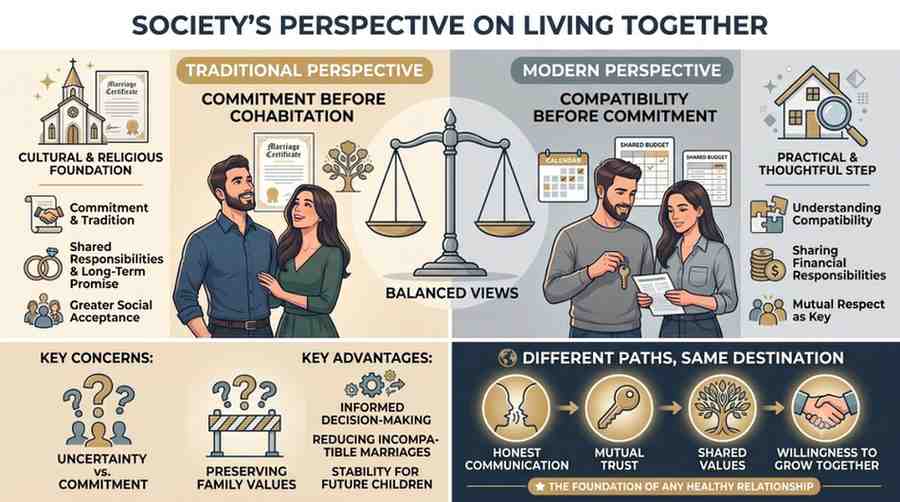
Infographic : How Society Views Living Together
–
Infographic: How Society Views Living Together
How Society Views Living Together
Two Perspectives, One Goal: Building a Meaningful Relationship
| 👨👩👧👦 Traditional Perspective | 🏙️ Modern Perspective |
| 💍 Marriage FirstCommitment begins after marriage. | 🏡 Compatibility FirstUnderstand each other before marriage. |
| ❤️ Commitment Through VowsMarriage symbolizes lifelong dedication. | 🤝 Commitment Through ExperienceShared experiences build trust and confidence. |
| 👪 Family ApprovalFamily values and traditions play an important role. | 🙋 Personal ChoiceIndividuals decide what works best for their relationship. |
| 🛡️ StabilityMarriage is seen as providing long-term security. | 🌱 FlexibilityRelationships evolve naturally before lifelong decisions. |
| 🏛️ Cultural & Religious ValuesLong-standing customs guide relationship choices. | 🕊️ Individual FreedomPersonal happiness and compatibility take priority. |
–
❤️ The Common Ground
❤️ Healthy Relationships Grow From
🤝 Mutual Respect
                │
        💬 Honest Communication
                │
         🎯 Shared Expectations
                │
          🌱 Trust & Understanding
Bottom Line
Whether a couple decide to cohabit before or after marriage, good relationships are based on trust, respect, and communication, rather than the living arrangements.
Whether a couple decide to cohabit before or after marriage, good relationships are based on trust, respect, and communication, rather than the living arrangements.
–
Pros and Cons of Living Together
Living together can be one of the most delightful experiences in a relationship, as well as one of the most challenging ones. On the one hand, sharing a home is a great way to experience life with your partner and create new memories. On the other hand, there are responsibilities that come with living together that may not be as easy to handle.
Like any major choice in a relationship, living together has its perks and downsides. It is important to consider both to make the best possible decision that is not clouded by emotions and preconceptions.
–
Advantages of Living Together
🏡 Better Understanding of Each Other’s Habits
While dating someone shows you their best qualities, living together displays their true nature
You come to understand how they act in different situations, how they handle responsibilities, and their financial habits. You are able to see their likes and dislikes more clearly, as well as how they react when the two of you are in conflict. In addition, you get to know their habits, whether it be leaving dishes in the sink or enjoying morning coffee in bed.
Each person’s habits are likely to become a part of your own, and so knowing them is essential in understanding how compatible you are with that person.
Shared Financial Responsibilities
Living together can be beneficial for a couple since it can alleviate financial stress.
Sharing the expenses of rent, utilities, groceries, internet, and other expenditures can make them more manageable, especially in a place where everything seems to be expensive.
In addition, couples can learn to budget and control their expenditures.
However, it is important to note that being financially transparent is crucial to avoid future complications.
Therefore, partners should have open communication about money matters and their financial goals.
Stronger Emotional Bonding
Sharing a home can provide many opportunities for creating bonds.
It can be more than just birthdays and anniversaries. It can be making breakfast for each other on a hectic morning. It can be comforting each other through rough days. It can be laughing at the burnt food that one has made. It can be enjoying peaceful evenings without having to say a word.
These moments can be the most treasured of all.
In time, working through the little challenges can create a sense of togetherness that can help build a strong, stable relationship.
An Opportunity to Test Long-Term Compatibility
Living together gives couples a taste of what it would be like to be together forever.
They both have to learn how to deal with eachother and everything that comes with that.
Having to work together on everyday tasks, pay bills, deal with arguments, having your own space, and making decisions together.
It can help a couple realize if they are really compatible for marriage or being together forever.
Although couples can’t always be perfectly compatible, they can work things out to make it easier for the future.
Improved Communication Through Daily Interaction
Living together leads to an increased amount of communication between partners.
Whether it be discussing what to buy at the grocery store or what to do on the weekends, couples have many opportunities to communicate throughout the day.
Additionally, disagreements may occur between partners and require effective communication in order to come to a peaceful resolution.
As a result, many couples who live together are better communicators, as well as better problem-solvers, and are more in tune with their partner’s emotional needs than they would be otherwise.
–
Challenges of Living Together
While living together offers many benefits, it also brings challenges that couples should acknowledge honestly rather than overlook.
Unclear Expectations When Commitment Isn’t Discussed
One of the biggest challenges is that partners assume that each has the same expectations without talking it through.
For instance, one partner may think that moving in together is the next step towards marriage while the other is not yet considering marriage. By failing to communicate their different expectations, they may end up creating resentment in either party, eventually leading to disappointment. By communicating openly, partners can avoid such misunderstandings and work towards building a future together.
Family and Social Pressure
In many cultures, dating before marriage is taboo.
Couples are often subjected to unwanted questions from friends or family, pressured by their parents, or even shunned by their community, all of which can place a strain on any relationship in addition to the natural challenges couples already face. Learning to compromise and understand each other in addition to understanding family dynamics is vital.
Financial Complications if the Relationship Ends
Sharing a home also means sharing the financial burden.
In the event that the relationship ends, disputes over the lease agreement, security deposit, furnishings, or even the pet can cause heartache and hard feelings.
Practical discussions can be uncomfortable, but they are necessary to avoid such painful situations in the future.
Emotional Attachment Without Shared Long-Term Goal
however,
if one is focused on building a future and the other is not willing to discuss commitment, then the attachment can be lopsided
The relationship can be comfortable due to both living together and spending time together, but one cannot deny that there is an underlying question of the future. Without future plans, happiness might not be lasting.
Staying Together Out of Convenience Rather Than Commitment
Sometimes couples stay together because it seems too hard to break up.
They have been living in the same house for a while, split the chores, got used to each other’s habits. It would be a hassle to find a new place to live, split the things they bought together, and adjust to the single life.
So staying together seems easier.
But that is not a good enough reason to stay in a relationship.
A relationship should be continued if and only if both people choose to be together. Not because it would be too much trouble to move out.
The Bottom Line
Living together is not necessarily a sign of a relationship’s success or failure.
It could lead to marriage and a long life of happiness for some couples, while for others, it could serve as an exercise to discover that they are not compatible for the long-term.
The experience itself is not the determining factor of a relationship’s fate. That responsibility lies in the hands of the partners and their ability to compromise, communicate, and grow together.
A strong relationship is built upon honesty and open-mindedness, while a weak one, built upon assumptions, only exposes the weaknesses between two people.
A shared home is a place that can showcase the compatibility between two people, but it cannot create it where there is none. Before moving in together or continuing to live together, ask yourselves this one simple question:
Are we living together because we want to build something together, or because it feels good right now?
The answer will tell you everything you need to know about the relationship.
–
“Love does not consist in gazing at each other, but in looking outward together in the same direction.”
— Antoine de Saint-Exupéry
Why include it?
This quote reinforces that a lasting relationship is defined by shared purpose and commitment—not simply by living under the same roof.
–
Signs You’re Living Together but Still in a Situationship
Living together often gives the illusion that everything is perfect in a relationship. You have a common address, split bills, celebrate holidays, and even introduce each other as a couple. Everything seems to be going smoothly on the outside.
However, there is often an underlying question that needs to be asked:
“What exactly are we building together?”
A relationship should be based on transparency, dedication, and commitment to each other and the future. If these values are not established, cohabiting can be an ambiguous act that hides insecurities and delusions.
While one partner thinks they are building a life together, the other is content with the status quo and does not want to make any commitments. It is essential to ask yourself the following questions if you suspect that something is wrong.
Living together is not necessarily wrong or a bad idea, but it can be a reflection of problems within the relationship itself. If you and your partner have been together for a while, it is natural to want to take the next step in your relationship.
However, if you feel that you are not on the same page, it is essential to have an honest conversation about your future together.
✅ Checklist: Are You Living Together but Still in a Situationship?
☐ You Avoid Defining the Relationship
Months—or even years—have passed, yet neither of you has clearly discussed what the relationship means. Conversations about labels are quickly changed, laughed off, or postponed indefinitely.
☐ Future Plans Are Always Vague
Whenever topics like marriage, buying a home, children, or long-term goals come up, the conversation becomes uncomfortable or ends with responses such as:
- “Let’s see what happens.”
- “Why plan so far ahead?”
- “We’re happy right now.”
Enjoying the present is healthy, but avoiding every discussion about the future often signals uncertainty.
☐ Commitment Conversations Make One Partner Uncomfortable
Whenever you ask questions like:
- “Are we exclusive?”
- “Where do you see us in a few years?”
- “What are we working toward?”
one partner changes the subject, becomes defensive, or says the conversation feels unnecessary.
Healthy relationships may have difficult conversations, but they don’t avoid them forever.
☐ You’re Introduced Differently in Different Situations
Sometimes you’re introduced as a boyfriend, girlfriend, or partner.
Other times you’re simply described as:
- “A friend.”
- “Someone I live with.”
- “My roommate.”
If the description changes depending on the audience, it may indicate uncertainty about the relationship itself.
☐ Family and Friends Don’t Know Your Real Relationship Status
Despite living together, your families may know little about your plans for the future.
Perhaps you and your partner have never talked marriage, have never been to each other’s family functions, or your partner just doesn’t introduce you as a big part of his/her life.
While this may not be an indication of an unhealthy relationship, it may show that your partner is reluctant to commit.
☐ Most Decisions Focus Only on the Present
You plan vacations, dinners, and weekends together.
But conversations rarely extend beyond the next few weeks.
Questions about career moves, relocating, marriage, or shared financial goals remain unanswered because neither partner wants to discuss them.
☐ One Partner Gives More Than the Other
Perhaps one person invests emotionally, imagines a shared future, and makes sacrifices for the relationship, while the other enjoys the benefits of living together without offering the same level of commitment.
When emotional investment becomes one-sided, disappointment often follows.
Healthy relationships thrive on mutual effort—not uncertainty.
☐ You Stay Together Mainly Because It’s Comfortable
Ask yourself honestly:
If you weren’t living together, would this relationship still continue exactly as it is?
Sometimes shared rent, familiar routines, convenience, or fear of change quietly become the reasons people stay together.
Comfort can keep people in the same house, but it cannot replace genuine commitment.
–
Warning Signs at a Glance
| ✅ Healthy Relationship | 🚩 Possible Situationship |
| You openly discuss your future together. | Future conversations are avoided. |
| Both partners agree on the relationship status. | The relationship remains undefined. |
| Commitment is expressed through words and actions. | One partner avoids labels or commitment. |
| Important decisions are made together. | Decisions focus only on the present. |
| Both invest equally in the relationship. | Emotional investment feels one-sided. |
Quick Self-Reflection
Rather than asking,
“Do we live together?”
ask yourself these questions:
- Do we both want the same future?
- Have we clearly defined our relationship?
- Do I feel emotionally secure rather than constantly uncertain?
- Can we talk openly about commitment without fear or avoidance?
- Are our actions matching our words?
If your answers raise more questions than confidence, the issue may not be your living arrangement—it may be the lack of clarity in your relationship.
Quick Insight
Sharing a home can make us feel committed to each other but true commitment happens when we are willing to have an open conversation about it. If you are always wondering where you truly stand, rather than knowing in your heart that you have something real and lasting together, it’s important that you understand why.
Keep in mind that the most successful relationships are between people who ask questions and answer them.
–
Green Flags vs Red Flags: Is Your Relationship Moving Forward or Standing Still?
Every relationship has its ups and downs. Some couples experience occasional disagreements, differences of opinion, or even arguments. Regardless of what happens, it’s essential that both people find a way to work through their issues.
You see, when you start living together, it can sometimes be hard to tell if you and your partner are growing as a couple – or just settling into a comfortable rut.
That’s why you shouldn’t take things like shared meals and sleeping arrangements for granted. Here’s how to tell if you and your partner are in a healthy relationship – or if you’re just in a situationship.
Situationships happen because of unanswered questions. Healthy relationships happen because of trust, communication, and commitment. Here are some helpful hints to point you in the right direction.
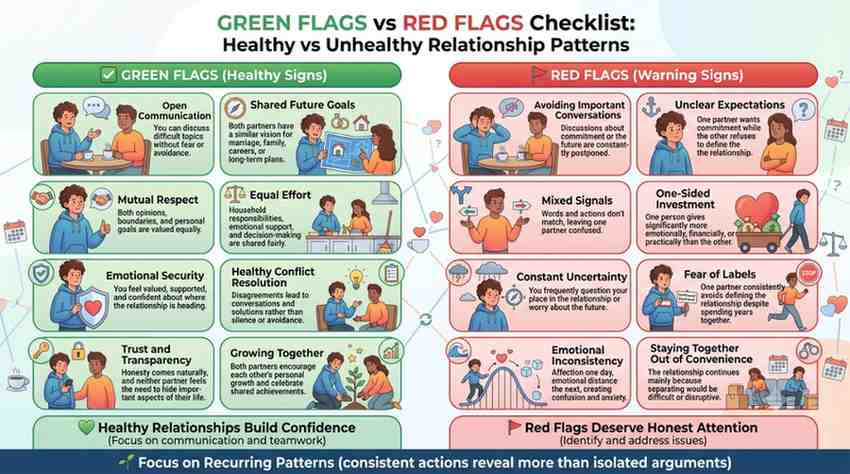
🚦 Green Flags vs Red Flags
| ✅ Green Flags (Healthy Signs) | 🚩 Red Flags (Warning Signs) |
| Open Communication – You can discuss difficult topics without fear or avoidance. | Avoiding Important Conversations – Discussions about commitment or the future are constantly postponed. |
| Shared Future Goals – Both partners have a similar vision for marriage, family, careers, or long-term plans. | Unclear Expectations – One partner wants commitment while the other refuses to define the relationship. |
| Mutual Respect – Both opinions, boundaries, and personal goals are valued equally. | Mixed Signals – Words and actions don’t match, leaving one partner confused. |
| Equal Effort – Household responsibilities, emotional support, and decision-making are shared fairly. | One-Sided Investment – One person gives significantly more emotionally, financially, or practically than the other. |
| Emotional Security – You feel valued, supported, and confident about where the relationship is heading. | Constant Uncertainty – You frequently question your place in the relationship or worry about the future. |
| Healthy Conflict Resolution – Disagreements lead to conversations and solutions rather than silence or avoidance. | Fear of Labels – One partner consistently avoids defining the relationship despite spending years together. |
| Trust and Transparency – Honesty comes naturally, and neither partner feels the need to hide important aspects of their life. | Emotional Inconsistency – Affection one day, emotional distance the next, creating confusion and anxiety. |
| Growing Together – Both partners encourage each other’s personal growth and celebrate shared achievements. | Staying Together Out of Convenience – The relationship continues mainly because separating would be difficult or disruptive. |
Healthy Relationships Build Confidence
Green flags don’t necessarily indicate that your relationship is perfect. After all, every couple experiences some conflicts, stressful events, and inevitable downs. What makes them different is that healthy relationships involve mutual support, open and honest communication, and cooperation.
By communicating with each other and prioritizing your efforts to solve problems together, you allow your relationship to flourish and thrive. And by being truthful, you lay the foundation of trust, which will withstand any challenges and serve as a pillar of your relationship. So, by choosing cooperation over keeping secrets, you give your relationship a future.
Red Flags Deserve Honest Attention
Red flags should not be seen as an ultimatum for the end of the relationship. Instead, they should be a reminder that something is pressing on the minds of one or both partners, and it’s important to address it sooner rather than later.
Avoiding the subject of commitment is not necessarily a red flag on its own, however, it is something that one partner may think about in light of both of their current and future life paths, career, potential relationship roadblocks, financial problems, and personal issues.
The main issue is not the fact that the hesitation is there, but the fact that it is chosen over direct and honest communication.
Ignoring the red flags will not make them disappear, and both partners should have the chance to openly discuss their concerns and agree on a shared path.
Focus on Patterns, Not Isolated Moments
Every relationship has its ups and downs. There are moments when everything seems to go wrong. Instead of thinking about your relationship in terms of one conversation or one fight, think about patterns. Think about the things that happen over and over again. Ask yourself questions like these:
Are we communicating well?
Are we holding up our end of the bargain?
Are we growing together or just staying together?
Do I feel safe?
Are we both in this relationship?
These questions can be more revealing than any conversation you have about your relationship.
Quick Insight
Green flags create clarity
Red flags create confusion
A healthy relationship should leave you both feeling prepared to weather any storm. If doubt has become your default setting, it’s time to replace it with something more reliable
After all, the most successful relationships are built on a foundation of two people who are willing to put in the work
not
two people who have somehow managed to avoid every potential complication
Think about it.
–
Infographic: Are You in a Situationship?
A Simple Decision Tree to Understand Your Relationship
                         ❤️ START HERE
                   Are you living together?
                              │
                 ┌────────────┴────────────┐
                 │                         │
               YES                        NO
                 │                         │
                 ▼                         ▼
      Have you clearly discussed      Have you clearly
         your relationship?       discussed your relationship?
                 │                         │
        ┌────────┴────────┐        ┌──────┴──────┐
        │                 │        │             │
       YES               NO       YES           NO
        │                 │        │             │
        ▼                 ▼        ▼             ▼
 Do both of you     Are there     Do both of    Are there
share the same      mixed         you share     mixed
future goals?       signals?      future goals? signals?
        │                 │        │             │
   ┌────┴────┐       ┌────┴────┐   ┌────┴────┐   ┌────┴────┐
   │         │       │         │   │         │   │         │
  YES       NO      YES       NO  YES       NO  YES       NO
   │         │       │         │   │         │   │         │
   ▼         ▼       ▼         ▼   ▼         ▼   ▼         ▼
✅ Healthy  ⚠️ Time  🚩 Possible  🤔 Talk   ✅ Healthy  ⚠️ Time 🚩 Possible 🤔 Talk
Relationship to Talk Situationship Honestly Relationship to Talk Situationship Honestly
Understanding Your Result
You and your partner have talked it over, you both know your goals and where each person is headed in life. It might not be perfect but you and your partner are both on the same page in your relationship and trust in one another.
Healthy Relationship
You and your partner have talked it over, you both know your goals and where each person is headed in life. It might not be perfect but you and your partner are both on the same page in your relationship and trust in one another.
Time for an Honest Conversation
Not all unanswered questions are situationships. Some couples just haven’t had the time or the guts to discuss certain things. So if your expectations aren’t getting met, it’s time to have an honest and open dialogue.
Possible Situationship
If your relationship lacks commitment, your future plans are always postponed, and you’re receiving mixed signals, it might be a situationship. The best course of action is to communicate openly and honestly.
Remember
Living together isn’t the determining factor. Clarity is.
Two people can live together, sharing a home, yet still have a healthy, committed relationship
Two people could also live together and be indecisive about their future with one another
What sets the two scenarios apart isn’t the shared space, but rather the level of openness and honesty about expectations, commitment, and future goals.
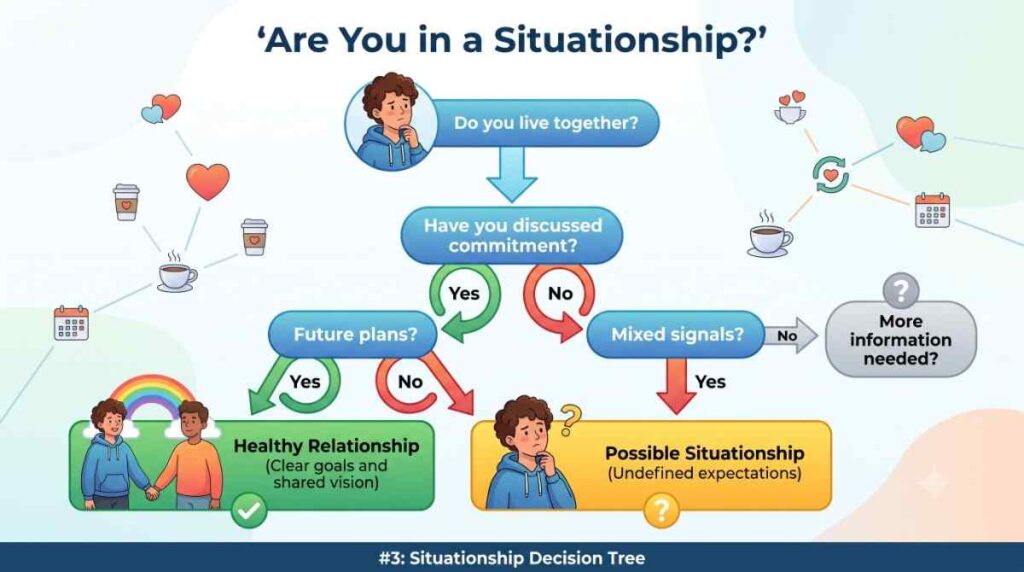
Note: A relationship isn’t defined by sharing a home—it’s defined by sharing clarity, commitment, and a common future.
This infographic gives an immediate self-assessment without oversimplifying the issue. It also reinforces the article’s central message: living together is a lifestyle choice, while a healthy relationship is built on communication, trust, and mutual commitment.
–
Link Basket
Pil Romantic Stories Love Proposal
Slow burn- Authentic Vs Synthetic love
–
Frequently Asked Questions
Is living together the same as dating-
No.
Can roommates become a situationship?
Yes.
Can a situationship survive living together?
Sometimes, but unclear expectations often create emotional stress.
Is living together before marriage a relationship?
Usually yes—but not always.
Can living together become a committed relationship?
Absolutely, if both partners communicate openly and agree on shared expectations.
–
Takeaway
A shared home doesn’t dictate your relationship; your commitment to one another does. If you know where you stand and where you are headed, then that’s a healthy relationship. But if you are clueless, it’s about time you had an awkward heart-to-heart.
End
–

0 Comments