
By: Ranjan Sarkhell
–
Table of Contents
–
Opening Quote
“I could easily forgive his pride, if he had not mortified mine.”
— Elizabeth Bennet, in Pride and Prejudice by Jane Austen
( This one’s a strong fit — Austen basically wrote the original enemies-to-lovers template with Elizabeth and Darcy, and this line captures exactly the wounded pride that fuels ahead Claire and James’s rivalry too.)
–
Key Takeaways: The Enemies to Lovers Trope
- What it is — Two characters start out as rivals or adversaries and slowly fall in love.
- The real source of tension — The conflict isn’t random; it usually masks unspoken attraction, respect, or old wounds.
- Why readers love it — The bigger the initial hostility, the more satisfying the eventual surrender feels.
- Common variations — Rivals to lovers, haters to lovers, forced proximity, and slow burn are all flavors of the same core idea.
- What makes it believable — A real reason for the conflict, gradual shifts, and honest moments of vulnerability.
- The role of banter — Sharp dialogue does double duty — it’s conflict and flirtation at once.
- Why they can’t just walk away — Proximity or stakes keep them orbiting each other long enough to fall.
- Where it shows up — Standalone novels, multi-book series, and serialized Wattpad-style fiction, each at a different pace.
–
Introduction:
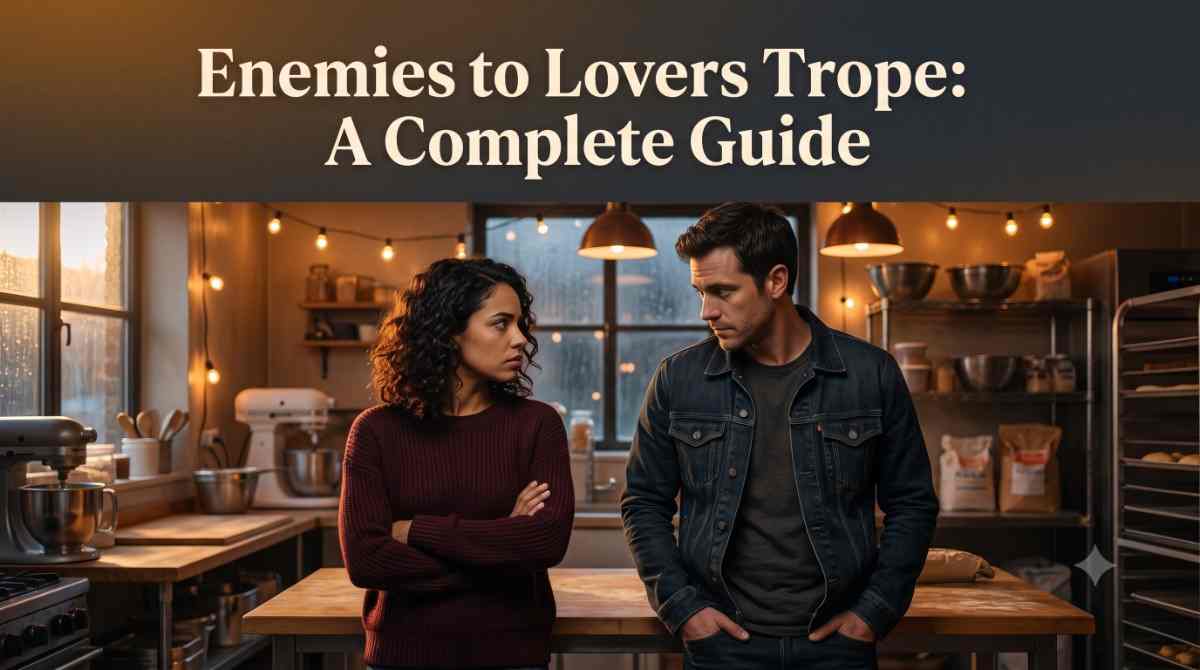
Claire Whitmore’s orders to herself when she inherited the family bakery were simple: never let James Calloway anywhere near her kitchen again.
The man had humiliated her in front of half the county at last year’s bake-off, and now, thanks to a will neither of them signed, they owned the same bakery together.
Neither was happy about it. Neither was backing down.
If you’ve ever picked up a romance where the two leads spend the first half of the book unable to stand each other, only to end up together by the last page, you already know why this trope works so well.
This guide walks through what it actually is, why readers can’t get enough of it, and what separates the stories that stay with you from the ones that don’t.
Few tropes in romance fiction spark as much devotion as enemies to lovers. It’s the slow, satisfying unraveling of two people who swore they’d never fall for each other — and somehow do anyway.
Whether the conflict comes from competition, an old grudge, or two personalities that simply clash on sight, the promise is always the same: the deeper the hatred starts, the sweeter the fall feels by the end.
–
What Is the Enemies to Lovers Trope?
At its heart, this is a story where two characters begin as adversaries and, over time, fall for each other.
Claire and James are a textbook case.
They’re rivals forced into an impossible partnership. But their setup is just one version of how this trope can start — the hostility could come from almost anywhere:
- Competing for the same job, prize, or relationship
- Standing on opposite sides of a conflict, war, or family feud
- A past betrayal neither one has forgiven
- Simply clashing personalities that spark friction every time they’re in a room together
What makes the trope work isn’t the hatred itself — it’s what’s hiding underneath it.
There’s usually a note of respect, attraction, or something unresolved that the characters aren’t ready to admit. Claire tells herself she can’t stand James.
She’s not wrong — he’s rude, self-centered, and made her look foolish in front of half the county. What she’s less honest about is why she notices everything he does.
–
Why Are These Stories So Popular?
The enemies to lovers trope shows up again and again in romance fiction, and it’s not hard to see why.
Any kind of conflict between two leads creates drama, and drama is what pulls a reader forward — it’s one of the main sources of appeal in a romance novel to begin with.
There’s also something deeply satisfying about watching two people who genuinely cannot stand each other slowly arrive at a mutual understanding of their feelings.
The bigger the initial hostility, the more rewarding it feels when it finally gives way.
Most enemies-to-lovers stories lean heavily on banter and dynamic conversation between the two leads.
The way they talk to each other becomes an important part of the story in itself — it reflects what’s really going on underneath, and gives the romance a sharper, more electric edge than it would have otherwise.
And because these characters start out guarded, they tend to carry real emotional barriers that have to come down before either one can admit what they’re feeling.
That’s a big part of why the trope lands so well emotionally — we love watching people get past their own pride and admit, finally, that they were wrong about each other.
–
Types of Enemies to Lovers
There are several common types of enemies-to-lovers stories, namely:
1. Rivals to lovers
2. Haters to lovers
3. Forced proximity + enemies
4. Slow burn enemies to lovers
In each case, the story focuses on the protagonists’ relationship evolving from initial feelings of animosity towards mutual love.
1. Rivals to lovers: Sophie Bennett and Daniel Cross spend their lives trying to one-up each other. It all changes when they both apply for the same junior lawyer position at the prestigious Cross & Whitmore law firm.
2. Haters to lovers: After her free-spirited roommate moves in with her, Lila Adams realizes she can’t stand everything about the girl – and not just the way she throws wild themed parties without asking.
3. Forced proximity + enemies: Claire Whitmore and James Calloway have one goal – to make the best bakery in the county. However, there are two problems with this plan: 1) They are enemies 2) They now co-own the bakery.
4. Slow burn enemies to lovers: In a span of three years, James Calloway and Claire Whitmore went from being bitter enemies to living together as a couple.
Each story is a variant of the same romance trope, utilizing different tools to get to the same place: the protagonists fall in love with each other despite (or because of) their initial feelings of hatred or rivalry.
| Variation | What It Means | Example |
| Rivals to Lovers | Competition-driven tension | Two junior lawyers, Sophie Bennett and Daniel Cross, gunning for the same partnership at their firm |
| Haters to Lovers | Dislike rooted in personality clashes rather than direct conflict | A free-spirited artist and her painfully rigid new roommate who can’t stand each other’s habits before they can admit anything else |
| Forced Proximity + Enemies | Enemies stuck working or living together | Claire and James, trapped as co-owners of one small-town bakery |
| Slow Burn Enemies to Lovers | The hostility-to-love arc stretched out over a long, simmering build | Sometimes plays out across an entire book series rather than a single story |
–
What Makes These Stories Actually Work
Not every “they hated each other, then fell in love” story lands the same way. The ones readers remember tend to share a few common elements — and Claire and James’s bakery standoff hits every one of them.
It starts with a believable reason for the initial hatred or rivalry. Claire and James knew each other from the local county bake-offs, where they’d competed against each other for years — their feud was a rivalry that had simply curdled over time.
It could’ve been any number of inciting incidents, really, so long as it gave their animosity real weight instead of feeling like a flimsy excuse to throw two people together.
From there, the protagonists have to grow fond of each other gradually. Claire and James didn’t wake up one morning and realize they liked each other — it was slower than that.
It began with small things: James fixing the walk-in fridge without being asked, remembering exactly how Claire takes her coffee.
Little proof, stacked up over time, that he wasn’t quite who she’d decided he was.
Somewhere in the middle of the story, there has to be a real moment of vulnerability — a point where the protagonists admit to themselves, and sometimes to each other, that their feelings aren’t as negative as they’ve claimed.
Around chapter twelve, James finally tells Claire the truth: the bake-off humiliation was never really about her. His father had been in that crowd, and James had been trying, and failing, to win the man’s approval.
That’s the crack in the armor. That’s the moment Claire — and the reader — starts seeing him differently.
Banter carries a lot of the weight, too. Claire and James use it the way most enemies-to-lovers couples do — as a way of masking what they actually feel, even as every exchange quietly gives them away.
And finally, the protagonists need a reason to stay in each other’s orbit that isn’t simply “because the plot needs them to.” Claire could’ve sold her half of the bakery and walked away from James entirely. She didn’t.
Their shared stake in something bigger than their pride is ultimately what made their story worth telling.
–
Enemies to Lovers in Books, Series, and Wattpad
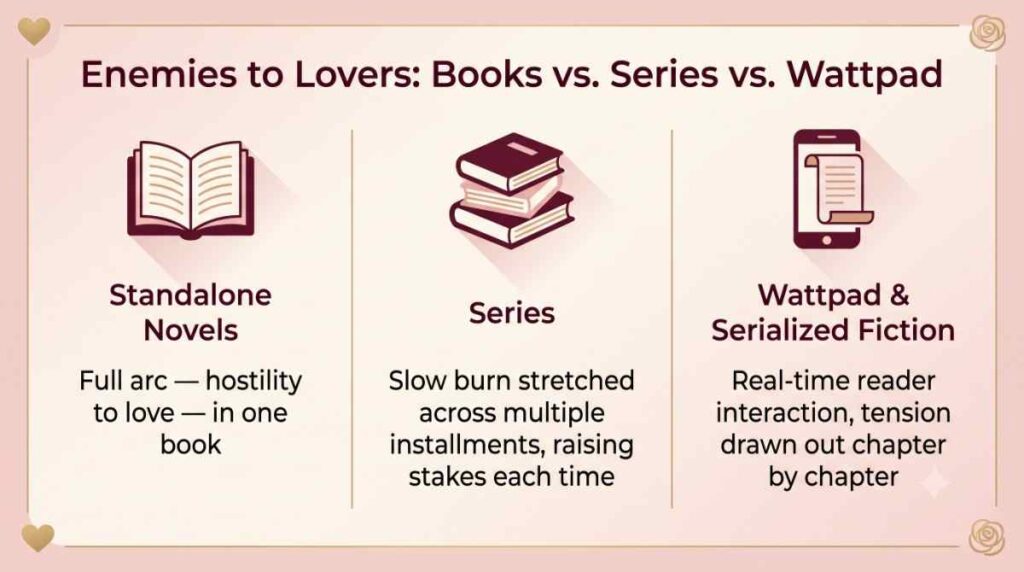
This trope shows up everywhere — full-length novels, ongoing Wattpad serials, and multi-book series that stretch the tension across an entire arc. Each format paces it a little differently:
- Standalone novels usually move through the whole arc, hostility to love, in one book.
- Series stretch the slow burn across several installments, raising the stakes each time.
- Wattpad and serialized fiction often lean into real-time reader reaction, drawing the tension out chapter by chapter.
–
Ready to See Real Enemies to Lovers Stories in Action?
Reading about the trope is one thing. Watching it unfold is another. If you want to see enemies to lovers done right, dive into our full collection of stories where rivalries turn into something neither character saw coming.
[Explore Our Enemies to Lovers Story Collection →] STAR WOWEN HEART
–
Closing Quote
“Love recognizes no barriers. It jumps hurdles, leaps fences, penetrates walls to arrive at its destination full of hope.”
— Maya Angelou
–
Looking for more romance trope guides? This post is part of our larger series on romance tropes — check back soon for more.
–
Link
Romantic Stories: UltimateGuide
Best Enemies to Lovers Romance BooksNext
Frequently Asked Questions
What trope is Enemies to Lovers?
It’s a romance trope where two characters start out as rivals or adversaries and slowly fall in love over the course of the story. Think Claire and James — bitter bakery rivals who end up co-owning the place, and eventually, each other’s hearts.
What does the “enemies to lovers” trope mean?
It means the romance begins in conflict rather than attraction. The two leads dislike, compete with, or actively oppose each other at the start, and the story’s arc is built around watching that hostility slowly give way to love.
What do you call enemies to lovers?
Depending on the flavor, it goes by a few names — rivals to lovers, haters to lovers, or forced proximity romance. They’re all close cousins of the same trope, just with slightly different reasons for the initial friction.
Why is the enemies to lovers trope so good?
Because the tension does double duty. Every argument, every sharp bit of banter, carries an undercurrent of attraction neither character is ready to admit — and watching that finally break is one of the most satisfying payoffs in romance fiction.
Why do enemies turn into lovers?
Usually because the hatred was never quite what it looked like. Underneath the conflict, there’s often respect, curiosity, or an attraction the characters have been actively denying — and enough time in each other’s orbit eventually wears that denial down.
Are enemies to lovers and rivals to lovers the same?
They’re closely related, but not identical. Rivals to lovers is usually rooted in competition — for a job, a prize, a title. Enemies to lovers can stem from that, but also from grudges, betrayals, or plain personality clashes that have nothing to do with rivalry.
Is enemies to lovers a genre?
Not quite — it’s a trope, not a genre. You’ll find it inside contemporary romance, fantasy, historical fiction, and more. The genre is the world the story lives in; the trope is the relationship dynamic driving it.
–

0 Comments