
BY: Ranjan Sarkhell
The characters below are illustrative composites, not real cases.This article is for general information, not legal advice. Laws and penalties change, so consult a qualified immigration or criminal defense attorney.
–
Table of Contents
–
Opening Quote
“Oh, what a tangled web we weave, when first we practice to deceive!”
Sir Walter Scott, Marmion (1808)
Quote reflects the human tendency to believe one small lie will stay small. It matches Rohan and Elena’s story, where a rehearsed account unravelled the moment an officer asked an unexpected question. This line is often wrongly credited to Shakespeare, so keep the Scott attribution.
–
Introduction
Picture a quiet Tuesday morning. Maya and her husband Daniel sit in a government waiting room with a folder of wedding photos, joint bank statements and a lease.
Their marriage is real, but their hands are still slightly damp.
Two officers call them into separate rooms and ask the same simple questions: Which side of the bed do you sleep on?
Who cooks dinner?
What did you do on your last birthday?
Where did you spend your first anniversary?
When the answers match, the couple goes home with a stamped form and a sense of relief.
When they don’t, an ordinary appointment can quietly become a criminal investigation. This is how many couples find themselves caught in a fake marriage case.
Sometimes the marriage really was a sham, and sometimes it was a genuine love story with thin paperwork and a bad interview day.
The stakes are high on both sides.
Some people are accused of marriage fraud and must prove their relationship is real. Others are neighbors, ex-partners or relatives who suspect a sham marriage and are unsure whether to speak up, what counts as evidence, and where a report should go.
Behind every case sit real people: an immigrant hoping to build a future, a citizen who may face prison, and sometimes a spouse who was deceived from the start.
This post explains how these situations unfold through simple stories, what the law says, what penalties are possible, and what to do if you are on either side of it.
Caught in Fake Marriage
“People caught in a fake marriage rarely fall to one big lie. They fall to a hundred small details they forgot to rehearse.”
Most people who end up caught in fake marriage cases are not exposed by a dramatic tip-off.
They are exposed by small inconsistencies that pile up until an officer can no longer ignore them. Rohan is a good example.
He paid a friend, Elena, to marry him so he could stay in the country. On paper, everything looked fine: a marriage certificate, a rented flat in both names, a handful of photos taken on the same afternoon.
But in the interview, the two were separated and asked how they met. Rohan said it was a café in spring.
Elena said it was a party in winter. He described her apartment as having a blue couch, and she said it was grey.
Neither had ever met the other’s family, and neither could name the other’s closest friend.
None of these answers alone proved anything. Together, they told the officer that the story had been rehearsed rather than lived.
The case was sent for a deeper review, which meant a home visit, a check of phone records and bank accounts, and a second round of interviews.
The turning point came when the officer asked each of them to describe the morning routine at home.
Rohan said Elena left for work at eight. Elena said she worked nights.
The lesson is that officers rarely rely on a single dramatic clue.
They look for a pattern, and a rehearsed story almost always breaks down under ordinary, unexpected questions.
Real couples forget details too, of course.
But their memories overlap on the big things, their mistakes are small and honest, and they can point to years of shared life that quietly backs up what they say.
“Most people caught in fake marriage cases are not undone by one big lie, but by a hundred small details they never rehearsed.”
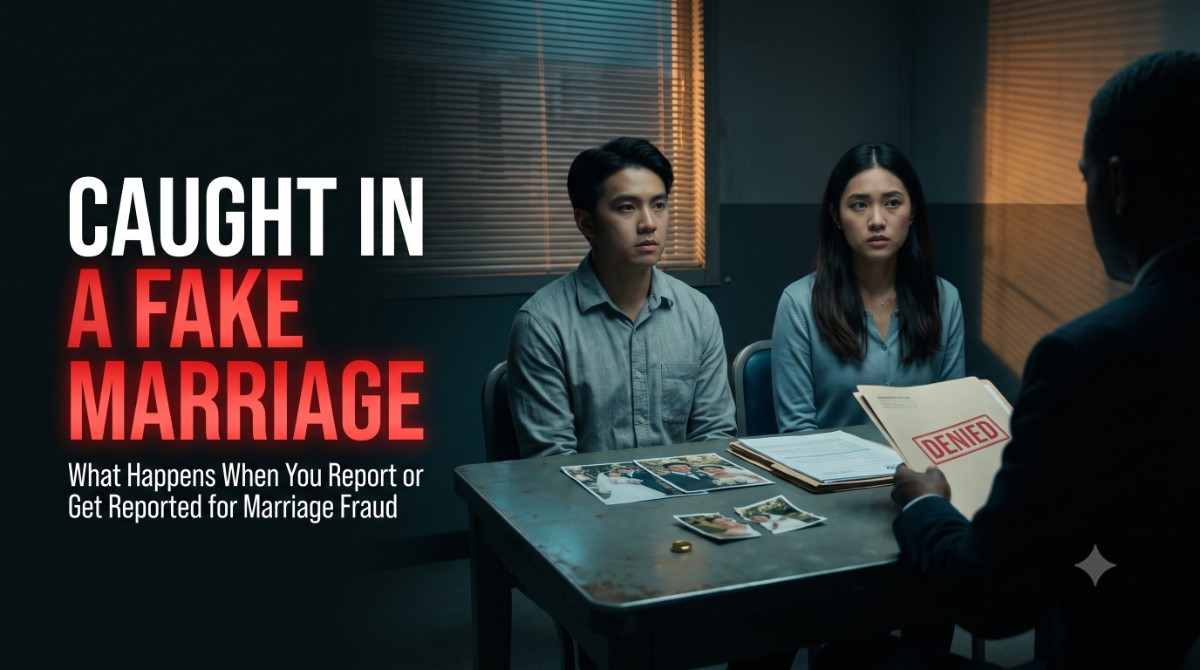
Caught in a Fake Marriage: What Happens When You Report (or Get Reported for) Marriage Fraud
Sham Marriage Immigration
Sham marriage immigration cases turn on one question: why did the couple marry?
The certificate and the ceremony are not the test.
A couple can hold a legal document, have a full wedding with guests and a cake, and still be judged a sham if the main purpose was a green card or residency rather than a shared life.
Think of Neha and Carlos. They married in a proper ceremony, and everything about the wedding was real.
But the two had agreed beforehand that Carlos, a citizen, would sponsor Neha, and that they would part ways once her papers came through.
Because that agreement existed, the marriage was a sham from the day it began, no matter how convincing the wedding looked.
Authorities call this the “intent at the time of marriage” question, and it is the heart of almost every case.
That is also why authorities do not treat a marriage as fake simply because it ended in divorce.
Plenty of genuine marriages fail, sometimes quickly. What they examine is what the couple intended when they said their vows, and whether they ever actually built a life together.
A divorce after a real attempt at marriage is very different from a divorce that follows immediately after the immigration benefit arrives.
“In sham marriage immigration cases, the wedding photos prove the ceremony. Only the years afterward prove the marriage.”
Caught in a Fake Marriage: What Happens When You Report (or Get Reported for) Marriage Fraud
Sham Marriage USA
A sham marriage USA case is a federal matter, and officers look closely at whether the couple lives together, shares money and knows each other’s daily routines.
They ask who pays the rent, whose name is on the utility bills, who has met whose parents, and what the couple does on an ordinary weekend.
These questions feel small, but together they paint a picture of whether two lives have truly merged.
Consider Hannah and Kofi, who live in different cities for work and see each other every second weekend.
Their arrangement is unusual, and an officer might raise an eyebrow at first.
But they can show years of flight bookings, daily messages, a joint savings account, and a lease they signed together for the city they plan to share.
Their marriage is unconventional, not fraudulent.
That distinction matters.
An unconventional but genuine marriage, such as a long-distance couple, a couple with a large age gap, or a pair from very different cultures, is not automatically suspect.
What matters is intent, and the evidence that supports it.
Couples in this position should keep records of their relationship as they go, because it is far easier to gather proof along the way than to reconstruct it years later under the pressure of an interview.
“A sham marriage USA officer is not counting your photos. They are counting your shared Tuesdays.”
Caught in a Fake Marriage: What Happens When You Report (or Get Reported for) Marriage Fraud
Marriage Fraud USCIS
Marriage fraud USCIS reviews begin the moment a marriage-based petition is filed. U.S. Citizenship and Immigration Services checks the paperwork, holds an in-person interview, and, for a two-year conditional green card, reviews the marriage again when the couple asks to remove the conditions.
Officers compare every document against the others, looking for stories that line up and for gaps that don’t.
Specialized fraud detection teams can step in at any stage, and a case that looked routine on day one can be reopened years later if new information appears.
Priya went through this. Married to a U.S. citizen named Marcus, she received a two-year conditional green card.
Life was busy: two jobs, a move, and a family illness. When the removal-of-conditions stage arrived, she realized she had never kept a tidy file.
Fortunately, the ordinary traces of a shared life were there. A joint tax return, a shared health insurance card, a lease with both names, and photos spanning two years all showed the marriage was real.
She spent one weekend organizing them by date, and the case went through without trouble.
Compare that with a couple who filed the same forms but had no joint bills, separate addresses and photos taken on a single afternoon.
Their paperwork was complete, but their lives did not overlap, and that is the gap officers look for.
The lesson for anyone in a genuine marriage is simple: build the paper trail as you live, not when the letter arrives.
A USCIS officer is not asking whether you love each other. The officer is asking whether your lives are shared and whether the evidence says so.
“Marriage fraud USCIS reviews never ask whether you love each other. They ask whether your lives are actually joined.”
Caught in a Fake Marriage: What Happens When You Report (or Get Reported for) Marriage Fraud
Proving a Sham Marriage
Proving a sham marriage usually depends on patterns, not one smoking gun.
No single mismatch decides a case, because real couples forget dates and disagree about small things too. Investigators build a picture from many small signals, and the picture either holds together or falls apart. They may notice:
- Interview answers that contradict each other on basic facts
- Separate addresses despite a claim of living together
- No joint lease, accounts or insurance
- Payments from one spouse to the other, especially around the wedding date
- Social media posts or neighbors’ statements that don’t fit the story
- One person repeatedly marrying foreign nationals
| What officers look at | Signs of a genuine marriage | Warning signs of a sham |
| Interview answers | Small mistakes, but big facts match | Identical, rehearsed answers or big contradictions |
| Home | Both people’s belongings, food for two | One spouse’s things missing, unused toothbrush |
| Money | Joint accounts, shared bills, tax returns | Payments from one spouse to the other |
| Family and friends | Each has met the other’s circle | Neither knows the other’s family or friends |
| Photos and messages | Spread over months or years | Taken on one day, or few messages |
| Timeline | Consistent story of how they met | Dates and places that shift |
Consider a building manager who told an officer that the “husband” in Unit 4B had never once been seen entering the flat, while the “wife” was there daily with a different man.
That one statement did not end the case, but it pushed the officer to check utility records, phone location data and social media, and the pieces began to fit a pattern of a marriage that existed only on paper.
Officers sometimes make unannounced home visits.
They notice whether both people’s clothes are in the wardrobe, whether the fridge holds food for two, and whether the toothbrushes are actually used.
Real marriages leave ordinary, overlapping traces: two toothbrushes, shared bills, years of messages.
Fake ones tend to leave staged evidence, and staged evidence is usually too neat.
“Proving a sham marriage takes patterns, and real couples leave patterns too: two toothbrushes, shared bills, years of messages.”
Caught in a Fake Marriage: What Happens When You Report (or Get Reported for) Marriage Fraud
Accused of Marriage Fraud
Being accused of marriage fraud does not mean you are guilty. Aisha and Tom married after a fast romance.
Because they had known each other only a few months and had a large age gap, an officer flagged their case for extra review.
They were truly in love, but their paperwork was thin, and the officer’s questions felt like an attack on the most personal part of their lives.
Tom said later that the worst part was being asked to prove something he had always thought needed no proof.
An accusation can come from a routine flag, an anonymous tip from a jealous ex-partner, or a mismatch at an interview. However it arrives, the first hours matter. If this happens to you:
- Respond to every notice and interview request. Ignoring a letter is treated as a lack of cooperation and can lead to denial on its own.
- Collect evidence of your real relationship: dated photos, travel records, messages, joint accounts and letters from friends and family who have seen your life together.
- Speak to an immigration attorney before answering detailed questions, especially if a criminal referral is possible.
- Never submit anything false. A modest but truthful case is far safer than a false statement, which is a separate offense.
Aisha and Tom did exactly this. They hired an attorney, gathered eighteen months of messages, hotel receipts from their honeymoon, and statements from both sets of parents.
They also wrote a simple timeline of how they met, when they moved in together, and what they planned. Their case was approved.
Being accused of marriage fraud is frightening, but a calm, honest and well-documented response is the strongest protection an innocent couple has.
“Being accused of marriage fraud feels like being asked to prove that the most personal part of your life is real.”
Caught in a Fake Marriage: What Happens When You Report (or Get Reported for) Marriage Fraud
Marriage Fraud Penalty
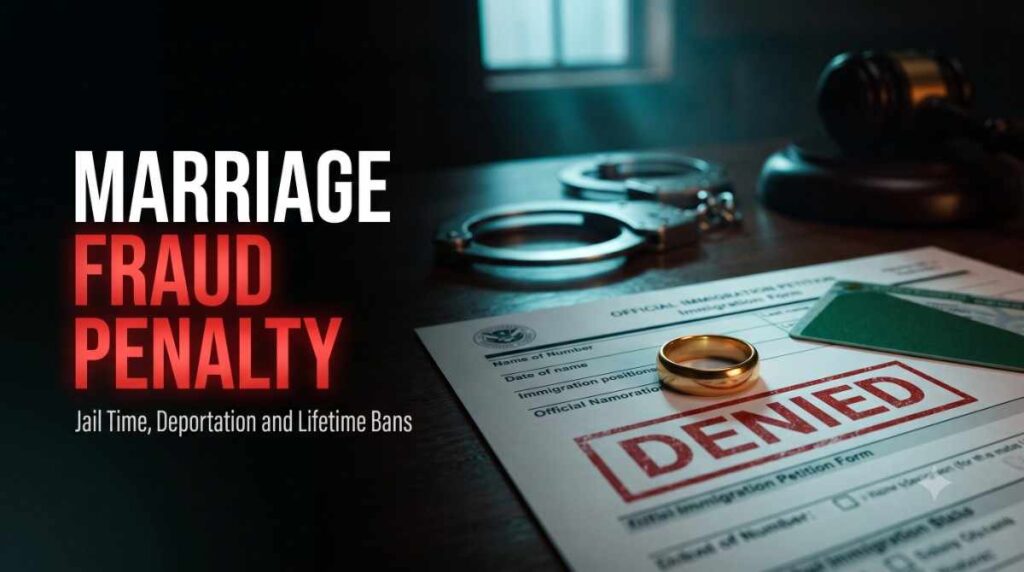
The marriage fraud penalty reaches far beyond a denied application.
The immigrant can face removal from the country and a lifetime bar on future family-based petitions, while the citizen or resident spouse can face criminal charges.
Even people who were never charged can find that a fraud finding in one file follows them into every later application, whether for a visa, a job, or citizenship.
Imagine Vikram, who was found to have entered a sham marriage a decade ago. He has since built a career, married someone he truly loves, and had two children.
When his new wife tried to sponsor him, the old finding surfaced, and the application was denied.
Nothing he had done since mattered, because the law treats a fraud finding as permanent. That is the part many people overlook when they call a fake marriage a “one-time favor.”
| Who is affected | Possible penalty |
| Immigrant spouse | Denial of the benefit, removal, lifetime bar on family-based petitions |
| Citizen or resident spouse | Criminal charges, fines, a fraud finding on record |
| Paid or “helper” spouse | Same criminal exposure as the immigrant, even without payment |
| Organizers or brokers | Harshest sentences, often conspiracy charges as well |
| Future applications | Fraud finding can block visas, sponsorship and citizenship |
“The marriage fraud penalty is rarely paid on the wedding day. It arrives years later, when a new life is already built.”
Caught in a Fake Marriage: What Happens When You Report (or Get Reported for) Marriage Fraud
Marriage Fraud Jail Time
Marriage fraud jail time can reach five years under U.S. federal law, along with a fine of up to $250,000.
Related crimes such as conspiracy or false statements on immigration forms can add charges and longer sentences.
People who organize fake marriages for profit, sometimes running networks that recruit paid spouses, are treated most harshly.
Take the case of a small ring that recruited several people to marry foreign nationals in exchange for cash.
When investigators unraveled it, both the organizers and the paid spouses faced charges, and some of the “spouses,” who thought they were doing a harmless favor, received prison sentences.
Anyone facing charges needs a criminal defense lawyer, not only an immigration one, because the immigration outcome and the criminal case can affect each other.
| Offense | Typical maximum under U.S. federal law |
| Marriage fraud to evade immigration law | Up to 5 years and a $250,000 fine |
| Conspiracy | Up to 5 years |
| False statements on immigration forms | Up to 5 years |
| Other document or visa fraud charges | Can be higher, depending on the offense |
“Marriage fraud jail time is the price of a favor that looked small and cost someone years.”
Caught in a Fake Marriage: What Happens When You Report (or Get Reported for) Marriage Fraud
Actual sentences vary by case, so check current law with a criminal defense lawyer.
Fake Marriage for the Sake of Legal
Some people believe a fake marriage for the sake of legal papers is harmless. Arjun’s cousin thought so.
He agreed to marry a friend to help her get residency, take no money, and divorce after a year.
He assumed good intentions made it acceptable, and he described it to his family as “a favor, like lending someone a car.”
The law disagrees. What makes a marriage fraudulent is the intent to get around immigration rules, whether or not money changes hands.
Both spouses can be prosecuted, including the citizen who was “just helping.”
When his friend’s case was reviewed, the couple’s answers fell apart under questioning, and Arjun’s cousin found himself facing questions he had no honest way to answer.
He had wanted to help a friend and instead put his own record and future at risk.
The uncomfortable truth is that generosity does not change the legal test.
If the purpose of the marriage is a legal benefit and not a shared life, it is a sham, no matter how kind the motive.
Anyone who is asked to marry a friend “just on paper” should treat the request as a serious legal risk, not a favor.
“A fake marriage for the sake of legal papers may feel like a favor, but the law only sees intent.”
Caught in a Fake Marriage: What Happens When You Report (or Get Reported for) Marriage Fraud
Getting Married for Business Purpose
Getting married for business purposes, such as to obtain a work permit or an easier route to registering a company, sits in the same risky territory.
Sofia, an entrepreneur, was tempted to marry a local partner to speed up her company registration.
A friend had told her that a local spouse would spare her months of paperwork and open doors to licenses and property. It sounded like a clever shortcut.
But authorities treat it as a sham when the couple never lives as spouses.
They can look at where each person sleeps, who pays the household bills, and whether the two spend any time together outside the business.
If the only shared thing is a company, the marriage looks like a contract in disguise.
Sofia’s adviser eventually talked her out of it, pointing out that a fraud finding would cost her far more than any delay in registering the company.
Real couples do build businesses together. The difference is order: the marriage is real first, and the business follows.
A couple who marry, share a home and later start a bakery are not committing fraud. A pair who marry only to unlock a business benefit and then live apart are, and the paperwork will not hide it.
“Getting married for business purpose turns a promise into a transaction, and the law treats transactions differently.”
Caught in a Fake Marriage: What Happens When You Report (or Get Reported for) Marriage Fraud
Green Card Marriage Horror Stories
Green card marriage horror stories are often about real marriages gone wrong, not fake ones.
Meera married a U.S. citizen in good faith and moved across the world for him. After she arrived, he began holding her status over her head.
He kept her passport, controlled her money, and warned that he would withdraw his sponsorship or report her to immigration if she ever complained.
Meera stayed silent for two years, believing she had no options.
In another case, a citizen named Daniel sponsors a spouse from abroad, pays for the flights, the fees and the first months of rent, and is abandoned the day the green card arrives.
He is left with heartbreak, financial obligations and the sense of having been used.
Immigration law offers some protection to people in Meera’s position, including a route for abused spouses to apply for status on their own without the abuser’s cooperation, and waivers that let a person remove conditions on a green card even after a marriage ends badly.
Most people only learn this after the damage is done.
If you are being threatened, the most important step is to speak to an immigration attorney or a reputable domestic violence organization, because leaving a bad marriage does not have to mean losing your right to stay.
“The worst green card marriage horror stories begin with real trust and end with a spouse holding status as leverage.”
Caught in a Fake Marriage: What Happens When You Report (or Get Reported for) Marriage Fraud
Immigration Fake Marriage Reporting
Immigration fake marriage reporting usually starts with a neighbor, ex-partner, coworker or relative.
Authorities take tips seriously but investigate before acting, and a tip alone is not proof.
Officers will treat a tip as a lead, then check records, interview the couple and look for evidence that either supports or contradicts the claim.
That is why motive matters. A tip from a worried landlord who noticed that one “spouse” never lives in the flat is very different from a tip sent by a bitter ex-partner who wants revenge.
Authorities are used to both, and they weigh them differently.
Anyone thinking of reporting should understand that the process is slow, that the outcome may never be shared with them, and that the people involved may be innocent.
| Country | Where to report | What to include |
| United States | USCIS online tip form or ICE tip line | Names, dates, addresses, short factual explanation |
| Canada | CBSA Border Watch line or IRCC | Names, addresses, what you personally observed |
“Immigration fake marriage reporting starts with a neighbor’s suspicion, but it only works when suspicion is backed by facts.”
Caught in a Fake Marriage: What Happens When You Report (or Get Reported for) Marriage Fraud
Reporting a Fake Marriage
If you are thinking about reporting a fake marriage, stick to what you have actually seen or know.
A quick wedding, an age gap or a cultural difference is not evidence. Consider Rina, who was certain her colleague’s marriage was fake because the couple had married after only three weeks. She had no other facts.
When she asked herself honestly why she wanted to report, she realized her suspicion came from jealousy about her colleague’s sudden good luck, not from anything she had witnessed.
She decided not to report, and later learned the couple had known each other for years before the wedding.
Ask yourself honestly whether you are acting on facts or on anger, because knowingly filing a false report can carry consequences for you.
A useful test is to write down what you personally saw, heard or know, separate from what you assume. If the list is empty, you probably do not have a report to make.
“Before reporting a fake marriage, ask yourself one honest question: what did I see, and what am I only assuming?”
Caught in a Fake Marriage: What Happens When You Report (or Get Reported for) Marriage Fraud
Reporting a Fake Marriage to Immigration
Reporting a fake marriage to immigration in the United States can be done through the USCIS online tip form or the ICE tip line.
Include names, dates, addresses and a short, factual explanation of why you believe the marriage is not genuine. Details such as where the couple lives, where each person works, and specific things you observed are far more useful than opinions.
You do not need to gather evidence by spying or confronting anyone, and you should never put yourself at risk.
In Canada, tips go to the Canada Border Services Agency (CBSA) through its Border Watch line, or to Immigration, Refugees and Citizenship Canada (IRCC).
Once submitted, you will usually not receive updates, because agencies do not share the progress of investigations with the public.
Check each agency’s official site for current contact details before you submit anything.
“Reporting a fake marriage to immigration is a serious step. Be sure of your facts, because someone’s whole future rests on them.”
Caught in a Fake Marriage: What Happens When You Report (or Get Reported for) Marriage Fraud
Marriage Frauds in India
Marriage frauds in India often look different from immigration cases.
Kavita married a groom who lived abroad. The families arranged the match quickly, the wedding was lavish, and the groom left for his job a week later, promising to send for her.
After the wedding he stopped answering her calls, and she later learned he was already married and had never intended to bring her abroad.
She was left with a broken marriage, financial losses, and a family that did not know where to turn.
Stories like this are common enough that they have their own name: abandoned brides of NRI marriages.
Other frauds involve hiding a previous marriage, misrepresenting a job or income, or demanding money after the wedding.
Indian law offers remedies, including criminal provisions on cheating and bigamy under the Bharatiya Nyaya Sanhita (which replaced the Indian Penal Code), domestic violence and dowry laws, and civil relief such as annulment or maintenance.
Register the marriage, keep copies of every document, save messages and passport details, and act quickly.
Cross-border cases are complex, so consult a family lawyer experienced in NRI matters, and consider approaching the nearest police station or women’s cell early, because delays make evidence harder to gather.
| Type of fraud | Possible legal route |
| Hiding an existing marriage | Bigamy provisions under the Bharatiya Nyaya Sanhita |
| Lying about job, income or status | Cheating provisions |
| Cruelty or harassment by husband or in-laws | Domestic violence and cruelty laws |
| Demand for money or gifts after the wedding | Dowry laws |
| Abandonment | Maintenance, annulment or divorce in civil court |
“Marriage frauds in India often begin with a lavish wedding and end with a silent phone.”
Caught in a Fake Marriage: What Happens When You Report (or Get Reported for) Marriage Fraud
Canadian Anti Fraud Centre
The Canadian Anti Fraud Centre (CAFC) is Canada’s national body for collecting reports on fraud and scams, including romance scams where someone builds a relationship to extract money.
It is not where you report immigration marriage fraud, which goes to CBSA or IRCC, but it is the right place if an online “partner” has asked you for money.
Consider Helen, who spent months chatting with a man she met online.
He said he wanted to marry her and move to Canada but needed money for a visa, then for a plane ticket, then for a medical bill.
By the time she suspected something, she had sent thousands of dollars. Her case was a romance scam, not marriage fraud, and the CAFC was the right place to report it.
She also told her bank straight away, which is a step many victims forget.
In Canada, a sponsored spouse whose relationship is found not genuine can be refused, and the sponsor can be barred from sponsoring again for years.
Canadian rules differ from U.S. ones, so rely on official government guidance and speak to a licensed immigration consultant or lawyer for your specific situation.
| Your situation | Where to report |
| Online “partner” asks you for money | Canadian Anti Fraud Centre and your bank |
| You suspect an immigration sham marriage in Canada | CBSA or IRCC |
| You suspect an immigration sham marriage in the U.S. | USCIS or ICE |
| Someone threatens you over your status | Immigration lawyer or a domestic violence organization |
Final Thoughts
Whether your own marriage is being questioned, you are tempted by a shortcut, or you are wondering whether to report someone, the same principle applies: authorities look at intent and evidence of a shared life.
Maya and Daniel walked out of that waiting room because their answers matched and their paperwork told the same story.
Rohan and Elena did not, because their story had been rehearsed rather than lived.
Genuine couples with honest paperwork have little to fear, especially if they keep records as they go.
Fake arrangements, even well-meaning ones, carry serious risk, from a permanent fraud finding to prison time.
And if you are thinking of reporting someone, make sure you are acting on facts, not feelings.
“The Canadian Anti Fraud Centre exists for the heartbreak where romance is only the bait and money is the goal.”
Caught in a Fake Marriage: What Happens When You Report (or Get Reported for) Marriage Fraud
–
Closing Quote
“A real marriage leaves a trail of ordinary days. A fake one leaves only a perfect story.”
(Quote reflects the tendency to trust polished stories over messy reality, which is exactly what officers test. It supports the “Proving a Sham Marriage” section, where genuine couples show toothbrushes, shared bills and years of messages, while staged evidence looks too neat.)
Final Thoughts
Whether your own marriage is being questioned, you are tempted by a shortcut, or you are wondering whether to report someone, the same principle applies: authorities look at intent and evidence of a shared life.
No one wants to be caught in a fake marriage case, and the difference between a close call and a life-changing finding almost always comes down to what the paperwork and the everyday details say.
Maya and Daniel walked out of that waiting room because their answers matched and their records told the same story. Rohan and Elena did not, because their story had been rehearsed rather than lived.
Their marriage fraud case began with a blue couch and a grey couch, and it ended with a finding that will follow them for life.
Genuine couples with honest paperwork have little to fear, especially if they keep records as they go.
Fake arrangements, even well-meaning ones, carry serious risk, from a permanent fraud finding to prison time. A sham marriage may feel like a small favor or a clever shortcut, but the law measures intent, not kindness.
And if you are thinking of reporting someone, make sure you are acting on facts, not feelings. A report can change an innocent couple’s future as surely as a real fraud can change a guilty one’s.
This article is for general information, not legal advice. Laws and penalties change, so consult a qualified immigration or criminal defense attorney.
“Whether you are caught in a fake marriage or simply questioned, honest paperwork and a shared life are the only lasting defense.”
Caught in a Fake Marriage: What Happens When You Report (or Get Reported for) Marriage Fraud
–
Link
Green Card Marriage Horror Stories: A Tale of Paper and Poison
–
FAQ
What happens if you are caught in a fake marriage?
If you are caught in a fake marriage, the immigration benefit is usually denied, and the immigrant can face removal and a lifetime bar on future family-based petitions. Both spouses can face criminal charges. Officers look at intent, so even a marriage with a real ceremony and a certificate can be judged a sham.
How much jail time can you get for marriage fraud?
Under U.S. federal law, marriage fraud jail time can reach up to five years, along with a fine of up to $250,000. Related charges such as conspiracy or false statements on immigration forms can add to the sentence. People who organize fake marriages for money are usually treated most harshly.
How do I report a fake marriage to immigration?
To report a fake marriage to immigration in the United States, use the USCIS online tip form or the ICE tip line. In Canada, tips go to CBSA through its Border Watch line, or to IRCC. Include names, dates, addresses and only facts you have personally observed. Check each agency’s official website for current contact details before submitting.
–

0 Comments