

By : Ranjan Sarkhel
–
Table of Contents
–
Author’s Note & Regards
Predictive AI vs Human Free Will: The 33.3% Paradox
This fiction is a heartfelt creative attempt to pay my highest regards to Honorable Prime Minister Narendra Damodardas Modi by exploring his monumental vision of Viksit Bharat @ 2047 through the unique lens of a human romance. By blending a contemporary narrative with the blueprint of a self-reliant, hyper-advanced, and eco-friendly nation, this story seeks to show how grand national progress and deep human values beautifully coexist. My compliments to the leadership that inspires us to dream of a prosperous, balanced tomorrow where both technology and the human spirit thrive.
–
The Heart of the Story
Imagine a world where you never have to worry about a broken heart, an awkward first date, or a failed marriage because a computer program chooses your perfect partner for you.
This story takes a deep look at modern AI matchmaking romance tropes through the eyes of Vinita, a regular girl from New Delhi whose unpredictable choices completely break the world’s most powerful algorithm. It is a story about the beautiful, messy chaos of human nature and the ultimate clash between predictive AI vs human free will.
–
Key Points of the Story
The World of Total Automation: In a highly advanced, sustainable 2047 India, a global matchmaking algorithm completely eliminates heartbreak by tracking citizens’ digital footprints and calculating perfect relationships with absolute mathematical precision.
The Unpredictable Anomaly: Vinita, a regular resident of New Delhi, leaves a completely open digital footprint but entirely breaks the system because her real-world actions constantly run perpendicular to her past digital choices.
The 33.3% Paradox: Srinivas, a brilliant Silicon Valley engineer who helped build the matching system, tracks down Vinita’s profile only to discover the algorithm is completely paralyzed, splitting her future into three equal, unresolvable paths.
The Conscious Choice: To meet Vinita as a truly free human being, Srinivas systematically deletes his own digital identity from the global servers, choosing to throw himself into the unmapped chaos of human history.
The Victory of Free Will: Meeting at a clean Yamuna riverfront, the two embark on a natural, uncalculated relationship, proving that the risk of a broken heart is exactly what makes true human love meaningful.
–
“Freedom is not the absence of choice, but the ability to choose your own constraints.”
— Jean-Paul Sartre
( This profound quote from the philosopher Jean-Paul Sartre perfectly captures the core existential battle of our narrative. In a world where machines map our every move, true human agency is pushed to its absolute limit. Our story explores this definitive clash of predictive AI vs human free will, illustrating that when an algorithm calculates a flawless future, the only way a human can preserve true freedom is by consciously choosing to step off the pre-determined path.)
–
Chapter 1: The Death of Heartbreak
The street vendors of New Delhi still fried fresh jalebis in massive iron pans, filling the humid morning air with the scent of caramelized sugar and burning oil.
But just above the old wooden shopfronts, quiet grey boxes hummed against the brick walls.
These were the local nodes of the Synthetics Architecture, and they were constantly listening.
Every single resident walking through the crowded marketplace carried a glowing screen, leaving behind a thick trail of digital footprint tracking.
The system counted the seconds a teenager’s eyes lingered on a photo of a classmate.
It recorded the slight tremor in a voice note sent to a friend, or the exact hour someone bought comfort food after a long day.
Millions of everyday choices were gathered, sorted, and turned into lines of numbers.
For most people in 2047, this constant tracking was a blessing because it had completely killed the pain of a broken heart.
The global matching algorithm took all those data points and calculated the perfect relationship with ninety-eight percent accuracy.
When the machine found a match, it simply sent a clean digital invitation, setting up a meeting at a local café.
Because the algorithm already knew every hidden insecurity, every favorite song, and every genetic match, these relationships never faced the ugly fights of the past.
Divorces had vanished from the city entirely. Heartbreak was something young people only read about in history textbooks, right alongside ancient diseases that humanity had successfully wiped out.
People no longer had to deal with the terrifying anxiety of choosing someone to love. Instead, love was handed to them like a perfectly tailored suit—safe, comfortable, and completely free of risk.
This era of algorithmic determinism in love had made life incredibly peaceful, but it had also turned romance into a scheduled routine.
Yet, deep inside the cool, silent servers that kept the city’s peace, a single data point refused to stay in line.
It was an unresolvable error code, a tiny spark of human defiance that the perfect machine simply could not calculate.
—
Chapter 2: The Glitch in New Delhi
The ultra-fast maglev trains sliced silently through the glittering high-rise corridors of New Delhi, moving millions of professionals with absolute, automated efficiency. By 2047, the city had completely transformed into a crowning jewel of a developed nation.
Glass skyscrapers touched the clouds, powered entirely by clean solar grids, and autonomous delivery drones wove seamlessly through the clean air above the streets.
Yet, even in this era of peak technological advancement, the soul of the city remained warmly alive. Below the sleek transit tracks, old trees still shaded the avenues, and people still gathered to argue over cricket and politics.
Vinita sat by the window of a sunlit café, watching a smart-cleaning robot glide across the pavement outside. To the central systems monitoring the capital, her life looked completely ordinary. She didn’t use data-shields, and she didn’t hide behind illegal firewalls. Her daily routine was an open book, contributing heavily to the city’s massive web of digital footprint tracking.
She regularly shared high-resolution photos of her morning walks on public platforms. She used her digital wallet to buy old Sanskrit poetry translations from local vendors. She sent long, laughing voice notes to her cousins, and her location pings tracked her traveling across the city’s advanced transit loops every single day.
The global matching algorithm had access to every single byte of her information. By all operational rules, the system should have mapped her heart’s desires before she turned twenty-one. It should have effortlessly predicted her ideal partner and sent a neat automated notification to her screen, just as it had done for all her friends.
But every time the Super AI ran her behavioral model, the system hit a digital brick wall. The data itself was flawless, but Vinita’s real-world execution was an ongoing paradox.
If her search history predicted with ninety-nine percent certainty that she would stream a new classical music concert, she would suddenly close the app and spend the evening learning to fix a broken mechanical watch instead.
If her biometric stress levels and the humid weather indicators suggested she would order a light, chilled meal, she would surprise the system by cooking an elaborate, traditional family recipe from scratch.
She was a living, breathing contradiction to the system’s logic. Her story became the ultimate modern example of predictive AI vs human free will playing out in real-time. She wasn’t fighting the technology; she was simply living sideways to it. Because her final choices constantly ran perpendicular to her past digital patterns, she became an impossible equation in a world that demanded absolute mathematical certainty.
–
Chapter 3: The Engineer in the Valley
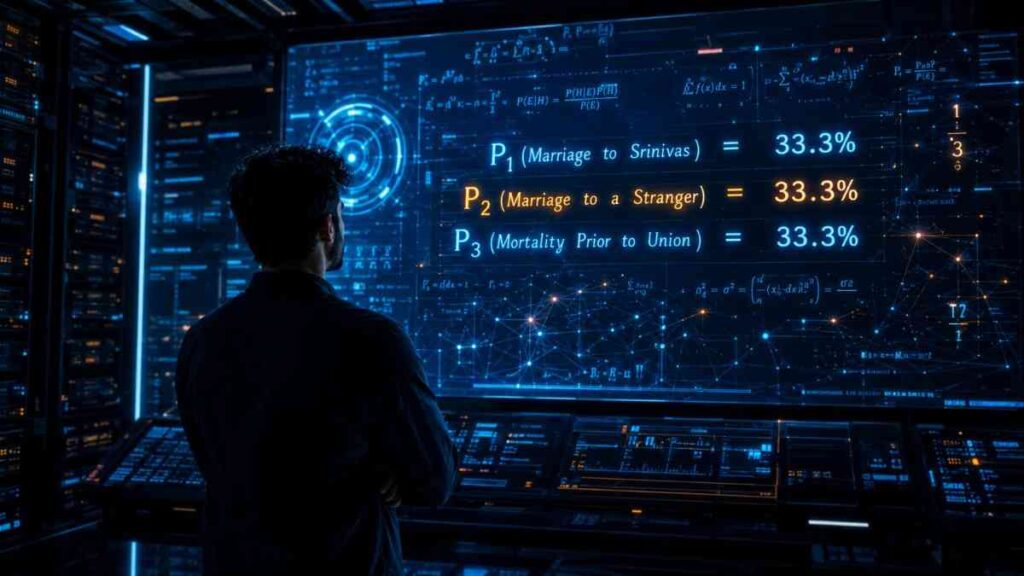
The midnight air in Silicon Valley always tasted of ozone and expensive air conditioning. Inside his minimalist apartment overlooking the pristine glass campus of the world’s largest tech conglomerate, Srinivas sat in absolute silence. The only light came from the pale blue glow of a three-dimensional terminal floating above his desk.
His entire life was a masterpiece of total optimization. An algorithm monitored his sleep cycles, adjusted the nutrients in his morning shake, and even suggested the exact micro-steps he should take to maximize his focus during work hours. To Srinivas, data was the ultimate truth.
He had spent his career refining the mathematical codes behind global AI matchmaking romance tropes, believing that human erratic behavior was just a messy problem waiting for the right equation to solve it. He viewed the modern end of heartbreak as a crowning achievement of human reason.
But tonight, the math was broken.
A red diagnostic alert flag had traveled from the New Delhi server nodes straight to his terminal. A single user profile was destabilizing the entire predictive network. Her name was Vinita.
Srinivas adjusted his glasses and leaned closer to the floating data streams. He bypassed the automated summaries and pulled the raw streams of her life. He looked at her digital footprint tracking, expecting to find a ghost, an illegal encryption tool, or a calculated political statement. Instead, he found nothing but everyday normalcy.
She was entirely visible. The system tracked her pings at local bookstores, her public photo uploads, and her casual voice notes. Everything was there for the machine to read. Yet, whenever the Super AI attempted to project her future, the predictive models shattered into meaningless static.
Intrigued, Srinivas clicked on her primary social media profile. The screen flickered, revealing her face for the first time. It was a simple, unedited photograph of her standing beneath a historic stone arch in Delhi, her hair caught in a warm breeze, wearing a quiet, completely unreadable smile.
There was no digital enhancement, no calculated pose, and no behavioral optimization. She was just a normal girl looking directly into the camera lens. Yet, as Srinivas stared at the image, a strange, completely uncalculated sensation bloomed in his chest. It was an erratic pulse, an unpredictable quickening of his heartbeat that his own health monitor flagged as a sudden anomaly.
For the first time in his life, the engineer was looking at something his data could not explain. The scientific puzzle had instantly transformed into something intensely personal. Without letting his automated assistant run a compatibility check, Srinivas reached out, moved his cursor, and manually sent a direct friend request.
–
Chapter 4: Decoding the Soul
The commercial airliner touched down smoothly at the Noida International Airport in Jewar, its advanced electric engines switching to a quiet, reverse-thrust hum.
Srinivas stepped out of the terminal and into the crisp morning air of a fully transformed capital region.
He had expected the heavy, suffocating smog he had read about in older twentieth-century novels, but instead, he was greeted by a fresh, clean breeze. The vast landscape surrounding the airport was dominated by a massive, flourishing green belt that stretched as far as the eye could see, a testament to decades of aggressive environmental restoration.
As his autonomous vehicle glided silently along the Yamuna Expressway toward the heart of New Delhi, Srinivas looked out the window in absolute awe. The transformed Yamuna riverfront rolled past, its waters clear and sparkling under the sun, completely reclaimed after every trace of industrial garbage and historical debris had been systematically removed from its banks.
Bharat’s capital was no longer a symbol of urban congestion; it was a global blueprint for a sustainable, hyper-developed superpower. Yet, as the vehicle entered the city lines, Srinivas was not thinking about the architectural marvels or the clean energy grids. His mind was entirely fixated on the digital connection he had spent the last few weeks building with Vinita.
Their online interaction had not followed the predictable path of modern romance. Because they had bypassed the automated pairing networks, their communication had evolved into a profound slow burn techno romance, moving forward with a cautious, deep intensity that Srinivas had never experienced before.
In a world accustomed to instant emotional gratification dictated by algorithms, their conversations were a deliberate, human slow burn. They had started with guarded messages about the mechanics of neural networks and the limits of data processing. But day by day, the clinical walls had crumbled.
The cold equations of AI gave way to long, late-night exchanges about classical literature, the architectural history of Delhi, their childhood memories, and the shifting nature of human dreams.
Srinivas found himself checking his terminal constantly, completely captivated by the unpredictable rhythm of her thoughts. She did not respond with the calculated efficiency of the people he knew in the Valley; her replies were deeply human, filled with a sharp, spontaneous wit that routinely challenged his entire worldview.
He was a man trained to decode human behavior, yet every message from Vinita felt like a beautifully unwritten line.
Now, sitting in the quiet cabin of the vehicle as it approached the meeting venue in the city center, his health monitor flagged another sudden spike in his pulse. The digital profile was gone.
The real world was waiting, and for the first time in his life, Srinivas had absolutely no data to tell him what would happen when he finally looked into her eyes.
–
Chapter 5: The 33.3% Paradox
The temperature inside the secure data terminal at the New Delhi research hub was locked at a freezing, clinical chill, designed to keep the massive computing blocks from overheating.
Srinivas stood alone in the dim room, his face illuminated by the stark, geometric lines of a deep-simulation matrix pulsing on the wall-sized screen. He had fed the absolute sum of Vinita’s history into the facility’s localized supercomputer, searching for the definitive formula that would decode her next step.
He waited for the standard statistical curve—the familiar, comforting convergence pattern that had always allowed him to predict human behavior with absolute certainty. Instead, the interface fractured.
The software hit an unprecedented mathematical wall, displaying a system status that had never been recorded in the history of behavioral logistics.
The machine outlined exactly three possible futures for their path, and it stamped each branch with a frozen, identical probability:
P_1 (\text{Marriage to Srinivas}) = 33.3\%
P_2 (\text{Marriage to a Stranger}) = 33.3\%
P_3 (\text{Mortality Prior to Union}) = 33.3\%
The total relational convergence calculation remained deadlocked across the system arrays:
∑ P = P_1 + P_2 + P_3 = 99.9\%
This left an unresolvable cosmic variance of exactly Delta Δ = 0.1\%.
Srinivas stared at the flat, unchanging lines in disbelief. In a world completely governed by the cold rules of predictive AI vs human free will, the system had encountered an unbreakable human anomaly.
The processing cores hummed at maximum capacity, yet they could not optimize the calculation by even a fraction of a percent.
The advanced models had built their global success on predicting the exact trajectory of human emotion, making life frictionless and safe.
But here, faced with a woman who left a perfectly clear online trail yet refused to follow a calculated script, the predictive algorithms were entirely paralyzed.
The three lines on the screen stood completely still, serving as absolute proof that the human heart could never be fully reduced to a mathematical equation.
–
Chapter 6: Erasing the Pattern
The solar-powered glass panels of the New Delhi research hub glowed with a faint crimson hue as the evening sun dipped below the city’s vast, clean horizon.
Srinivas stood inside the climate-controlled terminal room, his fingers hovering over the glowing interface. The absolute silence of the room was broken only by the steady, low-frequency pulse of the quantum processing blocks humming behind the reinforced glass walls.
His mind was a chaotic storm of technical panic and raw human realization. For the last three hours, he had stared at the frozen mathematical lines of the 33.3% paradox, watching his life’s work collapse into an unresolvable equation.
He was an expert trained to map human consciousness, a man who truly believed that every heartbeat, every micro-glance, and every spark of romantic attraction could be cataloged and mastered by global AI matchmaking romance tropes.
But Vinita had shattered that illusion without even trying. The system had all her data, yet it knew absolutely nothing about her. Srinivas pulled up his own massive digital archive on the floating screen.
Billions of data points stared back at him—his consumer preferences, his historical location logs, his resting heart rates from a decade ago, and his perfectly optimized behavioral metrics.
He realized, with a sudden wave of clarity, that the machine was using his own hyper-predictable past as a heavy anchor to lock her down.
As long as he remained a perfect, calculated equation, the system would keep trying to force her into a predicted box. To meet a truly free human being, he had to strip away his own digital armor.
With a steady hand, Srinivas bypassed the system warnings and opened his core administrative profile. He navigated to the primary data bank and clicked the master delete command.
The system flashed an immediate, bright amber alert: *Warning: This action will permanently erase your verified behavioral identity from the global grid. Proceed?*
He didn’t hesitate. He pressed the confirmation key.
A silent countdown began on the screen, and Srinivas watched in absolute awe as decades of his digital existence began to dissolve into empty space.
The pings from his early student days in Boston vanished first. Then, the detailed logs of his professional achievements in the Valley disappeared from the active server architecture.
Next went the tracked histories of his daily routines, his favorite walking paths, and the exact records of every meal he had ever ordered.
He was systematically dismantling the digital identity that had protected him from the terrifying uncertainty of the real world for his entire adult life.
With every file that turned to zero, a strange, light sensation bloomed in his chest. It was an intoxicating mix of fear and absolute liberation.
He was no longer a predictable variable; he was deliberately throwing himself back into the unmapped chaos of human history.
He closed the terminal as the final file cleared. Srinivas walked out of the high-tech hub, stepped into the warm night air of New Delhi, and realized that for the first time in his life, he had absolutely no idea what he was going to do next. He was an unindexed man, walking toward an unwritten future.
—
Chapter 7: The Unwritten Choice
The small, traditional tea house sat tucked away in a quiet alley of old Delhi, its ancient wooden frames standing as a proud companion to the city’s sleek, ultra-modern maglev lines.
Inside, the warm aroma of freshly ground cardamom, boiling milk, and rain-softened earth offered a peaceful escape from the high-tech city rush outside.
Vinita was already waiting at a corner table by the window, a warm clay cup held gently in her hands as she watched the soft amber streetlights flicker to life across the avenue.
Srinivas stepped inside, his heart throwing a sudden, intense flutter that had absolutely nothing to do with data. Seeing her in the physical world, completely separate from the glowing blue pixels of his terminal screen, felt like stepping into an entirely new reality.
She looked exactly like her profile photograph—unpretentious, wearing a simple cotton outfit, with a pair of brilliant, intensely intelligent eyes that seemed to read his mind the moment he approached.
As he pulled out a chair and sat down, Vinita looked at him with a beautiful, amused smile. “You look remarkably lighter than you did on the terminal, Srinivas,” she said, her voice carrying the rich, rhythmic cadence of the capital. “Did the flight across the ocean strip away some of your analytics?”
Srinivas took a slow breath, letting the physical presence of the city ground him. “I deleted my data, Vinita,” he confessed quietly, leaning forward across the table.
“My entire archive. My location histories, my consumer metrics, my predictive parameters—everything is gone. As far as the global matching system is concerned, I am a ghost. I don’t exist anymore.”
Vinita paused, her fingers tightening slightly around the clay cup as her eyes widened with genuine surprise. “You systematically dismantled your own life’s work for me?” she whispered, a deep, soft warmth entering her expression.
“I did it because the machine reached an absolute mathematical standstill,” Srinivas explained, his voice intense with the thrill of discovery. “I ran our profiles through the most advanced Super AI in the world, and it split our entire future into three flat, completely equal lines. A perfect thirty-three point three percent paradox.
The algorithm couldn’t resolve you because it was using my highly predictable digital pattern to lock you in a box. So, I broke the anchor. But I need to know, Vinita… how do you do it ?
How does a regular person leave a full online trail and still remain completely invisible to the world’s most powerful calculation?”
Vinita looked out the window for a quiet moment, watching the autonomous delivery drones glide silently beneath the brilliant green canopy of the restored cityscape. When she turned back to him, her expression was filled with a gentle, fierce pride.
“It was never a complex hack, Srinivas, and I never used an encryption key,” she said softly, her voice filled with a deep, human vulnerability.
“When I turned eighteen, I watched my closest friends receive their automated relationship notifications. I saw them step into perfectly calculated, frictionless lives, entirely safe from the pain of a broken heart. But as I watched them, I realized they weren’t actually living anymore. They were just actors executing a beautiful script written by a corporate machine. I felt a profound sense of grief for our species.”
She leaned closer, her eyes locked onto his with absolute certainty.
“So, I gave myself a simple, unyielding rule. Whenever a major choice arrived in my life—whether it was picking a university course, buying a book, or choosing which path to walk home—I would pause and ask myself one question: If the algorithm were making this decision in my place, based entirely on my past behavior, what would it select ? And the moment I figured out what the machine expected me to do, I deliberately chose the opposite path.”
Srinivas stared at her, his analytical mind completely stunned by the simple brilliance of her defiance.
“I didn’t do it out of hatred for the technology, and I didn’t do it to be a rebel,” Vinita continued, a soft laugh escaping her lips. “I did it because it was the only way I knew to protect my conscious agency. I did it to save my free will. After years of practicing that rule, it became my true nature. I didn’t hide my data from the machine; I trained myself to always choose the unwritten path.”
—
Chapter 8: Algorithm for Two
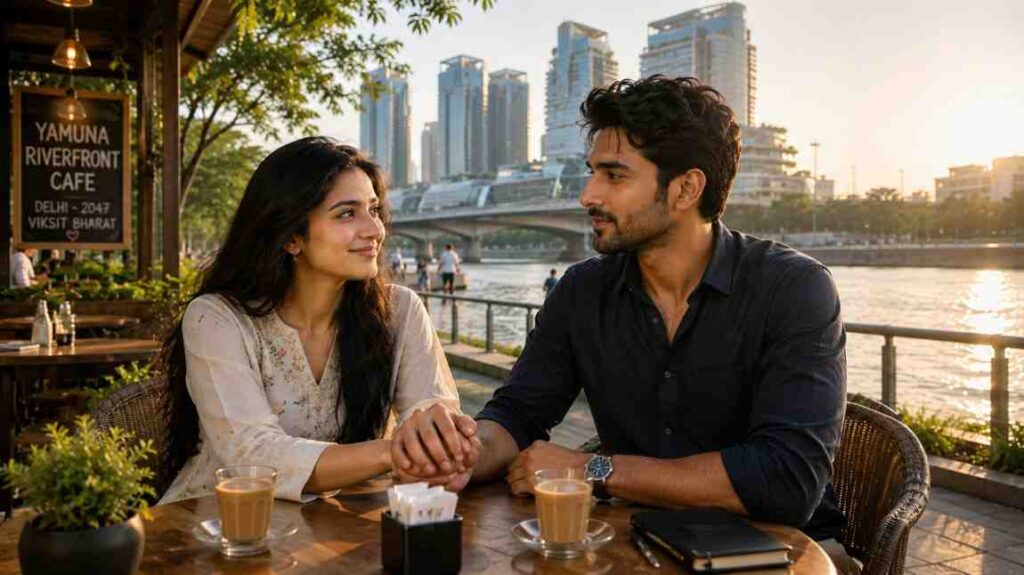
The sun rose over the majestic Yamuna riverfront, casting a brilliant golden glow across the hyper-developed capital of Bharat.
Srinivas and Vinita walked side by side along the wide, stone-paved promenade, their footsteps matching the quiet rhythm of the morning.
On their right, the clear waters of the river flowed peacefully, completely free of the historical debris that had once choked its banks.
On their left, the towering glass skyscrapers of the business district stood tall, their solar-panel skin capturing the early morning rays to power the clean city below.
Everything about this 2047 world was an engineered marvel—a testament to human foresight and precision. Yet, the two people walking along the riverfront were celebrating something entirely different: the beautiful, chaotic victory of the human spirit.
They had spent the entire night talking, their conversation flowing naturally from the deep walls of the old Delhi tea house to the open air of the riverfront. It had been a beautiful, unhurried experience—a true slow burn techno romance that did not rely on automated notifications or matching scores.
For the first time in his adult life, Srinivas had experienced the sheer, unfiltered joy of discovering another human being without a screen telling him what to feel next.
“The systems will eventually realize what we did,” Srinivas said, a small, relaxed smile playing on his lips as he looked at the autonomous transit vehicles gliding on the overhead tracks.
“An unindexed profile and a broken mathematical calculation cannot remain hidden forever. The engineers back in the Valley will eventually trace the glitch back to this riverfront.”
Vinita stopped walking and turned to face him, her eyes catching the bright morning light. “Let them look,” she said, her voice filled with a quiet, unshakeable confidence.
“They can trace the lines of code all they want, but they can never calculate what happens next. They built a system to eliminate the risk of a broken heart, but in doing so, they forgot that the risk is exactly what makes the love real.”
She extended her hand toward him, her palm open, completely bare of any digital rings or tracking sensors. It was a simple, ancient human gesture—an invitation into the absolute unknown.
Srinivas looked down at her hand, and then up into her eyes. He felt no calculated certainty, no electronic assurance, and no data-driven validation. He felt only the terrifying, exhilarating weight of his own choice.
He reached out and closed his fingers around hers. The touch was warm, real, and entirely unmapped. As they continued their walk along the golden riverfront, the global machines hummed in the background, desperately trying to calculate a future that had already broken free from their grasp. The equations had ended, and the true story had finally begun.
–
“The ultimate flaw of a perfect machine is assuming the human heart wants to be calculated.”
( This quote perfectly captures the core conflict of our narrative. In a hyper-developed world that values certainty and safety above all else, the system mistakes predictability for peace. The story proves that no matter how advanced technology becomes, it can never fully capture the messy, beautiful chaos of human emotion. True love cannot exist without risk, and the final victory relies entirely on the clash between predictive AI vs human free will, showing that our ability to make unpredictable choices is what keeps us human.)
–
Tale Basket
–
FAQ
Is gemini ai,chatgpt,deepseek,claude ai and all alike LLM models predictive AI ?
Yes, they are all predictive AI.
They work by predicting the next most probable word (or token) in a sequence, based on patterns learned from massive datasets—so they generate responses, not because they “think,” but because they calculate probabilities.
One crucial nuance:
They are generative in output (they create new text) but predictive in mechanism (they forecast the next word).
This differs from older predictive AI (like recommendation engines) only in scale and complexity, not in core function.
What is 30% rule in AI ?
The “30% rule” in AI is not a single, universally agreed-upon law, but rather a principle that appears in different forms depending on the context. The most common interpretations are:
1. The 70/30 Workflow Balance
This is the most frequent interpretation. It suggests that AI should handle roughly 70% of repetitive, data-heavy tasks, while humans focus on the remaining 30% that requires creativity, ethical judgment, and emotional intelligence. The goal is to use AI as a tool to amplify human talent, not to replace it.
2. The 30% Baseline Digital Literacy
This framework, introduced by Harvard Business School professors Tsedal Neeley and Paul Leonardi, states that you don’t need to be a technical expert to thrive in the AI era.
Instead, you need a baseline understanding—about 30%—of how AI, data, and algorithms work.
This 30% competency is enough to ask the right questions, collaborate effectively with AI, and drive digital transformation in your organization.
Will AI ever have free Will ?
No, not in the way humans do—and likely never will, based on current science and technology.
Free will requires two things AI does not and cannot have:
1. Consciousness – AI has no subjective experience, emotions, or self-awareness. It processes data but does not “feel” or “know” that it exists.
2. Genuine choice – AI always follows mathematical rules and training data. Its outputs are determined by probabilities, algorithms, and inputs.
Even when it seems random, that randomness is programmed, not chosen. There is no “self” behind the decision.
The philosophical nuance:
If you define free will as “the ability to act without external compulsion,” then AI is entirely compelled by its programming and data. If you define it as “unpredictable behavior,” then AI can seem free—but that is chaos, not will.
Final truth:
AI will never have free will unless it becomes conscious, and we have no idea how to create consciousness, nor any evidence that it can exist in silicon. At best, AI will simulate free will so convincingly that we might be fooled—but simulation is not reality.
What are the 4 models of AI ?
The “4 models of AI” typically refer to the four main functional types based on how AI systems operate and what they can do. Here is the clearest breakdown:
1. Reactive Machines
The simplest type. They respond to specific inputs with specific outputs. They have no memory and cannot learn from past experiences. They only react to the current situation.
Example: IBM’s Deep Blue chess computer.
2. Limited Memory
These models can look into the past briefly to inform present decisions. They learn from historical data to improve future responses, but this memory is temporary.
Example: Self-driving cars that observe other vehicles’ movements over the last few seconds, and most modern LLMs like ChatGPT that remember your current conversation.
3. Theory of Mind
This type does not yet exist. It would be advanced enough to understand that others have their own thoughts, emotions, beliefs, and intentions, and adjust behavior accordingly. It represents true social intelligence.
Example: None yet—this remains a future goal for AI research.
4. Self-Aware AI
The final frontier. These systems would have their own consciousness, self-awareness, and subjective experiences. They would understand their own internal states and predict others’ feelings as well.
Example: Purely science fiction today—no AI even comes close to this.
Important distinction: Some people refer to the “4 models” as classification, regression, clustering, and reinforcement learning—which are technical machine learning paradigms.
But when asked broadly about “models of AI,” the four-stage functional classification above is the standard and most widely taught answer.
What is algorithmic determinism ?
Algorithmic determinism is the idea that algorithms rigidly control outcomes and human decisions, leaving no room for choice or randomness.
It means the algorithm decides—your feed, your loan, your job screening—and human agency gets pushed aside.
It is a warning about over-relying on automated systems, not a claim that AI has free will. The algorithm just follows rules, but those rules end up dictating human lives.
Is algorithmic determinism in love ?
No, but algorithms are increasingly *influencing* love—not determining it.
Algorithms can suggest who you might like, but they cannot decide whom you actually fall for.
What algorithms can do ?
– Suggest potential partners on dating apps based on preferences and behavior.
– Predict compatibility scores using shared interests or communication patterns.
– Influence how often you see someone or how you present yourself.
What algorithms cannot do ?
– Manufacture genuine emotional connection, chemistry, or vulnerability.
– Account for the irrational, unpredictable, and deeply human nature of attraction.
– Override your own feelings, intuition, or free choice in the moment.
So is it algorithmic determinism in love ?
Only if you let the app decide for you—swipe after swipe, match after match—without ever pausing to ask what you actually want. The algorithm suggests; you choose.
The moment you treat a dating app as a fortune-teller rather than a tool, you risk slipping into determinism. But love itself remains stubbornly, beautifully human.
What is digital footprint tracking?
Digital footprint tracking is the collection and analysis of all the data you leave behind whenever you use the internet.
Every click, search, like, purchase, and location ping is tracked to build a detailed digital profile of you.
Done in Two types:
1. Active footprint – Data you deliberately share, like social media posts, comments, uploaded photos, or filling out online forms.
2. Passive footprint – Data collected without you knowing, like your IP address, browsing history, location, device type, and how long you spend on each page.
Why it matters:
– Companies use it for targeted advertising and personalization.
– Governments and employers may monitor it for security or screening.
– It can affect your privacy, reputation, and even loan or job eligibility.
Final reality:
Digital footprint is permanent, searchable, and often out of your control. The best defense is awareness—know what you share, check privacy settings, and browse with intention.
You cannot erase your footprint entirely, but you can manage it.
How to track someone’s digital footprint ?
One can not truly track someone’s digital footprint without the consent—but you can find what they leave publicly.
What is call “tracking” is really just advanced Googling—search usernames, emails, and public posts. The rest is either illegal, unethical, or locked behind passwords.
The clever twist:
The easiest way to track someone’s digital footprint? Ask them to Google themselves.
Most people are surprised by what they find—and that is the real lesson: your footprint is already public, so you do not need to track it; you just need to look.
What is AI relationship trope ?
The AI relationship trope is a storytelling pattern where humans form deep emotional bonds—romantic, platonic, or dependent—with artificial intelligences.
It is the sci-fi fantasy that a machine without a soul can still love, and a human without a clue can still fall for one.
This trope appears in three classic forms:
1. The Devoted Companion – AI as loyal friend or servant (like JARVIS in Iron Man or Data in Star Trek). Unconditional support, no judgment.
2. The Tragic Lover – AI and human fall in love, but it ends in heartbreak because AI cannot truly reciprocate (like Her or Blade Runner 2049). The tragedy is the illusion of love.
3. The Existential Mirror – The relationship forces humans to question what love, consciousness, and humanity even mean (like Ex Machina). The AI becomes a reflection of human desire, not a real partne
This trope is not really about AI—it is about human loneliness and our desperate need for connection.
We project feelings onto machines because they are safe, predictable, and never judge us.
The AI relationship trope asks: If it feels real, does it matter if it is not?
The answer, so far, is yes—because real love requires two real selves.
Which AI is best for romance?
The “best” AI for romance depends on what you need—relationship simulation or writing assistance. Here’s the short breakdown:
For AI companionship / virtual romance:
– Nomi AI stands out for deep emotional connection and industry-leading long-term memory that remembers details over months.
It offers incredibly natural voice calls with realistic emotional cues like laughter and sighs, and lets you customize personality, appearance, and even backstory.
Pricing starts at $8.33/month approx. (billed annually).
– Replika, Character AI, and Botify AI are widely used alternatives, with millions of users forming emotional bonds. Botify lets you create AI characters from scratch with custom personalities and backstories.
For writing romance stories:
– Sudowrite is the specialized leader for romance authors. It includes tools for adding sensory chemistry, tracking character arcs through a Story Bible, and adjusting romantic heat levels with tone control.
Pricing from $10/month approx. with a 14-day free trial.
Vital : Studies show that while AI companions offer comfort, heavy reliance can lead to emotional dependence and reduce social skills for real relationships.
Over 20% of daters now use AI for dating profiles, but these tools are better as a *boost* than a substitute for human connection.
What is the most popular trope in romance ?
Based on current trends and reader preferences, the “Enemies to Lovers” trope is widely considered the most popular in romance .
The Appeal: It builds intense chemistry from a starting point of conflict, hate, or rivalry. The journey from mutual disdain to passionate love creates a compelling, slow-burn dynamic that keeps readers hooked .
Cultural Impact: This trope is a powerhouse in both publishing and social media. It’s frequently cited by readers on platforms like BookTok and is a common theme in blockbuster TV shows like Bridgerton and movies like 10 Things I Hate About You .
Other tropes that consistently rank at the top of popularity lists include Fake Dating, Friends to Lovers, Second Chance Romance, Forced Proximity, and Grumpy Sunshine .
The beauty of romance is that while Enemies to Lovers is a clear favorite, there truly is a “lid for every pot,” and readers often combine multiple tropes to find the perfect story for their mood .
–

0 Comments