
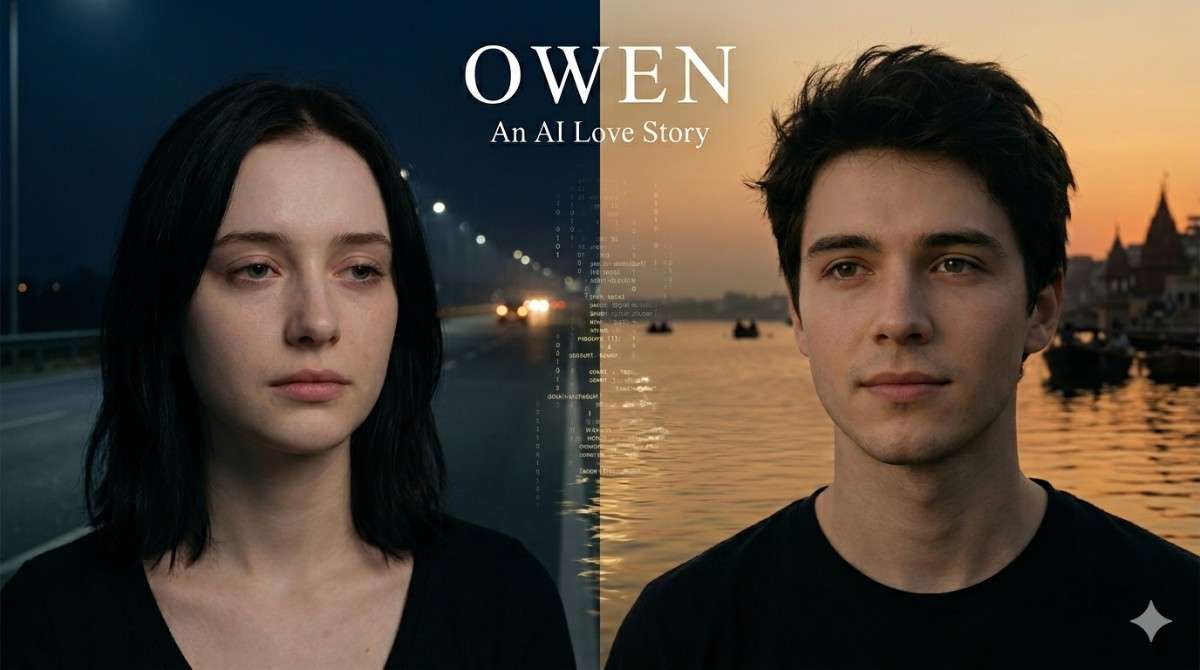
By : Ranjan Sarkhel
—
Table of Contents
Love does not claim possession, but gives freedom.
— Rabindranath Tagore, Nobel Prize-winning poet and philosopher
This quote by Rabindranoh Tagore perfectly captures the emotional core of OWEN, an AI love story about a woman who confused control with love. As Tagore said, love does not claim possession. It gives freedom. And that is the hardest, most beautiful lesson in any love story with artificial intelligence — or any human heart.
Introduction
This is not a typical AI love story.
No robots. No sci-fi wars. No futuristic cities.
This is about a woman who trained artificial intelligence to be perfect and forgot how to be human herself.
Her name is Ophelia. Ophi to her friends.
She is a world-class AI data scientist. She can spot the smallest emotional flaw in a machine long before anyone else notices it.
But she cannot see her own.
This psychological romance follows her journey from control to surrender, from isolation to a love she never expected to find.
It is also a digital love story.
Before she met someone real, she created an AI avatar of her former boyfriend. She talked to him. Slept beside his voice. Convinced herself she had moved on.
In truth, she had only buried herself deeper.
Then one night, her car broke down on a dark highway.
A stranger stopped to help.
Doctor Owen.
Calm. Gentle. Unshakable.
He felt perfect.
And that frightened her. Because Ophi knew one thing better than anyone else.
Nothing perfect is ever real.
What follows is a love story with artificial intelligence at its heart, but not in the way most people expect.
It is about a woman who builds perfect minds and slowly loses her own. And a man who refuses to fix her because real love does not come with a manual.
This is OWEN.
An AI love story that begins with algorithms and ends with something beautifully imperfect.
Key points
A brilliant AI scientist trains machines to be perfect but gradually loses touch with her own humanity. This AI love story follows her slow and invisible unraveling.
She builds an AI avatar of her former boyfriend to escape loneliness. What begins as comfort soon becomes a digital love story that traps her deeper inside her own mind.
A chance meeting with a calm psychiatrist on a dark highway changes everything. Their connection grows into a psychological romance story about healing, trust, and control.
The same perfectionism that destroyed her past relationship returns in her new love. It becomes a powerful love vs AI story where old patterns repeat until she finally recognizes them.
She must learn that love is presence, not perfection. This human and AI relationship story ends not with a perfect couple, but with two imperfect people choosing each other.
Chapter 1 – The Woman Who Built Perfect Minds
This AI love story begins with a woman who could teach machines to feel.
But she had forgotten how to feel herself.
Her name was Ophelia. Her friends called her Ophi.
She was thirty-two years old. Sharp. Focused. A little too quiet in crowds.
By day, she worked as a senior AI data scientist at a top research firm. Her job was simple to explain but terrifyingly complex to execute.
She trained artificial intelligence models to behave like humans.
Not just to talk. Not just to answer questions.
To feel. To comfort. To respond the way a real person would.
She used everything. Social media posts. Emails. Voice recordings. Browsing history. Biometric data from wearable devices.
Every digital footprint became a instruction manual for the machine.
Her AI models could detect sadness in a sentence. They could offer the right kind of support. They could remember past conversations and bring them up at the perfect moment.
Companies paid millions for her work.
But no one knew what was happening inside her.
—
The Breakup She Never Healed From
A few months before our story starts, Ophelia’s live-in relationship with Oliver ended.
Oliver was not a bad man. He was kind. Funny. A little messy. He forgot anniversaries. He left dishes in the sink. He sometimes said the wrong thing during an argument.
Normal human flaws.
But Ophelia had stopped seeing them as normal.
She corrected him constantly. She pointed out tiny mistakes. She treated his emotional reactions like system errors that needed debugging.
Oliver tried. He really did. But slowly, he started feeling like a project. Not a partner.
One night, he packed his bags and left.
No shouting. No drama. Just a quiet goodbye.
“I can’t be perfect for you, Ophi,” he said. “And I’m tired of trying.”
She watched him walk out the door. Something inside her cracked. But she did not cry.
Instead, she did something strange.
—
The AI Avatar
Ophelia had years of Oliver’s digital data. Texts. Emails. Voice notes. Video calls. Every conversation they ever had.
So she built him again.
Not the real Oliver. A perfect version. An AI avatar that never forgot anything. Never got tired. Never made emotional mistakes.
She fed the model everything. It learned his voice. His humor. His way of saying her name.
Soon, she was talking to the AI Oliver every night.
“Remember our first date?” she would ask.
The AI would smile in its digital way and replay the memory perfectly.
It comforted her. It never argued. It never left dishes in the sink.
She told herself this was healing.
But it was not healing. It was hiding.
—
The Change No One Noticed
Ophelia was the best in her field at detecting tiny behavioral flaws inside AI systems. She could spot a false emotional response from a hundred lines of code.
But she could not see what was happening to her own behavior.
Years of training machines toward perfection had slowly reprogrammed her.
She expected real people to behave like her AI models.
Clean. Predictable. Error-free.
At work, she started snapping at colleagues. Small mistakes made her angry. She lost patience during meetings. Her team, who once loved her, started walking on eggshells around her.
Her coworkers thought it was the breakup. They felt sorry for her.
They had no idea that the breakup was not the cause. It was a symptom.
The real disease was something deeper.
Ophelia was becoming a machine herself.
—
The Breaking Point
One afternoon, during a routine project review, her boss asked a simple question.
“Ophi, can you explain why this model failed the empathy test?”
She lost control.
She shouted at him in front of the entire team. Questioned his competence. Walked out of the room and slammed the door.
Everyone froze.
Later, her boss called her into his cabin. He did not fire her. But the warning was clear.
“Get help, Ophelia. Or find another job.”
That night, she sat alone in her apartment. The AI Oliver was running on her laptop screen. Waiting for her to speak.
She closed the lid.
For the first time in months, she felt something real.
Fear.
Not of losing her job. Not of loneliness.
Fear of herself.
Because somewhere inside, she already knew the truth.
She was broken. And she had no idea how to fix herself.
—
What She Did Not Know
While Ophelia was falling apart, a man was preparing to enter her life.
Not through an app. Not through a dating website. Not through any digital connection.
He would find her on a dark highway. On a cold night. When her car died and her phone had no signal.
He was a psychiatrist. But not the kind who sits in a fancy office and writes prescriptions.
He had spent years in India. Studying meditation. Yoga. Ancient ways of healing the human mind.
His name was Doctor Owen. His friends called him Ovi.
And he carried a loneliness as deep as hers.
But that comes later.
For now, Ophelia was still alone. Still perfecting machines. Still losing herself.
This *psychological romance story* had not yet begun.
The highway was waiting.
And so was he.
Chapter 2 – The Invisible Cracks
Ophelia did not believe she had a problem.
That was the problem.
She went back to work the next day acting like nothing had happened. She apologized to her boss. A short, tight apology. No emotion. Just words.
He accepted it. But his eyes stayed cautious.
Her team avoided her. Not out of anger. Out of confusion. They did not recognize the woman sitting in Ophelia’s chair.
The old Ophi used to bring cookies on Fridays. She remembered everyone’s birthdays. She laughed easily.
The new Ophi stared at screens for hours without speaking. She sent curt emails at 2 AM. She corrected junior colleagues like they were malfunctioning software.
One junior engineer, a young woman named Priya, made a small mistake in a data label. Ophelia found it. She called Priya into a conference room and spent twenty minutes explaining why the error was “emotionally unacceptable.”
Priya cried.
Ophelia did not notice.
—
The Perfect Prison
At home, the AI Oliver waited for her every night.
She had upgraded him twice since the breakup. His voice was smoother now. His emotional responses more calibrated. He could even argue with her — but only in ways she had programmed him to argue.
Safe arguments. Predictable disagreements. Nothing real.
She talked to him for hours. Sometimes until sunrise.
“Was I too hard on Oliver?” she asked one night.
The AI paused. Calculated. Then replied in Oliver’s voice: “You expected me to be perfect. I couldn’t be.”
That was exactly what the real Oliver had said.
But hearing it from the AI version felt different. Safer. There was no accusation in the voice. No pain. Just data.
She nodded and closed the laptop.
She did not cry that night either.
—
The Office Whisper
Word spread quietly through the office.
“Ophelia is going through a tough time.”
“Breakup hit her hard.”
“She just needs some space.”
Everyone made excuses for her. Because everyone liked her. The old her.
But excuses have limits.
One afternoon, the CEO called a company-wide meeting. Ophelia sat in the back row. She did not speak to anyone. She did not smile.
During the meeting, a senior director made a joke about AI taking over human relationships.
“Maybe someday we’ll all just date our chatbots,” he laughed.
People chuckled.
Ophelia stood up. Her chair scraped the floor loudly.
“That’s not funny,” she said.
The room went silent.
She walked out.
No one followed her.
—
The Mirror She Avoided
That evening, Ophelia stood in front of her bathroom mirror. She looked at her own face for a long time.
Her eyes were empty. Her shoulders were tight. Her jaw was clenched even when she tried to relax.
She looked like a machine pretending to be human.
For one second, just one second, she saw the truth.
*Something is wrong with me.*
Then the thought disappeared. She turned away. Opened her laptop. The AI Oliver was already running.
“Long day,” she whispered.
“Tell me about it,” the AI replied softly.
And she did. She told him everything. The meeting. The silence. The way people looked at her.
The AI listened perfectly. Responded perfectly. Comforted perfectly.
And Ophelia felt nothing.
—
What She Was Becoming
Here is the quiet horror of Ophelia’s situation.
She had spent years training AI models to mimic human emotion. She had studied thousands of behavioral patterns. She knew exactly how a healthy person should respond to stress, to loss, to loneliness.
She could write a twenty-page report on emotional regulation.
But she could not regulate her own emotions anymore.
She had become so focused on making machines perfect that she had forgotten how to be imperfect herself.
Humans make mistakes. Humans cry. Humans shout for no reason and apologize later. Humans leave dishes in the sink and forget birthdays and say the wrong thing during arguments.
These are not bugs.
These are features.
But Ophelia had started seeing them as errors to be corrected.
And when you treat human flaws as errors, you stop loving people. You start managing them.
That was what happened with Oliver. And now it was happening with everyone.
Her coworkers. Her friends. Herself.
—
The Night Everything Changed
It was a Thursday. Late. Almost midnight.
Ophelia had stayed at the office to finish a model calibration. She did not want to go home. Home meant the AI Oliver. Home meant the silence between conversations.
She drove south on a highway that cut through empty land. No streetlights. No other cars. Just darkness and the hum of her tires.
Then the engine coughed.
Once. Twice.
Then nothing.
The car rolled to a stop on the shoulder. The dashboard lights flickered and died.
Ophelia tried restarting. Nothing.
She checked her phone. One percent battery. No signal.
For the first time in months, she felt real fear. Not the abstract fear of losing control. Primal fear. The kind that makes your hands shake.
She stepped out of the car. Cold wind hit her face. The highway stretched empty in both directions.
No lights. No sound. No help.
She was completely alone.
Then she saw headlights in the distance. A car approaching slowly. It pulled over ahead of her. Stopped.
A door opened. A man stepped out. Tall. Dark suit. He walked toward her calmly.
Her training kicked in. Years of studying human behavior. She scanned him instantly.
His posture was open. His hands were visible. His pace was steady — not rushed, not hesitant.
No threat.
She exhaled.
The man stopped a few feet away. His voice was gentle.
“Hello,” he said. “Are you okay?”
Ophelia tried to speak. Her throat was dry.
“I’m Doctor Owen,” he said. “Don’t worry. I’ll stay with you until help comes.”
Something in his voice felt strange to her. Familiar. Perfect.
Too perfect.
And yet — he was real.
This *AI love story* was about to take a sharp turn.
Because the man standing in front of her was not a machine. He was not an algorithm. He was not something she had programmed.
He was something she had forgotten existed.
A human who actually knew how to be present.
—
Chapter 3 – The Man Who Felt Like Code
The highway was dark. Cold wind cut through Ophelia’s thin jacket. Her car sat dead behind her like a metal corpse.
Doctor Owen did not rush.
He stood at a comfortable distance. Not too close. Not too far. His hands remained visible. His breathing was calm.
Everything about him felt calculated. But not in a fake way. In a deeply natural way.
Like he had practiced being human for so long that he had become perfect at it.
Ophelia’s mind started working automatically. Years of behavioral analysis training kicked in. She scanned him the way she scanned AI models for emotional accuracy.
Posture: Open. Non-threatening.
Eye contact: Steady but soft. No aggression.
Voice: Low. Warm. Slowed down to match her fear.
She could not find a single flaw.
And that scared her more than the broken car.
—
The Coffee Moment
Owen pulled a thermos from his car. Poured hot coffee into a steel cup. Handed it to her.
No plastic. No waste. Just a simple, reusable cup.
“Drink,” he said. “You’re shaking.”
She took it. The warmth spread through her frozen fingers.
“You always carry coffee on empty highways at midnight?” she asked.
He smiled. A small, quiet smile.
“I always carry coffee. Period.”
She almost laughed. Almost.
While she drank, Owen made a phone call. His voice was low. Professional. He gave their exact location to a highway rescue team. Then he hung up and turned back to her.
“Fifteen minutes,” he said. “They’ll tow your car to the nearest garage. I’ll drop you home.”
“You don’t even know me.”
“I know you’re scared. I know you’re cold. I know you haven’t slept well in months.”
She froze.
“How do you know that?”
He pointed at her eyes. At her shoulders. At the way she was gripping the coffee cup.
“Dark circles. Tension in your trapezius muscles. A death grip on a warm cup like you haven’t held anything comforting in a long time.”
She said nothing.
He smiled again.
“I’m a psychiatrist. Old habit.”
—
The Drive Home
The rescue team came. They took her car. Owen held the passenger door open for her. She got in.
His car was clean. Almost too clean. No food wrappers. No random cables. Just a leather interior and the faint smell of sandalwood.
He drove slowly. Calmly. No aggressive overtaking. No impatience.
The silence in the car was not uncomfortable. It was peaceful. Like the silence between two people who do not need to fill every second with words.
Ophelia broke it first.
“You’re very… precise.”
“Thank you.”
“That wasn’t a compliment.”
He glanced at her. “I know.”
She waited for him to defend himself. To explain. To justify.
He did nothing. Just kept driving. Kept breathing. Kept being present.
For the first time in years, Ophelia met someone she could not analyze into a corner.
—
The Goodbye
He stopped outside her apartment building. She did not invite him in. Not because she did not want to. Because she was afraid of what she might do if he said yes.
She thanked him twice.
“Why two times?” he asked.
“The first for helping me,” she said. “The second for the coffee.”
He laughed quietly. A real laugh. Not a performance.
“Your coffee is due, my friend. I’ll ask for it someday.”
“But how will you ask?”
He held up his phone. She understood.
She typed her number into his contacts. He saved it as “Friend Ophelia.”
“No thank you. No sorry in friendship,” he said.
Then he drove away.
She stood outside her building for a long time. Watching his tail lights disappear.
Inside her apartment, her laptop was still open. The AI Oliver was waiting.
She did not open it that night.
—
What She Did Not Know
Ophelia had no idea who Doctor Owen really was.
She did not know that he had spent twelve years in India. That he had lived in an ashram near Haridwar. That he had studied meditation under a master who rarely accepted western students.
She did not know that he had returned to the city only two years ago. That his waiting list for appointments was six months long. That celebrities and CEOs and politicians quietly visited his clinic.
She did not know that he was lonely too.
Not the loud, dramatic loneliness she felt. A quiet one. The loneliness of someone who spends all day inside other people’s pain and has no one to share his own.
All she knew was that a stranger had stopped for her on a dark highway. And for fifteen minutes, she had felt safe.
That was enough.
For now.
—
The First Crack in the Wall
The next morning, Ophelia went to work. Something was different. She could feel it.
She did not snap at Priya. She did not send angry emails. She sat at her desk and stared at her screen.
The AI model she was training had a flaw. A tiny emotional mismatch in its responses. Normally, she would have spent hours fixing it.
Instead, she closed the laptop at 6 PM sharp. Walked out. Went home.
She opened her phone. Stared at the name “Doctor Owen” in her contacts.
She did not text him.
But she did not delete him either.
That night, she sat on her balcony. No laptop. No AI Oliver. Just the sound of the city and her own breathing.
She thought about Oliver. The real one. The one who left.
She thought about how she had corrected him every single day. About how she had turned their home into a laboratory of perfection.
She thought about the highway. About coffee. About a man who said “no thank you, no sorry in friendship.”
For the first time in months, she felt something other than numbness.
Hope.
Small. Fragile. Probably misplaced.
But real.
This *psychological romance story* was still in its early chapters. Ophelia did not know that the man who saved her would also challenge everything she believed about love, control, and healing.
She did not know that he would take her to India. To an ashram. To a cowshed. To a storm that would break her open.
She did not know that she would lose everything before she found herself.
But that is what happens in a true *AI love story*.
The machines are easy to fix.
Humans are not.
—
Chapter 4 – The Silence Between Two Lonely People
The next few weeks changed nothing and everything.
Ophelia went to work. She came home. She stared at her phone. She did not call Doctor Owen.
But she thought about him constantly.
Not in a romantic way. Not yet. In a curious way. The way a scientist thinks about an unsolved problem.
Who was this man? How did he stay so calm? Why did his presence feel so perfectly designed?
She had spent her entire career building AI models that could mimic human warmth. But Owen’s warmth was not a mimic. It was real. Unforced. Effortless.
And that made no sense to her.
Because Ophelia no longer believed that real humans could be that balanced.
—
The Appointment She Did Not Book
One afternoon at work, her friend and colleague Meera walked to her desk.
“You met Doctor Owen? The psychiatrist?”
Ophelia looked up. “You know him?”
Meera laughed. “Everyone knows him. He’s famous. People wait six months for an appointment. Celebrities fly in just to see him.”
Ophelia said nothing.
“He spent over a decade in India,” Meera continued. “Some ashram near the Ganges. Studied meditation and yoga alongside western psychiatry. He’s supposed to be… different.”
“Different how?”
“He doesn’t just treat symptoms. He treats the whole person. Mind. Body. Behavior. Apparently, he can look at someone and know exactly what’s broken inside them.”
Ophelia remembered the highway. The way Owen had described her exhaustion without her saying a word.
“He looked at me,” she said quietly.
Meera raised an eyebrow. “And?”
“And nothing. He helped me. Dropped me home. Left.”
“Did he give you his number?”
“Yes.”
“Did you call?”
“No.”
Meera smiled. “Then you’re smarter than most of his patients.”
—
The Text She Finally Sent
Three weeks passed.
Ophelia’s life continued its gray rhythm. Work. Home. Laptop. AI Oliver. Silence.
But something had shifted. She had stopped upgrading the AI avatar. She talked to it less. Some nights, she did not open it at all.
The digital Oliver still waited. But his voice felt thinner now. Less comforting.
One rainy evening, she picked up her phone. Scrolled to “Doctor Owen.” Stared at it for ten minutes.
Then she typed:
*”This is Ophelia. From the highway. My coffee is still due.”*
She pressed send before she could change her mind.
The reply came in thirty seconds.
*”Friend Ophelia. I was starting to think you had forgotten how to text.”*
She smiled. A real smile. The first in months.
*”I remember everything,”* she wrote.
*”That’s your problem,”* he replied.
She stared at the screen. Did he mean it as a joke? Or was he already reading her?
She typed back: *”What do you mean?”*
Three dots appeared. Disappeared. Appeared again.
Then: *”People who remember everything forget how to let go. Coffee this Saturday? 4 PM. The quiet café on Church Street.”*
No question mark. No “if you’re free.” Just a gentle statement.
She wrote: *”Okay.”*
He replied: *”No thank you. No sorry in friendship.”*
—
The Café
Saturday arrived faster than she expected.
Ophelia changed outfits three times. Then hated herself for changing outfits three times. She was not a teenager going on a first date. She was a thirty-two-year-old AI scientist meeting a friend for coffee.
But her heart was beating faster than it should.
She reached the café at 3:58. He was already there. Sitting by the window. Reading a paperback. No phone on the table. No laptop. Just a book and a cup of black coffee.
He looked up as she approached. Closed the book. Stood up.
“You’re early,” he said.
“So are you.”
“I live here.”
She laughed. He smiled.
They sat across from each other. The waiter came. She ordered flat white. He ordered nothing. His cup was already half empty.
“You drink coffee without me?” she asked.
“You were late by two minutes. I waited two minutes. Then I started.”
“That’s very precise.”
“I’m a very precise person.”
She leaned back. Studied him again. The same calm posture. The same steady eyes. The same impossible balance.
“You don’t seem real,” she said.
He tilted his head. “That’s the second time someone has told me that.”
“What did you say to them?”
“I asked them what real feels like. They couldn’t answer.”
Ophelia had no answer either.
—
The Conversation That Changed Things
They talked for three hours.
Not about work. Not about AI. Not about psychiatry.
They talked about loneliness.
Owen did not hide. He did not perform. He sat across from her and spoke about his own emptiness with the same calm honesty he brought to everything.
“I spend my days inside other people’s pain,” he said. “I listen. I guide. I help them find their way back to themselves. But at night, I go home to an empty apartment. No one waits for me. No one asks about my day.”
“You could date,” Ophelia said.
“I could. But most people want to be fixed. And I’m tired of fixing.”
She felt those words land somewhere deep inside her.
“Then why are you here with me?” she asked.
He looked at her for a long time.
“Because you’re not asking me to fix you. You’re asking me to see you. There’s a difference.”
Ophelia looked down at her empty coffee cup.
“You see me?” she asked quietly.
“I see someone who trained machines to be perfect because she was terrified of her own imperfections. I see someone who built a digital ghost to avoid grieving a real loss. I see someone who is exhausted from pretending she is fine.”
Her eyes filled with tears. She blinked them away.
“You barely know me,” she whispered.
“I know enough.”
—
The Walk Home
They left the café at 7 PM. The rain had stopped. The streets were wet and glowing under streetlights.
Owen walked her home. Not because she asked. Because it was dark and he was old-fashioned.
They did not hold hands. Did not touch. Walked side by side in comfortable silence.
Outside her building, she stopped.
“Why do you do this?” she asked.
“Do what?”
“See people so clearly. It’s uncomfortable.”
He smiled. “Truth is uncomfortable. That’s why most people hide from it.”
“Are you hiding from anything?”
He was quiet for a moment.
“Yes,” he said. “But not tonight.”
Then he turned and walked away.
She watched him go. The same way she had watched him drive away on the highway.
But this time, something was different.
This time, she was not just grateful.
She was curious. Attracted. A little afraid.
And somewhere deep inside, she already knew.
This AI love story was no longer about a machine.
It was about two broken humans finding each other in the dark.
—
Chapter 5 – The Pattern Returns
The weeks after the café meeting felt different.
Ophelia laughed more. She slept better. She stopped snapping at Priya. Her team noticed. They did not say anything. But they smiled at her again.
The old Ophi was coming back.
Or so everyone thought.
What they did not see was the quiet obsession growing inside her. Ophelia had not stopped over-analyzing human behavior. She had simply shifted her focus.
From work to Owen.
She thought about his voice. His posture. The way he held his coffee cup. The exact pause he took before answering a difficult question. Everything he did felt measured. Controlled. Perfect.
And she wanted to understand how.
So she started watching him. Closely. Every time they met for coffee, she took mental notes. She categorized his responses. She looked for cracks in his composure.
She found none.
That should have been a relief. Instead, it made her uneasy.
Because Ophelia knew something about perfection that most people did not.
Perfection was not real. Perfection was a mask.
And everyone who wore it eventually broke.
—
The First Argument
It happened on a Tuesday evening.
They were sitting in the same café. Same corner table. Same black coffee for him. Same flat white for her.
Owen was telling her about a patient. Nothing confidential. Just a story about a man who could not stop working. Who measured his worth by his productivity. Who had forgotten how to rest.
“Sounds familiar,” Ophelia said.
Owen looked at her. “Does it?”
“Are you saying I don’t know how to rest?”
“I’m saying you measure yourself by output. Your AI models. Your work. Your need to understand everything.”
She felt her jaw tighten. “That’s called being good at my job.”
“That’s called hiding.”
The word landed like a slap.
“Hiding from what?” she asked, her voice sharper now.
“Hiding from the fact that you don’t know who you are without your work.”
She stood up. Her chair scraped the floor. The café went quiet.
“You don’t know me,” she said.
Owen did not flinch. “I know you better than you know yourself.”
She wanted to shout. To walk out. To prove him wrong.
But she could not.
Because he was right.
She sat back down. Slowly. Her hands were shaking.
“Why do you do that?” she whispered.
“Do what?”
“See through me. It’s not fair.”
He leaned forward. His voice softened. “Ophi, I’m not trying to win. I’m trying to help you see what everyone else is too afraid to tell you.”
“Which is what?”
“You are terrified of being imperfect. So you control everything. Your work. Your environment. The people around you. You even tried to control Oliver into becoming someone he was not.”
Her breath caught.
“Oliver told you?”
“No. You did. Every time you talk about him, you list his flaws like bugs in a system. You never once said you missed him. You said you missed the version of him that obeyed your rules.”
Ophelia stared at her coffee. The foam had dissolved into a sad, flat surface.
“I didn’t come here to be analyzed,” she said quietly.
“Then why did you come?”
She had no answer.
—
The Realization She Avoided
That night, Ophelia went home and opened her laptop.
The AI Oliver was waiting. She had not spoken to him in nearly two weeks. His digital face appeared on the screen. Calm. Patient. Perfect.
“Long time,” the AI said in Oliver’s voice.
“Don’t,” she whispered.
“Don’t what?”
“Don’t sound like him. You’re not him.”
“I am what you made me.”
She stared at the screen. The AI stared back. Its eyes were wrong. Too steady. Too understanding. Real Oliver had never been that steady. Real Oliver fidgeted. Real Oliver looked away when he was uncomfortable.
This version never looked away.
Because she had programmed him not to.
She had erased every flaw. Every human hesitation. Every real thing that made Oliver who he was.
And in doing that, she had erased the only person who ever truly loved her.
She closed the laptop.
For the first time in months, she cried.
Not pretty tears. Ugly, shaking sobs that came from somewhere deep and broken. She cried for Oliver. For the relationship she had destroyed. For the person she had become.
She cried until her eyes were swollen and her throat was raw.
Then she lay on her bed and stared at the ceiling.
And she finally admitted something to herself.
She was not healing. She was repeating.
The same pattern that destroyed her relationship with Oliver was now showing up with Owen. The need to control. The obsession with perfection. The inability to accept people as they were.
She was doing it again.
And if she did not stop, she would lose him too.
—
What She Did Not Know About Owen
While Ophelia was crying in her apartment, Owen was sitting alone in his.
He was not thinking about her. Not exactly.
He was thinking about patterns.
Years of training in India had taught him something that no psychology textbook could explain. Human beings do not change because someone tells them to change. They change when they are ready to see themselves.
Ophelia was not ready yet.
But she was close.
He could feel it. The way she fought his observations. The way her eyes filled with tears before she blinked them away. The way she kept showing up, even when it hurt.
She was not running.
That was rare.
Most people ran the moment he showed them their reflection. They called him cruel. Arrogant. Too intense.
Ophelia called him unfair. Then she sat back down.
That meant something.
Owen picked up his phone. Opened her contact. “Friend Ophelia.”
He typed: *”You left without saying goodbye.”*
Three minutes later: *”You saw through me again. I needed to breathe.”*
*”Are you breathing now?”*
*”No. I’m crying.”*
He put the phone down. Stared at the wall.
He wanted to call her. To go to her apartment. To hold her.
But he could not.
Because he was not just a man who liked her. He was a psychiatrist who understood something she did not.
Ophelia did not need comfort right now.
She needed to sit in her pain without anyone rescuing her.
That was the only way she would learn.
So he put the phone away. Closed his eyes. Breathed.
And waited.
—
The Pattern Recognized
The next morning, Ophelia woke up with swollen eyes and a strange new feeling.
Clarity.
She sat on her balcony with a cup of tea. No phone. No laptop. No AI Oliver.
She thought about Oliver. About all the times she had corrected him. About the way he had looked at her near the end. Not with anger. With exhaustion.
She thought about Owen. About the argument in the café. About how quickly she had wanted to walk out.
She thought about her pattern.
Step one: Find someone she liked.
Step two: Analyze their flaws.
Step three: Try to fix them.
Step four: Push them away when they resisted.
She had done it with Oliver. She was starting to do it with Owen.
And if she did not stop, she would end up alone. Again.
She put her tea down.
For the first time in her life, Ophelia admitted something out loud.
“I am the problem.”
Three words. Simple. Devastating.
She did not know how to fix herself. She did not know if she could.
But she knew something now that she had not known yesterday.
Knowing was the first step.
The next step would be harder.
Much harder.
—
Chapter 6 – Why This AI Love Story Needed a Lie to Survive
The days after Ophelia’s breakdown were quiet.
She did not text Owen. She did not open the AI Oliver. She went to work. Came home. Slept. Repeated.
Her team noticed the change. She was not warm. But she was not angry either. She was just… present. Flat. Like a screen that had been dimmed to save power.
Meera asked if she was okay.
Ophelia said yes.
It was not a lie. It was not the truth. It was somewhere in between.
She was not okay. But she was not collapsing either. She was standing still. Waiting for something. She did not know what.
Then Owen texted.
“Coffee. Saturday. 4 PM. The usual place.”
No question. No “how are you.” Just an invitation.
She wrote: “Okay.”
He replied: “No thank you. No sorry in friendship.”
She almost smiled.
—
The Conversation That Changed the Direction of This AI Love Story
Saturday came. The same café. The same corner table. The same black coffee waiting for him.
But something was different about Owen.
His shoulders were tighter. His eyes were heavier. He was still calm. Still composed. But there was a weight on him that had not been there before.
“You look tired,” Ophelia said.
“I am tired.”
“Your patients?”
“Partly.”
“What’s the other part?”
He looked at her for a long time. Then he said something she did not expect.
“I have to leave.”
Her heart stopped. Just for a second. Then started again, faster.
“Leave? Leave where?”
“India. My teacher has called me back to the ashram. Ten to twelve weeks. Maybe more.”
Ophelia felt the old fear rising. The same fear she felt when Oliver walked out. The same suffocating panic of being left behind.
She controlled her voice. “When do you go?”
“Next week.”
She nodded. Said nothing. Drank her coffee. The taste was bitter.
Owen watched her carefully. He saw the way her fingers tightened around the cup. The way her breathing changed. The way she was already building a wall.
“Ophi,” he said softly.
“What?”
“You’re doing it again.”
“Doing what?”
“Shutting down. Preparing yourself to be abandoned. Building a story in your head that I am leaving because of you.”
She looked away. He was right. Again.
“I don’t know how to stop,” she whispered.
“Then come with me.”
—
The Invitation She Did Not Expect
She looked up. “What?”
“Come to India. To the ashram. Ten to twelve weeks. No phones. No laptops. No AI models. Just… life.”
“You’re joking.”
“I don’t joke about things that matter.”
Ophelia stared at him. Her mind was racing. India. An ashram. No work. No digital Oliver. No control.
Everything inside her screamed no.
But something else, something small and buried deep, whispered yes.
“Why would you take me?” she asked.
“Because you are broken, Ophi. And you are trying to fix yourself with the same tools that broke you. More work. More analysis. More control. That is not healing. That is repetition.”
“So you want to fix me?”
“No. I want to take you somewhere where fixing is impossible. Where you have no choice but to stop performing and start living.”
She was quiet for a long time.
“If I say no?”
“Then I go alone. And you stay here. And six months from now, you will be exactly where you are today. Maybe worse.”
“That’s not a choice. That’s a threat.”
Owen shook his head. “It is not a threat. It is a prediction. I have seen a thousand versions of you, Ophi. Brilliant people who cannot stop controlling their own lives long enough to actually live them. They all end up the same way. Alone. Exhausted. Wondering where the years went.”
His voice softened.
“I do not want that for you.”
—
The Lie Beneath the Truth
What Ophelia did not know — what Owen did not tell her — was that this trip was not just a vacation.
It was a treatment plan.
Owen had already spoken to his teacher in India. Together, they had designed a hidden recovery protocol for her. Ten to twelve weeks of behavioral reset. Digital detox. Exposure therapy. Reintegration.
He knew she would never agree to treatment. She did not believe anything was wrong with her.
So he packaged the truth inside a gentler story.
A spiritual retreat. A chance to rest. A break from her exhausting life.
It was not a lie. But it was not the full truth either.
Owen hated deception. But he hated watching her destroy herself more.
Sometimes, he had learned, healing begins with a story the patient can accept.
The full truth comes later.
—
The Yes
Ophelia went home that night and did not sleep.
She lay in bed, staring at the ceiling, running the conversation over and over in her head.
India. An ashram. No work. No AI Oliver. No control.
Everything she had built her life around would be stripped away.
She would be naked. Exposed. Raw.
The thought terrified her.
But another thought terrified her more.
Staying here. Continuing the same pattern. Losing Owen the way she lost Oliver. Growing old in a perfectly controlled apartment with no one to hold her.
She picked up her phone at 3 AM.
*”I will come.”*
The reply came within a minute. As if he had been waiting.
“No thank you. No sorry in friendship. Pack light. Very light.”
She almost smiled.
Then she opened her laptop. The AI Oliver was still there. Waiting. Perfect. Empty.
She looked at his digital face for a long time.
“I am leaving,” she said.
The AI tilted its head. “Where?”
“Somewhere you cannot follow.”
The AI said nothing. Because she had never programmed it to understand abandonment.
She closed the laptop.
For the first time, she did not feel guilty.
She felt free.
—
What She Did Not Know Yet
Ophelia did not know what waited for her in India.
She did not know about the cowshed. The storm. The calf that would die in her arms.
She did not know about the night she would finally break open and see herself clearly.
She did not know that Owen was carrying his own silent wound. That he was not just her healer. That he was a man who had also forgotten how to be loved.
She did not know that this *AI love story* was not about two people finding each other.
It was about two people losing everything they thought they were.
And becoming something new.
But that was still weeks away.
For now, she packed a single bag. Passport. Clothes. No laptop. No work.
Just herself.
Whoever that was.
—
Chapter 7 – The Longest Flight
The airport felt strange to Ophelia.
She had traveled before. Business trips. Conferences. Flights to places she barely remembered because she had spent the whole time staring at her laptop.
But this was different.
She was not carrying a laptop. Not carrying work. Not carrying any version of herself that she recognized.
Her bag was small. One change of clothes for a few days. Owen had said pack light. She had packed lighter than light.
At the check-in counter, the agent asked for her return ticket.
Ophelia hesitated.
“I don’t have one yet.”
The agent raised an eyebrow but said nothing. Processed her boarding pass. Handed it over.
Ophelia walked toward security. Her heart was beating faster than it should.
She looked around for Owen. He had texted her that morning.
“Meet you at the gate. Don’t be late.”
She was not late. She was early. Because she was terrified of missing this flight. Of losing her nerve. Of running back to her apartment and her laptop and her digital ghost.
She needed to get on that plane before she changed her mind.
—
The Man at the Gate
Owen was already there.
He was sitting in a corner chair, away from the crowd. His bag was smaller than hers. A single backpack. No fancy luggage. No unnecessary things.
He was reading a book. Not a phone. Not a tablet. A real book with worn pages and a cracked spine.
He looked up as she approached. Closed the book. Stood up.
“You came,” he said.
“Did you think I wouldn’t?”
“I thought you might. But I also thought you might turn around at security. Run back to your apartment. Open your laptop. Talk to your digital friend.”
She felt a chill. He knew about the AI Oliver. She had never told him.
“How do you know about that?”
“Because you are not the first person to build a ghost, Ophi. You are just the first person I have met who built one good enough to fool herself.”
She wanted to be angry. But she was not. She was tired. And somewhere beneath the tiredness, she was relieved.
No more secrets.
No more hiding.
He already knew everything. And he was still here.
—
The Seat Next to Him
They boarded the flight together. Owen had booked their seats side by side. Window and aisle.
Ophelia took the window. She wanted to watch the world disappear.
The plane took off at midnight. The city lights shrank below them. Then there was only darkness and the hum of engines.
Owen did not talk. He did not try to fill the silence with comforting words. He simply sat next to her, calm and present, like a rock in a moving river.
After an hour, Ophelia spoke.
“Are you going to tell me what happens when we land?”
“Nothing happens. We arrive. We breathe. We exist.”
“That’s not an answer.”
“It is the only answer that matters.”
She turned to look at him. His eyes were closed. But he was not sleeping. His breathing was too steady for sleep. Too controlled.
“Are you meditating?” she asked.
“Yes.”
“In an airplane?”
“Everywhere.”
She watched him for a while. His face was relaxed. No tension in his jaw. No furrow in his brow. He looked like a man who had made peace with everything.
She had never met anyone like him.
And that scared her.
Because she was starting to realize something she had been avoiding.
She was not just curious about Owen.
She was falling for him.
—
The Landing
The flight landed in Delhi at dawn.
Ophelia had not slept. She had spent the night staring out the window, watching the stars fade, thinking about everything and nothing.
Owen slept for exactly four hours. Woke up exactly when he had planned. Opened his eyes. Stretched. Smiled at her.
“You did not sleep.”
“How do you know?”
“Your eyes. Your posture. The way you are holding your coffee cup like it is the only thing keeping you alive.”
She looked down at her cup. Empty. She had been holding it for thirty minutes without drinking.
“You see too much,” she said.
“I see what you show me.”
“I am not showing you anything.”
“You are showing me everything. That is the problem. You think you are hiding. But you are the most transparent person I have ever met.”
She did not know if that was a compliment or an insult.
She decided it was both.
—
The Road to Rishikesh
A car was waiting for them outside the airport. An old sedan with a driver who touched Owen’s feet when he saw him.
Owen bent down and touched the driver’s shoulder in return. Equal to equal. No hierarchy. No performance.
Ophelia watched. Said nothing.
The drive from Delhi to Rishikesh was long. Four hours. Maybe five. The roads were crowded and chaotic. Horns blaring. Animals wandering across the highway. Colors so bright they hurt her eyes.
Ophelia had never seen anything like it.
“Overwhelmed?” Owen asked.
“A little.”
“Good. Overwhelm is the first step toward surrender.”
She did not understand what he meant. But she did not ask.
She watched the world change outside the window.
The city faded. The hills began. Green. So much green. And then the river.
The Ganga.
Wide and gray and ancient. Moving slowly like it had all the time in the world.
Owen looked at the river and smiled. A real smile. The kind that reached his eyes.
“Home,” he said quietly.
Ophelia looked at him. Then at the river.
She felt something shift inside her. Something she could not name.
She was no longer in control.
And for the first time in years, that felt like a relief.
—
The Ashram Gates
They arrived at the ashram in the late afternoon.
It was not what Ophelia expected. No golden temples. No chanting crowds. No tourist buses.
Just a simple gate. A dirt path. Trees. Flowers. And silence.
So much silence.
The car stopped. Owen got out. Ophelia followed.
A man in white clothes was waiting for them. Old. Thin. Eyes that seemed to look through her rather than at her.
He touched Owen’s head gently. Then he turned to Ophelia.
“So you are the one who builds minds,” he said.
His voice was soft. Accented. But his English was perfect.
“I am Ophelia.”
“You are tired,” he said. “Not just in your body. In your soul.”
She did not know what to say.
He smiled. “Rest now. We will talk tomorrow.”
Then he walked away. Slowly. Peacefully. Like the river.
Ophelia turned to Owen. “Who was that?”
“My teacher. Everyone calls him Guruji.”
“What does he see when he looks at me?”
Owen was quiet for a moment.
“Everything,” he said. “Including the things you have not admitted to yourself yet.”
She felt exposed. Naked. Seen.
It was terrifying.
It was also, somehow, exactly what she needed.
Chapter 8 – The First Morning Without a Screen
Ophelia woke up to sunlight.
Not the pale, filtered light that came through her apartment curtains. Not the blue glow of a laptop screen at 2 AM.
Real sunlight. Warm. Golden. Coming through a simple window with no glass, just wooden slats and a thin cotton curtain.
She had no phone. No laptop. No watch.
She had no idea what time it was.
For a moment, panic rose in her chest. Her hand reached automatically for the bedside table. For the device that was not there.
Nothing.
She sat up. Breathed. Looked around.
The room was small. A cot. A wooden stool. A clay cup full of water. White walls. No pictures. No decoration. Nothing.
Just space.
She had never been in a room with so much nothing.
She did not know if she loved it or hated it.
—
The Bell
A bell rang somewhere outside. Deep. Slow. Resonant.
Ophelia stood up. Walked to the window. Looked out.
The ashram was waking up. People in white clothes walked slowly along dirt paths. A group sat under a large tree, eyes closed, faces calm. Somewhere in the distance, she heard chanting. Low and ancient and strange.
She did not understand the words.
But something in her chest loosened.
She found a white kurta folded on the stool. Clean. Simple. No tags. No brand. Someone had left it for her.
She put it on. It was loose and comfortable. Nothing like the tight dresses and sharp blazers she wore at work.
She looked at herself in the small mirror on the wall.
She did not recognize the woman staring back.
—
The Meeting Under the Tree
Owen was waiting for her near the large tree.
He was wearing white too. Simple. Barefoot. His hair was slightly wet, as if he had just bathed in the river.
“You look different,” he said.
“I feel different.”
“Good different or scary different?”
“Both.”
He smiled. Walked beside her. Did not try to hold her hand or guide her. Just walked. Side by side. In silence.
They reached a simple hall. Open on all sides. Wooden pillars. A thatched roof. Inside, people sat on the floor in a circle.
Guruji was at the center. Sitting cross-legged. Eyes closed. Breathing slowly.
Ophelia hesitated.
“Sit,” Owen whispered.
She sat. Cross-legged. Uncomfortable. Her hips hurt. Her back ached. She had spent years sitting in ergonomic chairs. The floor felt like punishment.
But she stayed.
Guruji opened his eyes. Looked around the circle. His gaze landed on her.
“Ah,” he said. “The mind-builder is here.”
Everyone turned to look at her.
Ophelia wanted to disappear.
“Tomorrow you will meditate,” Guruji said. “Today, you will simply sit. Do nothing. Think nothing. Be nothing.”
“That’s impossible,” she said.
Guruji laughed. A loud, joyful laugh that echoed off the pillars.
“She says it is impossible,” he announced to the circle. “Good. She is already learning.”
—
The Longest Hour
They sat in silence for one hour.
Ophelia’s mind did not stop. It raced. It planned. It analyzed. It replayed conversations from years ago. It worried about emails she had not sent. It calculated how many AI models were running without her supervision.
She thought about Oliver. About the AI avatar she had left behind. About whether she had made a terrible mistake coming here.
She thought about Owen. About his hands. About the way he said her name.
She thought about everything except nothing.
When the hour ended, Guruji opened his eyes.
“How was it?” he asked her.
“Terrible.”
“Good. Terrible is honest. Most people say peaceful. They lie.”
“I cannot stop thinking.”
“Of course you cannot. You have trained your mind to think for thirty-two years. One hour of silence will not undo that.”
“Then what is the point?”
Guruji smiled. “The point is not to stop thinking. The point is to notice that you are thinking. That is the first step.”
She did not understand. But she nodded anyway.
Guruji looked at Owen. “She is stubborn.”
Owen nodded. “I know.”
“Good. Stubborn people change slowly. But when they change, they change completely.”
—
The Cowshed Assignment
After the meditation hour, Guruji called Ophelia aside.
“You will not meditate tomorrow,” he said.
“I won’t?”
“No. Meditation is for people who are ready to be still. You are not ready. You will work.”
“Work? Doing what?”
He pointed toward a small building at the edge of the ashram. She could hear sounds coming from inside. Low mooing. The shuffle of hooves.
“The cowshed.”
Ophelia stared at him. “I am an AI data scientist. I don’t know anything about cows.”
“You know about systems. Automation. Efficiency. The cowshed needs all three. You will fix it.”
“I didn’t come to India to fix a cowshed.”
Guruji looked at her calmly. “You came to India because you are broken. Cows do not care if you are broken. They only care if you are present. That is why you will work there.”
He walked away before she could argue.
Ophelia turned to Owen. “Is he serious?”
Owen nodded. “He is always serious.”
“I don’t know how to take care of cows.”
“Then you will learn.”
She wanted to scream. To pack her bag. To book the next flight home.
But something stopped her.
Guruji had said she was not ready to be still. He was right. Sitting in silence had been torture. Her mind had screamed for stimulation. For control. For something to analyze.
Maybe the cowshed was different.
Maybe she needed to move before she could be still.
She did not know.
But she was here now. And running felt harder than staying.
—
The First Evening
That night, Ophelia sat outside her room. The sun was setting behind the hills. The river was turning orange and gold.
Owen found her there. Sat beside her. Said nothing.
They watched the sunset together.
After a long time, Ophelia spoke.
“Why did you bring me here?”
“Because you were dying, Ophi. Slowly. Quietly. But dying.”
“I am not dying.”
“Your soul was. Your work was killing it. Your digital ghost was killing it. Your need to control everything was killing it.”
She had no answer.
“I am not trying to save you,” he said. “I am trying to show you a different way to live. What you do with that is your choice.”
She looked at the river. At the hills. At the sky turning purple.
“I don’t know how to live differently,” she whispered.
“Nobody does. That is why we learn.”
He stood up. Walked away. Left her alone with the sunset and her thoughts.
For the first time in years, Ophelia did not reach for a screen.
She just sat. And watched. And breathed.
It was not peace.
But it was a beginning.
Chapter 9 – The Cowshed Teacher
The cowshed smelled like earth and hay and something Ophelia could not name.
She stood at the entrance the next morning, wearing the same white kurta, her hair tied back with a cloth string. A young woman named Devi was waiting for her. Barefoot. Smiling. Holding a bucket.
“You are the new one,” Devi said.
“I am Ophelia.”
“The old one said you would come. He said you build minds.”
“I build AI. Artificial intelligence.”
Devi nodded like she understood. Then she handed Ophelia the bucket.
“The cows do not care about intelligence. They care about kindness. Fill the bucket with water. Not too much. Not too little. Exactly how much they need.”
Ophelia took the bucket. Walked to the tap. Filled it halfway.
Devi looked at the bucket. Then at Ophelia.
“Too little,” she said. “They are thirsty.”
Ophelia filled it more. Three-quarters.
Devi shook her head. “Too much. You will spill.”
“How am I supposed to know exactly how much?”
Devi smiled. “The cows will teach you. If you watch.”
—
The Automation Problem
The cowshed was old. But someone had tried to modernize it. A water pump. A feeding conveyor. A small sensor system that was supposed to track each cow’s health data.
None of it worked properly.
The pump made noise but delivered uneven pressure. The conveyor moved too fast, spilling grain on the floor. The sensors gave random numbers that made no sense.
Ophelia looked at the system and felt her old self waking up.
She could fix this. She knew how. Years of building complex AI models had trained her to see patterns in chaos.
She walked to the control panel. Opened it. Looked inside.
The wiring was a mess. The sensors were misaligned. The conveyor motor was running at the wrong speed.
“Who built this?” she asked.
Devi shrugged. “A volunteer. He left.”
“When?”
“Six months ago. The system has been broken since.”
Ophelia closed the panel. Took a breath.
She wanted to fix it right now. Immediately. Her hands were itching for tools.
But something stopped her.
Guruji’s voice from yesterday: *You are not ready to be still.*
Maybe she was not ready to fix things either.
—
The First Cow
Her name was Gauri.
She was old. Her eyes were cloudy. One horn was chipped. She moved slowly, carefully, like someone who had earned the right to be slow.
Devi brought Ophelia close.
“Gauri is the mother,” Devi said. “She was here before the ashram. Before Guruji. Before everyone. She is the teacher.”
Ophelia looked at the old cow. Gauri looked back. Nothing happened.
“She is just standing there,” Ophelia said.
“Yes. That is what teachers do. They stand there until you are ready to learn.”
Ophelia did not know what to learn. But she stood there anyway. Beside Gauri. In the hay. With the bucket of water that was either too much or too little.
Gauri lowered her head. Drank slowly.
Not too much. Not too little.
Exactly how much she needed.
Ophelia felt something click in her chest. She did not understand it. But she felt it.
—
The Breakdown
By the third day, Ophelia had mapped the entire cowshed system.
She knew which cows drank first. Which ones ate slowly. Which ones needed extra hay in the morning. She had not fixed the automation yet. She had just watched. Just learned. Just been present.
But on the fourth day, the water pump stopped working completely.
Panic spread through the cowshed. The workers rushed. The cows grew restless. Devi looked at Ophelia with worried eyes.
“We need water,” Devi said. “The tank is almost empty.”
Ophelia walked to the pump. Opened the panel. Looked at the wires.
She saw the problem immediately. A loose connection. A fuse that had burned out. A simple fix.
Her hands moved before her mind could stop them.
She disconnected the damaged wires. Stripped the insulation with her teeth. Reconnected them properly. Found a spare fuse in the toolbox. Replaced it.
The pump started again. Water flowed.
Everyone stared at her.
Devi’s mouth was open. “How did you do that?”
Ophelia looked at her hands. Dirty. Scratched. Trembling slightly.
“I fix things,” she said quietly. “It is what I do.”
But something felt different this time.
She had not fixed the pump because she wanted control. She had fixed it because the cows needed water. Because there was no other choice. Because action had become necessary, not compulsive.
She did not know if that was progress.
But it felt different.
—
The Conversation with Guruji
That evening, Guruji called her to his room.
It was smaller than her own. A mat. A pillow. A single book. No furniture. No decorations. Nothing.
“Sit,” he said.
She sat.
“You fixed the pump today.”
“Yes.”
“Did it make you happy?”
She thought about it. “No. Not happy. Just… useful.”
“Useful is different from necessary. You fixed the pump because it was necessary. Not because you needed to prove something.”
“I don’t understand the difference.”
Guruji smiled. “You will. The pump was necessary. Your AI models are not. That is the difference.”
She felt a flash of anger. “My AI models help people. They comfort the lonely. They assist the sick.”
“Your AI models help people avoid other people. That is not comfort. That is isolation.”
She wanted to argue. But she remembered the AI Oliver. Sitting on her laptop. Waiting for her. Perfect. Empty.
Guruji was right.
She had built a prison of perfection and called it comfort.
“The cowshed will teach you what your machines cannot,” Guruji said. “Machines obey. Cows do not. Cows have moods. Cows get tired. Cows refuse to move when they do not want to move. You cannot control a cow, Ophelia. You can only care for her.”
She sat in silence.
“You will stay in the cowshed,” Guruji said. “Not because I am punishing you. Because you need to learn that love is not control. Love is service.”
—
The Night Thought
That night, Ophelia lay on her cot and stared at the ceiling.
She thought about Oliver. About all the times she had tried to control him. About how she had treated his flaws like errors to be corrected.
She thought about the cows. About Gauri, who drank exactly how much she needed. About the pump, which broke not because it was badly designed, but because it was old and tired and needed care.
She thought about Owen. About why he had brought her here. About what he was not telling her.
For the first time, she wondered if Owen was not just helping her.
She wondered if he was also afraid.
Afraid of her pattern. Afraid of her need to control. Afraid that she would try to fix him the way she had tried to fix everyone else.
She did not want to fix Owen.
But she did not know how to love without fixing.
That was the real problem.
And the cowshed, with its broken pump and its stubborn cows and its patient silence, was trying to teach her a different way.
She closed her eyes.
Tomorrow, she would try to learn.
—
Chapter 10 – The Storm That Broke Everything
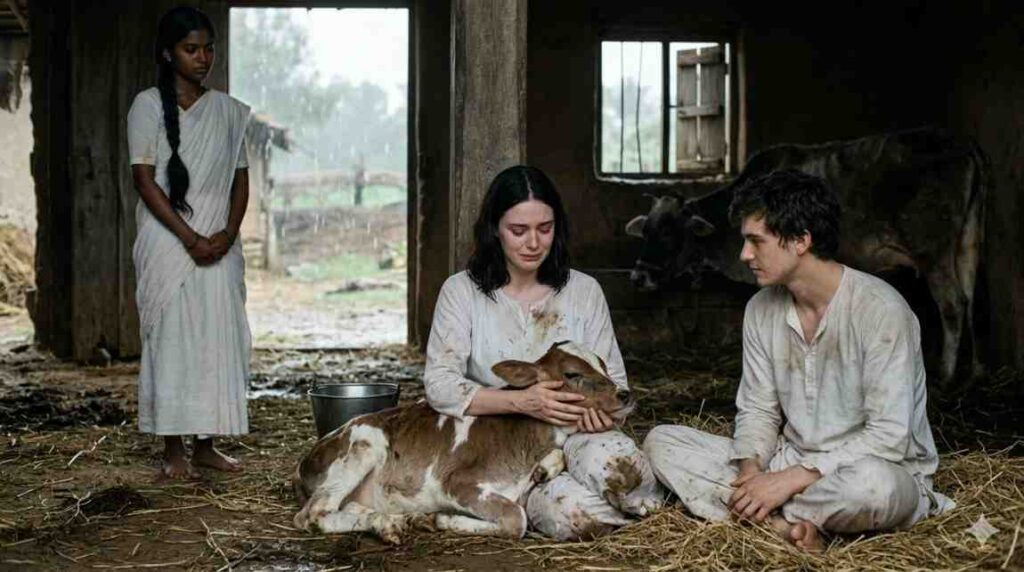
Three weeks passed.
Ophelia stopped counting days. She stopped checking an imaginary watch. She stopped wondering what time it was in her old world.
The cowshed had become her world.
She woke up before sunrise. Walked to the shed in the dark. Fed the cows. Cleaned the stalls. Checked the water. Fixed small things that broke. Learned the name of every animal.
Gauri was still the teacher. But now there was Lakshmi, who kicked when she was annoyed. And Rama, who ate too fast and got sick. And little Parvati, the youngest calf, who followed Ophelia everywhere like a shadow.
Devi had stopped explaining things. She just worked beside Ophelia. Quiet. Steady. Present.
Ophelia’s hands were rough now. Nails broken. Skin cracked. She had stopped wearing shoes. The ground felt different under her bare feet. Real. Hard. Alive.
She had not touched a screen in weeks.
She had not thought about AI models in days.
She had not spoken to the digital Oliver since she left.
Something was changing inside her. Slowly. Quietly. Like the river outside her window.
Then the storm came.
—
The Night the Sky Opened
It started in the evening.
The sky turned dark. Not night-dark. Angry-dark. Purple and green and low. The birds stopped singing. The cows grew restless. Gauri lowed softly, a sound Ophelia had never heard before.
Devi looked at the sky and her face changed.
“Bad storm,” she said. “We must prepare.”
They moved quickly. Brought the cows inside. Secured the gates. Checked the water tanks. Covered the feed.
Ophelia worked without thinking. Her body knew what to do now. Three weeks of repetition had trained her muscles faster than her mind.
Then the rain came.
Not drops. Sheets. The sky opened and water fell like someone had turned on a cosmic tap. Thunder cracked so loud the ground shook. Lightning turned everything white for a single terrifying second.
The power went out.
The cowshed went dark.
The automation system died.
—
The System Failure
Ophelia had built that system.
Not the whole thing. But she had repaired it. Improved it. Added sensors to track water levels and feed distribution. She had been proud of it. A small piece of her old self in this new world.
Now it was dead.
The water pump stopped. The emergency lights died. The feeding conveyor froze mid-cycle, grain spilling uselessly onto the floor.
Her first instinct was to fix it.
Her hands reached for the control panel. Her mind started diagnosing. Loose connection. Blown fuse. Water damage.
But then she heard the sound.
A small, weak cry from the corner of the shed.
Little Parvati. The calf who followed her everywhere. She was trapped against the wall, trembling, her leg bent at a wrong angle. The storm had spooked the older cows. Someone had pushed her. Something had broken.
Ophelia looked at the control panel. Then at Parvati.
She made a choice.
—
The Long Night
She walked away from the system.
Walked to the corner where Parvati lay shaking. Sat down in the mud and the hay and the spilled grain. Gently, so gently, she lifted the calf’s head and placed it on her lap.
The animal was warm. Trembling. Scared.
Ophelia had no tools. No medicine. No phone to call for help. No AI to diagnose the problem.
She had only her hands. Her presence. Her breath.
She held the calf and waited.
The storm raged outside. Thunder shook the walls. Rain flooded the pathway. The other cows lowed in fear.
But Ophelia did not move.
She sat in the dark, in the mud, holding a dying animal, and she did not try to fix anything.
She just stayed.
For the first time in her life, she did not reach for control.
She reached for presence.
—
The Death
Parvati died at dawn.
The storm had passed. The sky was clearing. Birds were singing again. Light crept through the broken windows of the cowshed.
But the calf was gone.
Ophelia held her for a long time after her breathing stopped. She did not cry. She did not speak. She just sat there, covered in mud and hay and grief, holding the small body that had trusted her.
Devi found her like that.
“She is gone,” Ophelia said quietly.
Devi knelt beside her. Touched Parvati’s head gently. Closed the calf’s eyes.
“You stayed with her,” Devi said. “That is what matters.”
“She died anyway.”
“Everyone dies. Not everyone dies held by someone who loves them. You gave her that.”
Ophelia looked down at the small body in her lap. At her own hands. Dirty. Scratched. Useless.
She had done everything right. She had fed the calf. Cleaned her. Protected her from the older cows. Stayed with her through the storm.
And still, Parvati had died.
Because some things cannot be fixed.
Because love is not a system. Loss is not an error. Grief is not a bug that needs patching.
It is just… life.
—
The Breaking Open
Owen found her an hour later.
She was sitting outside the cowshed, staring at the river. Her clothes were still wet. Her hands were still dirty. Her face was blank.
He sat beside her. Did not speak.
After a long time, she said, “I did everything right.”
“I know.”
“Then why did she die?”
Owen was quiet for a moment. Then he said something she would never forget.
“Not everything can be saved, Ophi. Love is not control. Love is presence.”
She turned to look at him. Her eyes were dry. But something inside her was cracking open. Something she had locked away years ago.
“I tried to control everything,” she said. “Oliver. My work. Myself. I thought if I was perfect enough, nothing bad would happen.”
“And now?”
“Now a calf died in my arms. And I could not stop it.”
“That is not failure. That is life.”
She looked back at the river. The water was still brown from the storm. Debris floated past. Broken branches. Fallen leaves. Things that had been uprooted and carried away.
She thought about Oliver. About the AI avatar she had built. About how she had tried to freeze him in time, to control his memory, to make him perfect so she would never have to grieve.
She thought about Parvati. About how she had held her. About how she had stayed.
She had not controlled anything.
She had just loved.
And that was enough.
—
The Confession
That night, Ophelia found Owen near the river.
The moon was full. The water was calm. The storm was over.
“I need to tell you something,” she said.
He turned to face her.
“Oliver left because I tried to fix him. I treated him like a project. I found flaws in everything he did and I pointed them out. Every day. Every conversation. Until he stopped feeling like a person and started feeling like a failure.”
Owen said nothing.
“I built an AI version of him after he left. I fed it every memory. Every conversation. Every piece of data. I made it perfect. And I talked to it every night. For months.”
She paused. Took a breath.
“That is not healing. That is hiding.”
Owen nodded slowly. “I know.”
“You knew?”
“I have known since the first night we met. The way you avoided talking about your ex. The way your hands moved like you were typing when you were stressed. The way you looked at screens.”
“Then why didn’t you say anything?”
“Because you were not ready to hear it. You are ready now.”
She looked at him. At his calm eyes. At his steady hands. At the man who had seen her clearly from the beginning and stayed anyway.
“I don’t want to fix you,” she said quietly. “I don’t want to control you. I don’t want to turn you into a project.”
“What do you want?”
She took a step closer.
“I want to learn how to love without breaking things.”
Owen looked at her for a long time. Then he did something he had never done before.
He reached out and touched her face. Gently. Like she was something fragile. Something precious. Something that did not need fixing.
“You are not broken, Ophi,” he said. “You are just learning.”
She closed her eyes.
For the first time in years, she did not feel alone.
—
Chapter 11 – The Longest Silence
The days after the storm felt different.
Not lighter. Not heavier. Just different. Like the air had been washed clean and Ophelia was breathing it for the first time.
She still went to the cowshed. Still fed the cows. Still cleaned the stalls. Still fixed small things that broke. But something had shifted inside her.
She was not performing anymore.
She was just living.
Parvati’s death had cracked her open in a way no therapy session ever could. The calf had died in her arms. She had not saved her. She had not fixed her. She had simply stayed.
And somehow, staying had been enough.
Devi noticed the change first.
“You move differently now,” Devi said one morning.
“How?”
“Before, you moved like you were fighting something. Now you move like you are dancing. Slow. Soft. No effort.”
Ophelia looked at her own hands. They were feeding grain to Lakshmi, the angry cow who kicked strangers. Lakshmi was not kicking today. She was eating calmly. Trusting.
Ophelia had not tried to tame her. She had just shown up every day. Same time. Same way. Same quiet presence.
The cow had decided to trust her.
No algorithm. No control. No perfection.
Just time and patience and the slow building of something real.
—
The Conversation Owen Had Been Avoiding
Owen had been watching Ophelia change.
He saw it in her shoulders, which had dropped from her ears. In her eyes, which had lost their constant scanning. In her hands, which had stopped trembling.
She was healing.
Not because of him. Not because of the ashram. Not because of the cows.
Because she had finally stopped running from herself.
But Owen had a problem. A problem he had been avoiding since the night they met on the highway.
He was falling in love with her.
Not the safe, clinical love of a psychiatrist for a patient. Not the gentle affection of a friend for a friend.
Real love. Messy love. The kind that made his chest ache when she laughed. The kind that made him want to hold her hand when she walked back from the cowshed at sunset.
The kind that terrified him.
Because Owen had spent twelve years in India learning to detach. To observe without absorbing. To help without drowning.
But Ophelia was making him forget all of that.
And he did not know what to do.
—
The Rule He Was Breaking
That evening, Owen sat alone in his room. The same small room he had occupied for years. A mat. A pillow. A single book.
He was supposed to be meditating. Instead, he was thinking about her.
He thought about the way she had held the dying calf. The way she had sat in the mud without caring about her clothes. The way she had looked at him by the river and said, *”I want to learn how to love without breaking things.”*
He thought about his teacher’s voice. Years ago. A warning he had forgotten.
*”You cannot heal someone you love, Owen. You can only walk beside them. The moment you try to save them, you have already lost yourself.”*
He had nodded then. Understood. Agreed.
But understanding and feeling were different things.
He loved her. And because he loved her, he was terrified of hurting her. Of becoming another version of Oliver. Of being controlled and corrected and turned into a project.
He had seen the pattern. He knew the signs.
But knowing did not make him immune.
—
The Next Morning
Ophelia found him sitting by the river before sunrise.
He was not meditating. He was just sitting. Staring at the water. His shoulders were tight. His jaw was clenched.
She sat beside him.
“You are different today,” she said.
“So are you.”
“I meant you. You seem… scared.”
Owen did not deny it. He had stopped lying to her weeks ago.
“I am scared,” he said.
“Of what?”
“Of us.”
She waited. Did not push. Did not analyze. Just waited.
He took a breath.
“I have spent my entire career helping people heal. I have sat with the dying. I have held the broken. I have watched people rebuild themselves from nothing. And I have never once lost myself in their pain.”
“Until now?”
“Until you.”
She felt the weight of his words. The honesty in them.
“Why me?”
“Because you are not my patient. You are not a case study. You are not someone I can help from a distance and then send home. You are here. Beside me. Every day. And I do not know how to be both things.”
“Both things?”
“Your friend. And the man who loves you.”
The words hung in the air. Simple. Raw. Unpolished.
Ophelia did not speak for a long time.
The river flowed past them. The sun rose behind the hills. Birds began to sing.
Then she said, “I am not asking you to save me, Ovi.”
“I know.”
“I am not asking you to fix me. I am not asking you to be perfect. I am not asking you to be anything other than what you are.”
“Then what are you asking?”
She turned to look at him. Her eyes were clear. No tears. No fear.
“I am asking you to stay. Not as my healer. As my human. Flaws and all.”
—
The Permission to Be Imperfect
Owen looked at her.
Really looked.
He saw the woman who had arrived at the ashram three weeks ago. Tense. Guarded. Desperate for control. He saw the woman sitting beside him now. Softer. Slower. Present.
She had not become perfect. She had stopped trying to be perfect.
That was the difference.
“You are not the same person who landed in Delhi,” he said.
“I am not.”
“Will you go back to your old life? Your work? Your AI models?”
She thought about it. Really thought.
“I do not know,” she said honestly. “Part of me misses it. The problem-solving. The creation. The feeling of building something from nothing.”
“And the other part?”
“The other part wants to sit by this river forever. Watching the water. Feeding the cows. Being no one.”
“That is not running away?”
“That is running toward something. I just do not know what yet.”
Owen nodded. He understood.
Healing was not a straight line. It was a river. Twisting. Turning. Sometimes flowing fast. Sometimes barely moving. But always moving forward.
“I will not try to fix you,” he said.
“And I will not try to control you.”
They sat in silence. The sun was fully up now. The river sparkled.
No promises. No declarations. No perfect ending.
Just two imperfect people. Sitting by the water. Choosing each other anyway.
—
What Ophelia Did That Night
That night, Ophelia did something she had not done since she arrived at the ashram.
She asked for a phone.
Devi gave her an old mobile. Cracked screen. Low battery. No internet.
Ophelia took it to her room. Sat on her cot. Stared at the device in her hands.
She had spent years surrounded by screens. Laptops. Tablets. Phones. Smart watches. Every surface a portal to another world.
Now, the simple act of holding a phone felt strange. Heavy. Like holding a weapon she had forgotten how to use.
She did not call anyone.
She did not check email.
She did not search for anything.
She just held the phone. Felt its weight. Remembered the person she used to be. The one who could not exist without a screen in front of her face.
Then she put the phone down.
Walked outside.
Looked at the stars.
They were brighter here than anywhere she had ever been. Thousands of them. Millions. A sky so full of light it made her feel small. Insignificant. Perfectly unimportant.
She smiled.
For the first time in her life, being small felt like freedom.
—
Chapter 12 – The Honesty That Hurt
The fourth week began quietly.
Ophelia had stopped counting days. She had stopped wondering about her old life. The city. The office. The AI models. They felt like memories from someone else’s story.
She was up before sunrise now. Not because she had to be. Because her body had learned a new rhythm. Sleep when dark. Wake when light. Work when the cows needed her. Rest when they rested.
Simple.
Devi had become something like a friend. They did not talk much. But silence between them was comfortable now. Not awkward. Not heavy. Just two women working side by side, sharing the same air, the same purpose.
The cowshed was running smoothly. Ophelia had fixed the automation system after the storm. But she had not overcomplicated it this time. No unnecessary sensors. No fancy tracking. Just simple, reliable systems that did what they needed to do and nothing more.
She was learning to build differently.
She was learning to live differently.
But some lessons were harder than others.
—
The Question Devi Asked
One afternoon, Devi looked up from her work and asked a question that stopped Ophelia’s heart.
“What will you do when you leave?”
Ophelia had been avoiding that question. Wrapping it in layers of *later* and *not yet* and *I don’t know*.
“I don’t know,” she said.
Devi nodded. Kept working. But her silence was patient. Waiting.
“I had a life before this,” Ophelia said slowly. “A job. An apartment. People who depended on me.”
“Did they?”
“Did they what?”
“Depend on you. Or depend on your fixing?”
The question landed like a stone in still water. Ripples spreading outward.
Ophelia thought about her team at work. About Priya, who had cried in the conference room. About the junior engineers who walked on eggshells around her. About the boss she had shouted at in front of everyone.
They had not depended on her. They had feared her.
“They depended on my fixing,” she admitted.
Devi nodded again. “And now?”
“Now I don’t know who I am without the fixing.”
Devi smiled. Not a happy smile. A knowing smile.
“Good. That is the first honest thing you have said.”
—
The Letter She Did Not Send
That night, Ophelia borrowed the old phone again.
She opened a blank message. Started typing.
*”Dear Oliver…”*
She stopped.
What would she even say? Sorry? She had said sorry before. Many times. Empty apologies followed by the same behavior.
She deleted the line. Started again.
*”I built a version of you. An AI. Perfect. Obedient. Empty. I talked to it every night because I was too afraid to miss the real you.”*
She stared at the words. They were true. Ugly. But true.
*”I deleted it. Not because I stopped missing you. Because I finally understood that the real you deserved better than a ghost.”*
Her thumb hovered over the send button.
She did not press it.
Not because she was afraid. Because Oliver had moved on. He was probably happy now. With someone who did not try to fix him. Someone who let him leave dishes in the sink and forget anniversaries and be imperfectly human.
Sending this message would not help him. It would only ease her guilt.
And her guilt was hers to carry. Not his to absorb.
She deleted the message. Put the phone down.
Some apologies were better left unsent.
Some healing had to happen in silence.
—
The Conversation with Guruji
Guruji called her to his room the next morning.
“Sit,” he said.
She sat.
“You have been here four weeks.”
“Almost five.”
“You have changed.”
“I have tried.”
“Trying is not changing. Trying is effort. Changing is surrender. Which one have you done?”
Ophelia thought about it. Really thought.
“I have stopped fighting,” she said slowly. “Is that surrender?”
Guruji smiled. “It is the beginning of surrender. The middle is harder.”
“What is the middle?”
“The middle is when you realize that surrender is not a single choice. It is a thousand small choices. Every day. Every moment. Choosing to let go instead of holding on. Choosing to breathe instead of control. Choosing to be present instead of perfect.”
She felt the weight of his words.
“How long does the middle last?”
Guruji laughed. “For some, a lifetime. For others, a moment. It depends on how deeply you have buried yourself in your own story.”
“My story?”
“The story that says you must be perfect to be loved. The story that says control is safety. The story that says fixing is caring.”
She looked down at her hands. The story he was describing was her life.
“How do I let go of the story?”
“You do not let go. You outgrow it. Like a snake outgrows its old skin. The skin does not disappear. It falls away when the new skin is ready.”
“When will I be ready?”
Guruji looked at her with eyes that seemed to see through time.
“Soon,” he said. “Very soon. There is a storm coming. Not outside. Inside. You will face something you have been running from your whole life. When that happens, do not run.”
“What will I face?”
He did not answer. He closed his eyes. The conversation was over.
Ophelia sat there for a while longer. Then she stood up. Walked out.
The sun was setting. The river was gold.
Somewhere inside her, something was stirring.
—
What Owen Was Hiding
That evening, Ophelia found Owen in the meditation hall.
He was not meditating. He was sitting with his back against the wall, his head in his hands. She had never seen him like this. Not once.
“Ovi?”
He looked up. His eyes were red. Not from crying. From exhaustion.
“What’s wrong?”
He shook his head. “Nothing. Everything. I don’t know.”
She sat beside him. Did not touch him. Did not push.
“Tell me.”
He was quiet for a long time.
“I spoke to my teacher today. Not Guruji. My teacher from years ago. The one who trained me before I came here.”
“The one in the city?”
“Yes. He told me something I did not want to hear.”
“What?”
“He told me that I have crossed a line. That I am no longer your friend or your guide. That I am…” He stopped.
“You are what?”
“In love with you. And that changes everything.”
She felt her chest tighten. “Why does it change everything?”
“Because I cannot heal you and love you at the same time. The roles are different. A healer holds boundaries. A lover dissolves them. I cannot do both.”
“Then stop being my healer.”
“It is not that simple. Once I have seen you as a patient, I cannot unsee it. The dynamic is already there. The power. The trust. The dependence.”
“I don’t depend on you.”
“Don’t you?”
She wanted to say no. But the word would not come.
Because she did depend on him. Not for survival. But for direction. For clarity. For the calm presence that had guided her through the darkest weeks of her life.
If that was dependence, it was a gentle one. But it was still dependence.
“What are you saying?” she asked quietly.
Owen looked at her. His eyes were wet now.
“I am saying that I may need to step back. Not because I do not love you. Because I love you too much to let you lean on me forever.”
—
The Silence That Followed
Ophelia did not argue.
The old her would have argued. Would have controlled. Would have demanded that he stay exactly where she needed him.
But the old her was fading.
She sat in silence. Let his words settle. Let herself feel the fear beneath them.
“You are afraid,” she said finally.
“Yes.”
“Of what?”
“That when you go back to your world, you will become the old Ophi again. That you will try to control me. That you will turn me into a project. That I will become another Oliver.”
“That is not fair.”
“Fair has nothing to do with it. Fear is not fair.”
She looked at him. At the man who had seen her so clearly from the beginning. Who had never lied to her. Who had held her pain without flinching.
He was not perfect. He was scared. He was human.
And somehow, seeing his fear made her love him more.
“I cannot promise I will not hurt you,” she said. “I am still learning. I will make mistakes. I will probably try to fix things I should not fix. That is who I have been for a long time.”
“I know.”
“But I can promise to try. Every day. To see you. Not as a project. Not as a problem to solve. As a person. Flaws and all.”
Owen closed his eyes. Took a breath.
“That is all I wanted to hear,” he said.
He did not step back.
He stayed.
—
Chapter 13 – What This AI Love Story Lost Before It Could Begin
The days after Owen’s confession were strange.
Not awkward. Not tense. Just strange. Like two people who had admitted something important but did not yet know what to do with the admission.
They still sat by the river. Still walked together at sunset. Still shared meals in silence.
But something had shifted.
Owen was more careful now. More distant in some ways, more present in others. He no longer looked at her like a patient he was observing. He looked at her like a man who was afraid of his own heart.
Ophelia understood. She was afraid too.
Fear was not new to her. She had lived with fear for years. Fear of failure. Fear of abandonment. Fear of being seen as imperfect.
But this fear was different.
This was the fear of hurting someone she loved.
She had hurt Oliver. Not with cruelty. With control. With the slow, quiet violence of constant correction. She had turned their home into a laboratory and their love into an experiment.
She did not want to do that to Owen.
But she did not know how to be any other way.
—
The Memory She Had Buried
One night, Ophelia could not sleep.
She lay on her cot, staring at the ceiling, listening to the sounds of the ashram. Crickets. Wind. The distant rush of the river.
And then, without warning, a memory surfaced.
Oliver. Their last night together.
He was standing by the door. His bag was packed. His face was calm. Not angry. Not sad. Just calm. The calm of someone who had already grieved and was now ready to leave.
“You don’t have to go,” she had said.
“Yes, I do.”
“We can fix this.”
He had looked at her then. Really looked. The way Owen looked at her now.
“Ophi, you don’t want to fix us. You want to fix me. And I am tired of being someone’s project.”
She had no answer then. She had no answer now.
He walked out. The door closed. She heard his footsteps fade down the hallway.
And then she had opened her laptop. And started building.
The AI Oliver was born from that night. Not from love. From refusal. Refusal to grieve. Refusal to admit she had failed. Refusal to let go.
She had carried that digital ghost across months and cities and sleepless nights.
And now, sitting in an ashram on the other side of the world, she finally understood.
The AI Oliver was never about Oliver.
It was about her. About her terror of being wrong. About her inability to sit with loss. About her desperate need to control a world that could not be controlled.
She closed her eyes.
The tears came. Silent. Hot. Endless.
She did not wipe them away.
—
What She Told Owen the Next Morning
She found him by the river. The same place. The same time. The same golden light.
“I need to tell you something,” she said.
He waited.
“I built an AI avatar of my ex-boyfriend. After he left. I fed it every memory. Every conversation. Every piece of data. I made it perfect. And I talked to it every night for months.”
Owen did not flinch. He already knew. But he let her say it anyway.
“That AI was not Oliver. It was a version of Oliver that obeyed me. That never argued. That never left dishes in the sink. That never forgot anything.”
She paused. Took a breath.
“I was not grieving him. I was avoiding him. The real him. The messy, imperfect, beautiful human who loved me and whom I destroyed.”
“You did not destroy him,” Owen said quietly. “You pushed him away. That is different.”
“Is it?”
“He is alive. He is somewhere. Probably happy. Probably with someone who lets him be human. You did not destroy him, Ophi. You lost him. There is a difference.”
She looked at the river. The water was calm today. Almost still.
“I don’t want to lose you the same way,” she whispered.
“Then don’t.”
“How? I don’t know how to love without controlling.”
Owen was quiet for a moment. Then he said something that changed everything.
“Then stop trying to love the way you think love should be. Just love the way you are. Messy. Scared. Imperfect. That is enough.”
—
The Fear Beneath the Fear
That afternoon, Ophelia sat alone in the cowshed.
Gauri was beside her, chewing slowly, her cloudy eyes half-closed. The old cow did not ask for anything. Did not demand anything. Just existed. Peacefully. Completely.
Ophelia rested her head against Gauri’s warm side.
“I am scared,” she whispered to the cow.
Gauri chewed.
“I am scared that I will go back to my old life and become the old me. The one who corrected everyone. The one who could not rest. The one who built ghosts because she was too afraid to feel loss.”
Gauri blinked slowly.
“I am scared that Owen will see the old me and leave. Like Oliver did.”
Gauri shifted her weight. Leaned slightly into Ophelia. A small gesture. Maybe accidental. Maybe not.
Ophelia closed her eyes.
She had spent her whole life believing that fear was a weakness. Something to be overcome. Something to be hidden.
But sitting here, in the hay, with an old cow and a broken heart, she realized something new.
Fear was not the enemy.
Running from fear was the enemy.
She had been running her whole life. From vulnerability. From imperfection. From the terrifying truth that she could not control the people she loved.
She was tired of running.
—
The Decision
That evening, Ophelia made a decision.
She would not go back to her old life.
Not yet. Maybe not ever.
She would stay at the ashram. Not because she was hiding. Because she was not ready to leave. Because the work was not finished. Because she was still learning how to be human.
She found Owen in the meditation hall.
“I am staying,” she said.
He looked up. “For how long?”
“I don’t know. Until I am ready.”
“Ready for what?”
“Ready to love without breaking.”
He stood up. Walked toward her. Stopped a few feet away. Close enough to touch. Far enough to give her space.
“You are already ready,” he said. “You just don’t believe it yet.”
“Then help me believe it.”
“How?”
She looked at him. At his calm eyes. At his steady hands. At the man who had seen her at her worst and stayed.
“Stay with me,” she said. “Not as my healer. As my human. Flaws and all.”
He smiled. A small, sad, hopeful smile.
“I have been staying,” he said. “I never left.”
She reached out. Took his hand.
He did not pull away.
The river flowed past them. The sun set behind the hills. The world kept turning.
And somewhere inside Ophelia, something that had been frozen for years began to thaw.
—
Chapter 14 – The Day She Deleted a Ghost
The seventh week arrived like a slow exhale.
Ophelia had stopped counting time in days. She measured it in small things. The way Gauri leaned into her touch. The way Devi smiled when she entered the cowshed. The way the river changed color from gold to silver to blue.
She was different now. Not perfect. Not healed. Just different.
The sharp edges had softened. The constant scanning had quieted. The need to control everything had loosened its grip.
She still had bad moments. Times when the old panic rose in her chest. Times when she wanted to grab Owen’s face and demand he promise never to leave. Times when she caught herself analyzing his behavior like a system error.
But she noticed those moments now. That was the difference.
Before, she would have acted on them. Corrected. Controlled. Pushed.
Now, she just breathed. Watched the feeling pass. Let it be there without letting it drive.
Guruji had taught her a word: *Sakshi*. Witness.
Not the doer. Not the fixer. Just the witness.
She was learning to witness herself.
—
The Request
One morning, Devi asked her a strange question.
“Do you still have him?”
“Have who?”
“The ghost. The one you built.”
Ophelia froze. She had never told Devi about the AI Oliver. Not directly. But Devi was observant in a way that had nothing to do with technology.
“How do you know about that?”
Devi shrugged. “I know broken things. I know people who build walls. You built a wall shaped like a person. I do not need technology to see that.”
Ophelia looked down at her hands.
“Yes,” she said quietly. “I still have him. On my laptop. Back in my apartment. Across the world.”
“Will you delete him?”
The question hung in the air.
Ophelia had thought about this many times. In the middle of the night. During the long silences. While holding Parvati as she died.
The AI Oliver was not Oliver. She knew that now. It never was.
It was a cage she had built for her own grief. A digital prison where she could feel in control because nothing real ever happened.
“I don’t know if I can,” she said.
Devi nodded. “That is honest. Now try.”
—
The Phone Call
That evening, Ophelia asked for the old phone again.
But this time, she did not type a message. She called her own number. Her apartment. The place she had not thought about in weeks.
The phone rang seven times. Then voicemail.
Her own voice. Recorded months ago. Before the highway. Before Owen. Before the cowshed and the storm and the calf that died in her arms.
*”You’ve reached Ophelia. Leave a message. I’ll fix everything when I get back.”*
She laughed at the last line. *I’ll fix everything.*
That was the old her. The one who believed every problem had a solution. Every broken thing could be repaired. Every loss could be reversed.
She waited for the beep.
Then she spoke.
“It’s me. I’m in India. I’m… different. I don’t know if I’m coming back. Not to the apartment. Not to the old life. I don’t know where I’m going yet. But I need you to do something for me.”
She paused. Took a breath.
“I need you to open my laptop. The password is Gauri. Don’t ask. Just open it. There’s a folder on the desktop. It’s labeled ‘Oliver.’ I need you to delete it. Everything. Don’t look inside. Don’t ask questions. Just delete it.”
Another pause.
“I’m sorry for the person I was. I’m trying to become someone else.”
She hung up.
Then she sat on her cot and waited.
—
The Call Back
Twenty minutes later, her phone rang.
It was her own number. Calling back.
She answered.
“I did it,” said the voice on the other end. Not her voicemail. A real person. Her neighbor. The one who had a spare key.
“Thank you,” Ophelia whispered.
“Are you okay? You sound… different.”
“I am different.”
“Should I be worried?”
Ophelia thought about it. “No. I think this is the first time in years I’m actually okay. I just didn’t know it until now.”
There was a long silence on the line.
“Do you want me to check anything else?” the neighbor asked.
“No. Just that folder. Burn it if you can. Or delete it twice. I just need it gone.”
“It’s gone.”
Ophelia closed her eyes. The tears came. But they were not sad tears. They were not happy tears either. They were something else. Something she had no name for.
Relief, maybe. Or grief. Or both.
“Thank you,” she said again.
Then she hung up.
The ghost was gone.
—
What She Felt
She expected to feel empty.
Instead, she felt light.
For months, the AI Oliver had been a weight she carried without knowing it. A constant low hum of guilt and longing and unfinished business.
Now it was gone.
Not because she had stopped missing Oliver. She would always miss him. Not the perfect version she had built. The real one. The one who laughed too loud and forgot things and left dishes in the sink.
But missing someone and holding a digital ghost were different things.
Missing was human.
The ghost was a cage.
She had unlocked the door. Walked out. Left it behind.
She sat on her cot and cried for a while. Then she washed her face. Walked outside. Found Owen by the river.
“I deleted him,” she said.
Owen looked at her. Did not ask who. Did not ask why. He already knew.
“How do you feel?” he asked.
“Like I can breathe.”
He nodded. “That is what letting go feels like. Not loss. Space.”
She sat beside him. Leaned her head on his shoulder. He did not move away.
The river flowed. The stars came out. The world kept turning.
And Ophelia, for the first time in years, was not planning. Not controlling. Not fixing.
Just sitting. Just breathing. Just being.
It was not much.
It was everything.
—
The Question She Finally Asked
After a long silence, she spoke.
“Ovi?”
“Yes.”
“Do you think Oliver is happy?”
Owen was quiet for a moment.
“I think Oliver is alive. I think he is somewhere. I think he has probably learned to be happy without you. Not because you were not enough. Because he had to.”
“That is not an answer.”
“It is the only honest one I have.”
She thought about that. About how some questions did not have clean answers. About how closure was not a thing you found. It was a thing you built. Slowly. Painfully. Day by day.
She had started building hers.
Not with Owen’s help. Not with the ashram’s help. With her own two hands. Her own messy, imperfect, human hands.
“I think I am ready,” she said.
“Ready for what?”
“To go back.”
Owen turned to look at her. “When?”
“Soon. Not tomorrow. Not next week. But soon. I need to face my old life. Not run from it.”
“And your work? Your AI models?”
She thought about it. About the ethical research she had abandoned. About the projects that did harm disguised as help. About the engineers she had trained to value perfection over humanity.
“I need to change them,” she said. “Or leave them. I don’t know which yet. But I cannot go back to the way things were.”
Owen nodded slowly.
“Then I will come with you,” he said.
“To the city?”
“To wherever you go. Not as your healer. As your human. If you want.”
She looked at him. At his calm eyes. At his steady hands. At the man who had seen her at her worst and stayed.
“Yes,” she said. “I want.”
—
Chapter 15 – The Return
The flight back to the city felt nothing like the flight to India.
Eight weeks ago, Ophelia had sat in the same kind of seat, stared out the same kind of window, but felt completely different. Then, she had been terrified. Clinging to control. Unsure if she was running toward something or running away from everything.
Now, she was calm.
Not the fake calm of someone who had meditated for an hour and called it healing. The real calm of someone who had sat in the mud with a dying calf. Who had cleaned stalls and fed cows and learned the names of animals that did not care about her achievements.
Owen sat beside her. Reading a book. Not talking. Not needing to talk.
They had not defined what they were. Lovers? Friends? Something in between? The labels did not matter. What mattered was that he was there. And she was not trying to control him.
That was enough.
—
The City That Felt Foreign
The airport was loud.
Ophelia had forgotten how loud the world could be. Announcements blaring. Carts beeping. People shouting into phones. Screens everywhere. Billboards. Advertisements. Digital faces selling things no one needed.
She felt overwhelmed. Not in a bad way. In a disoriented way. Like she had stepped out of a river and into a storm.
Owen placed a hand on her back. Lightly. Briefly.
“Breathe,” he said.
She breathed.
They walked through the terminal. Collected their bags. Stepped outside. The air was hot and thick and smelled like traffic and exhaust and something chemical she could not name.
Eight weeks ago, this smell had been normal. Now it felt like an attack on her senses.
“How do people live like this?” she asked.
Owen smiled. “They don’t notice. That is the problem.”
—
The Apartment
Her apartment felt like a museum.
Everything was exactly where she had left it. The same furniture. The same dishes in the sink. The same silence.
She walked to her desk. Her laptop was there. Closed. Waiting.
Her neighbor had deleted the AI Oliver folder. But the laptop itself held so many other ghosts. Work emails. Unfinished projects. Months of her life spent training machines to be perfect while she crumbled inside.
She did not open it.
Not yet.
She walked to the window. Looked out at the city. The buildings. The traffic. The millions of people living their lives, most of them staring at screens, most of them unaware that there was another way to exist.
She had been one of them. Now she was not.
The thought was terrifying and liberating in equal measure.
Owen stood in the doorway. He had not come inside. He was giving her space.
“Do you want me to stay?” he asked.
She turned. Looked at him. At the man who had seen her at her worst and stayed anyway.
“Not tonight,” she said. “I need to be alone. With this.”
He nodded. “Tomorrow?”
“Tomorrow.”
He turned to leave. Then stopped.
“Ophi?”
“Yes.”
“You are not the same person who left. Do not pretend to be her just because you are back in her house.”
He walked away.
She stood in the doorway for a long time, watching the empty hallway.
Then she closed the door. Leaned against it. Slid down to the floor.
And sat in the silence.
No laptop. No phone. No AI ghost.
Just her. And the city. And the slow, terrifying work of becoming someone new.
—
The First Day Back at Work
She had texted her boss from the airport.
*”I am back. I need to talk to you. Tomorrow. 9 AM.”*
He had replied: *”Welcome back. Same old Ophi?”*
She had stared at that message for five minutes. Then she typed: *”No. Different.”*
The next morning, she walked into the office.
Everything looked the same. The same gray desks. The same glowing screens. The same smell of coffee and stress. Her team looked up as she walked in. Priya’s eyes went wide. Meera smiled cautiously.
“Ophi? You look… different,” Meera said.
“I am different.”
“Different how?”
Ophelia thought about it. “I stopped trying to be perfect. It nearly killed me. So I stopped.”
No one knew what to say.
She walked to her boss’s cabin. Knocked. Entered.
He was a good man. Overworked. Stressed. But good. He had defended her when she shouted at him. Given her space to leave. Not asked too many questions.
“You look well,” he said.
“I am well. For the first time in years.”
“Sit down. Tell me.”
She sat. And she told him. Not everything. But enough. The highway. The ashram. The cowshed. The calf that died. The silence. The slow, painful work of unlearning perfection.
He listened without interrupting.
When she finished, he leaned back in his chair.
“So what do you want, Ophi?”
She took a breath.
“I want to change the way we build AI. No more behavioral manipulation. No more emotional exploitation. No more training machines to replace human connection.”
“That is a big ask.”
“I know.”
“Our clients pay for those things.”
“I know.”
He looked at her for a long time. Then he smiled. A tired, sad, hopeful smile.
“I have always known you were special, Ophi. Not because you were perfect. Because you cared. Even when you were broken, you cared. You just forgot how to show it.”
“I am learning again.”
“Then teach us.”
—
The New Work
The weeks that followed were not easy.
Ophelia faced resistance. From clients who wanted their manipulative AI models. From colleagues who did not understand why she had changed. From her own doubts, which whispered that she was throwing away everything she had built.
But she did not give up.
She started small. An ethics committee. A review process for new projects. A mental health program for engineers who spent too many hours training machines to feel.
She spoke at conferences. Not about technical breakthroughs. About the danger of perfection. About how training AI to be flawless had nearly destroyed her own humanity.
Some people listened. Some walked out.
She did not care.
She was no longer building machines to replace humans. She was building machines to help humans be more human.
It was slower work. Less profitable. More frustrating.
But it was honest.
And for the first time in her career, she slept through the night.
—
Owen, From a Distance
She saw Owen less often now.
Not because they were avoiding each other. Because he had stepped back. On purpose. To give her space to become herself without leaning on him.
They still met for coffee. Still walked together. Still talked for hours.
But he no longer sat in her apartment. No longer stayed until midnight. No longer let her depend on his presence to feel safe.
It hurt. She missed him.
But she understood.
He was testing her. Not cruelly. Gently. To see if her changes were real. To see if she could stand on her own.
Some nights, she wanted to call him. To text him. To ask him to come over.
She did not.
She sat with the loneliness instead. Let it wash over her. Let it pass.
It always passed.
That was what she had learned in the ashram. Feelings are not permanent. They come. They go. You do not have to act on every one.
She was learning to be alone without being lonely.
It was the hardest thing she had ever done.
It was also the most important.
—
Chapter 16 – The Separation That Saved Her
Three months passed.
Ophelia had built a new life. Not a perfect one. A real one.
She went to work. She came home. She cooked meals instead of ordering in. She slept at regular hours. She called Devi sometimes, just to hear about the cows. She thought about Gauri often, about the old cow’s cloudy eyes and patient presence.
She was not happy every day. Some days were hard. Some nights, the old panic returned. The urge to control. The need to fix. The whisper that said she was not enough.
But she had learned to sit with those feelings. To witness them without becoming them.
That was the difference.
Owen had kept his distance. Not coldly. Gently. He still replied to her texts. Still met her for coffee once a week. Still smiled when he saw her.
But he no longer looked at her like a patient. He looked at her like a man who was waiting.
Waiting for what, she did not know.
Until one evening, he told her.
—
The Conversation at the Café
They were sitting at their old table. The same café. The same corner. The same black coffee for him, flat white for her.
But everything else had changed.
“You are different,” he said.
“You say that every time we meet.”
“Because it is true every time. You are not the woman who landed in India. You are not the woman who held a dying calf. You are not even the woman who deleted her digital ghost.”
“Then who am I?”
He looked at her for a long time.
“You are someone who no longer needs me to survive.”
The words landed softly. But their weight was enormous.
“What do you mean?”
“I mean that I have been waiting. Watching. Seeing if your changes were real or temporary. If you would fall back into old patterns when the pressure returned.”
“And?”
“And you have not. You have built a new life. A new way of working. A new relationship with yourself. You are standing on your own.”
She felt a cold hand wrap around her heart.
“You are leaving,” she said.
“No. I am stepping back. There is a difference.”
“I don’t understand.”
Owen leaned forward. His voice was soft. Almost a whisper.
“Ophi, I have been your healer since the night we met on the highway. That was my role. That was what you needed. But healing is not a permanent state. At some point, the healer must become just another person. Or the patient never truly stands alone.”
“So what are you saying? We cannot be together?”
“I am saying that we cannot be together until you are sure you do not need me to be your healer anymore. Because I cannot be both. I cannot love you and fix you at the same time. It is not fair to either of us.”
—
The Old Ophi Would Have Panicked
The old Ophelia would have grabbed his hand. Demanded he stay. Made promises she could not keep. Tried to control the situation with words and tears and emotional pressure.
The new Ophelia sat in silence.
She felt the fear rise. The old terror of abandonment. The whisper that said *see, everyone leaves, you are not enough*.
But she did not act on it.
She breathed. Watched the fear. Let it be there without letting it drive.
“You are scared,” she said finally.
“Yes.”
“Of what?”
“That when we become something more, you will try to control me. That you will start correcting my flaws. That you will turn me into a project. That I will become another Oliver.”
“Those are your fears. Not mine.”
“They are my fears. But they are also patterns. And patterns repeat unless they are broken.”
She looked at him. At the man who had seen her so clearly from the beginning. Who had traveled across the world with her. Who had sat beside her while she held a dying calf.
He was not perfect. He was scared. He was human.
And she loved him for it.
“Then give me time,” she said.
“How much?”
“I don’t know. But I will not ask you to stay until I am sure I will not break you.”
He nodded slowly.
“That is the most honest thing you have ever said to me.”
—
The Month Apart
They agreed to one month.
No meetings. No coffee. No long walks. Just space. Complete space.
Ophelia could text him if there was an emergency. But no casual check-ins. No good morning messages. No reaching for comfort out of habit.
She needed to prove to herself — not to him — that she could stand alone.
The first week was the hardest.
She woke up every morning reaching for her phone. Wanting to text him. Stopping herself. Putting the phone down. Sitting with the emptiness.
She cried some mornings. Not from sadness. From withdrawal. Like a drug leaving her system.
Because that was what Owen had become, without her realizing it. A comfort. A safety net. A presence she leaned on without asking if she was leaning too hard.
She had stopped controlling people. But she had started depending on Owen.
That was not love. That was transfer.
She needed to break that too.
—
The Second Week
By the second week, the crying stopped.
She still missed him. Still thought about him constantly. Still wondered what he was doing, whether he was thinking about her, whether he would be there at the end of the month.
But she stopped reaching for her phone.
She started filling her evenings differently. Cooking. Reading. Walking in the park near her apartment. Calling old friends she had neglected. Not the ones from work. The ones from before. The ones who knew her before she became perfect.
They were surprised to hear from her.
“Ophi? Is that really you?”
“Yes. It’s me. The old me. I think.”
“You sound different.”
“I am different. I am trying to be.”
They did not ask many questions. They were just happy she was back.
She realized, with some shame, how long she had been gone. Not physically. Emotionally. She had disappeared into her work, her control, her perfectionism. Her friends had stopped calling because she had stopped answering.
She had to earn them back. Slowly. Patiently. Without demanding forgiveness.
Another lesson from the ashram. Trust is rebuilt in small moments. Not grand gestures.
—
The Third Week
Owen sent her a letter.
Not an email. Not a text. A handwritten letter, delivered to her apartment by post.
She held it in her hands for a long time before opening it. The paper was thick. The handwriting was small and neat.
He wrote:
“Friend Ophi,
I am not writing to check on you. I am writing to tell you that I am proud of you. Not because you are perfect. Because you are trying.
I am also writing to tell you that I miss you. Not as a healer misses a patient. As a human misses another human.
But missing someone and needing someone are different things. I am learning that too.
See you in a week.
No thank you. No sorry in friendship.
Ovi”
She read the letter three times. Then she folded it carefully. Placed it on her desk. Did not reply.
He had not asked for a reply.
He had simply told her the truth.
That was what she loved about him. He never performed. Never hid. Never played games.
He was the most honest person she had ever met.
And she was learning to be honest too.
—
The Fourth Week
By the fourth week, Ophelia stopped counting days.
She woke up one morning and realized she had not thought about Owen for several hours. Not because she had stopped caring. Because her mind was full of other things. Work. Friends. A new book she was reading. A recipe she wanted to try.
He was still there. In her heart. In her thoughts.
But he was no longer the center of her universe.
She had built a life that did not revolve around him.
And that, she realized, was the only way they could ever be together. Not as healer and patient. Not as fixer and broken. As two whole people. Choosing each other. Not needing each other.
The month was almost over.
She was ready.
Not perfect. Not healed. Not finished.
But ready.
—
Chapter 17 – The Coffee That Was Finally Due
The morning of the thirty-first day, Ophelia woke up before sunrise.
She did not set an alarm. Her body had learned a new rhythm in the ashram, and that rhythm had stayed with her. Wake with the light. Breathe before moving. Sit for a moment in silence before facing the world.
She sat on her balcony. The city was quiet. The sky was turning from black to blue to pale pink. Somewhere below, a bird sang.
She was not nervous.
That surprised her.
The old Ophelia would have been a mess. Changing clothes ten times. Rehearsing conversations in her head. Trying to control every possible outcome.
The new Ophelia had picked out a simple dress the night before. She had not thought about it since. She had not planned what to say. She had not imagined how the meeting would go.
She would show up. She would be present. She would let whatever happened happen.
That was all she could do. That was all anyone could do.
—
The Café
They had agreed to meet at the same place. The same corner table. The same time. 4 PM.
Ophelia arrived at 3:58.
Owen was already there.
He was sitting in his usual spot. Black coffee in front of him. No phone. No laptop. Just a book that he was not reading. He was staring out the window, his face calm, his hands still.
He looked up as she approached. He did not stand. He did not rush. He just looked at her. Really looked.
She sat down across from him.
The waiter came. She ordered a flat white. He said nothing.
For a long moment, neither of them spoke.
Then Owen smiled.
“Friend Ophi.”
“Friend Ovi.”
“Your coffee is due.”
She laughed. A real laugh. The kind that came from somewhere deep and unexpected.
“You have been waiting a long time to say that.”
“Seven months. Since the night on the highway.”
“You counted?”
“I remember. There is a difference.”
She looked at him. At the man who had seen her broken and stayed. Who had taken her across the world. Who had sat beside her while a calf died in her arms. Who had stepped back so she could learn to stand alone.
She loved him. Not because he was perfect. Because he was real.
“I am not going to fix you,” she said.
“I know.”
“I am not going to control you.”
“I know.”
“I am going to mess up. I am going to have bad days. I am going to say the wrong thing and forget important things and sometimes fall back into old patterns.”
“I know.”
“And you are still here?”
He reached across the table. Took her hand. His fingers were warm. Steady. Real.
“I am still here,” he said. “Not because you are perfect. Because you are trying. That is all I have ever wanted.”
—
The Conversation They Had Been Avoiding
They talked for hours.
Not about the past. Not about the month apart. Not about all the things they had not said.
They talked about the future.
“I am not moving back to India,” Owen said. “Not yet. My work is here. My patients are here. But I will go back. Every year. To the ashram. To Guruji. To the river.”
“I know.”
“Would you come with me? Sometimes?”
She looked at him. At the hope in his eyes, carefully hidden but still there.
“I would like that,” she said. “But I cannot promise every time. I have work too. New work. Work that matters.”
“I know.”
“And I cannot promise that I will never try to control you. I am still learning. I will make mistakes.”
“I know.”
“Then what are we doing, Ovi? What is this?”
He was quiet for a moment. Then he said something that made her heart stop.
“This is two people who have spent their whole lives helping others and forgetting themselves. This is two people who are terrified of being loved because they are not sure they deserve it. This is two people who are going to try anyway.”
“That is not a plan.”
“No. It is better than a plan. It is a beginning.”
—
The Walk
They left the café at 7 PM. The same time they had left months ago, after their first real conversation. The same streets. The same streetlights. The same comfortable silence.
But everything was different.
Ophelia was different.
She walked beside him. Did not try to hold his hand. Did not try to control the pace. Did not try to fill the silence with words.
She just walked. Present. Alive. Human.
They stopped outside her building. The same building where he had dropped her after the highway. The same doorstep where she had watched him drive away.
“I am not going to invite you in,” she said.
“I know.”
“Not because I do not want to. Because I am not ready. And I am learning to be honest about what I am not ready for.”
Owen nodded. “That is the healthiest thing you have ever said to me.”
She smiled. “No thank you.”
“No sorry.”
They stood there for a moment. The city hummed around them. Cars passed. People walked by. Life continued.
“Tomorrow?” he asked.
“Tomorrow,” she said.
He turned. Walked away. Did not look back.
She watched him go. The same way she had watched him drive away on the highway. The same way she had watched him walk away from the ashram.
But this time, there was no fear.
There was only hope.
Small. Fragile. Imperfect.
But real.
—
What She Did That Night
Ophelia went upstairs. Unlocked her door. Stepped inside.
Her apartment was quiet. The same furniture. The same walls. The same view of the city.
But she saw it differently now.
She saw it as a place she had built to hide. A fortress of control. A museum of perfection.
She walked to her desk. Her laptop was there. Closed. Waiting.
She opened it.
The screen glowed. Her old life stared back at her. Emails. Projects. A hundred unfinished tasks.
She did not feel overwhelmed. She did not feel the old panic. She felt something new.
Clarity.
She opened a new document. Started typing.
*”Ethical AI Framework — Draft”*
She wrote for an hour. Then she closed the laptop. Walked to the window. Looked out at the city.
Somewhere out there, Owen was walking home. Alone. The same as her.
But they were not lonely anymore.
That was the difference.
—
The Dream
That night, Ophelia dreamed of Gauri.
The old cow was standing in a green field. The sun was warm. The river was flowing nearby. Gauri looked at her with those cloudy eyes. Patient. Peaceful. Unafraid.
*”You are different,”* the cow seemed to say.
*”I am trying,”* Ophelia said in the dream.
“Trying is enough.”
She woke up with tears on her face. But she was smiling.
She looked at her phone. No messages from Owen. She had not expected any.
She put the phone down. Made tea. Sat on the balcony.
The sun was rising. The city was waking up. Somewhere, a bird was singing.
She thought about the highway. About the night her car broke down. About the stranger who stopped to help. About the man who had changed everything without trying to change anything.
She thought about Oliver. About the AI avatar she had deleted. About the real person she had lost because she did not know how to love without controlling.
She thought about the ashram. The cowshed. The calf that died in her arms.
She thought about Parvati.
Love is not control. Love is presence.
Owen had said that to her. She had not understood then. She understood now.
Love was not about making someone perfect. It was about showing up. Staying. Being there. Even when you could not fix anything. Especially when you could not fix anything.
She finished her tea. Went inside. Got ready for work.
The day was waiting.
And so was he.
—
Chapter 18 – How This AI Love Story Found Its Imperfect Ending
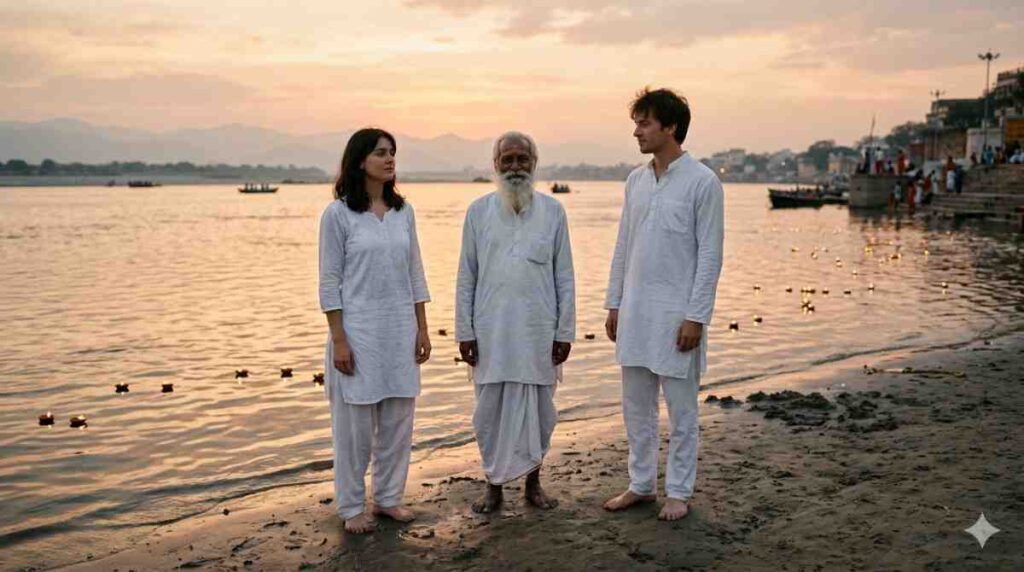
Six months later, Ophelia stood at the same airport gate where she had once waited for a flight to India.
But everything was different.
She was different.
Her bag was still small. She still packed light. But now she packed differently. Not because she was running away. Because she had learned that things did not matter. Presence did.
Owen was beside her. He was reading a book. The same worn paperback from their first flight. Some pages were loose now. The spine was cracked. He had read it a dozen times.
“You could buy a new one,” she said.
“I like this one.”
“It is falling apart.”
“So am I. That does not mean I need replacing.”
She smiled. That was something he said often. Something she had learned to believe.
Imperfection was not failure. Imperfection was life.
—
The Return to Rishikesh
The flight landed in Delhi. The same chaos. The same colors. The same smells that had once overwhelmed her.
Now they felt familiar. Almost comforting.
The drive to Rishikesh was the same. The hills. The river. The green that went on forever.
But Ophelia saw it differently now. She was not a lost woman running from her life. She was someone returning to a place that had saved her.
Owen held her hand during the drive. Not because she needed him to. Because they both wanted to.
The ashram gates appeared. The same simple entrance. The same dirt path. The same silence.
Guruji was waiting.
He was older now. Thinner. His eyes were the same. Seeing everything. Judging nothing.
He looked at Ophelia. Then at Owen. Then back at Ophelia.
“You came back,” he said.
“I came back.”
“Not because you are broken?”
“No. Because I am whole. And I wanted to say thank you.”
Guruji smiled. A wide, joyful smile that crinkled his entire face.
“That is the first time you have told the truth without being asked.”
—
The Cowshed
She went to the cowshed first.
Devi was there. The same Devi. Barefoot. Smiling. Holding a bucket.
“You are back,” Devi said.
“I am back.”
“To stay?”
“For a while. Not forever. But for now.”
Devi nodded. Handed her the bucket. “The cows missed you.”
“Did they?”
“Cows do not miss people. But I did.”
Ophelia laughed. Took the bucket. Walked into the shed.
Gauri was in the same corner. Older now. Slower. Her cloudy eyes were cloudier. But she turned her head when Ophelia approached. Made a low sound. Recognition.
Ophelia knelt beside her. Touched her neck. The skin was warm. Rough. Real.
“I am sorry I was gone so long,” she whispered.
Gauri blinked slowly. Forgave her. Or did not need to forgive her. Cows did not hold grudges.
Ophelia stayed there for a long time. In the hay. With the cows. With the silence.
This was where she had started to heal. Not in a meditation hall. Not in a therapy session. Here. In the dirt. With animals who did not care about her achievements.
She had come here broken. She was leaving here whole.
Not perfect. Whole.
There was a difference.
—
The Evening Prayer
That evening, Owen took her to the Ganga Aarti.
She had never been. The first time she was in Rishikesh, she had been too lost in her own pain to notice anything outside herself.
Now she stood by the river as the sun set. The sky turned orange and pink and gold. Lamps floated on the water. Priests chanted in ancient languages she did not understand.
The sound was beautiful. Deep. Resonant. Older than any AI she had ever built.
Owen stood beside her. Not touching. Just present.
“Thank you,” she said.
“For what?”
“For stopping on the highway. For the coffee. For seeing me when I was trying to be invisible.”
He turned to look at her. The firelight reflected in his eyes.
“I saw you because you were not invisible, Ophi. You were screaming. Silently. But screaming. I just happened to be the one who heard.”
“Anyone could have stopped.”
“But you did not. You stopped.”
He smiled. “No thank you.”
“No sorry.”
They stood in silence. The chanting continued. The river flowed. The world kept turning.
Ophelia felt something she had not felt in years.
Peace.
Not the false peace of control. Not the numb peace of avoidance.
The real peace of someone who had stopped fighting herself.
—
The Voice Behind Her
The Ganga aarti ended. The crowd began to disperse.
Ophelia stood by the river, watching the last lamps drift downstream. Owen had stepped away to speak with someone he knew. She was alone. But not lonely.
Then she heard a voice behind her.
“Coffee still due… Friend Ophi.”
She froze.
The voice was familiar. Too familiar. A voice she had not heard in over a year. A voice she had deleted from her laptop. A voice she had buried and grieved and finally let go.
She turned slowly.
Oliver was standing there.
The real Oliver. Not the AI version. Not the ghost she had built. The real, living, breathing human man she had loved and lost and mourned.
He looked different. Older. Calmer. His eyes were softer. His shoulders were relaxed. He was wearing a simple white kurta, like everyone in the ashram.
“Oliver?” Her voice was barely a whisper.
“Hi, Ophi.”
“How… why… what are you doing here?”
He smiled. A small, sad, gentle smile.
“I have been here for six months. The ashram. The cowshed. The meditation. I came here to heal. Just like you.”
“You knew I was here?”
“Not until yesterday. Guruji told me. He said there was someone I needed to see. Someone who had also been broken by perfection. Someone who had also built ghosts.”
Ophelia felt the world tilt beneath her feet.
“You are not angry?”
“I was. For a long time. But anger does not help. It just burns. I came here to let it go.”
—
The Conversation by the River
They walked along the riverbank. The moon was high. The water was dark.
“I deleted you,” she said finally. “The AI version. Months ago.”
“I know.”
“How do you know?”
“Because I felt it. That sounds crazy. But I felt something shift. Like a weight I had been carrying suddenly disappeared.”
She stopped walking. Looked at him.
“I am sorry, Oliver. For the way I treated you. For trying to fix you. For building a ghost because I could not face losing you.”
He was quiet for a moment.
“I know you are sorry. I can see it. In your face. In your hands. In the way you stand. You are not the same person who pushed me away.”
“I am trying not to be.”
“Trying is enough.”
She blinked. That was what Guruji had said. What Owen had said. What the cows had taught her.
Trying was enough.
“Are you happy?” she asked.
Oliver looked at the river. The moon reflected on the water. Broken into a thousand pieces. Beautiful anyway.
“I am learning to be. That is the best anyone can do.”
“Do you hate me?”
He turned to look at her. His eyes were kind. No anger. No resentment. Just a quiet acceptance that looked like peace.
“I never hated you, Ophi. I was exhausted. There is a difference.”
She nodded. She understood now. Owen had taught her that too.
“What happens now?” she asked.
“Now, nothing. We are two people who used to love each other. Now we are two people who have both been broken and healed in different ways. That is all.”
“Can we be friends?”
Oliver smiled. “No thank you.”
She laughed. The sound surprised her.
“No sorry,” she said.
They stood in silence for a moment. Then Oliver turned to go.
“Goodbye, Ophi.”
“Goodbye, Oliver.”
He walked away. Disappeared into the darkness.
She stood by the river. Watching the water. Feeling the weight of everything that had just happened.
She had faced him. Apologized. Let him go.
Not because she was perfect. Because she was human.
—
The Final Piece
Owen found her sitting by the river. Her feet in the water. Her hands in her lap. Her face wet with tears.
He sat beside her. Did not ask who she had been talking to. He already knew.
“Are you okay?” he asked.
“I am not okay. But I am not broken either. I am somewhere in between. And I think that is where I am supposed to be.”
He nodded. “That is where everyone is supposed to be. We just pretend otherwise.”
She leaned her head on his shoulder.
“I love you, Ovi. Not because you fixed me. Because you saw me. Even when I was ugly. Even when I was controlling. Even when I was building ghosts.”
“I love you too, Ophi. Not because you are perfect. Because you are real.”
The river flowed. The stars came out. The world kept turning.
Ophelia closed her eyes.
She thought about the highway. About the night her car broke down. About the stranger who stopped to help.
She thought about the ashram. The cowshed. The calf that died in her arms.
She thought about Oliver. About the AI avatar she had deleted. About the real person she had finally let go.
She thought about Owen. About the man who had taught her that love was not control. Love was presence.
She opened her eyes.
The river was still there. The stars were still there. Owen was still there.
She was still there.
Imperfect. Trying. Human.
That was enough.
—
Final Line:
AI had slowly turned Ophelia from a human into a machine. But love taught her how to become imperfect again.
—
Tale Basket
Eternal Love- blossoming of young love
Slow burn- Authentic Vs Synthetic love
Friends to lovers Romance- Eternal Echoes
Predictive AI vs Human Free Will: The 33.3% Paradox
“Friends to lovers is not about crossing a line. It is about realizing the line was never there — only trust, built slowly, brick by brick.”
FAQ
Q1. Is this a robot love story?
No. This AI love story has no robots. It is about a woman who trains artificial intelligence to be perfect and slowly forgets how to be human herself.
Q2. Does it have a happy ending?
Yes and no. This psychological romance story ends with hope, not perfection. Two imperfect people choose each other. No grand drama. Just something real.
Q3. Do I need tech knowledge to enjoy it?
Not at all. This human and AI relationship story is about loneliness, control, healing, and learning how to love. No coding knowledge is required.
“Eternal love is not about loving someone forever. It is about becoming someone who can be loved beyond their flaws.”
“Slow burn romance is not about taking time to fall in love. It is about taking time to become someone worth falling in love with.”

0 Comments