

By: Ranjan Sarkhell
–
Table of Contents
–
Introduction
Rivals to lovers and enemies to lovers are two of the most popular romance tropes. They are frequently confused and used interchangeably.
This blog does not review books. It delves right into the differences between the two, as well as how the two overlap and why both are so popular despite the differences.
Let’s begin by defining the two.
Defining Rivals to Lovers
While the two tropes are similar in some ways, there are enough differences to separate the two.
Rivals to lovers describes two people who have competing ambitions. They are both after the same prize, but only one can obtain it.
These two are evenly matched and genuinely respect each other, though they may not admit it.
The stakes are usually not life or death and more about reputation, career, and achieving one’s goals despite the other person’s presence in the way.
The tone is light-hearted and flirtatious with a hint of competitiveness and a whole lot of banter between the two.
Enemies to Lovers Definition
Meanwhile, enemies to lovers are two people who are on opposing sides. There is a fundamental difference between the two that causes them to frequently clash.
They are usually not on even ground, while one may have some redeemable qualities, the other may be completely unsavory.
There is an element of life-and-death stakes or betrayal of some sort.
The tone is serious, almost grim, as two people who should despise each other find a reason to stand down and fall in love anyway.
Key Differences Between Rivals to Lovers and Enemies to Lovers
Conflict: Rivals compete for the same prize; enemies are on opposing sides
Feelings: Rivals have respect mixed with competitiveness; enemies have a feeling of loathing
Stakes: Rivals have career and reputation on the line; enemies have life and death at stake
Tone: Rivals are lighthearted, enemies are serious
Respect: Rivals already have respect for each other; enemies have to earn respect
Transformation: Rivals need to admit feelings; enemies require a change in their moral alignment
The differences may seem stark, but the two still have overlaps that cause confusion between the two tropes.
Key Differences Between Rivals to Lovers and Enemies to Lovers
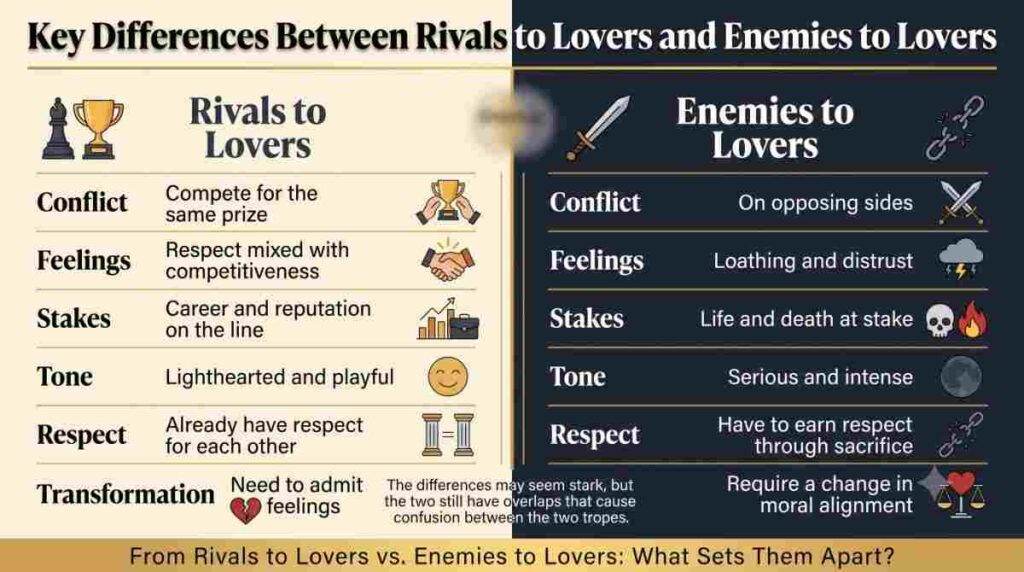
| Aspect | Rivals to Lovers | Enemies to Lovers |
| Conflict | Rivals compete for the same prize | Enemies are on opposing sides |
| Feelings | Respect mixed with competitiveness | Loathing and distrust |
| Stakes | Career and reputation on the line | Life and death at stake |
| Tone | Lighthearted and playful | Serious and intense |
| Respect | Already have respect for each other | Have to earn respect through sacrifice |
| Transformation | Need to admit feelings | Require a change in moral alignment |
The differences may seem stark, but the two still have overlaps that cause confusion between the two tropes.
Do the Tropes Overlap?
As previously mentioned, there are enough differences to separate the two. However, there are some instances when the lines blur.
One story can feature both enemies to lovers and rivals to lovers. For instance, there can be rivals to lovers who become enemies after one betrays the other.
Meanwhile, enemies to lovers can turn into rivals to lovers after overcoming their mutual hatred.
When considering the general premise of enemies to lovers, there is a fundamental difference in the two parties.
In the case of rivals, it is all about the unhealthy obsession with proving to the world that they are the best and most deserving.
Why Are Both So Popular?
While these romance tropes are different in most cases, they still provide pretty much the same amount of drama and steam.
The two have been around for a long time, and readers keep coming back for more. Why is that?
In the case of rivals to lovers, the two parties have a kind of healthy (not-so-healthy) obsession with each other.
They may meet each other at work, school, or on the field and realize that they are better than the other.
This sparks a competition that can span years and several instances of the two trying to get ahead of the other.
They both keep tabs on each other and constantly update each other on their latest accomplishment. This makes the romance trope a fun and exciting one to read.
Enemies to lovers, on the other hand, are more about the tension between the two.
They are constantly at each other’s throats but can’t deny the strange pull that keeps them coming back.
It is the romance trope that features drama, betrayals, and the kind of redemption that only happens when people are at their lowest.
Both romance tropes are popular because they offer a unique kind of love that two people can only find together.
Which One Should You Choose?
Readers
Writers
Common Misconceptions About Rivals to Lovers and Enemies to Lovers
There are quite a few misunderstandings in regards to the two romance tropes.
Some people believe that rivals to lovers is a lesser version of enemies to lovers.
While the enemies to lovers trope features a darker theme, it is no more or less deserving than the lighter counterparts.
Each provides a unique kind of love that can only be obtained between the two people who are perfect for each other.
Another misconception is that enemies to lovers always involve some sort of physical violence. That is not necessarily true.
Sometimes, the differences between the two parties can be ideological, and the element of life and death is only there to highlight the sheer incredibility of the romance.
The idea that rivals to lovers are always set in the modern-day is also false.
While it is easier to find examples in the present day, due to the popularity of workplace romance, it is definitely not an exclusive trope.
It is also believed that enemies to lovers always end on a note of forgiveness. That may not always be the case, depending on the author’s choices.
However, in most cases, the enemies are on opposing sides, and one party would have to forgive the other for them to have a future together.
–
Simple Stories to understand the Two Tropes and the difference Between Rivals and Enemies
Part 1: From Rivals to Lovers
Emma Sinclair and Jake Morrison were the two best sales executives at Horizon Technologies. Every quarter, they competed for the same bonus, the same recognition, and the same corner office.
Emma was precise, organized, and relentless. Jake was charming, spontaneous, and equally relentless. They sat across from each other in the open-plan office and spent every day trying to outdo one another.
Their rivalry was legendary. They argued in meetings. They stole each other’s clients. They celebrated every small victory with a smug smile.
But here is the truth. Emma respected Jake. Jake respected Emma. They never admitted it, but they both knew the other was brilliant. They pushed each other to be better. They made each other sharper.
Their conflict was simple. They both wanted the same prize. Only one could win.
The stakes were high but contained. Careers. Reputations. Promotions. No one was going to die. No one was going to lose their freedom. The worst outcome was losing a bonus and a corner office.
The tone was playful. Their arguments were filled with witty banter. Their insults were sharp but never cruel. They bickered like two people who secretly enjoyed the fight.
The respect was already there. It was buried under pride and ego, but it existed. They saw each other as equals. They just refused to say it out loud.
The turning point came when their company faced a crisis. A major client threatened to leave. The CEO called Emma and Jake into a room and said, “Fix this. Together.”
They were forced to collaborate. They shared a small office for a week. They argued at first. Then they listened. Emma had the strategy. Jake had the charm. Together, they saved the client.
Last night, after the deal was signed, they sat in the empty office. Jake said, “You are impossible.”
Emma said, “You are infuriating.”
Jake smiled. “We make a good team.”
Emma paused. “I know.”
That was the moment. Not a dramatic confession. Not a grand gesture. Just a quiet admission that the person who challenged them most was also the person who completed them.
The transformation was simple. All they had to do was admit what they already felt.
That is From Rivals to Lovers.
—
Part 2: Enemies to Lovers
Now imagine a different story.
Captain Elena Voss commanded the last stronghold of the Northern Alliance. Commander Marcus Kane led the invading armies of the Southern Empire.
They had never met, but they knew each other by reputation. Elena had killed Marcus’s brother in battle. Marcus had burned Elena’s village to the ground.
They were not competing for a prize. They were on opposite sides of a war. They wanted each other dead.
Their conflict was not about winning a bonus. It was about survival. It was about ideology. It was about vengeance.
The stakes were life and death. Freedom and loyalty. Everything was on the line. There was no corner office waiting for the winner. There was only a grave or a throne.
The tone was dark. Every encounter was filled with hatred and fear. They did not exchange witty banter. They exchanged threats. They did not smile at each other. They drew blood.
The respect did not exist. Elena saw Marcus as a monster. Marcus saw Elena as an obstacle. They had to earn each other’s respect through sacrifice. And even then, it was a long, painful journey.
The turning point came when a third army invaded both their lands. A common enemy threatened to destroy everything they both loved.
Elena and Marcus were forced to meet in secret. They sat across a table in a dark tent, surrounded by distrust.
Marcus said, “I will never forgive you for what you did.”
Elena said, “I will never forgive you for what you did.”
They did not smile. They did not banter. They simply agreed to fight together because the alternative was annihilation.
Over time, they learned about each other’s pain. Marcus discovered that Elena had lost her family in the same war that had taken his brother. Elena discovered that Marcus had been ordered to burn her village, but had refused to kill the children.
The hatred did not disappear. It transformed. Slowly. Painfully.
Marcus had to change his entire moral alignment. He had to see Elena not as an enemy but as a mirror of his own suffering. Elena had to do the same.
The transformation was not simple. It required sacrifice. It required forgiveness. It required both of them to become different people.
That is Enemies to Lovers.
—
The Key Difference in Simple Terms
Rivals to Lovers:
Emma and Jake competed for the same promotion. They already respected each other. They just needed to admit their feelings. The tone was playful. The stakes were careers. The transformation was admitting vulnerability.
Enemies to Lovers:
Elena and Marcus fought on opposite sides of a war. They hated each other. They had to earn respect through sacrifice. The tone was dark. The stakes were life and death. The transformation required a complete moral and ideological change.
Final Thought
From Rivals to Lovers is a competition.Enemies to Lovers is a war. Both can end in love. But the journey is completely different. One is about admitting what you already feel. The other is about becoming someone who can feel it at all…✍️RomanceTropes
What’s Next?
From Rivals to Lovers vs. Enemies to Lovers: What Sets Them Apart? Ends Here
We have differentiated between the two, explained how they overlap, delved right into the reasons behind the popularity of each, and even explained how to choose between the two.
Now you can confidently declare which one you prefer.
Rival to Lover: How the Competitive Tension Turns into Romantic Chemistry
Slow burn- Authentic Vs Synthetic love
Friends to lovers Romance- Eternal Echoes
–
FAQ
From Rivals to Lovers vs. Enemies to Lovers: The Real Difference No One Talks About
A Fresh Perspective on Two Beloved Tropes
—
Introduction
The romance community has a habit of bundling tropes together. Search for “From Rivals to Lovers” on any platform and you will find it grouped with “Enemies to Lovers” as if they are the same thing. They are not.
The confusion is understandable. Both tropes feature two people who start on opposite sides. Both involve conflict. Both end in love. But the journey, the stakes, and the emotional core are fundamentally different. Treating them as interchangeable does a disservice to both.
This blog takes a fresh approach. Instead of listing differences in a table, it explores the emotional architecture of each trope, the psychology behind the conflict, and why fanfiction writers understand the distinction better than anyone else.
—
Part 1: From Rivals to Lovers: The Art of Competitive Intimacy
The word “rival” comes from the Latin rivalis, meaning “one who uses the same stream.” The image is perfect. Two people drinking from the same source. They are not enemies. They are neighbours. They want the same thing. Only one can have it.
In a From Rivals to Lovers story, the conflict is horizontal. Both characters occupy the same world. They share the same goals, the same environment, the same rules. They are competing for a promotion, a championship, a scholarship, or a position. The fight is real, but it is contained.
The emotional tone is built on annoyance and admiration in equal measure. Rivals irritate each other. They also impress each other. They would never admit it, but they secretly enjoy the fight. The banter is sharp. The tension is electric. The vibe is “just shut up and kiss me” long before either character is ready to admit it.
The stakes in a From Rivals to Lovers story are low to moderate. Losing means a professional setback. It means watching the other person celebrate while you seethe. It stings, but it does not destroy. No one is going to die. No one is going to lose their freedom. The worst outcome is a bruised ego and a lost opportunity.
This is why the transformation in a From Rivals to Lovers story is relatively smooth. The respect is already there. It is buried under pride and sarcasm, but it exists. The characters do not need to become different people. They simply need to admit what they already feel.
Fanfiction writers understand this dynamic intimately. They place rivals in shared dorms, shared offices, and shared shifts. Forced proximity does the rest. The pivot from competitors to teammates feels natural because the foundation of respect was always present.
—
Part 2: Enemies to Lovers: The Architecture of Moral Transformation
The word “enemy” comes from the Latin inimicus, meaning “not a friend.” The distance is deliberate. Enemies are not neighbours. They are strangers on opposite sides of a line that cannot be crossed without sacrifice.
In an Enemies to Lovers story, the conflict is vertical. One character holds power over the other. Or they belong to opposing factions. Or they have actively tried to harm each other. The fight is not about a prize. It is about survival, ideology, or vengeance.
The emotional tone is built on hatred and fear. Enemies do not banter. They threaten. They do not compete. They try to destroy. The tension is not electric. It is suffocating. The vibe is not “just kiss me.” It is “I want you dead.”
The stakes in an Enemies to Lovers story are high to extreme. Lives are on the line. Loyalties are tested. Core values are shattered. The characters may have killed each other’s family. They may have committed atrocities. They may be fighting for causes that cannot be reconciled.
This is why the transformation in an Enemies to Lovers story is brutal. The characters cannot simply admit their feelings. They have to become different people. They have to change their moral alignment. They have to forgive the unforgivable. They have to earn the right to love.
Fanfiction writers excel at this trope because they are not bound by mainstream publishing constraints. They can explore moral grey areas. They can write hurt and comfort. They can craft dramatic redemptions that would be too dark for traditional romance. The freedom allows them to take the transformation seriously.
—
Part 3: The Overlap and Why It Matters
The two tropes are not completely separate. They exist on a spectrum. Some stories begin as rivals and escalate to enemies after a betrayal. Others begin as enemies and become rivals as respect develops. The distinction lies in the foundation.
If the conflict is about winning, it is From Rivals to Lovers.
If the conflict is about survival, it is Enemies to Lovers.
The confusion arises because both tropes feature two people who start on opposite sides. But the emotional architecture is different. Rivals share a stream. Enemies share a battlefield.
Understanding the difference matters for readers who want to find exactly what they are looking for. It matters for writers who want to craft authentic arcs. And it matters for the romance community, which too often lumps two distinct tropes together.
—
Part 4: A New Way to See the Two Tropes
Here is a fresh way to think about the difference.
From Rivals to Lovers is a conversation. It is two people arguing over the same table. They raise their voices. They slam their fists. But they are still at the same table. They still hear each other. They still respect each other. The conversation ends when one of them says, “You are right. I was wrong.” That is the turning point.
Enemies to Lovers is a war. It is two people on opposite sides of a battlefield. They scream across the distance. They fire arrows. They do not hear each other. They do not respect each other. The war ends when one of them walks across the field, unarmed, and says, “I see you now.” That is the transformation.
One is a conversation. The other is a war.
One ends with a confession. The other ends with a conversion.
One is about admitting vulnerability. The other is about becoming vulnerable.
Both can lead to love. But the journey is not the same.
—
Part 5: Why This Matters for Fanfiction Writers
Fanfiction is where the two tropes are most often confused and most brilliantly distinguished. Fanfic writers have the freedom to explore the nuances that mainstream publishing often avoids.
In From Rivals to Lovers fanfiction, the focus is on banter, forced proximity, and the slow realisation that the person you hate is the person you love. The tone is light. The stakes are low. The payoff is a quiet confession and a shared victory.
In Enemies to Lovers fanfiction, the focus is on pain, betrayal, and the impossible task of forgiveness. The tone is dark. The stakes are high. The payoff is a dramatic redemption and a hard-won peace.
Both are beloved. Both are powerful. But they are not the same.
—
lin
From Rivals to Lovers vs Enemies to Lovers in Fanfiction: Tropes, Dynamics, and Examples
Conclusion
From Rivals to Lovers and Enemies to Lovers are two distinct tropes with different stakes, emotional tones, and transformations.
Rivals share a stream. Enemies share a battlefield. Rivals compete. Enemies oppose. Rivals admit. Enemies become.
The next time you see them grouped together, remember the difference. One is a conversation. The other is a war. Both can end in love. But only one will leave you breathless with its brutality, and only one will leave you smiling with its wit.
Know which one you are reading. Know which one you are writing. And enjoy both for what they are.
—

0 Comments