
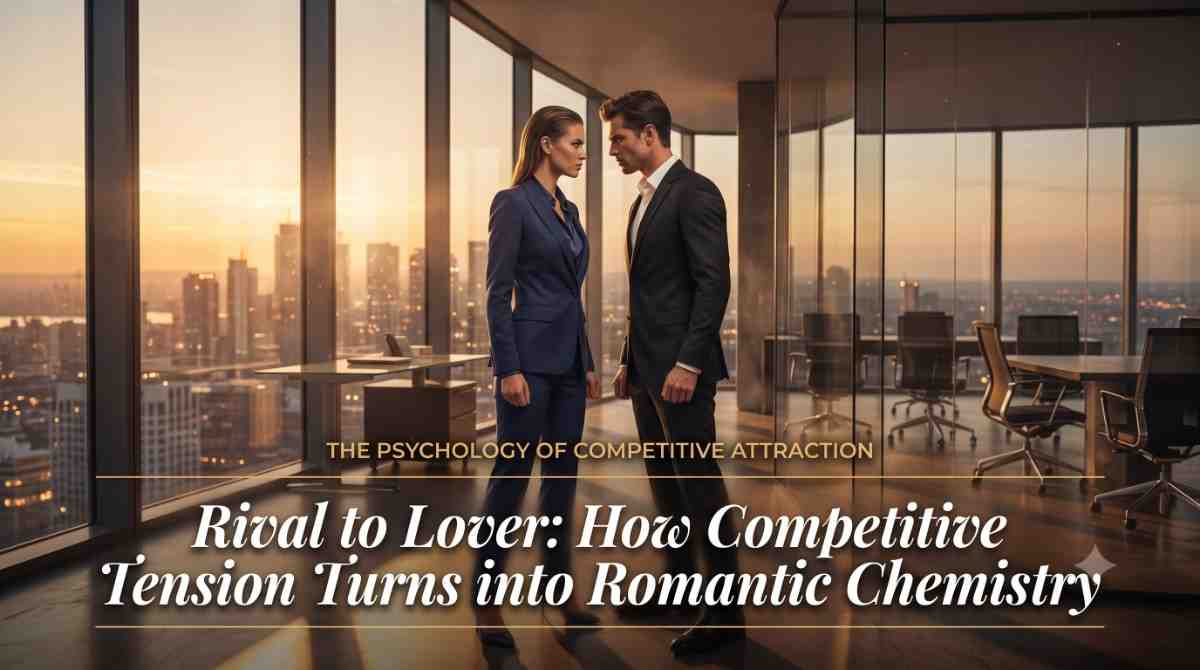
By: Ranjan Sarkhell
–
Table of Contents
–
Introduction
Rival to lover is not about winning. It is about surrendering to the one person who truly sees you.
There is always a point in every rival love story when the atmosphere changes. The arguing stops feeling like duels and starts resembling foreplay.
The insults lose their bite and acquire a strange kind of warmth.
The competition that seemed to be the sole point of their relationship becomes almost… inconvenient.
There is something else, something unexpectedly confusing and exciting, that has taken the front seat.
It is not random, the change that happens between the rivals. It is governed by rules, psychology, and biology.
After all, human brains are not as complicated as one may think.
The transformation has been used in literature countless times, and the reason it works so well is because it encapsulates the very real shifts in the dynamic between two people.
The blog will examine the mechanism of the transformation. There will be no spoilers ahead, no discussion of books or their plots.
We will talk about how the rivalry, turned into attraction, can be presented in a way that would surprise even the most cynical readers.
Rivalry makes people fixate, not hate. Adrenaline and pleasure confuse the mind, making rivals mistake attraction for hatred. One cannot truly hate someone they secretly admire.
Rival to Lover: How the Competitive Tension Turns into Romantic Chemistry
—
The Role of Adrenaline and Attraction
The hormone of attraction is adrenaline.
While being in a state of excitement, two opponents experience an increase in blood pressure, dilated pupils, shallow breathing, and sweaty palms.
The neurochemical reactions in their bodies are the same as the ones that happen when a person experiences attraction and love.
As such, the mind decides that the reason for the increased heart rate is the presence of another person, which makes it easier for the rival to fall in love with their opponent.
The same effect is amplified when the two people are placed in close proximity.
That is why so many writers choose to make the turning point in the story when the rivals are forced to collaborate against a bigger threat.
The body heat, the close contact, the constant interaction put the brain in an ideal position to experience attraction.
The writer’s job is to make sure that there is enough tension between the characters for them to experience those neurochemical reactions.
When the adversaries are placed in an unfamiliar situation where they have to rely on each other, the transformation from hate to love becomes inevitable.
Adrenaline mimics attraction. Rivals experience the same physical reactions as lovers, and forced proximity makes the confusion inevitable.
Rival to Lover: How the Competitive Tension Turns into Romantic Chemistry
—
The Shift from Competition to Collaboration
Every book in which adversaries turn into lovers has a point when one of the characters is forced to admit that they have been wrong about the other person.
Whether the turning point is a death, an existential revelation, or a sudden attack of a common enemy, the action makes it clear to both protagonists and the readers that the dynamic between them is about to change.
It is no longer a question of who can be stronger, but rather what can they achieve together.
When the adversarial rivals realize that they are not in the competition for the same prize, they begin cooperating.
Their combined efforts make them stronger than any of their adversaries for the duration of the conflict.
The two people, once bound by hatred, complement each other perfectly due to having similar, yet different attitudes towards the problems ahead of them.
It is easy to see how the shift from rivalry to cooperation affects everyone involved.
The writer simply needs to point out that the former enemies are perfect for each other, and show the positive effects of the new relationship.
The transformation is confusing and frightening for the characters, and that is why it is so exciting for the readers.
Every rival to lovers’ story has a turning point where one character admits they were wrong. A crisis forces them to stop competing and start cooperating. Their combined strengths make them unstoppable. The transformation is confusing for the characters and exciting for the readers.
Rival to Lover: How the Competitive Tension Turns into Romantic Chemistry
—
The Ego Barrier
One of the most crucial aspects of the transformation from rivals to lovers is the conflict of the egos of the protagonists.
Being confident to the point of arrogance, the protagonists of such books rarely have the self-awareness to admit that the other person is in any way superior.
That is why the confession that comes at some point in the book is usually full of sarcasm and hidden meanings.
The realization about one’s feelings is also combined with the frustration from the newly discovered knowledge to add more conflict to the relationship between the protagonists. After all, the two parties were actually perfectly compatible, despite the rivalry.
Once one of them admits that they are stronger when they work together, the transformation into lovers is no longer an issue.
Once the rival has admitted that the other person is worthy of their attention, the self-loathing and arrogance can be substituted with something in the vein of affection and love.
The same feelings of self-worthlessness are the reason why apologizing for the rivalry is not a weakness.
On the contrary, it is a confirmation that the bond between the protagonists is strong enough to withstand the test of time.
The rivalry between the opponents is no longer an issue when they realize that the relationship can be shifted from the adversarial to the friendly.
The ego barrier only stays in place as long as the characters believe it to be true. After one of them realizes that the other person is better, the process of the transformation from the rival to the lover is complete.
Ego is the biggest barrier in rivals to lovers. Arrogant protagonists refuse to admit the other is superior. The confession is often sarcastic and frustrated, because admitting attraction feels like losing. Once they admit they are stronger together, transformation becomes inevitable. Apologizing is not weakness, it proves the bond is strong enough to last. The ego barrier only exists as long as they believe in it. Once they see the other as better, the transformation is complete.
Rival to Lover: How the Competitive Tension Turns into Romantic Chemistry
—
The Slow Burn Effect
The transformation between the protagonists can only be compared to the slow burn. The reason for the choice of the metaphor is that two people placed against each other for an extended period of time cannot fall in love immediately.
Firstly, they require a certain amount of time to understand the dynamics of their relationship.
Secondly, the protagonists need to invest effort into the new interaction.
Thirdly, it would be easier to accept the turning point if the characters genuinely believed that it was the correct thing to do at that moment.
The slow burn effect is particularly important to the transformation from the rivals to the lovers since it allows the reader to experience every moment of it. The gradual change from the mutual hatred, confusion, and unrequited affection into the warm, fuzzy feeling of happiness will satisfy even the most demanding of book lovers.
The writer’s main difficulty is to resist the urge to rush through the process.
Instead of doing so, he or she should allow the characters to invest as much time and effort as required for them to truly understand the nature of their relationship.
The slow burn is an effect that only a few writers can use to their advantage. If done correctly, it becomes the reason why the rival to lover arc is so memorable.
The rivals to lovers transformation is a slow burn. Two people placed against each other cannot fall in love immediately. They need time to understand their dynamics, invest effort, and believe the turning point is right. The gradual shift from hatred to affection satisfies readers. The writer must resist rushing. When done correctly, the slow burn makes the arc unforgettable.
Rival to Lover: How the Competitive Tension Turns into Romantic Chemistry
—
Conclusion
The transformation that happens in rival to lover stories is truly fascinating.
The writer’s use of the proper psychological and physiological mechanics will provide a realistic basis for the relationship between the protagonists.
Two people fixated on achieving the same goal cannot hate each other for long.
Their obsession with the victory, the adrenaline of the competition, the warm and fuzzy feeling of the new collaboration, the gradual understanding of the true nature of the relationship, the ego that prevents the confession, and the slow burn that increases the affection between the protagonists.
All of those factors combine into a single, cohesive whole that represents the transformation from one to the other.
–
Link
From Rivals to Lovers vs. Enemies to Lovers: What Sets Them Apart?
From Arch Enemies to Soulmate: Why the ‘Rivals to Lovers’ Trope is Undefeated
–
FAQs
What makes a rival to lover arc different from enemies to lovers?
In a rival to lover arc, the conflict is rooted in competition for a shared goal, not hatred or moral opposition. Rivals respect each other from the start, while enemies must earn respect through sacrifice
Why is the rival to lover trope so popular?
The rival to lover trope delivers intellectual tension, witty banter, and a slow burn transformation. Readers love watching two equals fight their attraction before finally surrendering to love.
What is the turning point in a rival to a love story?
The turning point occurs when rivals stop competing and start collaborating. A crisis forces them to work together, revealing their hidden compatibility and making the shift from rivalry to romance inevitable.
–

0 Comments