
By: Ranjan Sarkhell
–
Table of Contents
–
Open Quote
“It is a truth universally acknowledged, that a single man in possession of a good fortune, must be in want of a wife.” — Jane Austen, Pride and Prejudice
–
Introduction
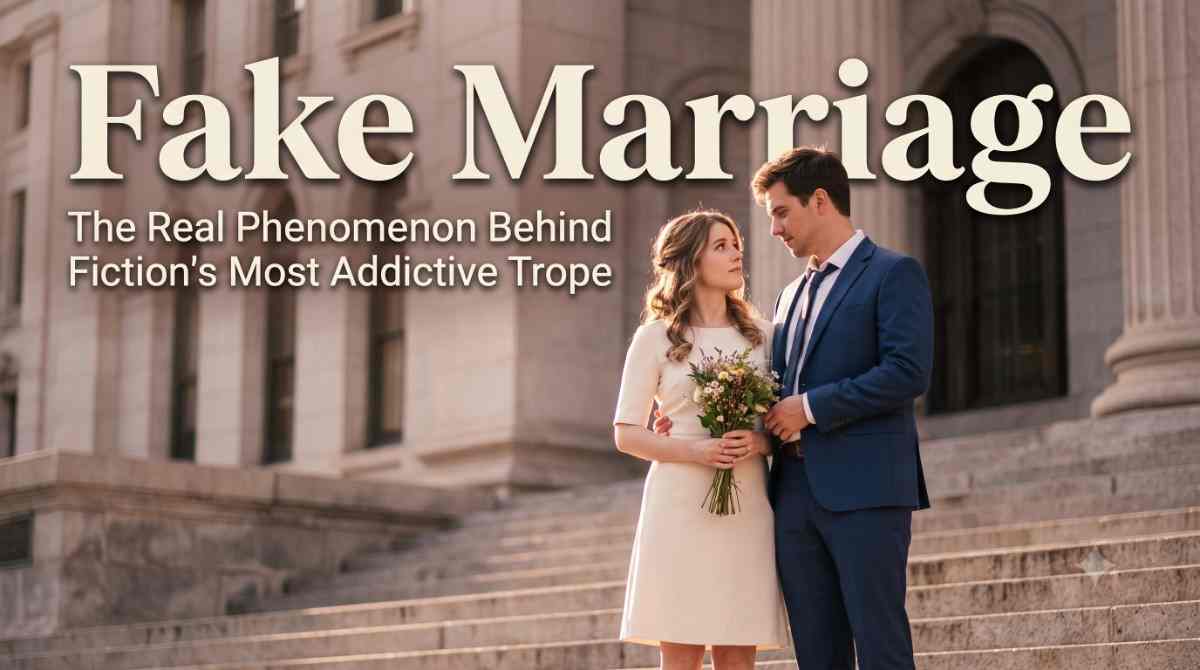
Mia and Jake had never met before the morning they stood in front of a judge and said “I do.”
It wasn’t romantic. It wasn’t planned over candlelight.
Mia needed a green card. Jake needed rent money.
They signed the papers, smiled for a photo, and went their separate ways — until an immigration officer knocked on the door six months later asking questions neither of them had rehearsed answers for.
This is the quiet, messy reality behind the words fake marriage — a phrase that shows up everywhere from courtroom filings to bestselling romance novels.
But here’s the strange part: the same three words mean two completely different things depending on where you find them.
In real life, a fake marriage is a legal risk.
In fiction, it’s one of the most beloved romance tropes ever written — the setup behind hundreds of bestselling books, from cozy small-town romances to dark mafia thrillers.
This post walks through both sides — the real-world phenomenon and the story trope — so you understand exactly what a fake marriage is, why people attempt it, why writers keep reaching for it, and why readers can’t stop falling for it on the page.
–
What Is a Fake Marriage, Really?
At its simplest, a fake marriage is a marriage entered into without the intention of building a real relationship. Two people marry not for love, but for a benefit — usually legal, financial, or logistical.
Think of Mia and Jake. Their marriage checked every legal box: a license, a ceremony, signatures. But the intention behind it was missing.
That missing intention is exactly what turns an ordinary marriage into what the law calls marriage fraud.
Here’s a simple way to picture the difference:
| Type of Marriage | Intention | Legal Status |
| Real Marriage | Building a life together | Fully legal |
| Fake Marriage | Gaining a benefit (visa, money, status) | Illegal if discovered |
| Arranged Marriage | Family-matched, but genuine commitment | Fully legal |
A fake marriage isn’t about how the wedding looks. It’s about what’s actually happening underneath it — and that gap between appearance and truth is exactly what makes it so useful as a storytelling device, which we’ll get to shortly.
–
Fake Marriage vs. Marriage Fraud vs. Sham Marriage
People often use these three phrases like they’re interchangeable, but they carry slightly different weight.
- Fake marriage is the everyday term — the casual way people describe a marriage that isn’t real.
- Marriage fraud is the legal term. This is what shows up in immigration paperwork and court documents when authorities believe a fake marriage was used to cheat the system.
- Sham marriage is often used in the UK and in immigration law specifically, referring to a marriage staged purely to get around visa or residency rules.
So when Jake and Mia’s officer opened an investigation, she wasn’t calling it a “fake marriage” in her report. She was calling it marriage fraud — because that’s the phrase with legal teeth.
–
How Authorities Spot a Fake Marriage
Immigration officers aren’t guessing. They’re trained to notice patterns that separate real couples from staged ones. A few common red flags:
- Couples who can’t answer basic questions about each other (birthdays, family names, daily habits)
- No shared financial history — no joint bank account, no shared bills
- Living at different addresses
- Little to no photo or communication history together
- A large financial payment tied to the marriage
Mia and Jake got caught on the second point. They’d never opened a joint account. To the officer, that one detail told the whole story.
Consider another case: Tom, a construction worker in Ohio, married Elena so she could stay in the country after her student visa expired.
On paper, everything looked fine — same address, a rushed but real-looking wedding album.
But when investigators interviewed them separately, Tom said they’d met at a bar. Elena said they’d met at church. That single inconsistency was enough to reopen the case.
–
The Real Cost of a Fake Marriage
A fake marriage isn’t just an awkward inconvenience if discovered — it can carry serious consequences. Depending on the country and the case, people found guilty of marriage fraud can face:
- Denial or reversal of a visa or green card
- Heavy fines
- Criminal charges, including possible jail time
- A permanent record that affects future applications
This is exactly why, in real life, a fake marriage is treated as a serious legal gamble — not a shortcut. It’s a decision people make when they feel out of options, and it rarely ends the way they hoped.
–
Real-World Risks and Legal Realities of a Fake Marriage
Proving a Sham Marriage
Authorities don’t rely on one piece of evidence alone. Proving a sham marriage usually means building a pattern — inconsistent answers during separate interviews, no shared finances, different home addresses, or a near-total absence of photos and communication history together.
Investigators often request bank statements, lease agreements, utility bills, and even social media activity to see whether a couple’s daily life matches what a real marriage would look like.
A single red flag rarely closes a case — but several together, like Tom and Elena’s mismatched “how we met” story, are usually enough to reopen one.
Fake Marriage Green Card Cost
People considering a fake marriage for a green card often underestimate what’s actually at stake financially.
Beyond any payment made to the other party — which itself is illegal and traceable — there are application fees, legal costs if caught, and potential fines that can run into thousands of dollars.
If marriage fraud is confirmed, any money spent on the original green card application is lost entirely, on top of penalties.
The short-term “cost” of arranging a fake marriage is almost always far smaller than the long-term financial and legal cost of getting caught.
How Do I Report a Fake Marriage to Immigration?
In the United States, suspected marriage fraud can be reported directly to U.S. Citizenship and Immigration Services (USCIS) through their tip line or online portal, where reports can typically be submitted anonymously.
In the UK, suspected sham marriages can be reported to the Home Office. Reports are generally most useful when they include specific details — names, addresses, or observed inconsistencies — rather than vague suspicion alone, since investigators need concrete leads to open a case.
Risk of Fake Marriage
The risk of a fake marriage extends beyond the person seeking a visa or status — the other party involved can face consequences too, even if they were paid or promised a benefit for participating.
Both individuals can be investigated, both can lose future immigration privileges, and in serious cases, both can face criminal charges.
Unlike fiction, where a fake marriage almost always resolves into a happy ending, the real-life risk runs in the opposite direction — toward exposure, not romance.
Penalty for Fake Marriage UK
Under UK immigration law, entering a sham marriage to circumvent immigration rules is a criminal offense.
Penalties can include fines, imprisonment of up to 14 years in the most serious fraud cases, deportation, and a permanent bar on future visa applications.
The Home Office has increased scrutiny on suspected sham marriages in recent years, with registrars legally required to report any wedding they suspect is not genuine before it can proceed.
–
So Why Does Fiction Love the Fake Marriage Trope So Much?
Here’s where the story flips completely.
In books and movies, a fake marriage isn’t a crime scene — it’s a setup for falling in love. Picture this: two strangers agree to marry for practical reasons — an inheritance, a visa, a family obligation, a business deal.
They move in together, pretend for the cameras, argue over silverware and shared closets, and slowly, painfully, fall for each other for real.
Readers eat this up because the fake marriage trope solves a storytelling problem instantly. Normally, a writer has to spend chapters building two people’s history before they can convincingly fall in love.
But a fake marriage skips straight to intimacy — shared space, shared secrets, shared stakes — without either character having to admit they wanted it in the first place.
That’s the appeal. The characters get all the closeness of a real relationship while still being able to say, “This isn’t real. I don’t have feelings for you.” Until, of course, they do.
Example 1: The Guardianship Fake Marriage
Think about Sarah and Daniel — two characters in a story who marry only so Daniel can keep custody of his little sister after their parents pass away.
Sarah needs stability. Daniel needs a co-guardian the court will approve.
On paper, it looks almost like marriage fraud — a marriage of convenience dressed up to satisfy a judge.
Neither expects to fall in love.
At first, the arrangement was strictly logistical. Sarah moves into the spare room.
They split chores, split bills, and rehearse answers in case a social worker asks how they met.
But three months into pretending, Daniel starts noticing Sarah hums while making coffee. Sarah starts noticing she looks forward to his voice at the door before she even hears his key turn.
The turning point comes on a rainy Tuesday, when Daniel’s little sister has a nightmare and calls out for “Mom” before catching herself — and instead of correcting her, Sarah simply sits at the edge of the bed and stays until the girl falls back asleep.
Daniel watches from the doorway, and something in his chest quietly rearranges itself. Neither says anything about it the next morning — because saying it would mean admitting the marriage stopped being fake somewhere along the way.
Example 2: The Inheritance Fake Marriage
Or take Claire, a character who inherits her grandmother’s vineyard on one condition: she has to be married within sixty days, or the entire estate passes to a cousin she’s never liked.
She barely knows Ethan, the quiet, sharp-tongued vineyard manager who’s worked the land for years — but he needs the job to survive, and she needs a husband on paper before the deadline.
What starts as a strictly transactional deal — a signed agreement, separate bedrooms, a shared understanding that this is business and nothing more — begins to unravel the first time they’re forced to perform as a real couple in front of her family.
At a dinner meant to convince her skeptical aunt the marriage is genuine, Ethan reaches for Claire’s hand under the table without thinking, and instead of pulling away, she laces her fingers through his. It isn’t for the audience.
It’s the first honest thing either of them has done since the wedding.
By the time the sixty days are up, the paperwork says they’re married — but so does everything else. Neither of them wants to sign the annulment.
Example 3: The Mafia Fake Marriage
In darker, mafia-romance style stories, the setup gets higher stakes and higher walls. Picture Nina, forced into a marriage with Victor, the son of a rival crime family, to seal a fragile truce between two dangerous organizations.
This isn’t romance by choice — it’s survival dressed as a wedding, the kind of arrangement that would read as a sham marriage to anyone outside their world, except the consequences of exposure aren’t legal, they’re lethal.
Neither trusts the other at first. Nina sleeps with a knife under her pillow for the first month. Victor doesn’t let her near his study.
But living under the same roof means noticing things neither of them planned to notice — the way Victor always double-checks the locks before bed, the way Nina hums old lullabies when she thinks no one’s listening.
The turning point arrives the night a rival family tries to breach the estate. Victor doesn’t think twice before shielding Nina with his own body, taking a graze meant for her shoulder.
Later, stitching him up with shaking hands, Nina realizes the fear she feels isn’t for herself anymore.
The fake marriage trope here isn’t just about romance — it’s about survival slowly forcing two guarded people to let someone in, one dangerous night at a time.
Example 4: The Workplace Fake Marriage
Then there’s the corporate version — think of James, a rising executive who needs a “stable married image” to land a major promotion, and Beth, his sharp, sarcastic coworker who agrees to play the part in exchange for a transfer she’s been chasing for years.
What begins as an office arrangement — rehearsed hand-holding at company dinners, matching answers about “how they met,” a fake engagement ring Beth keeps in her desk drawer between events — starts to blur the moment James shows up at her apartment during a crisis that has nothing to do with appearances.
His father is in the hospital, and instead of calling anyone from his contact list of polished business acquaintances, he calls Beth. Not because the marriage demands it. Because he wanted her there.
Beth opens the door in pajamas, takes one look at his face, and doesn’t ask a single question — she just grabs her coat.
Sitting beside him in a hospital waiting room at 2 a.m., neither of them mentions the promotion, or the transfer, or any of the reasons this started.
For the first time, it just feels like two people who happen to care about each other. The fake marriage, somewhere in that waiting room, quietly stops being fake.
Example 5: The Historical Fake Marriage
Historical romance leans on this trope constantly. Picture Eleanor, a widow in Regency England who needs a husband to keep her late husband’s estate out of her greedy brother-in-law’s hands, and Captain Wesley, a war veteran with no fortune but an old family name worth borrowing.
Their marriage is a transaction, plainly negotiated — her estate secured, his name lent, nothing more expected of either party.
But the letters exchanged in the weeks before the wedding, meant to settle only practical details like dates and witnesses, start to carry small, unplanned warmth. Wesley asks after her health.
Eleanor asks after his old war wound. Neither meant for the correspondence to become the best part of their week, but it does.
The turning point comes on their wedding night, when convention would have them retreat to separate rooms as agreed. Instead, they sit up talking until dawn — about grief, about survival, about the families neither of them ever expected to build.
By the time they actually marry in front of witnesses the next morning, the ceremony is almost a formality.
The real vow happened hours earlier, in a candlelit room, when neither of them was performing for anyone at all.
That tension — the space between “this isn’t real” and “wait, is it?” — is why readers keep coming back to this trope again and again, across every genre it touches.
–
Fake Marriage in Fiction vs. Real Life: A Quick Comparison
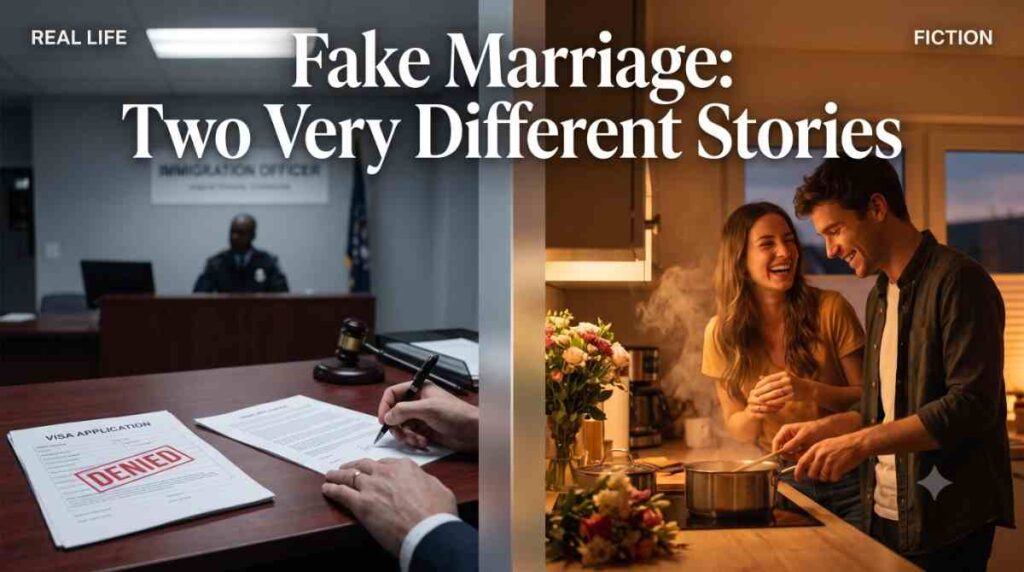
| Real-Life Fake Marriage | Fiction’s Fake Marriage Trope | |
| Motive | Visa, money, legal status | Plot device, forced proximity |
| Risk | Legal consequences, jail, fines | Emotional risk only |
| Outcome | Often ends in investigation or annulment | Often ends in genuine love |
| Reader/Viewer Reaction | Concern, legal seriousness | Excitement, anticipation, swooning |
This contrast is exactly why the trope works so well as entertainment. Real marriage fraud carries fear and consequence. The fictional version borrows the tension of secrecy without any of the real danger — which makes it feel thrilling instead of frightening.
–
Why Writers Keep Reaching for This Trope
From a craft perspective, the fake marriage trope is almost too useful to resist. It instantly creates:
- Forced proximity — the characters have no choice but to be around each other constantly
- Built-in conflict — at least one person usually doesn’t want the arrangement
- A ticking clock — most fake marriages have a deadline, an inheritance date, a visa hearing, a court appearance
- A built-in secret — someone always has to lie to family, friends, or the public about the relationship being real
- A natural slow burn — because the characters can’t admit real feelings without breaking the terms of their own arrangement
Every one of those elements is something writers normally have to build from scratch.
The fake marriage trope hands them all five at once, which is exactly why it keeps showing up in new books every year, reshaped for new genres and new audiences.
–
The Many Faces of the Fake Marriage Trope
The core idea stays the same, but writers dress it up differently depending on genre:
| Genre | Typical Setup | Emotional Flavor |
| Contemporary Romance | Visa, inheritance, or business deal | Light, banter-heavy |
| Mafia Romance | Truce or protection marriage | Dark, high stakes |
| Historical Romance | Estate, title, or family obligation | Slow, formal, letter-driven |
| Workplace Romance | Image, promotion, or public appearance | Witty, competitive |
| Small-Town Romance | Custody, community pressure, family favor | Warm, cozy |
Whichever flavor a writer chooses, the emotional engine is identical: two people forced into closeness who are not allowed to admit, at first, that they want to be there.
–
Why This Trope Isn’t Going Anywhere
Every year, new books and shows lean on the fake marriage setup, and it keeps working because it taps into something readers genuinely want: watching two people fall in love almost by accident, without the fear of vulnerability getting in the way first.
The “fake” label gives both characters — and by extension, the reader — permission to enjoy intimacy without the pressure of it meaning anything. Until it very much does.
It’s also flexible.
Writers have used the fake marriage trope in historical romance, mafia romance, workplace romance, small-town fiction, and even light-hearted comedies.
The setup changes, but the emotional engine stays the same: two people forced into closeness, slowly losing the ability to pretend they don’t care.
–
Key Takeaways
- A fake marriage is a marriage without genuine intent, usually entered into for a practical benefit like a visa or money.
- Marriage fraud is the legal term used when a fake marriage is used to deceive immigration or legal systems.
- A sham marriage is a term often used specifically in immigration contexts, especially in the UK.
- Getting caught in a fake marriage can lead to fines, denied visas, or even jail time.
- In fiction, the fake marriage trope flips the real-world risk into romantic tension — two people forced into closeness who slowly fall for each other for real.
- The trope shows up across nearly every genre — contemporary, mafia, historical, workplace, small-town — because it hands writers five storytelling tools at once: proximity, conflict, a deadline, a secret, and a slow burn.
- The trope remains popular because it lets characters (and readers) experience intimacy without vulnerability — until they can’t avoid it anymore.
–
Link
Fake Marriage, Forced Proximity, Fragile Love Story
Immigration Fake Marriage: How Marriage Fraud Actually Gets Investigated
Bound by a Fake Marriage: How an Inheritance Rewrote Our Love Story
Frequently Asked Questions
Can you go to jail for fake marriage?
Yes, in serious cases. If a fake marriage is proven to be marriage fraud — meaning it was entered into specifically to deceive immigration authorities — the consequences can include criminal charges, fines, and in some cases, prison time. In the United States, marriage fraud can carry penalties of up to five years in prison and fines up to $250,000. In the UK, sentences for sham marriage offenses can go even higher, up to 14 years in the most serious cases. Jail time isn’t automatic for every case, but it’s a real legal risk, not just a technicality.
Can I report a fake marriage?
Yes. In the US, suspected marriage fraud can be reported to U.S. Citizenship and Immigration Services (USCIS), often through their online tip portal, and reports can typically be made anonymously. In the UK, suspected sham marriages can be reported to the Home Office. The more specific details you can provide — names, addresses, or clear inconsistencies you’ve noticed — the more useful the report is for investigators to act on.
What does “fake wedding” mean?
A “fake wedding” usually refers to the ceremony itself — the staged event, photos, and paperwork — performed to make a fake marriage look convincing to outsiders, family, or authorities. It’s essentially the visible performance layer of a fake marriage: the rings, the vows, the paper trail, all without the genuine relationship behind it. In fiction, the term is sometimes used more loosely to describe any staged or pretend wedding scene used as a plot device, regardless of legal implications.
How to spot a fake marriage?
Investigators — and sometimes even friends or family — usually look for the same handful of red flags: couples who can’t answer basic questions about each other, no shared financial history like joint bank accounts or bills, different home addresses, very few shared photos or messages, and a noticeable financial payment tied to the marriage. No single sign proves anything on its own, but several of these together usually point to a fake marriage rather than a genuine one.
–
Close quote:
“We started this as a lie. Somewhere along the way, it became the truest thing I’ve ever done.” — from a well-loved romance trope, echoed in stories everywhere.
–

0 Comments