
By: Ranjan Sarkhell
–
Table of Contents
–
Introduction
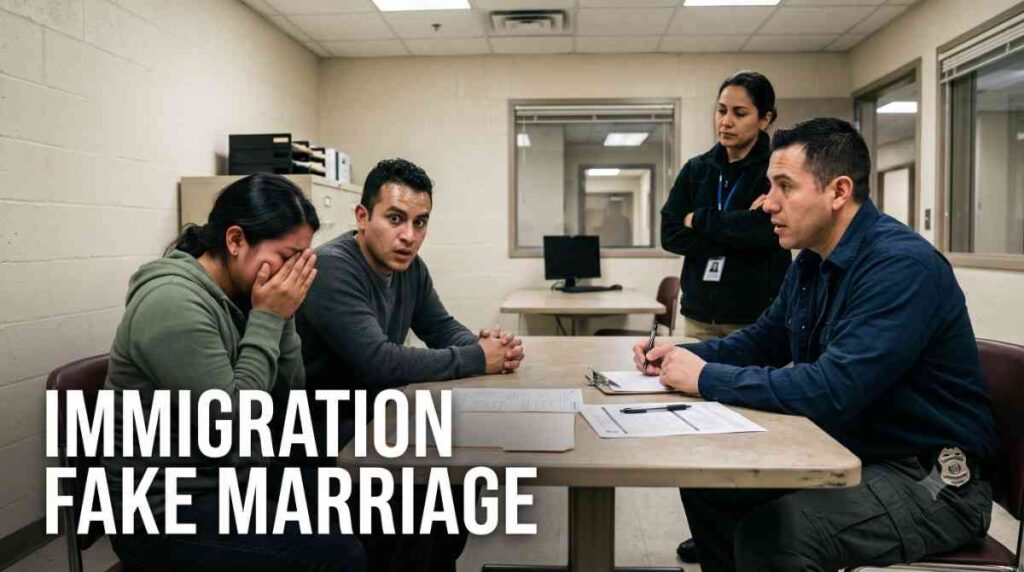
In March 2023, a couple sat down for their green card interview in Pittsburgh. They’d rehearsed the story, had the paperwork, and had already been legally married for over a year.
By the end of the interview, the officer wasn’t convinced — and what unraveled from there became one of the clearest real-world examples of an immigration fake marriage case: two federal convictions, a grand jury subpoena, and a green card denial.
That case is a good place to start, because it shows exactly how immigration fake marriage investigations actually unfold — not in theory, but in practice.
“A marriage certificate proves a ceremony happened. It doesn’t prove a marriage did — and that gap is exactly where fraud investigators live.”
Immigration Fake Marriage: How Marriage Fraud Actually Gets Investigated
What Counts as Marriage Fraud
USCIS defines marriage fraud narrowly: a marriage entered solely to obtain an immigration benefit, not out of genuine intent to build a life together.
That covers paying someone to marry you, both spouses knowingly agreeing to a sham arrangement, or one spouse being deceived into marriage under false pretenses.
Legally valid marriages — properly licensed, even consummated — can still be ruled fraudulent if the intent at the time of marriage wasn’t real.
The Pittsburgh case above is a textbook illustration: the marriage was on paper, the couple lived through a real wedding, and it still didn’t survive scrutiny because the underlying intent was to trade a green card for cash.
An immigration fake marriage doesn’t need a fake wedding. It just needs a fake reason for the real one.”
–
Visa Frauds in India — Where the Fake Marriage Pipeline Often Starts
“A visa fraud rarely stops at a fake document. Sooner or later, someone has to marry the lie.”
Not every immigration fake marriage case begins with a well-organized network.
In May 2025, Delhi Police unwound a case in Gandhinagar that shows how visa fraud and sham marriage fraud are often the same operation wearing two hats.
A 23-year-old man had flown into IGI Airport on a passport bearing someone else’s identity. Under questioning, he admitted his real name and said an agent, Nagajan Karavadra, had built his entire fake identity, voter ID, birth certificate, residence proof, for roughly 10 lakh rupees.
The final piece of that fake identity was a sham marriage to a Bulgarian woman, arranged specifically to exploit the EU’s family settlement scheme.
That single case captures most of what’s driving India’s visa fraud problem right now.
Delhi Police made the scale of the problem public in January 2026: over 130 individuals were arrested through 2025 alone for visa and passport fraud, with more than 100 bank accounts frozen as investigators traced the money behind these networks.
A few patterns keep showing up. High-risk regions include Punjab, Haryana, Delhi, Gujarat, especially Ahmedabad and Surat, Kerala, and Telangana, which continue to be the states where recruitment for these schemes concentrates.
Target destinations remain Canada, the US, Australia, the UK, and Gulf nations, the most sought-after and most exploited destinations. Beyond arrests, Delhi Police issued 140 lookout circulars in 2025 to intercept accused individuals attempting to flee before prosecution.
The common playbook keeps repeating too. Fake e-visa websites are fraudulent replicas of India’s official e-visa portal designed to harvest applicant data and application fees before a real application is ever filed.
Document forging and staged finances involve agents fabricating degrees, fake work experience, and short-term cash deposits designed to simulate genuine proof of funds, the same forgery playbook used in the Gandhinagar case to build an entirely fake identity. And sham marriage as the final step, as the Gandhinagar case shows, isn’t always the whole scheme; sometimes it’s the last document needed to complete a fake identity built on forged paperwork.
The warning signs are fairly consistent across cases: promises of unusually fast processing or guaranteed visa approval, demands for large upfront cash payments before any real documentation changes hands, and communication only through unofficial channels, personal WhatsApp numbers or non-government email addresses instead of verifiable agency contacts.
–
How USCIS Actually Investigates a Case
1. The Interview Is Where It Usually Starts Unraveling
In that 2023 case, a woman named Kalee Huff had agreed to marry a foreign national, Aakash Makwana, for $10,000 — money she said her family needed.
They planned to divorce quietly once he got his green card. At the interview, officers asked the kind of granular, everyday-life questions couples in real marriages answer without thinking — and the story didn’t hold. Makwana’s application was denied on the spot.
This tracks with how USCIS trains its officers generally: ask detailed questions about relationship history, daily routines, finances, and future plans, then watch for the answers that feel rehearsed rather than lived-in.
The story:
On September 3, 2021, in a small ceremony in Greenbrier County, West Virginia, Kalee Ann Huff got married. On paper, it was an ordinary wedding. In reality, it was the opening move in a scheme that would take four years, two federal investigations, and a grand jury subpoena to fully unwind.
Huff’s family needed money. Her brother-in-law, Joseph Sanchez, had a proposition: marry a foreign national named Aakash Prakash Makwana, whose visa was about to expire, and the marriage would keep him legally in the country. In exchange, Huff was promised $10,000. She agreed — pressured, she later admitted, more by family financial strain than by any interest in the scheme itself. As it turned out, she never actually received a dollar of it. Sanchez, who’d helped broker the whole arrangement, was promised the same $10,000 and ended up with only $3,000 of it himself.
Makwana’s story was its own kind of desperate. He’d arrived in the U.S. in November 2019 on a J-1 visa, working in hotel hospitality and culinary service — the kind of visa that comes with a hard expiration date and no easy path to extend it. His authorized stay ended on November 24, 2020. He stayed anyway. By August 2021, he and his conspirators had landed on marriage as the fix.
The plan had a built-in exit strategy from day one: once Makwana secured his green card, he and Huff would quietly divorce. All they had to do first was convince a federal immigration officer that the marriage was real.
That test came in March 2023, when the couple traveled to Pittsburgh for their green card interview. They’d prepared for it — rehearsed answers, assembled paperwork, presented themselves as a couple with a genuine relationship. It didn’t work. The interviewing officer wasn’t convinced, and Makwana’s green card application was denied on the spot.
Most schemes might have ended there. This one didn’t. Makwana, still determined to stay in the country, pivoted to a different — and considerably more serious — approach. He filed a Form I-360, a petition typically used by abused spouses of U.S. citizens to self-petition for status independent of their abuser. To support it, he falsely claimed that Huff had physically and emotionally abused him during the marriage — a direct fabrication, filed specifically to buy himself more time in the country and improve his odds at a green card through an entirely different legal channel. As part of building his case, he also falsified a residential lease agreement, adding a property manager’s name and signature without that person’s knowledge or consent — the act that would later become a separate federal identity theft charge.
For months, the fabricated story held. Then, on August 8, 2023, immigration officers came back and confronted Huff directly. Faced with the evidence against her, she signed a statement admitting the truth: she had knowingly entered the marriage specifically to help Makwana evade U.S. immigration law.
That admission didn’t end things either — it escalated them. Prosecutors moved forward with a marriage fraud case, and as part of it, subpoenaed Huff to testify before a federal grand jury in Charleston on December 10, 2024. Under a cooperation agreement, she was expected to tell the truth about the scheme. Instead, when questioned about material facts relevant to the investigation, she gave false answers — adding a perjury charge to the marriage fraud charge she was already facing.
By the time it was over, the case had pulled in more people than just Huff and Makwana. Sanchez pleaded guilty in January 2025 for his role arranging the marriage and pressuring Huff into it. Investigators also connected the scheme to a local employer, Rajesh Patel, who admitted making cash payments to Makwana’s co-conspirators, and Patel’s wife, who separately pleaded guilty to unlawfully employing aliens.
On June 12, 2025, Chief U.S. District Judge Frank W. Volk sentenced Huff to five years of federal probation, including one year of home detention. Sanchez received the same five years of probation. Makwana pleaded guilty to aggravated identity theft and faced a mandatory two years in prison on top of it — along with removal from the United States once his sentence was served.
What stands out most about the case isn’t the marriage itself — plenty of marriage fraud schemes look exactly like this one on paper. It’s how long the fabrication kept evolving even after the first attempt failed: a denied interview didn’t end the scheme, it just triggered a new, riskier lie layered on top of the old one. That pattern — fraud compounding on fraud rather than stopping at the first setback — is often what turns a civil immigration denial into a full federal prosecution.
2. When Interviews Aren’t Enough, USCIS Escalates to a Stokes Interview
If officers remain unconvinced, the case can move to a “Stokes interview,” where each spouse is questioned separately about the same details — how you met, what your partner had for breakfast, who’s on the lease.
Officers then compare notes for the discrepancies that don’t matter individually but add up: he says Tuesday, she says Thursday; he says they met at a coffee shop, she says a party.
A Stokes interview alone doesn’t sink a case, but it means USCIS wants more proof before it lets go of its doubts.
3. Confrontation and the Paper Trail
Huff’s case didn’t end at the denied interview. Months later, in August 2023, immigration officers came back and confronted her directly. She signed a statement admitting she’d married Makwana specifically to help him evade immigration law.
That admission became the evidentiary backbone of the criminal case that followed — she was later subpoenaed to a federal grand jury, and prosecutors caught her giving false testimony there too, which added a perjury charge on top of the marriage fraud charge.
This is a pattern worth noting: investigations rarely end with a denial. A denied petition is often just the point where the criminal investigation begins.
4. Scale Changes Everything — Organized Schemes Get RICO-Style Treatment
Not every case is one couple and $10,000. In August 2026, the Justice Department charged 11 people in an alleged decade-long scheme that engineered more than 1,000 sham marriages between Chinese nationals and U.S. citizens.
Prosecutors described a “full-service” operation — staged wedding ceremonies at restaurants, hired photographers, joint bank accounts opened purely for paper trails, and coaching sessions before USCIS interviews.
Investigators reportedly found prenuptial agreements that undercut the couples’ own story, including language stating the spouses would live independently and not interfere with each other’s lives — evidence prosecutors used to argue there was never any intent to build a shared life.
The lesson from that case: the more organized and “professional” the fraud looks — staged photos, coached answers, manufactured joint accounts — the more it tends to attract federal task-force-level attention, because it signals a network rather than a single desperate couple.
5. Border and Local U.S. Attorney’s Offices Run Their Own Cases
Marriage fraud enforcement isn’t centralized in one office. In Puerto Rico, U.S. Border Patrol itself investigated and helped indict a couple — a citizen of Uzbekistan and a local resident — for marrying in 2024 specifically to evade immigration law, roughly a year before the indictment came down.
That case shows how border agencies, not just USCIS or ICE, can independently build and refer marriage fraud cases.
“Every immigration fake marriage case has the same weak point: two people who’ve never really lived one life, trying to describe it as if they had.”
–
The Immigration Marriage Interview: What Actually Gets Asked
“An immigration marriage interview doesn’t test what a couple says. It tests what they’ve actually lived.”
Since the interview is where nearly every one of these cases either survives or collapses, it’s worth breaking down what genuinely happens in the room, beyond just “they ask questions.”
Officers are trained to move past scripted basics, how did you meet, when did you marry, into granular daily-life detail: what side of the bed each person sleeps on, who does the grocery shopping, what the other spouse’s parents do for work, what they argued about last. None of these questions have a correct answer; they’re designed to surface the texture of a real shared life, which is exactly what’s hardest to fabricate convincingly under time pressure.
When answers feel rehearsed, inconsistent, or suspiciously vague on basic details, that’s what triggers escalation to a Stokes interview, a site visit, or an FDNS referral, the same path the Pittsburgh case followed.
The story:
On March 3, 2025, a 23-year-old passenger walked up to the immigration counter at Delhi’s IGI Airport, headed for London.
His passport looked ordinary enough — issued under the name Maulik Ranmalbhai Odedra. But something about it didn’t sit right with the officer doing the routine check, and instead of waving him through, they pulled him aside.
Under questioning, the story fell apart fast. The man admitted his real name wasn’t Maulik Odedra at all — it was Mahesh Ranmalbhai Odedara, a resident of Porbandar, Gujarat.
Every document in his possession — the passport, the identity behind it, the paper trail supporting his travel — had been manufactured for him.
And he wasn’t shy about explaining how, or how much it had cost him: roughly ₹10 lakh, paid to a Gandhinagar-based travel agent named Nagajan Lilabhai Karavadra.
What Karavadra had built for his client wasn’t a simple forged passport. It was an entire second identity — a voter ID, a birth certificate, residence proof, all constructed around the fictional “Maulik Odedra.”
And the final piece, the one that gave the whole fake identity legal legitimacy in the eyes of European immigration authorities, was a marriage.
Karavadra had arranged a sham wedding between “Maulik Odedra” and a Bulgarian woman, specifically to exploit the EU’s family settlement scheme — the legal pathway that lets a non-EU spouse of an EU citizen gain residency rights across the bloc.
It worked, at least for a while. Odedra had already used this fabricated identity to travel internationally more than once, returning to India in November 2022 and again in February 2025 — both times passing through immigration checks on documents nobody had questioned, until the day someone finally did.
Once Delhi Police traced the case back to Karavadra, they moved fast. After multiple raids, they arrested him in Gandhinagar.
In custody, he reportedly admitted his role in the racket without much resistance — and gave police a detail that explained a lot about how well the scheme worked: he hadn’t started out as a fraud agent.
He’d spent time living and working in the UK, and it was there, police say, that he first came into contact with people running similar operations.
He returned to India in 2023 and put what he’d learned to use, building his own network.
What makes this case worth dwelling on isn’t just the fraud itself — it’s how ordinary each individual piece looked.
A passport that seemed real. A wedding that, on paper, was legally valid. A wife who existed, a marriage certificate that was real, a family settlement application that followed the correct legal process.
Nothing about it screamed “fraud” until an immigration officer noticed one small inconsistency at a boarding gate — and pulled a thread that unraveled an entire manufactured life.
–
The Red Flags Behind These Real Cases
“The red flags in an immigration fake marriage case are rarely about one bad answer — they’re about a pattern of answers no real couple would think to rehearse.”
Looking across these cases, the same warning signs keep showing up:
- A payment arrangement with a schedule attached — Huff and Sanchez in the West Virginia case were each promised installments tied to milestones (marriage finalized, green card approved), which is exactly the kind of transactional structure investigators look for once they’re digging.
- A pre-planned exit — Huff and Makwana had already agreed to divorce once the green card came through, before the marriage even happened.
- Manufactured evidence of a shared life — the 1,000-marriage scheme staged weddings, opened joint bank accounts, and coached couples, precisely because genuine cohabitation evidence is what real investigations dig for.
- A written record that contradicts the story — the prenuptial agreements in the Chinese national case explicitly stated the spouses would live separately, directly undercutting their own applications.
- Inconsistent interview testimony — the detail-level mismatches that separate interviews are specifically designed to expose.
“Real couples forget anniversaries. Fake ones forget everything else.”
Immigration Fake Marriage: How Marriage Fraud Actually Gets Investigated
What Actually Happens to People Once Fraud Is Found
“An immigration fake marriage might end a relationship on paper. What it actually ends is a green card, a clean record, and sometimes a person’s freedom.”
The consequences in these real cases weren’t hypothetical:
- Huff: five years of federal probation, including one year of home detention, for marriage fraud and perjury.
- Sanchez (the man paid to help find someone to marry Makwana): five years of federal probation for participating in the conspiracy.
- Makwana: green card application denied, and separately faced an aggravated identity theft allegation for forging a property manager’s signature on a fake lease used as supporting evidence.
- The Puerto Rico couple: indicted and arrested, with the case still presumed innocent until proven guilty, but now facing federal prosecution rather than a quiet visa denial.
Beyond individual sentences, a fraud finding under INA §204(c) creates a permanent bar — that beneficiary can never have a future immigrant petition approved on their behalf again, even in a completely genuine later marriage.
“You can fake a wedding album. You can’t fake a shared life under cross-examination.”
Immigration Fake Marriage: How Marriage Fraud Actually Gets Investigated
–
Link
Fake Marriage for a Green Card: Is It Really Possible to Get Away With It?
Fake Marriage: The Real Phenomenon Behind Fiction’s Most Addictive Trop
–
FAQ
Can you report a fake marriage to immigration?
Yes, and it’s exactly how some of these cases start — through USCIS or ICE tip lines, or through a spouse, neighbor, or coworker coming forward. In the Puerto Rico case, it was the Border Patrol’s own investigation that triggered the indictment, without a public tip at all.
What happens to a person who fakes a marriage for immigration purposes?
Based on how these cases have actually been resolved: probation or prison time, fines, a permanent immigration bar, and in the Makwana case, an outright denial of the green card application itself — plus a separate identity theft allegation layered on top.
Can I marry my friend for a green card?
No. Intent is what matters, not whether the couple gets along or the marriage is amicable. The West Virginia case shows this plainly — no one there disputed that the marriage ceremony was real and legal; what made it fraudulent was the agreement to marry specifically for immigration status in exchange for money.
Is it illegal to have a sham marriage?
Yes, for both spouses. Huff wasn’t a bystander — she was convicted alongside Makwana, and Sanchez, who never even married anyone himself but helped arrange the marriage, was convicted too, for participating in the conspiracy.
How does USCIS prove a marriage is a sham?
Not through a single smoking gun, but through accumulation: interview inconsistencies, admissions after confrontation, documents that contradict the couple’s story (like the prenups in the Chinese national case), and in Huff’s case, a signed statement she gave after officers directly confronted her — which then became the foundation for the criminal case.
What happens when you report a fake marriage?
USCIS typically opens a review of the sponsoring petition, which can trigger a Stokes interview or site visit for the couple involved. It doesn’t result in an automatic finding of fraud — the couple still gets the chance to respond and provide evidence — but it does put the case under active scrutiny rather than routine processing.
Is a sham marriage illegal in India specifically?
Under India’s Bharatiya Nyaya Sanhita, 2023, arranging or facilitating a fraudulent marriage as part of a broader immigration scheme — like the Gandhinagar case — can bring cheating charges under Section 316, and in more serious, organized cases, human trafficking provisions under Sections 359–360, depending on how the scheme was run.
Are visa frauds in India connected to immigration fake marriage cases?
Often, yes. As the Gandhinagar case shows, a sham marriage is sometimes just one component of a larger identity-fraud package — forged documents, a fabricated backstory, and a staged marriage all built by the same agent for a single payment.

0 Comments