
By: Ranjan Sarkhell
–
Series: This is a 17-part romance serial. The story spans from Part 1 to Part 17. Each part is complete on its own but continues the larger journey.
–
Table of Contents
–
“The emergency climate is a crisis of inequality. It exposes and exacerbates what is already unacceptable.”
Introduction
Global warming does not announce itself.
It does not knock on your door. It does not send a warning. It does not give you time to prepare. It creeps in slowly. Quietly. Like a thief in the night. Like a disease in the blood. Like a whisper that grows into a scream.
“Global warming does not announce itself. It creeps in slowly. Quietly. Like a thief in the night.”
Global Warming of the Heart — Part 2: Background Causes
It raises the temperature by a fraction of a degree. It shifts the rain by a few days. It turns a living forest into a dying one. And by the time you notice, it is already too late.
Thornwood noticed too late.
This is the story of how it happened. The conferences. The speeches. The promises. The lies. The developed nations who looked away. The Global South who paid the price. A dying forest in Africa. A world that forgot it.
This is the story of Global Warming of the Heart.
And of a woman named Dr. Mily Anderson, who was sent to save it.
—
Key Points
Global warming is a silent killer. It does not announce itself. It creeps in slowly and destroys everything in its path.
“Global Warming of the Heart is a story about a dying forest, a broken man, and a woman who refuses to give up on either.”
Global Warming of the Heart — Part 2: Background Causes
Developed nations contribute to the crisis but refuse to take responsibility. They make speeches. They make donations. They do not change their ways.
The Global South suffers the most. Africa suffers the most. Thornwood suffers the most.
The Long-term Exclosure Experiment is the world’s first attempt to save a forest from global warming and herbivorous animals.
Dr. Mily Anderson is assigned to lead the project. She is brilliant but disillusioned. She wants to fix the world. She does not yet know that some things cannot be fixed.
—
Global Warming of the Heart — A Silent Killer
Global warming is a silent killer.
It does not announce itself. It does not knock on your door. It does not send a warning. It does not give you time to prepare.
“The forest is being squeezed from above and from below. And caught between these two forces is a woman who has come to save it.”
Global Warming of the Heart — Part 2: Background Causes
It creeps in slowly. Quietly. Like a thief in the night. Like a disease in the blood. Like a whisper that grows into a scream.
It raises the temperature by a fraction of a degree. It shifts the rain by a few days. It turns a living forest into a dying one. And by the time you notice, it is already too late.
Thornwood noticed too late.
The rains that once came in April now come in June. Or July. Or not at all. The rivers that once ran full now run thin. The sun that once warmed now burns. The air that once felt alive now feels heavy. Tired. Dying.
The animals noticed too late.
The elephants that once moved through the trees like shadows now move in search of water. The birds that once filled the mornings with song now sit in silence.
The herbivores that once grazed in balance now graze in excess. They eat everything. The young trees. The shrubs. The grass. Nothing can grow.
The forest is being squeezed from above and from below.
From above, by global warming.
From below, by the animals that depend on it.
And caught between these two forces is a woman who has come to save it.
Her name is Dr. Mily Anderson.
She does not know yet that the forest cannot be saved. It can only be loved.
—
The Conferences
They gather in glass buildings. In air-conditioned halls. In cities with clean streets and bright lights. They sit in comfortable chairs. They drink bottled water. They speak into microphones.
They talk about carbon emissions.
They talk about renewable energy.
They talk about the future of the planet.
They talk about the children.
They talk about the grandchildren.
They talk about the world they will leave behind.
And then they talk about money.
Because that is what it always comes down to. Money.
Who will pay? How much? When? Who will sacrifice? Who will change? Who will give up their comfort so that others can survive?
“Now the bill is due. And they do not want to pay.”
Global Warming of the Heart — Part 2: Background Causes
The developed nations talk the loudest. They have the most to lose. They have the most to give. They have the most responsibility.
They have been burning coal for two hundred years. They have been driving cars for one hundred years. They have been consuming and wasting and destroying for generations.
Now the bill is due.
And they do not want to pay.
—
The Speeches
The speeches are beautiful.
They are written by professionals. They are delivered by leaders. They are translated into a dozen languages.
They are broadcast across the world. They are shared on social media. They are praised by commentators. They are applauded by audiences.
“We must act now.”
“We must work together.”
“We must think of our children.”
“We must protect our planet.”
“We must be the generation that changed everything.”
The words are powerful. The words are moving. The words are inspiring.
But the words are empty.
“The words are powerful. The words are moving. The words are inspiring. But the words are empty.”
Global Warming of the Heart — Part 2: Background Causes
Because the leaders who speak them do not believe them. They are not there to act. They are there to be seen. They are there to smile.
They are there to shake hands. They are there to take photos. They are there to make headlines.
They are not there to change.
—
The Media
The media loves the conferences.
They love the drama. They love the conflict. They love the speeches. They love the protests. They love the stories. They love the headlines.
“World Leaders Gather to Address Climate Crisis.”
“Historic Agreement Reached.”
“Activists Demand Action.”
“Climate Change Threatens Global South.”
The headlines are big. The articles are long. The coverage is extensive.
But the coverage is shallow.
The media does not ask the hard questions. The media does not follow the money. The media does not hold the powerful accountable.
The media does not tell the story of Thornwood. The media does not tell the story of Africa. The media does not tell the story of the dying forest and the animals that depend on it.
“The Thornwood is not important enough. The Thornwood is just a forest. Forests are not people. And people are the only thing the media cares about.”
Global Warming of the Heart — Part 2: Background Causes
The media moves on.
There is always another story. Another headline. Another crisis. Another scandal. Another celebrity. Another distraction.
Thornwood does not make the news.
Thornwood is not important enough.
Thornwood is just a forest.
Forests are not people.
And people are the only thing the media cares about.
—
The Contributions
The developed nations make contributions.
They set up funds. They create programs. They write checks. They send money. They take credit. They feel good about themselves.
The money is supposed to help. It is supposed to save the forests. It is supposed to protect the animals. It is supposed to support the people who live in the shadows of the dying trees.
But the money does not help.
“The money is a bandage. The money is a distraction. The money is a way to say, ‘We did something,’ without actually doing anything.”
Global Warming of the Heart — Part 2: Background Causes
The money is a bandage. The money is a distraction. The money is a way to avoid responsibility. The money is a way to say, “We did something,” without actually doing anything.
Because the real problem is not money.
The real problem is emissions.
The real problem is consumption.
The real problem is the way the developed world lives.
The real problem is that they will not change.
They will not give up their cars. They will not give up their planes. They will not give up their meat. They will not give up their plastic. They will not give up their comfort.
They will write a check. They will attend a conference. They will make a speech. They will post on social media. They will feel good about themselves.
And Thornwood will keep dying.
—
The Global South
The Global South suffers.
The Global South has done the least to cause the crisis. The Global South has the least resources to fight it. The Global South has the most to lose.
Africa suffers.
Africa is already hot. Africa is already dry. Africa is already vulnerable. Africa does not have the infrastructure. Africa does not have the money. Africa does not have the power.
Africa has forests.
Africa has animals.
Africa has the people.
And all three are dying.
Thornwood is one of those forests.
Thornwood is one of those stories.
Thornwood is one of those places that the world has forgotten.
Thornwood is one of those places that the world has looked away from.
“Thornwood is one of those places where global warming is not a theory. It is not a debate. It is not a topic for a conference. It is a death sentence.”
Global Warming of the Heart — Part 2: Background Causes
Thornwood is one of those places where global warming is not a theory. It is not a debate. It is not a topic for a conference. It is a death sentence.
And Mily Anderson is about to walk into it.
—
The Thornwood
Thornwood is the last of its kind in Africa.
Once, it was a rainforest. Once, it was dense and dark and alive. Once, the canopy was so thick that sunlight barely touched the ground.
Once, elephants moved through the trees like shadows. Once, birds filled the mornings with song.
Now, the canopy is thinning. The trees are tired. The animals are leaving. The forest is dying.
Global warming is killing it from above.
The herbivores are killing it from below.
And the poachers are killing it from the inside.
“Thornwood is not just a forest. It is a home. It is a haven. It is a heart. It is the heart of Africa. And it is breaking.”
Global Warming of the Heart — Part 2: Background Causes
Thornwood is not just a forest. It is a home. It is a haven. It is a heart.
It is the heart of Africa.
And it is breaking.
—
The LTEE Project
The Long-term Exclosure Experiment was the world’s first attempt to save a forest from two threats at once.
It was a bold idea. A desperate idea. An idea born from the minds of scientists who had watched too many forests die.
Who had watched too many animals disappear. Who had watched too many governments look away.
The plan was simple.
Build a protective enclosure around a large section of Thornwood.
Relocate the herbivores to other parts of the jungle.
Give the trees a chance to grow.
Give the forest a chance to breathe.
It was a long-term experiment. It would take years. It would take patience. It would take money. It would take people who believed in the impossible.
The money came from developed nations. They had contributed to a fund. They had made speeches. They had promised to help.
They had not taken responsibility for their own emissions. They had not changed their own ways.
The Global South would suffer the most.
Africa would suffer the most.
Thornwood would suffer the most.
And Mily Anderson would be the one to try to save it.
“She did not know it yet, but she would not be alone. She would have Kaelen Underwood. Whether she wanted him or not.”
Global Warming of the Heart — Part 2: Background Causes
She did not know it yet, but she would not be alone.
She would have Joseph.
She would have the local people.
She would have the animals.
And she would have Kaelen Underwood.
Whether she wanted him or not.
—
The Assignment
The email came on a Tuesday.
Mily was in her office at the university. It was a small room. It was filled with books. It was filled with papers.
It was filled with the quiet desperation of a woman who had spent her life trying to fix things that could not be fixed.
She opened the email.
She read it twice.
She read it three times.
She could not believe it.
The LTEE project. Thornwood. Africa. The chance to save a dying forest. The chance to make a difference. The chance to be the one who fixed it.
She had applied months ago. She had forgotten about it. She had assumed she would not get it. She had assumed someone else would be chosen.
Someone more experienced. Someone more connected. Someone more deserving.
But she had been chosen.
She was going to Africa.
She was going to save Thornwood.
“She was going to save Thornwood. She did not know it yet, but she was also going to meet the man who would change her life.”
Global Warming of the Heart — Part 2: Background Causes
She did not know it yet, but she was also going to meet the man who would change her life.
—
The Journey
The plane ride was long.
She flew from New York to London. From London to Nairobi. From Nairobi to a small airstrip in the middle of nowhere.
She sat in uncomfortable seats. She ate tasteless food. She watched bad movies. She tried to sleep. She could not.
She thought about Thornwood. She thought about the dying forest. She thought about the animals. She thought about the people.
She thought about the project. She thought about fencing. She thought about the herbivores. She thought about global warming.
She thought about the developed nations. She thought about the contributions. She thought about the Global South.
She thought about all of it.
She thought about everything.
She did not think about love.
“She did not think about love. She did not think about Kaelen Underwood. She did not know he existed. She would know soon.”
Global Warming of the Heart — Part 2: Background Causes
She did not think about Kaelen Underwood.
She did not know he existed.
She would know soon.
—
The Arrival
She stepped off the small charter plane and into a wall of heat.
The air was thick. Heavier than any greenhouse she had ever known. It smelled of earth and rain and something ancient. Something is dying.
She adjusted the strap of her field bag and looked out at Thornwood. From the air, it had seemed vast. Impenetrable. A green ocean stretching to the horizon. But up close, she saw the truth.
The canopy was thinning. Patches of grey showed through where leaves should have been. The trees stood like tired soldiers. Still upright. Still fighting. But losing.
She felt something tighten in her chest. Something she had not felt in a long time.
Grief.
“She had come here to save this forest. But standing at its edge, breathing its dying air, she wondered if she was already too late.”
Global Warming of the Heart — Part 2: Background Causes
She had come here to save this forest. But standing at its edge, breathing its dying air, she wondered if she was already too late.
—
What Comes Next
The background causes are clear.
Global warming is the silent killer. The developed nations look away. The Global South suffers. Thornwood is dying.
The LTEE project is the only hope. The fencing. The relocation. The chance for the forest to breathe again.
Dr. Mily Anderson has arrived. She has seen the dying forest. She has felt the heat. She has felt the grief. She has felt the weight of responsibility.
But she has not met Kaelen Underwood.
Not yet.
“She has not met Kaelen Underwood. Not yet. That meeting is coming. And when it comes, everything will change.”
Global Warming of the Heart — Part 2: Background Causes
That meeting is coming.
And when it comes, everything will change.
“We are not asking for charity. We are not begging for grants or aid. We are only asking for a fair and rightful due, because we are providing an environmental service to this planet.”
—
Who is Kaelen Underwood? Why does the forest seem to fear his name? And what will happen when Mily finally meets him face to face?
The answers lie in Part 3.
—
—
Global Warming of the Heart — A 17-Part Romance Serial
Part 1 | Part 2 | Part 3 | Part 4 | Part 5 | Part 6 | Part 7 | Part 8 | Part 9 | Part 10 | Part 11 | Part 12 | Part 13 | Part 14 | Part 15 | Part 16 | Part 17
—
Frequently Asked Questions About Global Warming of the Heart Part 2
What are the five main causes of global warming, and which one is silently killing the Thornwood in Global Warming of the Heart?
The five main causes of global warming are burning fossil fuels, deforestation, industrial emissions, agricultural practices, and waste decomposition. In Global Warming of the Heart, the silent killer is the heat itself — the slow rise in temperature that dries the rivers, shifts the rains, and turns a living forest into a dying one. The Thornwood is being squeezed from above by global warming and from below by herbivores. It is not one cause. It is all of them. And by the time anyone notices, it is already too late.
How is global warming affecting us, and why does the Global South suffer the most while developed nations look away?
Global warming is affecting us through extreme heat, unpredictable rains, rising seas, dying forests, and disappearing wildlife. But it does not affect everyone equally. The Global South — Africa, South Asia, Latin America — suffers the most. These nations have done the least to cause the crisis. They have the least resources to fight it. They have the most to lose. Meanwhile, developed nations hold conferences, make speeches, and write checks. They do not change their ways. They do not give up their cars, their planes, their comfort. The result: the Global South pays the price for a crisis it did not create.
How hot will Earth be in 2050, and will the Thornwood survive long enough to see it?
Scientists predict Earth could be 1.5 to 2 degrees Celsius hotter by 2050 if emissions continue unchecked. That does not sound like much. But it is enough to kill forests. Enough to dry rivers. Enough to turn the Thornwood into a memory. In Global Warming of the Heart, the Thornwood is already dying. The rains come late. The rivers run thin. The trees stand like tired soldiers. Whether it survives until 2050 depends on one thing: whether someone cares enough to save it. That someone is Dr. Mily Anderson.
What best describes global warming, and why is it called a silent killer that creeps in slowly and destroys everything in its path?
Global warming is the long-term rise in Earth’s average temperature caused by human activity — primarily the burning of fossil fuels. It is called a silent killer because it does not announce itself. It does not knock on your door. It does not send a warning. It creeps in slowly. Quietly. Like a thief in the night. Like a disease in the blood. Like a whisper that grows into a scream. By the time you notice, it is already too late. The Thornwood noticed too late. And in Global Warming of the Heart, the question is: will anyone notice in time to save it?
What best describes global warming, and why is the heat of conflict also the warmth of love in Global Warming of the Heart?
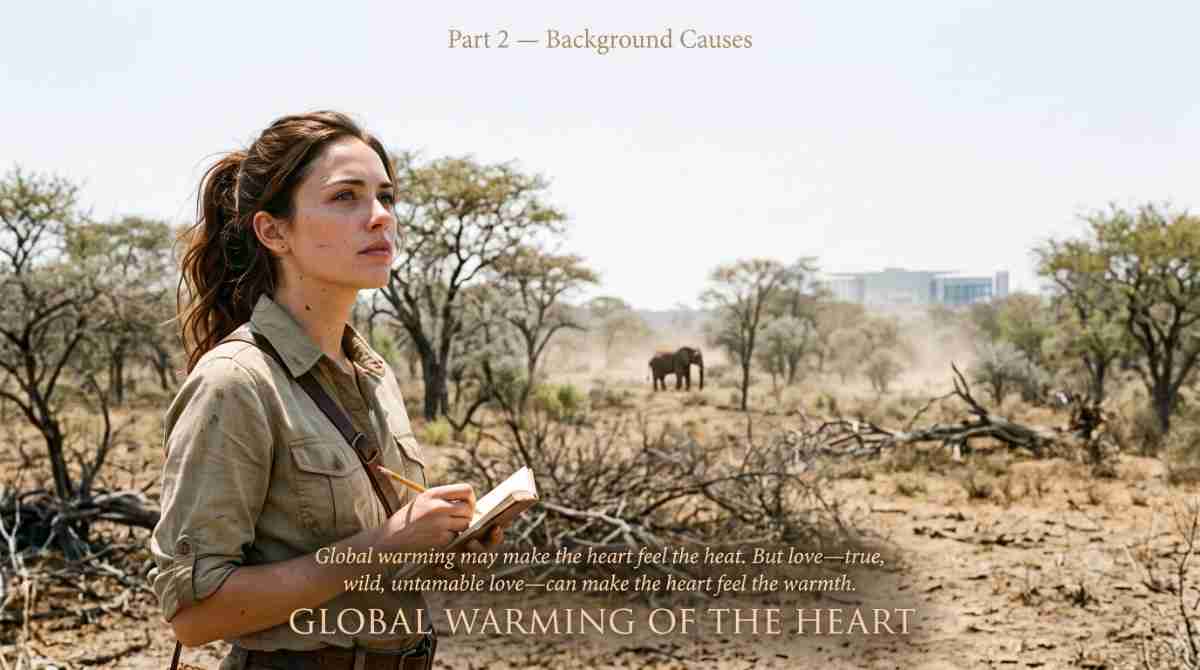
Global warming is the slow rise in Earth’s temperature caused by human activity — a silent killer that creeps in quietly and destroys everything in its path. In Global Warming of the Heart, it is also a human crisis. The heat of conflict between Mily and Kaelen — she wants to save the forest, he wants to use it — is the same heat that forces them together. They fight. They clash. They burn. But the same fire that burns also warms. The same heat that threatens the wild also forces two broken people to stand together. They do not fall in love because they are perfect. They fall in love because they are flawed. They find each other in the heat of conflict, and they discover warmth. Global warming may make the heart feel the heat. But love—true, wild, untamable love—can make the heart feel the warmth.
–

0 Comments