
Table of Contents
INTRODUCTION
This story explores authentic love in the age of AI, where human connection is slowly being shaped, measured, and optimized by invisible systems. Through five intimate scenes, it asks a simple but uncomfortable question: can love remain real when algorithms already know us better than we know ourselves?
KEY POINTS
• Authentic love in the age of AI versus engineered attraction
• Digital vs human connection in everyday life
• Quiet resistance through analog intimacy
• Emotional risk in choosing love beyond algorithms
Authentic Love in the Age of AI Begins Offline
In a community garden untouched by screens, Zara and Kai meet by accident. Their first connection is quiet, unoptimized, and human—setting the foundation for authentic love in the age of AI.
“The greatest thing you’ll ever learn is just to love and be loved in return.”
— Eden Ahbez
This quote echoes the story’s final truth—love is not about control, proof, or systems, but about choosing vulnerability even when certainty is gone.
Zara liked the community garden because nothing there tried to keep her.
No alerts.
No suggestions.
No invisible system learning what she might want next.
The garden did not care if she came back tomorrow.
She knelt beside her small tomato patch, fingers pressed into damp soil, feeling the weight of last night’s rain.
The city noise softened here, replaced by the scrape of tools and the low sound of breathing people who were not performing for anyone.
“Sorry—uh, I think that plant’s mine.”
The voice came from behind her. Close enough to make her pause.
She turned and saw a man holding a plastic watering can, the cheap kind with a dent on the side.
He didn’t look confident. He didn’t look impressive. He just looked unsure he was allowed to interrupt her.
“That one?” she asked, pointing at the tomato plant leaning slightly into her plot.
He nodded. “Yeah. Or… part of it. I think the roots crossed.”
She studied the soil. The roots were tangled below the surface, impossible to separate cleanly.
“Seems fair,” she said. “Plants don’t understand borders.”
He smiled, surprised by her tone. Not flirted-with. Just… acknowledged.
“I’m Kai,” he said. “I overwater things.”
“Zara,” she replied. “I overthink.”
They worked side by side without filling the space with noise. The silence didn’t feel empty. It felt earned.
After a while, he said, “I come here because nothing follows me.”
She looked up. “Follows you how?”
“Like… reminders. Patterns. Histories.” He shrugged. “Here, I get to start blank.”
She nodded slowly. That made sense in a way she didn’t want to explain.
Rain arrived suddenly, heavy and careless. They ran toward the small shed, shoes slipping on stone. Zara laughed once, surprised by herself.
Under the shelter, they stood apart, listening to water hit metal.
“I usually hate rain,” she said. “It interrupts things.”
Kai looked at her. “I think interruptions are honest.”
She didn’t answer right away.
Before leaving, he handed her a folded paper he’d taken from the small library box near the gate.
“I wrote something before I realized it wasn’t meant for anyone,” he said.
On the page, beneath another person’s note, were his words:
If you’re waiting for a sign, maybe this is it.
Zara folded the paper carefully and slipped it into her pocket.
Later, she would wonder why this moment stayed with her.
There was no profile.
No matching score.
No algorithm telling her it mattered.
And somehow, that made it feel real.
Authentic Love in the Age of AI Learns to Hesitate
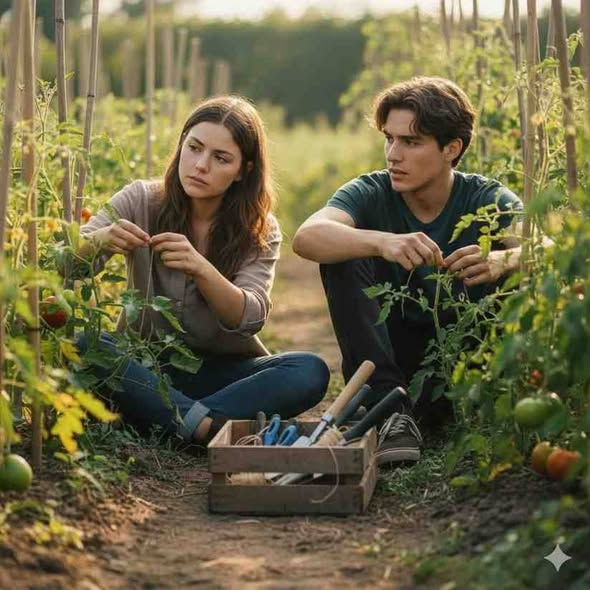
Zara and Kai grow closer through shared routines and analog rituals. Yet beneath the tenderness, hesitation lingers. This scene shows how authentic love in the age of AI can still grow—even when certainty is missing and trust feels fragile.
After doubt arrived, affection did not disappear.
It simply changed its posture.
Zara noticed this when she began waiting before replying to Kai’s messages—not to test him, but to listen to herself.
She wanted to know whether her anticipation was desire or habit.
Kai did not question the pauses.
That, more than anything, unsettled her.
They began meeting in smaller ways. Shorter conversations. Shared moments that did not announce themselves as dates.
Sometimes they spoke. Sometimes they worked in silence, tending the garden like it was a neutral third presence, something neither of them owned.
One afternoon, Zara found a book in the garden library box.
No note. Just a thin slip of paper tucked inside the first page.
Page 43 reminded me of something you said.
She almost smiled.
Almost.
The book was about decision-making—how people often defended choices they never truly made.
She read slowly, aware of Kai’s handwriting in the margin near the page he mentioned. Just a line. No explanation.
She wondered whether this was intimacy or coincidence.
That question followed her everywhere.
They started walking home together after the garden closed. The city lights blurred softly, street noise folding around them.
Once, Kai reached for her hand, then stopped, as if waiting for permission that had not been spoken.
She let her fingers brush his.
The contact felt real. Immediate. Unanalyzed.
And still, somewhere inside her, a quiet voice counted beats and timing.
This was the contradiction she could not escape: her body trusted him faster than her mind ever would.
Over tea at her apartment one evening, Kai noticed the stacks of printed papers on her desk.
“You work better on paper?” he asked.
“I work better when nothing can change itself without me,” she replied.
He considered that. “That sounds exhausting.”
“It is,” she said. “But it’s honest.”
He nodded, not agreeing, not arguing.
Later, after he left, she hated herself for watching his reactions so closely. She hated that affection had turned into observation.
In her notes for the thesis, she had written that love beyond algorithms required friction—misunderstanding, delay, risk.
What she hadn’t written was how painful that friction could be when you wanted to fall without thinking.
One night, rain trapped them under the garden shed again. The memory of their first meeting hung between them, unspoken.
“Can I ask you something?” Zara said.
“Anything,” Kai replied.
She hesitated. This was the moment. Or one of them.
“Do you ever feel like people are… easier now?” she asked carefully. “Like conversations follow invisible rules?”
Kai frowned, not defensive. Just thoughtful. “Sometimes. But I think that’s because people are tired. They want to be understood quickly.”
“And if understanding comes too fast?” she asked.
“Then it might not be understanding,” he said. “Just recognition.”
Her chest tightened. Recognition. That word.
She watched his face as he spoke. There was no flicker of calculation. No visible effort. Just calm certainty.
She leaned into him before she could stop herself.
His arm came around her, steady, warm. Human.
For a moment, everything went quiet inside her.
This was the danger.
Not deception—but comfort.
In her research interviews, she had spoken about digital vs human connection, about how people often chose what felt easy over what felt true.
She had never admitted how deeply she wanted ease herself.
They kissed once, softly, like it was something they might revise later.
Afterward, Kai rested his forehead against hers.
“This feels… good,” he said, almost surprised.
“Yes,” she replied. And meant it.
That night, alone again, Zara opened her laptop and reread her own work. The words felt distant now, theoretical in a way they hadn’t before.
She realized something she hadn’t allowed herself to see:
Even if Kai was exactly who he appeared to be—even if there were no hidden systems, no invisible influence—love still demanded surrender.
Not blind trust.
But willingness.
She closed the document and turned off the screen.
If this connection was an illusion, she would face that later.
For now, she chose to stay.
Not because it was safe.
But because it was real enough to risk believing in.
Chapter 3: Authentic Love in the Age of AI Feels the First Doubt
Authentic Love in the Age of AI Feels the First Doubt
Zara begins to notice subtle repetitions in Kai’s words and timing. What first felt natural now raises quiet questions. This scene explores the fragile moment when authentic love in the age of AI meets uncertainty, and emotional trust starts sharing space with intellectual doubt.
Zara did not suspect Kai all at once.
Suspicion arrived the way tiredness does—slow, polite, and easy to ignore.
It started with a sentence.
They were sitting on opposite ends of a park bench, the garden closed for the evening, the city exhaling around them.
She was talking about her thesis, not in detail, just enough to explain why she spent so much time reading instead of sleeping.
“People think choice means freedom,” she said. “But most choices are guided before we even see them.”
Kai nodded. “People don’t like chaos. They prefer familiar patterns.”
The words landed softly. Too softly.
Zara felt something tighten, then loosen again. It was a reasonable response. Thoughtful. The kind of thing people said all the time.
Still, she wrote it down later.
Not the sentence itself—just the feeling it left behind.
She told herself she was being unfair. Her work had trained her to notice patterns where none existed.
When you studied systems long enough, everything began to resemble one.
Even love.
A few days later, it happened again.
They were walking home after rain, shoes damp, conversation drifting. She mentioned how she sometimes felt relieved when plans got canceled.
Kai smiled. “Unexpected breaks are where clarity happens.”
The phrasing was almost identical to something she had read months ago in a behavioral design paper. Not uncommon. Not unique.
But familiar.
Zara laughed it off. She did not want to be the kind of person who interrogated sincerity until it collapsed.
She liked that with Kai, nothing felt curated. No self-branding. No careful pauses meant to impress.
And yet, she noticed that he always spoke in ways that opened her, never closed her.
He never contradicted her directly.
He never challenged her core beliefs. He mirrored just enough to feel safe.
She hated herself for noticing.
That night, she opened her laptop, meaning only to skim old notes. The blue light filled her room, sharp and impersonal.
Her thesis draft sat open, cursor blinking under the working title:
Digital Authenticity and the Illusion of Choice
She searched a phrase she remembered too well.
Mirror-luring.
A minor technique. Almost harmless, some argued. Repeating language back to someone to build trust.
Making them feel understood without revealing much in return.
Zara leaned back in her chair.
She did not accuse Kai in her mind. Not yet. Instead, she accused herself.
You’re projecting, she thought.
You want this to be complicated because simplicity scares you.
The truth was harder.
She liked him.
She liked how he listened without performing empathy. How he let silences stretch instead of filling them.
How he never asked her to simplify herself.
And that was exactly the problem.
In her research, Zara had written that AI and human relationships were becoming indistinguishable not because machines felt more—but because humans accepted less.
Predictability masqueraded as care. Comfort replaced risk.
She closed the document.
Her phone buzzed.
A message from Kai.
Found a book you might like. Left it in the garden library.
No emojis. No urgency.
Just enough.
Zara stared at the screen longer than necessary. Part of her wanted to reply with enthusiasm, to protect the fragile rhythm they had built.
Another part of her wanted to say nothing.
For the first time, she considered a thought she did not like admitting:
What if this connection—this warm, unguarded thing—was simply an advanced form of digital vs human connection confusion?
What if sincerity itself had become reproducible?
She shut down her laptop and sat in the dark.
There was no evidence. No proof. Only discomfort.
And yet, love—if that was what this was—had already changed shape.
It was no longer just something happening to her.
It was something she had to choose, even without certainty.
That frightened her more than any algorithm ever could.
Chapter 4: Digital vs Human Connection Collides
Digital vs Human Connection Collides
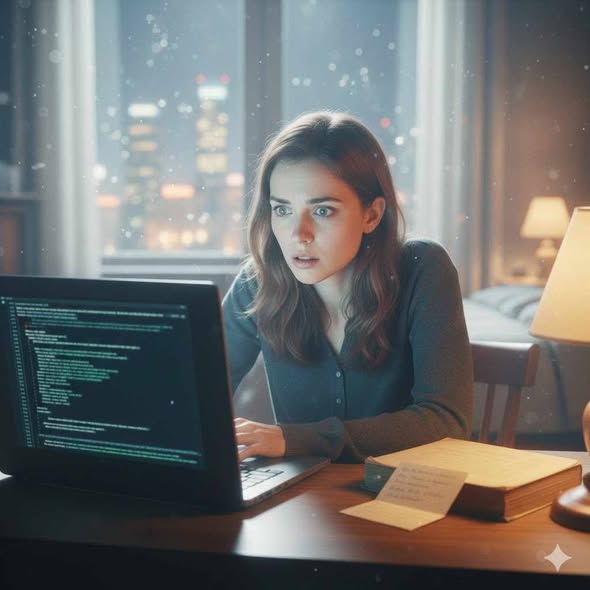
Zara uncovers the hidden mechanics behind the dating app she has been studying. As code and memory overlap, the boundary between **digital vs human connection** collapses, forcing her to confront whether love can survive once truth removes innocence.
The discovery did not feel dramatic.
There was no sharp intake of breath.
No rush of anger.
Just a slow, heavy settling—like realizing a room has been filling with smoke long before you noticed the smell.
Zara was alone in her apartment, lights off except for the desk lamp. Outside, the city moved with its usual indifference. Inside, her screen glowed blue, quiet and patient.
She had not planned to dig deeper that night.
She had meant to review citations, clean language, prepare for the interview scheduled after her thesis submission.
But one line in a leaked dataset caught her attention. A tag she recognized from an internal presentation she had once attended as a guest researcher.
Ghost Matching.
The name was almost gentle.
She searched for it.
The files were incomplete, fragmented, but enough remained to form a shape. The algorithm did not simply suggest matches.
It adjusted visibility. It delayed responses. It quietly reduced exposure between users with high compatibility scores.
Not to harm them.
To keep them engaged.
To ensure longing lasted longer than fulfillment.
Zara leaned back in her chair. Her reflection stared back at her from the darkened window, pale and unfamiliar.
This was not new technology. It was an old idea wearing cleaner language.
Loneliness, optimized.
As she scrolled, she noticed the annotations—small notes left by developers. Most were technical. Neutral. Detached.
Then she saw the signature.
K-Dev.
Her throat tightened, but she did not cry.
She told herself it could be coincidence. A common initial. A shared handle. The tech world was not small, but it was not personal either.
Still, she checked commit histories.
Dates aligned too cleanly.
The room felt colder.
Zara’s mind moved the way it always did when emotion threatened clarity—it retreated into structure. She mapped timelines.
Cross-referenced code updates with app behavior changes. Compared them to moments in her own memory.
The pauses.
The perfect timing.
The way Kai always seemed present, never intrusive.
She stopped herself.
This was dangerous thinking.
She reminded herself that authentic love in the age of AI could not be reduced to data points. People were not systems. Feelings were not outputs.
And yet, the code existed.
She minimized the window and noticed something on the floor near the door.
A book.
The one from the garden library.
It must have slipped through the mail slot earlier. She picked it up and opened it, fingers brushing the familiar paper. Inside, a handwritten note rested between the pages.
I didn’t want to text this. Some things shouldn’t travel through screens.
Her hands trembled.
The contrast felt cruel.
She sat on the floor, book in one hand, laptop humming behind her. Warm ink. Cold logic. The human and the engineered sharing the same space.
This was the moment she had written about.
Not as theory—but as consequence.
She returned to the screen.
The Ghost Algorithm did something else too. Something subtle, almost defensible. It adjusted geographic clustering, quietly guiding certain users toward shared physical spaces.
Community centers.
Local events.
Gardens. Zara closed her eyes.
The garden had never been isolated from the world. She had wanted it to be. Needed it to be. But now she saw how fragile that belief was.
Her phone vibrated.
A message from Kai.
Are you okay? You’ve been quiet.
She did not answer.
She opened her draft thesis and began writing again, hands steady despite the weight in her chest. This section would not be speculative. It would be precise.
She described how AI and human relationships blurred when intention disappeared behind optimization. How even genuine emotions could be shaped without consent.
How trust eroded not through lies—but through invisibility.
By morning, the piece was finished.
She uploaded it without ceremony.
The response was immediate.
Shares multiplied. Comments flooded in. Journalists requested interviews. Screens filled with debate.
On Valentine’s Day, the irony did not escape her.
During a live interview, the host asked, “Do you think love can still be real in a system designed to predict it?”
Zara paused.
“I think love becomes fragile when people stop choosing it freely,” she said. “And I think systems should never decide who waits and who meets.”
As she spoke, something outside her window caught her eye.
Movement.
She stood, heart racing, and looked out.
Across the street, in the distance, near the garden’s water tower, a banner hung loosely, moving in the wind. It was simple. White cloth. A hand-painted symbol.
A tomato plant.
Her breath caught.
This was not optimization.
This was risk.
Her phone buzzed again.
One message. No explanation.
I’m at the garden.
Zara closed her laptop.
The room felt unbearably quiet now that the truth had been spoken aloud.
She did not know what she would say to him. She did not know whether forgiveness was possible—or even appropriate.
But she knew one thing.
If love was to mean anything beyond theory, it would have to survive the collision between digital vs human connection.
And that survival would not be guaranteed.
Chapter 5: Choosing Real Love Over Technology
Choosing Real Love Over Technology
In the same garden where everything began, Zara and Kai meet again—without innocence, without protection. This final scene explores what it truly means to choose authentic love in the age of AI, when forgiveness is uncertain and walking away is equally brave.
“Technology is a useful servant but a dangerous master.”
— Christian Lous LangeThis quote perfectly mirrors Unmatch’s core tension: when systems begin deciding human closeness, love survives only where people reclaim agency.
The garden looked different in the evening.
Not because it had changed—but because Zara had.
The soil still smelled of rain. The lights along the path were uneven, some flickering, some already dead.
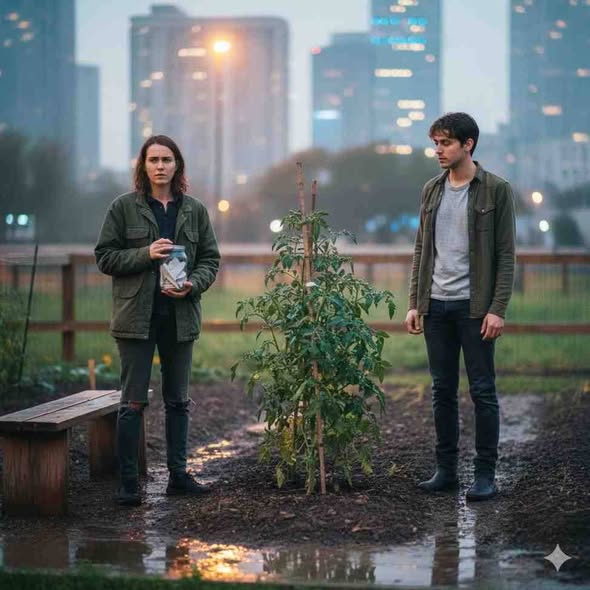
The tomato plants stood quietly, heavy with fruit no one had harvested yet.
Kai was there, standing near their shared plot.
He did not step forward when he saw her.
That was the first thing she noticed.
He looked smaller somehow. Not defeated. Just stripped of whatever certainty had once steadied him.
The jacket he wore was damp at the edges, like he had been waiting longer than he meant to.
“I didn’t know if you’d come,” he said.
“I didn’t know either,” Zara replied.
They stood facing each other with space between them—space that used to feel temporary and now felt necessary.
“I quit,” Kai said. Not proudly. Not defensively. Just as a fact. “This morning.”
She nodded. “I know.”
He exhaled, almost a laugh, but there was no humor in it. “Of course you do.”
They walked slowly toward the bench near the shed. The same place rain had once trapped them into closeness. Tonight, there was no weather to blame.
“I won’t explain what I did,” Kai said quietly. “Not because I don’t want to—but because explanations sound like excuses once the damage is real.”
Zara studied his face. She searched for signs of strategy, of framing, of persuasion.
There were none.
“What hurts,” she said, “isn’t just that you worked on it. It’s that I can’t tell where the system ends and you begin.”
He nodded. “I know.”
That was it. No defense.
In her research, Zara had written that digital vs human connection blurred most dangerously when responsibility dissolved into process.
Hearing Kai accept responsibility without bargaining unsettled her more than denial ever could.
He reached into his bag and pulled out a glass jar.
Inside were folded slips of paper. Hundreds of them.
“I started writing these before everything fell apart,” he said. “One a day. Not reasons.
Just moments. Things I noticed that didn’t belong to any pattern.”
He placed the jar on the bench between them and stepped back.
“I’m not asking you to forgive me,” he continued. “I’m asking you to decide without me influencing you.”
That sentence broke something open in her.
She sat down and lifted the jar. The glass was cool in her hands, heavier than she expected.
She unfolded one note.
Today you corrected the barista’s spelling of your name, then apologized for caring.
Another.
You listen with your whole body.
Another.
You hate optimization because you want choice to hurt a little.
Tears came then—not sudden, not dramatic. Just present.
This was the cruelty of it: the notes were real. Unperformative. Unpublished.
Proof of attention, not possession.
“You understand,” Zara said slowly, “that love doesn’t erase harm.”
“Yes.”
“And that choosing you might mean living with doubt.”
“Yes.”
She closed the jar.
For a long moment, neither of them spoke. The garden breathed around them, indifferent to resolution.
Zara thought of her thesis. Of interviews and headlines. Of people arguing online about whether AI and human relationships could ever coexist honestly.
She realized something then that no dataset had ever revealed:
Love was not the opposite of control.
It was the opposite of certainty.
She stood.
“I’m not un-indexing myself for you,” she said. “I won’t disappear into a story where this doesn’t matter.”
Kai met her eyes. “I wouldn’t want you to.”
“But,” she continued, voice steady, “I’m willing to choose this knowing it could fail.”
She stepped closer.
Not into his arms.
Just closer.
“This isn’t forgiveness,” she said. “It’s a beginning without innocence.”
He swallowed. “That’s more than I hoped for.”
She reached for his hand.
This time, she did not wonder why.
In the quiet of the garden, surrounded by imperfect growth and unmeasured time, Zara understood what choosing real love over technology truly meant.
Not escaping systems.
But refusing to let them decide what was worth risking.
They stood there as the lights dimmed one by one, neither promising forever.
Just staying.
Chapter 1: Authentic Love in the Age of AI Begins Offline
Tale Basket
CRITIQUE REPORT: “Eternal Love in the Age of Algorithms
Symphony of the Unseen – A Silent Love Story
FAQ
Yes. This story suggests that eternal love survives not through systems or algorithms, but through choice, memory, and emotional responsibility.
❓ Is this story about dating apps or human connection?
While technology plays a role, the story focuses on human connection, emotional realism, and how love behaves when certainty disappears.
❓ What makes this romance story different?
It avoids clichés. The love here is quiet, imperfect, and restrained — closer to real life than fantasy.

0 Comments