

Fake Marriage Romance in a Lighthouse

Read Time :
Table of Contents
Introduction
A lighthouse, a will, and a condition no one expected—this is how Elara’s story begins. Her inheritance came with a demand: marriage within a year, or the crumbling stone tower would slip from her hands. Unready for love yet unwilling to lose her grandfather’s legacy, she chose a strange path. She placed an advertisement, not for romance, but for survival—seeking a partner willing to enter a fake marriage.
It was meant to be a paper bond, a performance for the sake of inheritance. Yet when Liam, a quiet marine biologist marked by storms and loss, arrived to share the lighthouse, the arrangement proved heavier than ink and signatures. What began as a convenient deception would, under the weight of waves and silence, shift into something both fragile and real.
Inheritance, Loneliness, and a Fake Marriage
The sea was never kind to Elara. Its weight pressed against her chest in dreams, and in waking life, even the sound of waves made her step back from the shore. Yet here she was, standing on the edge of her late grandfather’s island, clutching a folded will that demanded more than she thought she could give.
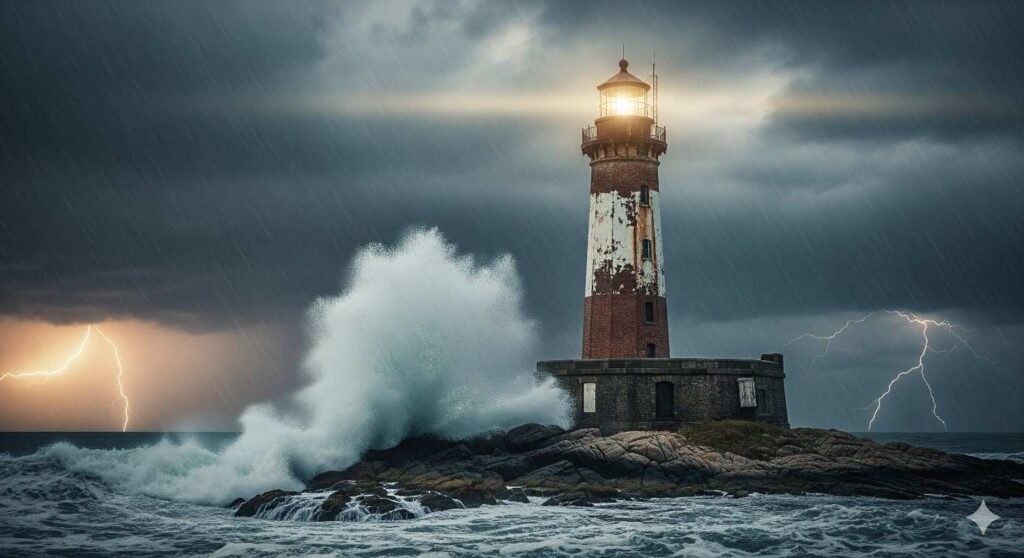
The old lighthouse, rising like a weary bone from the rocks, had passed to her. But the inheritance carried a condition: she must marry within a year and prove she could live here six long months.
Marriage. She had never managed love, let alone the steady presence of a husband. In her confusion, she posted an odd advertisement—half desperate, half comical—seeking a partner for a fake marriage.
She did not expect anyone would answer.
But Liam did.
He arrived not with a smile but with salt still in his beard and notebooks tucked beneath his arm. A marine biologist, studying whales and storms. The shack he lived in was collapsing from last winter’s winds, and her offer—strange as it sounded—gave him shelter, space for his research, and something sturdier than driftwood to lean on.
Their agreement was clear: he would be her husband of convenience, helping her keep the lighthouse alive. She would sign papers, play her role, and keep the inheritance. No love, no permanence. A transaction written on the fog.
Still, Elara noticed the silence between them was not empty—it was like a tide that pulled and pushed, sometimes gently, sometimes hard enough to unsettle the rocks beneath her feet.
Awkward Rituals of a Fake Marriage
They began with awkward rituals. Elara, timid with tools, dropped nails and tangled rope. Liam watched her clumsiness with a stillness that was not judgment, though she sometimes thought it was. He moved slowly, repairing broken lantern glass, oiling hinges, and marking whale migrations in his notebook.
In the evenings, they cooked on a temperamental stove. Elara burned potatoes; Liam said little but ate them anyway, his fork clinking gently against tin. Sometimes he corrected her grip on a hammer, his hand briefly brushing hers—too brief to mean anything, too long to ignore.
“Funny arrangement, isn’t it?” she once said, trying to fill the silence.
“Fake marriages often are,” he replied, his voice low, almost absent-minded, as if naming a fact from a tide chart.
The words lingered between them longer than she expected.
At night, when storms swept across the island, Elara heard the foghorn moan. She pulled her blanket tighter, wishing the sea would quiet. Sometimes, in those moments, Liam’s shadow passed her door—never entering, never speaking—just a reminder that someone else lived inside the stone walls.
She told herself it was nothing. He was just a man bound to her by a document and a roof. Yet the lighthouse, like a watchful eye, seemed to suggest otherwise.
Symbols in Stone, Glass, and Water
The work of restoration became a language. Broken glass mended, rusted gears coaxed back into motion, paint spread like fragile hope across weather-beaten stone.
Elara painted the lighthouse in slow, halting strokes, her brush trembling each time wind carried salt spray into her face. Liam tightened the lantern’s machinery, his silence heavy but steadying.
The lighthouse itself became a symbol of their agreement—standing tall because two strangers, tied by a fake marriage, refused to let it collapse.
One evening, Elara asked about the whales he followed. Liam paused, staring out at the gray horizon before answering.
“They grieve,” he said, voice rougher than usual. “When one dies, the others carry it. Days. Sometimes weeks. They sing differently then. Lower. Slower.”
Elara said nothing, but her brush stopped moving. She thought of his silence, the way he sometimes sat staring at the sea with clenched jaw. She began to guess what loss he carried, though he never spoke of it directly.
And he, in turn, began to see her fears not as weakness but as threads of her determination—the way she fought to protect her grandfather’s legacy despite her dread of the water.
Storm, Silence, and Fractures in the Fake Marriage
It happened on a stormy night.
The sea howled as if it meant to swallow the island. Waves pounded against rock, shaking the old lighthouse until dust rained from its ceiling. Elara and Liam, trapped inside, sat across from each other with lantern light flickering between them.
At first they spoke of practical things—oil reserves, roof leaks, the fragility of the windows. But the storm’s persistence gnawed at them until words broke loose from deeper places.
Elara admitted she was afraid she would fail. Afraid she was not strong enough for this island, this inheritance, or even this strange marriage made of paper and silence.
Liam, after a long pause, told her of the accident years ago—the colleague swept off a research vessel, the endless water offering no body, no closure. Since then, he had carried that absence like a stone in his chest.
Their agreement—the neat fiction of a fake marriage—shifted in that lantern-lit confession. Elara’s hand rested on the table, hesitant, and Liam’s rested near it. Not touching, but near. Close enough that the storm outside felt less certain than the quiet between them.
When Pretend Becomes Real
Days passed after the storm, but the air between them had changed. The chores of survival—patching leaks, feeding lamps, cooking small meals—seemed different. She found herself watching the way Liam wrote notes, the way his brow furrowed when he counted whale songs. He, in turn, seemed softened by her awkward laughter when she dropped yet another tool.
Once, while painting, she splattered red across her cheek by accident. He reached out, thumb brushing the paint away, then pulled back too quickly. They both looked away, the silence awkward, almost guilty.
Their words became hesitant. Elara caught herself saying “we” instead of “I.” Liam caught himself standing too close at the railing, as though sharing the view was necessary.
They never said it aloud. Not then. But the pretense of fake marriage was eroding, replaced by something unsteady, something dangerous, something alive.
The Decision Beneath the Lighthouse
As summer waned, the deadline in the will approached. Papers would be signed, proof given, inheritance secured. They could end the arrangement neatly.
Yet neither spoke of endings. Instead, they lingered in small moments—the brush of hands on a rope, the way her laughter seemed to echo differently inside stone walls now.
One evening, as the sun slid into the sea, Elara finally asked, “When this is over, will you leave?”
Liam hesitated. The answer should have been simple. But he looked at her, at the lighthouse behind her, at the sea that both haunted and healed him.
“I don’t know,” he said. “Maybe the arrangement wasn’t so fake after all.”
She did not press. The lighthouse lantern turned slowly above them, its beam sweeping across waves like an uncertain promise.
And in that silence, they both knew their story was not finished. The inheritance was just paper. What mattered was what had grown in its shadow—fragile, hesitant, but undeniably real.
Conclusion: The Lighthouse and Its Truth
The lighthouse stood restored, its beam slicing through fog as ships passed by. To outsiders, Elara and Liam were a married couple, guardians of an old stone tower. A convenient truth born from a fake marriage.
But within those walls, where storms had howled and silences had stretched, something else had taken root. Not the perfection of romance, but the irregular rhythm of two flawed people trying, failing, and trying again.
Perhaps the marriage had begun as a lie. Yet under the gaze of the lighthouse, lies and truths blurred, and in that blur, they found something close to love.
END
Ruse Fake Marriage Force Proximity
❓ What is a fake marriage in romance stories?
A fake marriage is a popular romance trope where two characters pretend to be married—usually for practical reasons like inheritance, survival, or convenience. Over time, the pretense often gives way to real emotions, blurring the line between arrangement and love.
❓ Why do readers enjoy fake marriage romances?
Readers are drawn to fake marriage romances because they mix tension, secrecy, and intimacy. The characters are forced into close proximity, creating awkward rituals, emotional misfires, and moments where genuine love unexpectedly grows out of a lie.
❓ How does “The Keeper’s Wife: A Fake Marriage by the Lighthouse” use this trope?
This story uses the fake marriage trope against the backdrop of a lonely lighthouse. Elara and Liam enter into a marriage of convenience to secure an inheritance, but storms, silence, and shared labor slowly turn their arrangement into something fragile yet deeply real.

0 Comments