
By: Ranjan Sarkhell
–
Table of Contents
Open quote:
“There is no greater agony than bearing an untold story inside you.” — Maya Angelou
–
Introduction
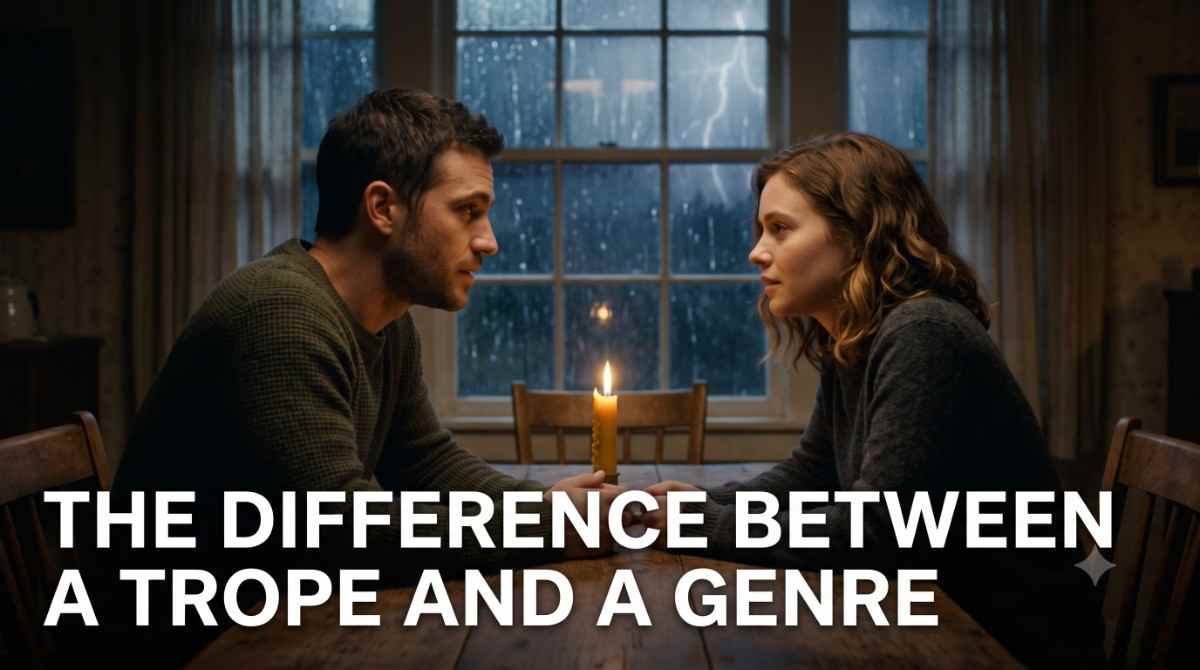
Two people are trapped together during a storm. The power’s out, the phone’s dead, and Sarah knows Jack is hiding something.
If this is a romance, the storm is forcing them to finally admit what they’ve been dodging for three hundred pages.
If it’s a thriller, the storm is forcing them to figure out which one of them is lying before sunrise.
If it’s horror, the storm doesn’t care about either of them — something else just came in through the back door.
Same setup. Same beat. Three completely different books.
That’s really the fastest way to understand difference between trope and genre — a question most explanations answer with a dictionary entry instead of showing you what it actually looks like on the page.
Here’s the short version:
A genre is the broad category that tells a reader what kind of experience they’re signing up for — Romance, Mystery, Horror, Fantasy.
A trope is a specific, recognizable device used inside that story to deliver on the promise — things like enemies-to-lovers, the chosen one, or a storm that traps two people together with a secret between them.
Genre sets the promise. Trope is how a writer keeps it.
That distinction sounds simple written out like this. It gets a lot more interesting once you watch the same trope walk into three different genres and come out looking like a completely different story each time.
–
Genre is the neighborhood. Trope is the furniture.
What is the difference between trope and genre?
–
Quick Takeaways
- Genre is the broad category that sets reader expectations — the emotional promise a story makes before page one.
- Trope is a specific, recognizable storytelling device, character type, or plot pattern used inside a story.
- Genre tells you what kind of experience you’re getting; trope is how the writer delivers it.
- You don’t choose between genre and trope — you choose genre first, then use tropes as building blocks within it.
- The same trope can appear across different genres and feel completely different each time, because the genre reshapes its purpose.
- “Genre tropes” means tropes so tied to a genre that readers expect them as part of its unwritten contract.
- The Swap Test: swap the element for something else. If the story’s emotional target stays the same, you swap a trope. If the emotional target changes, you swap genres.
| Genre | Trope | |
|---|---|---|
| What it is | Broad category/style | Specific recurring device |
| Sets | The overall promise | The building blocks |
| Chosen | First | Within the genre |
| Examples | Romance, Horror, Mystery | Enemies-to-lovers, chosen one, ticking clock |
–
Where the Words Actually Come From
Before the story examples, one thing almost nobody mentions: the two words don’t just mean different things — their origins point at different jobs.
Genre comes from the French word for “kind” or “type.” It’s a classification question — what kind of thing am I looking at?
Trope comes from the Greek tropos, meaning “a turn” or “a turning.” It’s a movement question — how does the story turn here?
That’s the whole argument in two word histories. Genre categorizes. Trope turns. A genre tells you what shelf you’re standing in front of. A trope is a specific twist the story takes while you’re standing there.
–
The Difference Between Trope and Genre, in One Story Told Three Ways
Let’s take one trope and drag it through three genres to see what genre actually does to it.
The trope: someone returns after a long absence, changed.
In a family drama, Daniel comes home for his father’s funeral. He hasn’t spoken to his sisters in a decade. The tension isn’t “will something bad happen” — it’s “will they forgive him, and does he even deserve it.” The payoff is emotional: a hard conversation, a slow thaw, maybe a door that stays shut.
In a mystery, that same returning brother is now a suspect. Daniel left town right after the incident everyone’s been quietly not-talking about for ten years, and now he’s back the same week a neighbor goes missing. The reader isn’t asking “will they forgive him” — they’re asking “what does he know.”
In horror, Daniel comes back and he’s wrong somehow. Same face, same voice, but his sister Emily catches him standing very still in the backyard at 3 a.m., not doing anything, just standing there. The genre has taken the identical premise and pointed it at dread instead of grief or guilt.
| Genre | What happens to the trope | Reader’s core question | Emotional payoff |
| Family Drama | Daniel returns for his father’s funeral | “Will they forgive him?” | Reconciliation, or a door that stays shut |
| Mystery | Daniel returns as a suspect | “What does he know?” | Truth uncovered |
| Horror | Daniel returns, but wrong | “What happened to him?” | Dread, not resolution |
Nothing about the trope itself changed. What changed is the promise. A genre is a promise to the reader about what kind of experience they’re signing up for. A trope is a tool the writer uses to deliver on that promise — a recognizable shape the reader already understands, so the writer doesn’t have to build every beat from scratch.
Readers pick a genre the way you’d pick a restaurant. You don’t walk into a steakhouse wondering if they’ll surprise you with sushi. You walk in because you know what you’re getting, and the specific cut of steak — that’s the trope. The genre is the promise; the trope is how the kitchen keeps it.
–
Why “Which One Do You Choose” Is the Wrong Questions
Genre and trope aren’t competing choices. You pick a genre first — the promise you’re making before a reader reads a single sentence — and then you pick tropes as the vocabulary you use to keep that promise.
Think of it like a musician choosing a key versus a chord. The key (genre) sets the emotional register of the entire piece before a single note plays. The chords (tropes) are the specific choices made within that key. Nobody asks “should I choose the key or the chord” — you need both, and one exists inside the other.
This is why “enemies to lovers” can live comfortably in a fantasy epic, a corporate rom-com, and a YA contemporary all at once. Take Grace and Noah: in a fantasy, their enmity might be political — rival houses, a war neither of them started. In a workplace rom-com, it’s a shared office and a stolen promotion. In a YA contemporary, it’s a student council election gone personal. The trope is portable. What changes is the genre’s promise wrapped around it.
A useful test: ask what the reader is actually hoping happens by the last page. “I hope they end up together” is romance, no matter which tropes carried you there. “I hope the truth comes out” is mystery or thriller. That hoped-for outcome is the genre talking. The tropes are just how you built the road to it.
–
Are Tropes Just Lazy Writing?
This is worth addressing directly, because it’s a real argument readers have, not just a definition problem. Some writers treat “trope” as an insult — shorthand for unoriginal, paint-by-numbers storytelling.
That’s a misread of what a trope actually does. A trope isn’t the absence of originality — it’s a shared vocabulary. Sonnets have a fixed structure and nobody calls Shakespeare lazy for using one. What makes a trope feel tired isn’t that it’s a trope; it’s that the writer used it without asking what it’s for in this specific story.
Enemies-to-lovers is only stale when the “enemies” part is skin-deep. It’s electric when the conflict is real enough that the reader isn’t sure the characters should end up together — and the genre’s promise is what tells the writer how far they’re allowed to push that doubt before readers stop
Here’s something that didn’t exist when older writing guides were codifying genre theory: tropes are now a discovery system.
On BookTok, Amazon, and Kindle Unlimited, readers increasingly search by trope, not trusting the story.
The trope isn’t the problem. An uninterrogated trope is.
–
Why This Matters More Than It Used To
Just by genre — typing “enemies to lovers” or “forced proximity” directly into a search bar the way they used to type “romance novel.”
Genre still tells a platform which category to file a book under. But trope has become the tag that determines whether the right reader actually finds it once it’s there.
A book can be correctly generated and still invisible if it isn’t tagged with the tropes readers are actively hunting for.
That’s not a literary distinction anymore — it’s a discoverability one, and it’s reshaped how a lot of working authors describe their own books.
–
What “Genre Tropes” Actually Means
A genre trope is a trope so strongly associated with a specific genre that readers now expect it there — it’s practically part of the promise.
The wise old mentor who dies right before the final act isn’t required by any rule of storytelling. But fantasy readers have seen it so often that the genre has quietly absorbed it as a convention. Picture a character like Samuel — grizzled, cryptic, dead by act three — and it feels right in a fantasy novel. Drop that same beat into a legal thriller and it’ll feel oddly out of place, because that genre made a different promise from the start.
A ticking clock — a deadline the hero has to beat — feels almost mandatory in a thriller. Put it in a quiet literary novel about a marriage falling apart, and it can feel like the wrong genre wandered into the room, unless the writer is deliberately bending expectations on purpose.
| Genre | Common Tropes |
| Romance | Enemies-to-lovers, fake dating, one bed, grumpy-sunshine |
| Fantasy | The chosen one, wise mentor, ancient prophecy |
| Mystery/Thriller | Ticking clock, unreliable narrator, hardboiled detective |
| Horror | The final girl, the wrong house, something’s-not-right-with-them |
Genre conventions, in other words, are simply tropes that got popular enough inside one genre to become an unwritten rule.
–
Back to the Storm
So go back to that opening scene — Sarah and Jack, no power, a secret in the room.
If you’re a writer staring at a blank page, this isn’t really a vocabulary question. It’s a sequencing question. Decide the promise first: are you writing a story about falling in love, solving a crime, or surviving something that shouldn’t exist? That’s your genre, and it’s the lens everything else gets filtered through.
Then reach for your tropes — forced proximity, the reluctant return, the unreliable narrator, whatever fits — not as decoration, but as the load-bearing structure that makes the promise land. A trope used well doesn’t feel like a cliché; it feels like recognition. Readers lean in because they know this shape, and they’re curious what you’ll do with it.
The storm doesn’t care what kind of story it’s in. But by the time it’s over, the reader always knows exactly what kind of story they just lived through — which, in the end, is the whole difference between a trope and a genre.
–
Close quote:
Genre is the neighborhood, Trope is the furniture.
–
Link
Romantic Stories: UltimateGuide
–
Frequently Asked Questions
What’s an example of a trope?
Enemies-to-lovers, the chosen one, forced proximity, the unreliable narrator, the ticking clock — any recurring, recognizable story pattern readers already know how to read.
Is why-choose a genre or a trope?
It’s a trope — a romance sub-trope where the main character ends up with more than one love interest instead of choosing just one. It shows up inside the romance or fantasy-romance genre; it isn’t a genre on its own.
Genre or trope — which do you choose?
You don’t choose between them. Genre is decided first (the promise); tropes are the tools you use inside it (how you keep the promise).
What are the 13 genres?
There’s no single official list, but a commonly cited set includes: Romance, Mystery, Thriller, Horror, Fantasy, Science Fiction, Historical Fiction, Literary Fiction, Western, Adventure, Crime, Young Adult, and Comedy/Satire.
What does “genre tropes” mean?
Tropes so tied to a specific genre that readers expect them as part of that genre’s unwritten contract — like the mentor’s death in fantasy or the meet-cute in romance.
Are tropes bad writing?
No — an uninterrogated trope is. A trope used with intention creates recognition, not cliché.
–

0 Comments