
By: Ranjan Sarkhel
–
Table of Contents
–
Quote
“The heart has its reasons which reason knows not.”
— Blaise Pascal
( This quote fits beautifully with our blog’s argument: Pascal was a brilliant mathematician and philosopher, yet even he acknowledged that love and the heart operate on logic no equation can capture. It reinforces your central point — that love can be described through metaphor, chemistry, or behavior models, but never fully measured or reduced to a single formula. )
–
Introduction
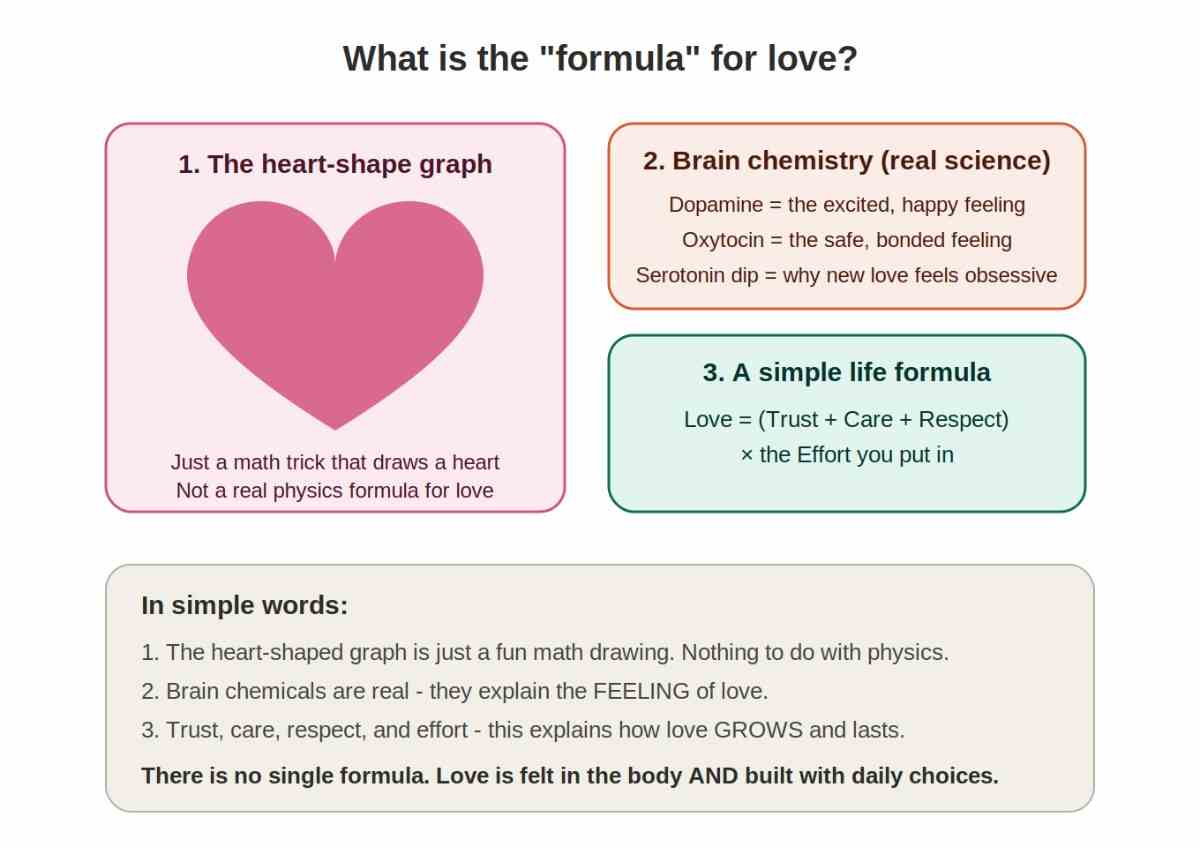
Search “formula for love” online and you’ll find three completely different answers competing for the same title — a physics equation, a list of brain chemicals, and a psychology formula.
Most people assume these are all versions of the same scientific fact. They’re not.
Here’s the truth: none of these are literal formulas for love, the way E=mc² is a formula for energy.
They’re three different lenses — a physics metaphor, real biochemistry, and a behavioral psychology model — that people use to talk about love in a structured way.
Each one explains a different piece of the puzzle, and mixing them up is exactly why so much online content about the “formula for love” is misleading.
Let’s break down what each one actually means, and where the common misconception comes from.
–
1. Dirac’s Equation — The Quantum Entanglement Metaphor
Paul Dirac’s actual equation describes the behavior of electrons in quantum mechanics. It has absolutely nothing to do with romance, feelings, or relationships.
So why does it keep showing up in “formula for love” search results?
The confusion comes from a related but separate concept called quantum entanglement. Entangled particles, once linked, continue to affect each other’s state even when separated by vast distances.
Somewhere along the way, the internet romanticized this idea into a poetic metaphor: two people who form a deep connection stay linked in some invisible way, even after they separate.
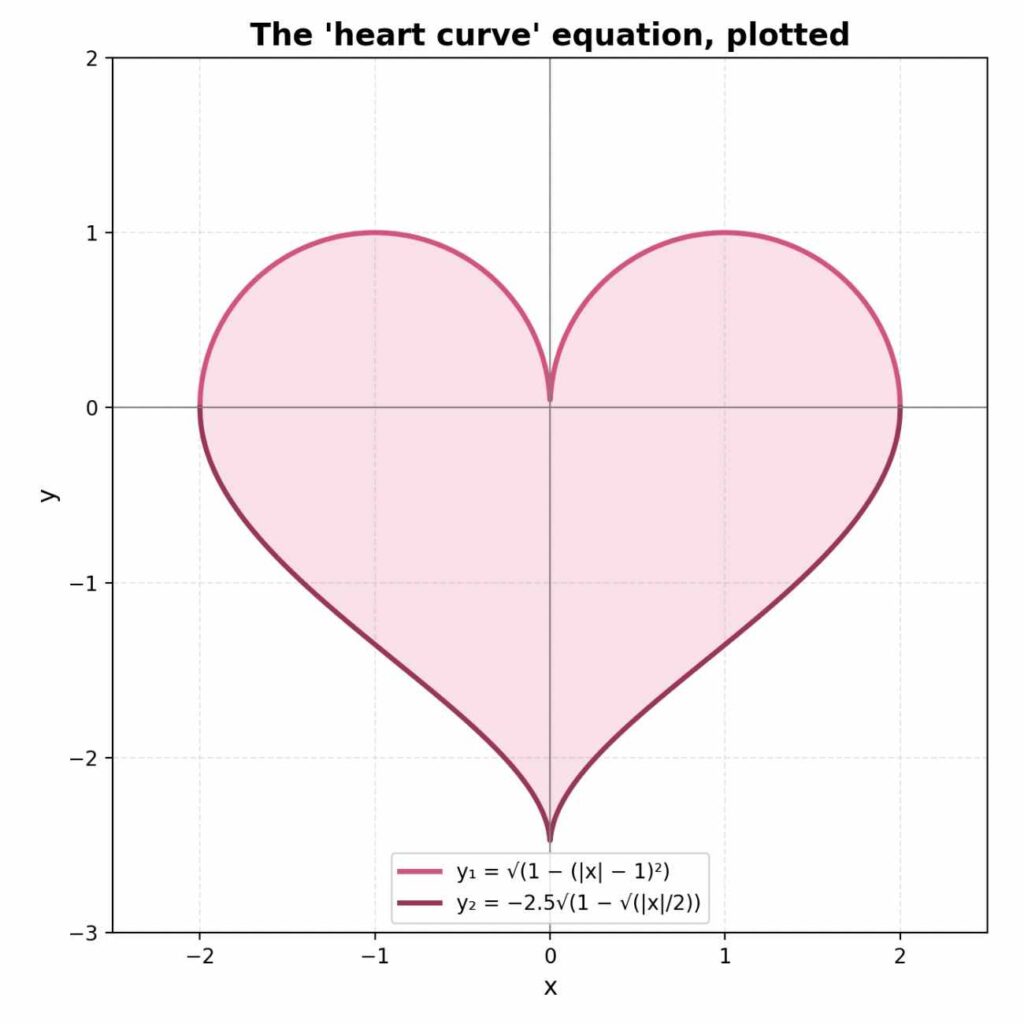
“This is what usually gets mistaken for Dirac’s equation online — it’s actually a completely different, much simpler piece of math: y₁ = √(1 − (|x| − 1)²) and y₂ = −2.5√(1 − √(|x|/2)), which plots into a heart shape when graphed. It has nothing to do with quantum physics.”
This is the core misconception worth clearing up: the viral “heart equation” people share as the formula for love isn’t Dirac’s equation at all — it’s an unrelated graphing trick that happens to draw a heart shape when plotted on an x-y axis. It’s clever math, but it’s not physics, and it’s not a scientific claim about human connection.
“Love is composed of a single soul inhabiting two bodies.”
— Aristotle
Aristotle‘s thoughts ties in nicely with the Dirac/quantum entanglement as — Aristotle’s idea of two becoming one poetically mirrors the “particles remain linked” metaphor without any physics involved at all.
–
2. The Chemical Cocktail — What’s Actually Happening in Your Brain
This is the one lens grounded in real, peer-reviewed neuroscience. When people fall in love, three chemicals do most of the work:
- Dopamine — drives the “high,” the craving, the reward-seeking feeling of wanting to be near someone.
- Oxytocin — often called the bonding hormone, released during physical closeness like hugging and touch, and responsible for building trust and attachment.
- Serotonin — interestingly, drops during early romantic love. Researchers believe this explains the obsessive, can’t-stop-thinking-about-them phase, since similar chemical patterns show up in obsessive-compulsive states.
This explains the feeling of love — the racing heart, the obsession, the comfort of closeness. But brain chemistry alone can’t explain why some relationships last decades while others fade in months. That’s where the third lens comes in.
–
3. The Behavioral Equation — A Psychological Model, Not a Scientific Formula
Love = (Trust + Care + Respect) × Effort
This isn’t a scientific formula either. It’s a conceptual model, popular in relationship psychology and self-help writing, used to explain why some relationships thrive and others quietly fall apart.
The idea is simple: trust, care, and respect are the raw ingredients. But they only translate into a strong, lasting bond when multiplied by consistent effort.
Add all the right ingredients and skip the effort, and the bond stays weak — no matter how genuine the trust or care actually is.
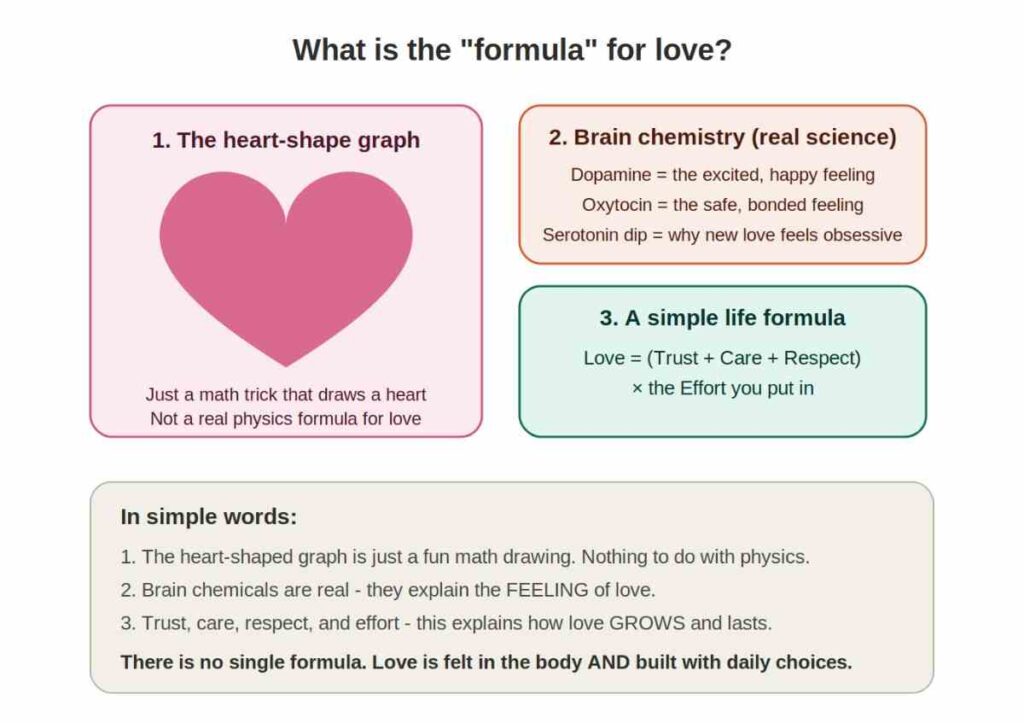
heart-shape graph vs. brain chemistry vs. behavioral formula
“The three ideas people confuse under one search term — only one of them is real neuroscience.”
RomanceTropes.com
–
So, What Is the Real Formula for Love?
There isn’t one — and that’s the honest answer.
Love isn’t reducible to a single formula because it operates on three completely different levels at once:
- A poetic/philosophical level — the idea of connection that persists, even across distance.
- A biological level — real, measurable brain chemistry that explains the feeling.
- A practical level — the daily choices and effort that determine whether love lasts.
Each “formula” floating around online captures a different piece of a much bigger, messier picture.
Understanding the difference between them — rather than treating them as interchangeable — is the first step to actually understanding what love is, instead of just sharing a pretty equation that doesn’t mean what it claims to.
End
Link Basket
Romantic Stories:Ultimate Guide
The Summer We Stopped Pretending: A Childhood Best Friends to Lovers Slow Burn Story
–
FAQ
Is there an actual scientific formula for love?
No — not in the way a formula like E=mc² works. What people call the “formula for love” is really three separate ideas mixed together: a physics-inspired metaphor, real brain chemistry, and a psychological relationship model. Each explains a different part of love, but none of them measure or predict it as a single equation.
What is the viral heart-shaped equation people share online?
It’s a simple graphing trick — two math equations that, when plotted on a graph, happen to form a heart shape. It’s often mistakenly labeled as “Dirac’s equation” or linked to quantum physics, but it has no real connection to either. It’s just clever math that looks romantic, not a scientific formula for love.
Can brain chemistry alone explain why love lasts?
No. Chemicals like dopamine, oxytocin, and serotonin explain the feeling of love — the excitement, the bonding, the obsession in early romance. But lasting love depends on consistent effort, trust, and care over time, which is a behavioral and emotional choice, not something chemistry can sustain on its own.
–

0 Comments