

By: Ranjan Sarkhel
Table of Contents
–
1 : Meaning of Situationship
Have you ever felt like you were in a relationship, but no one ever called it one?
You spend time together, share personal moments, text every day, and even support each other through life’s ups and downs.
Yet when someone asks, “So, are you two together?” neither of you has a clear answer. If this sounds familiar, you may have wondered about the meaning of situationship and why so many people find themselves in this kind of connection.
The term has become increasingly common in modern dating because relationships do not always fit into clear categories anymore.
Some people want emotional closeness without commitment, while others avoid labels until they feel certain about the future.
As a result, many people experience what is commonly called a situationship. Understanding the situationship meaning can help you recognize whether your relationship is built on shared expectations or lingering uncertainty.
The meaning of situationship is simple: it describes a romantic connection that includes emotional or physical intimacy but lacks a clear commitment or an agreed relationship status.
In other words, a situationship means two people share many parts of a relationship without officially defining what they are to each other.
If someone asks you to define situationship, the easiest definition of situationship is a relationship that exists somewhere between casual dating and a committed partnership.
Throughout this guide, you’ll learn what a situationship looks like, why people enter one, its common signs, and whether it can grow into a healthy, committed relationship.
If you’d like, the next section can be “What Is a Situationship?”, written in the same natural, reader-friendly style.
–
2: Key Points
- A situationship is a real relationship experience that involves emotional or physical intimacy but lacks clear commitment or defined expectations.
- Uncertainty is the defining characteristic of a situationship, often leaving one or both partners unsure about the future.
- Honest communication is the best way to reduce confusion and understand whether both people want the same kind of relationship.
- Shared expectations matter more than relationship labels. A title alone cannot create trust or commitment.
- Not every situationship is unhealthy. Some naturally grow into committed relationships when both partners communicate openly and move forward together.
–
3: How the Term “Situationship” Became Popular
Although the experience behind a situationship has existed for generations, the word “situationship” is relatively new. People have always formed romantic connections that were difficult to define. What changed was not the relationship itself, but the language people used to describe it.
Language experts trace the earliest recorded use of the word situationship to the late 2000s, with documented online usage appearing in 2010.
During the following decade, the term spread rapidly across the internet as more people searched for a simple way to describe relationships that felt like more than casual dating but less than a committed partnership. (Merriam-Webster)
The growing popularity of smartphones, dating apps, and social media played an important role in bringing the term into everyday conversations.
As millions of people began sharing their dating experiences online, Facebook, Twitter (now X), Instagram, Reddit, Tumblr, YouTube, Snapchat, and later TikTok became places where the word “situationship” was used to describe modern relationship experiences.
Dating apps such as Tinder, Bumble, and Hinge also helped popularize the term as discussions about modern dating became more common.
Today, situationship has become part of everyday dating vocabulary around the world. It appears in dictionaries, relationship advice, podcasts, television shows, and countless online discussions.
While the word is modern, the emotions behind it—hope, uncertainty, affection, and unanswered questions—have existed for much longer.
My Perspective
In my opinion, situationships did not suddenly appear in the 2010s. Relationships without clear labels have probably existed throughout history. What changed was that the digital age finally gave people a simple and widely accepted word to describe an experience that had long existed but had no common name. Social media did not create the phenomenon—it simply helped the word “situationship” become part of everyday language.
One factual correction
It is not accurate to say the term situationship came into existence around 2010. The evidence suggests:
- The word “situationship” was in use by 2008 according to Merriam-Webster’s word history.
- One of the earliest documented online uses appeared in a 2010 blog post on Baggage Reclaim. (Know Your Meme)
- The term gained widespread popularity during the mid-to-late 2010s through social media, dating apps, blogs, and online discussions before becoming mainstream in the early 2020s.
So instead of saying it came into existence in 2010, it’s better to say it entered popular online usage during the 2010s.
–
4: What Is a Situationship?
A situationship is a romantic connection that feels like a relationship but lacks clear commitment and agreed expectations.
Two people may spend a lot of time together, communicate regularly, and even develop strong emotional feelings, yet they never define what the relationship actually is.
This uncertainty is what makes a situationship different from a committed relationship.
Unlike casual dating, a situationship often involves a deeper emotional bond. You may celebrate special occasions together, rely on each other for support, or even meet each other’s friends.
However, conversations about exclusivity, future plans, or relationship labels are often delayed or avoided. As a result, one or both people may feel confused about where the relationship is heading.
The situationship meaning can vary from one couple to another. Some people are comfortable taking things slowly without labels, while others hope the connection will eventually become a committed relationship.
Problems usually arise when both people have different expectations but never talk openly about them.
For example, imagine Alex and Emma have been seeing each other for six months. They go on dates every weekend, message each other throughout the day, and introduce one another to close friends.
Despite acting like a couple, they have never discussed whether they are exclusive or what they want for the future.
Their connection has many qualities of a relationship, but without clarity or commitment, it fits the definition of a situationship.
A situationship is not automatically good or bad. For some people, it is a temporary stage before commitment.
For others, it can become emotionally exhausting if uncertainty continues for too long. The key difference is not the absence of a label but the absence of shared understanding about the relationship.
This section naturally reinforces the primary topic without overusing keywords, keeps the language at a high-school reading level, and ends with an important insight that prepares readers for the next section: “Why Do People End Up in a Situationship?”
–
5: Why Do People End Up in a Situationship?
People rarely plan to be in a situationship. Most connections begin with genuine attraction, shared interests, or emotional chemistry.
Over time, however, the relationship can settle into an uncertain space where both people enjoy being together but avoid talking about commitment. This often happens gradually rather than through a conscious decision.
One common reason is the fear of commitment. Some people enjoy the closeness of a relationship but worry about the responsibilities that come with making it official.
They may want companionship while keeping their options open, especially if they are unsure about their long-term feelings.
Another reason is emotional uncertainty. A person may care deeply about someone but still need time to understand their own emotions.
Instead of defining the relationship too quickly, they choose to let things continue without clear expectations.
While this approach can feel comfortable at first, it may also create confusion if both partners are not on the same page.
Life circumstances also play a role. Busy careers, higher education, long-distance living, or major personal goals can make people hesitant to commit.
They may value the relationship but feel that the timing is not right for a serious partnership.
Past experiences can also shape relationship choices. Someone who has gone through heartbreak, betrayal, or a painful breakup may become cautious about committing again.
Relationship psychologists have found that previous emotional experiences and different attachment styles can influence how comfortable people feel with closeness and commitment.
Individuals with avoidant attachment, for example, may prefer emotional connection while keeping a certain level of independence.
Modern dating culture has added another layer of complexity. Dating apps and social media provide endless opportunities to meet new people, making it easier for some individuals to delay commitment.
Instead of having clear conversations about the future, couples may continue enjoying the present without defining the relationship.
Not every situationship begins for negative reasons. Sometimes both people genuinely want to take things slowly and get to know each other before making a commitment.
The important question is whether both partners share the same expectations. When communication is honest and both people understand where they stand, uncertainty becomes much easier to manage.
When expectations remain unspoken, however, a situationship can lead to disappointment, frustration, and emotional stress.
–
6: Signs You Are in a Situationship
Not every situationship looks the same, but most share one thing in common—uncertainty. You may feel emotionally connected and spend plenty of time together, yet still wonder where the relationship is heading.
If several of the signs below sound familiar, you may be in a situationship rather than a committed relationship.
✅ You Act Like a Couple
You go on dates, celebrate birthdays, text throughout the day, and support each other during difficult times. To friends and family, you may even look like a couple. However, despite behaving like partners, your relationship has never been clearly defined.
✅ No One Defines the Relationship
Whenever the topic of labels or commitment comes up, the conversation quickly changes or gets postponed. Weeks or even months pass without either person saying, “We’re in a relationship.” This lack of clarity is one of the most common signs of a situationship.
✅ Future Conversations Are Avoided
Talking about future plans makes one or both of you uncomfortable. Whether it is planning a vacation together, attending a family event, or discussing long-term goals, the conversation often stays focused on the present instead of the future.
✅ You Receive Mixed Signals
Some days the connection feels strong and affectionate, while on other days communication becomes distant or inconsistent. These mixed signals can leave you constantly wondering how the other person truly feels, creating emotional confusion and self-doubt.
✅ Commitment Keeps Getting Postponed
You hear phrases like, “Let’s not rush things,” “I’m not ready yet,” or “We’ll see what happens.” While taking time to build a relationship is healthy, repeated delays without any clear direction can keep the relationship stuck in uncertainty.
✅ You Don’t Know Where You Stand
You are unsure whether the relationship is exclusive. You may hesitate to introduce the other person as your partner because you honestly don’t know how they see the relationship. This uncertainty often creates anxiety and makes it difficult to feel emotionally secure.
✅ Your Emotional Investment Feels Unequal
One person may be planning a future together while the other is simply enjoying the moment. When expectations are different but never discussed openly, disappointment can slowly replace excitement.
Quick Checklist: Are You in a Situationship?
Use this simple checklist to reflect on your own relationship.
- □ We spend a lot of time together but have never defined the relationship.
- □ We act like a couple, but there is no clear commitment.
- □ Conversations about the future are usually avoided.
- □ I often receive mixed or confusing signals.
- □ I am unsure whether we are exclusive.
- □ Commitment keeps getting delayed without a clear reason.
- □ I frequently wonder where this relationship is going.
If you checked several of these boxes, your relationship may fit the definition of a situationship. The next step is not to panic but to have an open and honest conversation.
Clear communication is often the first step toward understanding whether the relationship has the potential to grow into something more committed.
Infographic: Are You in a Situationship?
Not every relationship is easy to define. Follow the decision tree below to see whether your connection shows the common signs of a situationship. Remember that this is only a guide—honest communication is always the best way to understand where your relationship stands
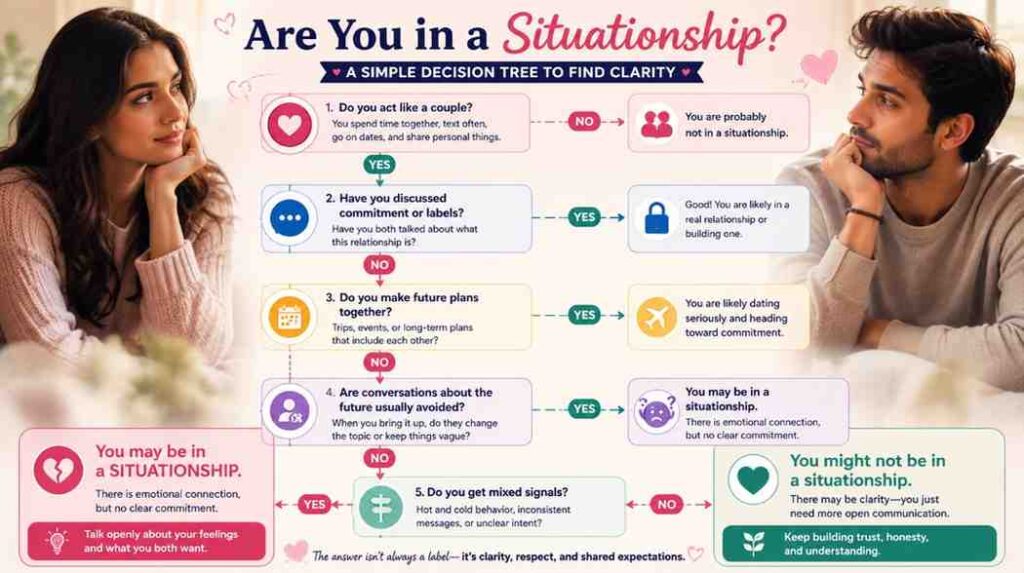
If your answers lead to “You may be in a situationship,” it doesn’t necessarily mean the relationship is unhealthy. It simply suggests that you and your partner may benefit from an open conversation about commitment, expectations, and your shared future.
A Situationship Story: Emma & Ethan



Image Story: Emma & Ethan — So Close, Yet So Uncertain
“We’re together almost every day… but neither of us knows what we are.”
Emma Parker and Ethan Brooks had spent nearly eight months together.
They met almost every weekend, knew each other’s favorite coffee, watched movies late into the night, and texted each other every morning before work. Friends assumed they were a couple.
Yet neither of them had ever asked the simplest question:
“What are we?”
That evening, they sat on opposite ends of the sofa. Only a few feet separated them, but the silence between them felt much wider.
Ethan stared toward the window, wondering whether bringing up commitment would push Emma away.
Emma looked down quietly, wishing Ethan would finally say the words she had been waiting to hear.
No one was angry.
No one wanted to leave.
Neither of them had stopped caring.
They were simply trapped inside the uncertainty that defines many situationships—sharing affection, memories, and companionship without knowing where the relationship was actually headed.
Sometimes, emotional distance is not created by a lack of love. It grows because two people are afraid to have one honest conversation.
Perhaps the greatest lesson this image teaches is that clarity rarely arrives on its own. It begins the moment someone has the courage to ask, “Are we building a future together?”
“The greatest distance in a situationship isn’t measured in feet—it’s measured in the words left unspoken.”
–
7: Situationship vs Relationship
At first glance, a situationship and a committed relationship can look very similar. In both, two people may spend time together, share personal moments, and develop genuine feelings.
The biggest difference is not the amount of affection but the level of clarity and commitment. A healthy relationship is built on shared expectations and open communication, while a situationship often leaves one or both people wondering where they truly stand.
The table below highlights the key differences.
| Situationship | Relationship |
| Commitment: No clear commitment or agreement about the relationship. | Commitment: Both partners openly commit to building the relationship together. |
| Communication: Conversations about labels or the future are often avoided or delayed. | Communication: Honest discussions about feelings, goals, and concerns are encouraged. |
| Expectations: Expectations are unclear and may differ between partners. | Expectations: Both people understand and agree on what they expect from the relationship. |
| Future Planning: Long-term plans are uncertain or rarely discussed. | Future Planning: Partners comfortably make plans and talk about a shared future. |
| Exclusivity: It may be unclear whether either person is dating someone else. | Exclusivity: Both partners clearly understand whether the relationship is exclusive. |
| Emotional Security: One or both partners may experience confusion, anxiety, or mixed emotions. | Emotional Security: The relationship provides greater trust, stability, and emotional reassurance. |
It is important to remember that every relationship develops at its own pace. A situationship is not automatically unhealthy, and a committed relationship is not automatically perfect.
What matters most is whether both people share the same understanding of the relationship and feel comfortable discussing it openly.
If one person expects commitment while the other prefers to keep things undefined, misunderstandings and emotional stress can quickly develop.
On the other hand, when both partners communicate honestly about their feelings, expectations, and future goals, they are more likely to build a relationship based on trust and mutual respect rather than uncertainty.
Instead of focusing only on the label, ask yourself a more meaningful question: Do both of us understand and want the same kind of relationship? The answer to that question often reveals more than any title ever could.
–
8: Situationship vs Friends With Benefits
A situationship and a friends-with-benefits (FWB) arrangement are often confused because neither necessarily includes a committed relationship. However, they are not the same.
The biggest difference lies in the emotional connection and what each person expects from the relationship.
While a friends-with-benefits arrangement is usually based on friendship and physical intimacy without romantic commitment, a situationship often involves stronger romantic feelings and uncertainty about where the relationship is heading.
The comparison below explains the key differences.
| Situationship | Friends With Benefits (FWB) |
| Emotions: Romantic feelings are often present, and emotional attachment may grow over time. | Emotions: The focus is usually on friendship and physical intimacy, with little or no expectation of romance. |
| Exclusivity: It is often unclear whether the relationship is exclusive. | Exclusivity: Partners generally do not expect exclusivity unless they agree otherwise. |
| Expectations: One or both people may secretly hope the relationship becomes more serious. | Expectations: Both people usually agree that the relationship is casual and not committed. |
| Communication: Conversations about commitment or labels are often avoided, leading to uncertainty. | Communication: The casual nature of the arrangement is typically discussed and understood from the beginning. |
| Long-Term Goals: Future plans may be unclear because the relationship has not been defined. | Long-Term Goals: Long-term romantic plans are generally not part of the arrangement. |
Although both types of relationships can work when both people share the same expectations, problems often arise when feelings change.
In a situationship, one partner may hope for commitment while the other prefers to keep the relationship undefined.
In a friends-with-benefits arrangement, emotional attachment can gradually develop, making the original agreement more complicated.
Neither relationship is automatically right or wrong. The healthiest choice depends on honest communication, mutual respect, and shared expectations.
When both people clearly understand the nature of their connection, they are less likely to experience confusion or emotional disappointment.
–
9: Green Flags vs Red Flags in a Situationship
Not every situationship is unhealthy. Some people intentionally choose to take things slowly while they build trust and get to know each other better.
In these cases, both partners understand the situation and feel comfortable with the pace of the relationship.
Problems usually arise when expectations are unclear or communication is missing.
The table below highlights the difference between healthy signs green flags and warning signs red flags.
| 🟢 Green Flags | 🔴 Red Flags |
| Both people are honest about what they want from the relationship. | One person avoids every conversation about commitment or the future. |
| Communication is open, respectful, and consistent. | Messages and attention are inconsistent, creating mixed signals. |
| Both partners agree to take things slowly. | One partner wants commitment while the other refuses to discuss it. |
| Boundaries and expectations are clearly discussed. | Expectations are never discussed, leading to confusion and frustration. |
| Both people respect each other’s feelings and personal space. | One person’s emotional needs are regularly ignored or dismissed. |
| Trust continues to grow even without a formal label. | Trust is weakened by secrecy, dishonesty, or broken promises. |
| The relationship gradually moves toward greater clarity over time. | The relationship remains uncertain for months or years without any progress. |
A situationship can be a healthy stage if both people are choosing it for the same reasons.
For example, a couple may decide to focus on finishing college, building their careers, or healing from past relationships before making a long-term commitment.
As long as they communicate openly and respect each other’s expectations, taking things slowly is not necessarily a problem.
On the other hand, repeated uncertainty can become emotionally draining. If one partner keeps postponing important conversations, sends mixed signals, or avoids discussing the future altogether, the relationship may no longer feel balanced.
Over time, this lack of clarity can lead to anxiety, disappointment, and loss of trust.
The healthiest relationships—whether they have a label or not—are built on honesty, mutual respect, and shared expectations.
Rather than asking, “Do we have a title?”, ask yourself, “Do we both understand where this relationship is going?”
The answer to that question often reveals whether your situationship is growing in a healthy direction or remaining stuck in uncertainty.
–
10: Common Myths About Situationships
Because situationships have become more common in modern dating, they are also surrounded by many misconceptions.
Some people believe they are always harmful, while others think love is enough to make everything work out. The truth is usually more balanced.
Understanding the facts can help you make healthier relationship decisions instead of relying on popular myths.
| Myth | Fact |
| Labels don’t matter. | A label itself is not the most important thing, but having a shared understanding of the relationship is. Clear expectations reduce confusion and help both people feel secure |
| Every situationship is toxic. | Not all situationships are unhealthy. Some couples intentionally take things slowly while building trust. They communicate openly and understand each other’s expectations. |
Situationships never become relationships. | Many situationships do grow into committed relationships when both partners develop mutual trust, communicate honestly, and want the same future. Others end because their goals no longer match. |
Love alone solves uncertainty. | Strong feelings are important, but love cannot replace honest communication. Even people who deeply care for each other need to discuss commitment, expectations, and future plans. |
If someone really loves you, they will automatically commit. | People move at different speeds because of personal experiences, life circumstances, or fears. Healthy commitment grows through trust, communication, and mutual readiness—not assumptions. |
| Waiting longer will always make the relationship stronger. | Time by itself does not create clarity. Without meaningful conversations, uncertainty can continue for months or even years. |
It is easy to believe these myths because every relationship is unique, and there is no single timeline that works for everyone.
However, relying on assumptions instead of honest conversations often leads to disappointment.
A situationship should not be judged only by whether it has a label. Instead, ask whether both people understand the relationship in the same way, respect each other’s feelings, and communicate openly about the future.
When expectations are shared, a situationship may simply be a temporary stage. When expectations remain hidden, even genuine love can struggle to overcome uncertainty.
The healthiest relationships are built on more than feelings alone. They also require trust, respect, communication, and a willingness to create a shared path forward.
–
11: Warning Signs You Shouldn’t Ignore
Every relationship has challenges, but some patterns deserve your attention. A situationship becomes emotionally unhealthy when uncertainty turns into a constant source of stress instead of a temporary stage of getting to know each other.
If you notice the following warning signs, it may be time to have an honest conversation about where the relationship is heading
| ⚠️ Future discussions are repeatedly avoided. Whenever you bring up topics like commitment, exclusivity, or future plans, the conversation quickly changes or is postponed. While needing time is normal, avoiding these discussions indefinitely often keeps the relationship stuck in uncertainty |
| ⚠️ One partner invests significantly more than the other. You are the one making plans, sending messages first, offering emotional support, or trying to move the relationship forward. Healthy relationships involve mutual effort, even if each person expresses it differently. |
| ⚠️ The relationship creates ongoing anxiety rather than stability. Instead of feeling secure and valued, you spend a lot of time wondering where you stand. Constant overthinking, emotional ups and downs, and fear of losing the relationship can be signs that your needs for clarity are not being met. |
| ⚠️ Communication disappears whenever commitment is mentioned. Your partner becomes distant, changes the subject, or suddenly communicates less after conversations about the relationship. Consistently avoiding important discussions can prevent trust from growing. |
| ⚠️ Promises are repeated, but nothing changes. You often hear statements like, “Let’s see what happens,” or “Maybe later,” yet weeks or months pass without any real progress. Good intentions should eventually be supported by meaningful actions. |
| ⚠️ You feel unable to express your needs. If you hesitate to talk about your feelings because you fear pushing the other person away, the relationship may lack the emotional safety needed for healthy communication. |
Seeing one of these signs does not automatically mean the relationship is doomed. However, if several warning signs continue over a long period without improvement, it is worth asking whether the relationship is meeting your emotional needs.
Honest conversations, mutual respect, and shared expectations are essential for turning uncertainty into clarity and building a healthier future together.
–
12: Real-Life Situationship Example
Every situationship is different, but they often begin in ordinary, everyday situations. The following examples show how two people can develop a close emotional connection without clearly defining their relationship.
1. College Classmates
Ava and Ryan met during their first year at university. They studied together, had lunch almost every day, and spent weekends exploring the city with friends.
Over time, they became each other’s closest companion and even celebrated birthdays together.
Although everyone assumed they were dating, neither of them ever talked about becoming a couple.
They enjoyed what they had but avoided discussing commitment because graduation and future career plans felt uncertain.
Their relationship had all the signs of a couple, yet it remained a situationship because there was no shared understanding of where it was going.
2. Office Colleagues
Emma and Daniel worked in the same company and gradually became close after collaborating on several projects.
They often had coffee together, stayed late at work, and spent time together outside the office.
Both enjoyed the relationship but worried that dating could complicate their professional lives.
Instead of discussing their feelings openly, they continued spending time together without defining the relationship.
As months passed, emotional attachment grew, but uncertainty remained because neither wanted to risk changing the dynamic.
3. Long-Distance Dating
After meeting during a vacation, Sophia and Ethan stayed in touch through daily messages and video calls.
They supported each other through career challenges and celebrated special occasions online.
Despite feeling emotionally connected, they never discussed exclusivity or whether they were building a future together.
The distance made difficult conversations easy to postpone.
One partner believed they were slowly moving toward a committed relationship, while the other simply enjoyed the connection without making long-term plans.
The lack of clarity eventually created frustration and confusion.
4. Dating App Connection
Liam and Chloe matched on a dating app and quickly discovered they had many shared interests.
They met regularly, talked for hours, and even introduced each other to close friends. However, every conversation about commitment ended with comments like, “Let’s just see where things go.”
Months later, they were still spending most weekends together but had never agreed on what the relationship meant.
While both enjoyed each other’s company, their different expectations created uncertainty about the future.
5. Childhood Friends Reconnecting
Mia and Noah had been childhood friends before losing touch for several years. When they reconnected through social media, their friendship quickly turned into something deeper.
They spoke every day, traveled together, and became an important part of each other’s lives.
Because they valued their long friendship, both feared that defining the relationship might change what they already had.
As a result, they remained emotionally close without discussing commitment. What began as a comfortable friendship gradually became a situationship, leaving both unsure whether they were simply friends or something more.
These examples show that a situationship can happen in many different ways. The setting may change, but the common thread is the same: two people share a meaningful connection without clearly defining their relationship.
Whether that uncertainty leads to a committed partnership or an emotional crossroads often depends on honest communication and shared expectations.
–
13: How to Talk About the Relationship
Starting a conversation about your relationship can feel uncomfortable, especially if you are worried about the answer.
However, avoiding the discussion usually creates more confusion than clarity. A calm, honest conversation gives both people the chance to express their feelings, understand each other’s expectations, and decide whether they want the same future.
The goal is not to pressure your partner into making an immediate decision. Instead, focus on creating a safe space where both of you can speak openly and respectfully.
1. When You Want Clarity
Instead of saying:
“Where is this going?”
Try saying:
“I’ve really enjoyed getting to know you, and I’d like to understand whether we’re both hoping for the same kind of relationship.”
2. When You Want to Discuss Commitment
Instead of saying:
“Why won’t you commit?”
Try saying:
“I care about what we have, and I’d like to know how you see our relationship and whether you picture us becoming more serious.”
3. When You Feel Confused
Instead of saying:
“You keep giving me mixed signals.”
Try saying:
“Sometimes I’m unsure about where we stand. I’d appreciate hearing how you feel so we can better understand each other’s expectations.”
4. When You Want to Know About Exclusivity
Instead of saying:
“Are you seeing someone else?”
Try saying:
“I’d like to talk about whether we’re dating only each other because having that clarity is important to me.”
5. When the Relationship Hasn’t Progressed
Instead of saying:
“We’ve been doing this forever.”
Try saying:
“We’ve shared a lot of meaningful moments together, and I think it’s a good time to talk about what we both want moving forward.”
6. When Your Needs Are Changing
Instead of saying:
“I can’t do this anymore.”
Try saying:
“My feelings have grown, and I’ve realized I need more clarity about our relationship. I’d like to know if we’re looking for the same future.”
Tips for a Healthy Conversation
Before you begin the discussion, keep these simple guidelines in mind.
- Choose a calm and private moment rather than bringing it up during an argument.
- Speak about your own feelings instead of making accusations.
- Listen carefully without interrupting or becoming defensive.
- Be honest about what you need from the relationship.
- Respect the other person’s perspective, even if it is different from your own.
Remember, there is no perfect script that guarantees a particular outcome. The purpose of the conversation is not to hear the answer you hope for but to discover the truth.
If both people want the same kind of relationship, honest communication can strengthen the connection. If your goals are different, knowing that early allows both of you to make decisions that are healthier and more respectful for the future.
Ethan & Emma – The Walk That Had No Destination



Ethan & Emma – The Walk That Had No Destination
“The hardest relationships aren’t the ones filled with conflict—they’re the ones filled with love, but missing the courage to ask, ‘What are we?'”
The evening sun painted the city in shades of gold as Ethan and Emma walked side by side through the busy streets. To anyone passing by, they looked like an ordinary couple enjoying another beautiful sunset.
But appearances rarely tell the whole story.
They had spent almost every weekend together for the past eleven months. They knew each other’s favorite coffee, shared playlists, celebrated birthdays, and laughed over inside jokes that no one else understood. Friends assumed they were dating.
Yet neither of them had ever asked the simplest question.
“What are we?”
Emma wanted to slip her hand into Ethan’s, but she hesitated. Sometimes he held it. Sometimes he didn’t. There were no rules—only guesses.
Ethan glanced at her more than once, wanting to tell her how important she had become. Instead, he talked about work, weekend plans, and the restaurant they wanted to try next week. The conversation stayed comfortably on the surface, avoiding the one topic that mattered most.
As they reached the intersection, they stopped for the traffic light.
For a brief moment, they stood only a few feet apart, both looking in different directions.
The silence between them wasn’t awkward.
It was uncertain.
Neither was walking away from the other, yet neither was walking toward a shared future.
That is often how a situationship feels. There may be genuine affection, emotional connection, and countless memories together, but without an honest conversation about commitment, even the happiest moments can be overshadowed by unanswered questions.
Sometimes the greatest distance between two people isn’t measured in steps.
It’s measured in words that remain unspoken.
Ethan and Emma continued walking when the light turned green.
The road ahead was open.
Whether they would walk it together—or eventually choose different paths—depended not on their feelings, but on one courageous conversation they had both been avoiding.
“Sometimes two people walk the same road, share the same sunsets, and create the same memories, yet remain strangers to each other’s future because no one dares to define the journey.”
–
14: Can a Situationship Become a Relationship?
The simple answer is yes—but not every situationship does. Some situationships naturally grow into healthy, committed relationships as trust deepens and both people realize they want the same future.
Others remain uncertain for months or even years because one or both partners are unwilling or unable to commit.
Relationship experts generally agree that successful relationships are built on three key ingredients: trust, communication, and shared expectations.
A situationship has the best chance of becoming a committed relationship when both partners are willing to have honest conversations about these areas.
When a Situationship Can Work
A situationship may develop into a healthy relationship when:
- Both people genuinely care about each other.
- Communication is open and honest.
- They share similar relationship goals.
- Trust continues to grow over time.
- Both partners are willing to discuss commitment when the time feels right.
For example, two people may choose to take things slowly while finishing college or focusing on their careers.
If they continue communicating openly and eventually agree on a shared future, the situationship can become a strong and lasting relationship.
When It Usually Doesn’t Work
Not every situationship has a happy ending. It often struggles when:
- One person wants commitment while the other does not.
- Conversations about the future are repeatedly avoided.
- Mixed signals continue without explanation.
- One partner keeps postponing commitment with no clear reason.
- Trust is damaged by dishonesty or inconsistent behavior.
Research in relationship psychology suggests that uncertainty can increase stress and reduce relationship satisfaction over time.
When people do not know where they stand, they are more likely to experience anxiety, insecurity, and emotional exhaustion.
Clear communication helps reduce this uncertainty and supports healthier relationships.
Set Realistic Expectations
It is natural to hope that love will solve every problem, but healthy relationships require more than strong feelings.
A situationship does not automatically become a committed partnership simply because enough time has passed.
Lasting relationships grow through shared decisions, mutual effort, and honest conversations.
Instead of waiting silently for things to change, pay attention to actions as well as words.
Ask yourself whether the relationship is moving forward or simply staying in the same uncertain place.
Build Healthy Boundaries
Healthy boundaries protect both partners and encourage mutual respect. Consider discussing:
- What each of you wants from the relationship.
- Whether the relationship is exclusive.
- Personal boundaries and emotional needs.
- A realistic timeline for future conversations.
- What commitment means to each of you.
These discussions help prevent misunderstandings and allow both people to make informed decisions about their future together.
Warning Signs to Watch For
A situationship is less likely to become a committed relationship if you notice these patterns:
- Promises without meaningful action.
- Repeated avoidance of important conversations.
- Consistent mixed signals.
- Feeling anxious more often than emotionally secure.
- Your needs and feelings are regularly dismissed.
There is no universal timeline for when a situationship should become a relationship.
What matters most is not how long you have been together but whether the relationship is moving toward greater trust, clarity, and mutual commitment.
If both people are willing to communicate honestly and work toward the same future, a situationship can become a meaningful relationship.
If not, accepting the reality may be healthier than waiting indefinitely for change.
Situationship vs Relationship: When Does the Transition Happen?
A situationship does not become a relationship simply because more time has passed.
The real difference lies in mutual commitment, clear communication, and shared expectations.
Two people may spend months together, yet still remain in a situationship if they continue avoiding conversations about the future.
A committed relationship begins when both partners openly choose to invest in each other and agree on what the relationship means.
Instead of wondering where they stand, they have a shared understanding of their goals, boundaries, and level of commitment.
| Situationship | Relationship |
| The future is uncertain. | The future is discussed and planned together. |
| Expectations are often unclear. | Expectations are openly shared and understood. |
| Commitment may be delayed or undefined. | Commitment is mutual and clearly expressed. |
| Emotional security can fluctuate. | Trust and emotional security continue to grow. |
| Important conversations are often postponed. | Honest communication is a regular part of the relationship. |
The transition from a situationship to a relationship usually happens through a series of honest conversations rather than one dramatic moment.
When both people communicate openly, respect each other’s needs, and choose the same direction for the future, uncertainty gradually gives way to commitment.
That is when a situationship has the strongest chance of becoming a healthy and lasting relationship.
–
15: Situationships: Liberal and Conservative Perspectives
The meaning of a situationship is not the same for everyone. Some people see it as a healthy way to explore a relationship without rushing into commitment.
Others believe it creates unnecessary emotional confusion and prevents people from building secure, long-term relationships.
This difference of opinion has sparked discussions among psychologists, relationship experts, authors, celebrities, and dating platforms around the world.
While some celebrate situationships as a reflection of modern freedom and changing lifestyles, others warn that too much uncertainty can affect emotional well-being.
The debate generally falls into two broad perspectives. One emphasizes personal choice and flexibility, while the other highlights the importance of commitment, clarity, and emotional security.
The Liberal View: Freedom, Flexibility, and Personal Choice
Supporters of the liberal view believe that relationships have changed along with society.
Young adults today often spend more years pursuing higher education, building careers, traveling, and discovering their personal goals before settling down.
Because of these changing priorities, many feel that traditional relationship timelines do not always fit modern life.
Instead of moving quickly from dating to commitment, they prefer to let relationships develop naturally.
From this perspective, a situationship is not necessarily a sign of fear or indecision. It can simply be a conscious choice made by two people who enjoy spending time together while taking things one step at a time.
This changing attitude has also been reflected in popular culture.
In India, actress Deepika Padukone openly spoke about the early phase of her relationship with Ranveer Singh, describing a period of open dating before they became fully committed.
Her comments sparked widespread conversations about how modern relationships do not always follow a traditional path.
Similarly, actress Janhvi Kapoor and digital creator Kusha Kapila have discussed situationships in interviews and online conversations without treating them as something unusual or negative.
Their views reflect the experiences of many young adults who value emotional connection while also wanting the freedom to grow as individuals before making lifelong commitments.
Some psychologists also believe that this trend reflects larger social changes.
Psychologist Dr. Sai Joshi explains that many members of Generation Z and the millennial generation experience what researchers describe as “delayed adulthood.”
People spend longer in education, change careers more frequently, and focus on personal growth before settling into long-term partnerships.
In this stage of life, a situationship may provide companionship and emotional support without requiring the responsibilities that often come with a traditional committed relationship.
Supporters argue that this flexibility allows people to understand themselves better before making major relationship decisions.
Dating platforms have noticed similar trends.
Research and surveys conducted by platforms such as Tinder suggest that many young adults, particularly women, are comfortable with relationships that do not immediately require labels.
For them, removing the pressure of defining the relationship can create space to explore compatibility, establish personal boundaries, and decide whether the connection has long-term potential.
The same conversation is taking place beyond India.
Internationally, global celebrities have also contributed to changing ideas about modern relationships.
Singer Rihanna has often spoken about the importance of personal independence and emotional freedom before making major commitments.
While her personal journey eventually led to a committed family life, her earlier views encouraged many young people to think differently about traditional relationship expectations.
In literature, bestselling Irish author Sally Rooney has become one of the strongest voices exploring modern romance.
Novels such as Normal People and Conversations with Friends portray characters who share deep emotional connections without always defining their relationships.
Rather than presenting these relationships as failures, Rooney explores how complicated love, timing, and personal growth can be in today’s world.
Relationship psychologist Dr. Alexandra Solomon, a licensed clinical psychologist at Northwestern University and author of Loving Bravely, offers another thoughtful perspective.
She encourages what she calls “relational self-awareness,” which means understanding your own emotions, needs, and relationship patterns before making important decisions.
According to Dr. Solomon, a situationship can be healthy when both people freely choose it, communicate honestly, and understand each other’s expectations.
Research from organizations such as the Pew Research Center and dating platform Hinge also reflects changing relationship patterns among young adults in the United States and Europe.
Their studies suggest that many people intentionally choose slower, less traditional relationships because they want to focus on education, careers, mental well-being, or personal development before making long-term commitments.
From this perspective, a situationship is not seen as a problem to solve. Instead, it is viewed as one possible stage of modern dating, where two people explore their connection without feeling pressured to follow a fixed relationship timeline.
However, not everyone agrees with this view. Many psychologists, therapists, authors, and relationship experts believe that while situationships may begin with good intentions, they often create emotional uncertainty that can become difficult to manage. Their concerns form the other side of this global debate.
The Conservative and Critical View: Commitment, Clarity, and Emotional Well-Being
While many people see situationships as a natural part of modern dating, others believe they come with significant emotional risks.
This perspective is shared by relationship therapists, psychologists, authors, sociologists, and cultural commentators who argue that uncertainty may feel exciting at first but can become emotionally exhausting over time.
Their main concern is not that people choose non-traditional relationships. Instead, they question what happens when two people have different expectations but never discuss them openly.
One of the strongest voices in this conversation is British author and columnist Annie Lord, whose writing explores the realities of dating in the digital age.
She argues that dating apps have made it easier than ever to move from one connection to another.
As a result, some people begin treating relationships as temporary and easily replaceable.
According to Lord, the relaxed appearance of a situationship can sometimes hide deeper emotional needs that neither partner feels comfortable expressing.
Instead of creating freedom, this silence may encourage people to hide their true feelings simply to avoid appearing too serious or demanding.
Over time, that emotional restraint can become difficult to maintain.
Mental health professionals have raised similar concerns.
Psychologist Dr. Savita Date explains that most people naturally seek emotional security and reassurance in close relationships.
Although a situationship may begin as a casual arrangement, it often becomes unbalanced as one person develops stronger feelings while the other prefers to keep the relationship exactly as it is.
When this imbalance continues, the partner seeking greater commitment may begin questioning their own worth.
They may wonder why the relationship never moves forward despite investing time, care, and emotional energy.
According to Dr. Date, these unanswered questions can gradually affect confidence, self-esteem, and overall emotional well-being.
Relationship experts also point to another challenge—the absence of closure.
Insights shared by Therapy Group DC suggest that ending a situationship can sometimes feel even more painful than ending a committed relationship.
In a traditional breakup, both people usually recognize that the relationship has ended. In a situationship, however, there may never be a clear beginning or ending.
This emotional “limbo” can leave people wondering what the relationship actually meant, making it harder to process the experience and move forward.
The same concerns are echoed by experts across Europe and North America.
World-renowned Belgian psychotherapist Esther Perel, one of today’s leading relationship experts, has spoken about what she describes as “stable ambiguity.”
She explains that some people enjoy the closeness, companionship, and affection of a relationship while avoiding the responsibilities that often come with commitment.
Perel suggests that modern dating apps have created an environment where endless choices can make commitment feel more difficult.
Some people worry that choosing one partner means missing out on someone else. This fear of missing out, often called FOMO, can encourage individuals to remain emotionally undecided for much longer than they otherwise would.
She also warns about a pattern she describes as “contactless intimacy.”
People may communicate every day through messages, social media, and video calls, yet still avoid the honest conversations that build genuine emotional security.
Another influential thinker, Dr. Eva Illouz, a renowned Franco-Israeli sociologist and author of Why Love Hurts, examines situationships from a broader social perspective.
According to Dr. Illouz, modern dating has increasingly adopted the habits of consumer culture.
Dating apps give people access to an almost endless stream of potential partners, making it easier to keep searching instead of investing deeply in one relationship.
She argues that this constant availability of alternatives can make genuine commitment feel less attractive because another possibility always appears to be only one swipe away.
Many therapists in the United States and the United Kingdom share similar observations.
They acknowledge that some situationships are healthy and mutually understood.
However, they also report seeing many clients who experience ongoing anxiety because the relationship lacks clear expectations.
In these situations, one partner may feel pressured to appear relaxed and “easy-going” even when they secretly want greater commitment.
Instead of expressing their needs honestly, they suppress their feelings to avoid losing the relationship. Over time, this silence can create emotional stress, disappointment, and loneliness.
What the Global Debate Really Tells Us
The worldwide discussion about situationships does not produce one simple answer. Instead, it highlights an important truth: the success of any relationship depends less on its label and more on the quality of communication between the people involved.
Supporters believe situationships give individuals the freedom to grow, focus on their careers, and build relationships at their own pace.
Critics agree that personal freedom is valuable, but they warn that freedom without clarity can easily become confusion.
Both perspectives offer useful lessons.
A situationship can be a healthy choice when both people openly understand the nature of the relationship, respect each other’s boundaries, and share similar expectations.
In these cases, taking things slowly may strengthen trust rather than weaken it.
At the same time, if one partner hopes the relationship will naturally become more serious while the other avoids discussing commitment altogether, emotional pain often follows.
The problem is usually not the absence of a label. It is the absence of honest communication.
Perhaps that is the strongest message shared by relationship experts from around the world.
Whether a relationship is called a situationship, dating, or a committed partnership, lasting emotional well-being depends on trust, respect, openness, and shared expectations.
Rather than asking only, “What should we call this relationship?”, a more meaningful question may be, “Do we both understand what this relationship means—and are we moving toward the same future?”
For many couples, the answer to that question matters far more than the label itself.
16: What Psychology Says
Psychology does not use the word situationship as a formal clinical term, but researchers have spent decades studying the relationship patterns that often appear in situationships.
Their findings suggest that healthy relationships are built on clear communication, mutual trust, emotional security, and shared commitment rather than labels alone.
Attachment Styles Influence Relationships
Attachment theory explains that people develop different ways of connecting with others based on their early life experiences.
These patterns can continue into adulthood and influence romantic relationships.
For example, someone with a secure attachment style is generally comfortable expressing feelings, discussing commitment, and resolving disagreements.
In contrast, a person with an avoidant attachment style may value independence and feel uncomfortable with emotional closeness or commitment.
Someone with an anxious attachment style may worry about rejection and seek constant reassurance.
These differences do not determine the future of a relationship, but they can affect how two people communicate and respond to uncertainty.
Uncertainty Can Increase Emotional Stress
Most people feel more relaxed when they understand where they stand in a relationship.
When expectations remain unclear for a long time, uncertainty can create stress, self-doubt, and emotional exhaustion.
Research has shown that people often find uncertainty more difficult than receiving a clear answer, even if that answer is disappointing.
Knowing where a relationship stands allows people to make informed decisions instead of constantly guessing what the other person is thinking or feeling.
Commitment Builds Emotional Security
Commitment is more than simply calling someone a boyfriend, girlfriend, or partner. It involves making a shared decision to invest in the relationship and work through challenges together.
Psychologists have found that couples who communicate openly about their expectations and future goals often experience greater trust and emotional security.
This does not mean every relationship must move quickly, but clarity about shared intentions helps reduce confusion and strengthen the connection.
Emotional Investment Should Be Balanced
Healthy relationships usually involve mutual effort. Both partners contribute time, care, and emotional support, even if they express it in different ways.
Problems can arise when one person becomes deeply emotionally invested while the other continues treating the relationship as casual.
Over time, this imbalance may lead to frustration, disappointment, and feelings of being undervalued.
Relationship Satisfaction Depends on More Than Love
Love is an important part of a successful relationship, but psychology suggests it is only one piece of the puzzle.
Long-term relationship satisfaction is also influenced by trust, honest communication, respect, shared values, and the ability to solve problems together.
This is why two people can genuinely care about each other yet still struggle if they avoid important conversations about commitment or future plans.
Strong feelings create the foundation, but healthy communication and mutual understanding help the relationship grow.
The research offers a reassuring message: a situationship is not defined by whether it has a label.
Instead, the quality of the relationship depends on how well two people communicate, respect each other’s needs, and build trust over time.
When both partners are honest about their expectations and willing to work toward the same goals, they create the conditions for a healthier and more satisfying relationship.
Ethan & Emma – Three Conversations That Changed Everything
Sometimes the longest journey in a situationship isn’t from strangers to lovers—it’s from silence to honesty.
For almost a year, Ethan and Emma lived somewhere between friendship and love.
They laughed like a couple.
They missed each other like a couple.
But they never called themselves one.
Their story unfolded through three conversations.
Scene One: The Silence
It started with silence.
They met at their favorite café on a Saturday afternoon. Coffee grew cold while neither of them spoke about what truly mattered.
Emma searched Ethan’s face for reassurance.
Ethan wanted to tell her she meant everything to him.
Instead, they talked about work, travel, and weekend plans.
When they walked out, nothing had changed.
Sometimes, silence protects a relationship.
Sometimes, it slowly breaks one.
–
Scene Two: Together, Yet Miles Apart
A week later, they met again.
This time they shared the same table, but not the same moment.
Emma’s phone kept lighting up with messages she wasn’t interested in.
Ethan stirred his coffee, wondering whether he should finally ask the question that had lived in his mind for months.
“Are we building something together… or simply passing time?”
Neither spoke.
The café was full of conversations.
Their table had none.
Being physically together had never felt so emotionally distant.
That is one of the quietest signs of a situationship—not arguments, but conversations that never happen.
–
Scene Three: The Question
Another week passed.
Neither wanted to lose the other.
Neither wanted to keep pretending.
So they met one last time.
No phones.
No distractions.
Just two cups of coffee and enough courage to be honest.
Emma looked at Ethan.
“I don’t need perfect,” she said softly. “I just need clarity.”
Ethan nodded.
“I’ve been afraid that giving us a label would change what we have.”
Emma smiled sadly.
“It already has.”
For the first time, they stopped talking about plans for the weekend and started talking about plans for their future.
Whether their story became a committed relationship or ended with gratitude mattered less than what happened that afternoon.
They finally replaced assumptions with honesty.
Because every situationship eventually reaches a crossroads.
One road leads to commitment.
The other leads to goodbye.
But neither road can be found until someone has the courage to ask the question both hearts have been carrying all along:
“What are we?”
–
“A situationship doesn’t usually end because love disappears. It ends because silence becomes louder than the feelings both people were too afraid to name.”
17: Key Takeaways
Before you leave, here are the most important lessons to remember about situationships:
- A situationship is a real romantic experience where two people share an emotional or physical connection without clearly defining the relationship.
- The biggest difference between a situationship and a committed relationship is uncertainty. When expectations remain unclear, confusion often follows.
- Honest and respectful communication is the healthiest way to understand whether both partners want the same future.
- Relationship labels are less important than shared expectations, mutual trust, and consistent actions.
- Not every situationship is unhealthy. Some naturally develop into loving, committed relationships when both people communicate openly and grow together.
- Pay attention to actions as much as words. Consistency, respect, and reliability are stronger signs of commitment than promises alone.
- Healthy boundaries encourage meaningful conversations about exclusivity, commitment, emotional needs, and future plans.
- If uncertainty continues for a long time and your emotional needs remain unmet, it may be time to honestly evaluate whether the relationship is right for you.
- Every relationship is different, but the strongest ones are built on trust, respect, honest communication, and shared goals rather than labels alone.
In the end, a relationship is not defined by what you call it—it is defined by how two people treat each other every day.
–
Conclusion
Understanding the meaning of situationship is about more than learning a new dating term. It is about recognizing how modern relationships can exist in the space between casual dating and committed partnership.
A situationship may involve genuine affection, emotional support, and meaningful moments, but without clear communication, it can also create uncertainty and mixed expectations.
Every relationship is unique. Some situationships naturally grow into healthy, committed relationships, while others remain undefined because the people involved want different things.
Neither outcome is automatically right or wrong. What matters most is that both partners understand the relationship in the same way and feel comfortable expressing their needs.
Remember, clarity is more valuable than assumptions, and honest communication is stronger than silent hope.
A relationship does not become healthier simply because it has a label. It becomes healthier when both people share trust, respect, openness, and a common understanding of where they stand.
If you find yourself wondering whether you are in a situationship, do not be afraid to start a thoughtful conversation. Asking honest questions is not a sign of weakness—it is a sign of emotional maturity.
Whether the answer leads to a committed relationship or a different path, clarity allows both people to make choices that support their happiness, well-being, and future.
Sometimes, the most important step in any relationship is not finding the perfect label. It is having the courage to understand each other honestly.
–
Tale Basket
Final Thoughts: A Practical Guide to Understanding Modern Relationships
Romantic Stories: The Ultimate Guide to Love, Proposals, and Happily Ever After
A Seven Year Situationship- A Love StoryThat FinallyFound Its Name
Slow burn- Authentic Vs Synthetic love
–
“A collection of different shades and fragrances of love.”
Romance Bouquets
Eternal Love- blossoming of young love
Friends to lovers Romance- Eternal Echoes
FAQ
What is the difference between a situationship and a relationship?
A situationship involves emotional or romantic connection without clearly defined commitment, while a relationship is built on mutual commitment, shared expectations, and open communication. In a healthy relationship, both partners usually understand where they stand and what they want for the future.
Situationship vs relationship: Which is better?
Neither is automatically better. A situationship can work when both people genuinely want a label-free connection and communicate honestly. A committed relationship is usually a better choice for couples seeking long-term stability, emotional security, and shared future goals. The healthiest option depends on whether both partners have the same expectations.
What is the difference between a situationship and friends with benefits?
A situationship often includes emotional attachment and the possibility of a deeper relationship, even if it remains undefined. Friends with benefits usually focuses on friendship and physical intimacy without the expectation of a committed romantic relationship.
What does situationship mean in chat?
In text messages, social media, or online conversations, situationship usually refers to a relationship that has not been officially defined. If someone says, “We’re in a situationship,” they typically mean they share a romantic or emotional connection but have not agreed on labels, commitment, or future plans.
What does “I’m in a situationship” mean?
When someone says, “I’m in a situationship,” they usually mean they are romantically involved with someone but are unsure where the relationship is heading. The connection may feel like a relationship in many ways, yet there is little or no discussion about commitment or long-term expectations.
Are there any movies about situationships?
While few films use the word situationship, many explore relationships with unclear commitment, emotional uncertainty, or modern dating dynamics. Popular examples include 500 Days of Summer (2009), No Strings Attached (2011), Friends with Benefits (2011), Someone Great (2019), and Past Lives (2023). These movies examine themes such as emotional ambiguity, timing, commitment, and personal growth.
Which TV shows explore situationships?
Several popular TV shows feature characters navigating situationships or undefined relationships. Examples include Normal People, Love Life, Master of None, Insecure, and Sex Education. These series explore the challenges of modern dating, emotional vulnerability, and the importance of honest communication.
Is a situationship a red flag?
Not necessarily. A situationship is not automatically a red flag. It can be a healthy choice if both people understand the relationship, communicate openly, and share similar expectations. It becomes concerning when one partner consistently avoids commitment, sends mixed signals, or ignores the other person’s emotional needs.
Can a situationship last for years?
Yes. Some situationships continue for several years, especially when neither person addresses the future of the relationship. However, long-term uncertainty can create frustration and emotional stress if the partners have different expectations or goals.
Why are situationships becoming more common?
Many relationship experts believe situationships have become more common because of changing dating habits, career priorities, online dating apps, delayed marriage, and greater emphasis on personal independence. These factors have encouraged many people to explore relationships without immediately committing to traditional labels.
What are other names for a situationship?
Depending on the context, people may describe a situationship as an undefined relationship, no-label relationship, talking stage, almost relationship, complicated relationship, gray-area relationship, casual romantic connection, or exclusive but unlabeled relationship. Although these terms are not always identical, they all describe relationships that lack clear commitment or defined expectations.
–
Related Reading
If you found this guide helpful, you may also enjoy these articles and stories that explore modern dating, relationships, and the emotions behind situationships.
Informational Guides
| Signs of a Situationship – Learn how to recognize the common signs of an undefined relationship before emotional confusion grows. |
| Situationship vs Relationship – Compare commitment, communication, expectations, and emotional security to understand the key differences. |
| How to End a Situationship – Practical advice for ending an undefined relationship with honesty, respect, and emotional clarity. |
| Dating vs Relationship – Discover how casual dating differs from a committed relationship and when the transition usually happens. |
–
Romance Stories
| The Last Day of a Situationship – A heartfelt romance about love, unanswered questions, and the courage to seek clarity before it’s too late. |
| Situationship Stories Collection – Explore more emotional romance stories inspired by modern relationships, second chances, difficult choices, and unforgettable endings. |
Whether you’re looking for relationship advice or simply enjoy emotional love stories, these articles will help you better understand the complexities of modern romance while continuing your reading journey.
END
–

0 Comments