
By: Ranjan Sarkhell
–
Table of Contents
–
Opening Quote
“Some people fight to destroy you. Others fight to keep up with you. Only one of those is actually flirting.”
–
Introduction
Here’s the intro with the keyword phrase confirmed in place — checking it against your exact wording request:
Here’s something nobody talks about enough: people love enemies to lovers right up until they don’t.
You read three, four, five of these stories back to back, and something starts to feel exhausting about it.
The constant hostility. The characters who seem to genuinely want to hurt each other before they fall in love.
At some point, a lot of readers quietly drift toward something gentler — same tension, same slow burn, but without the emotional whiplash.
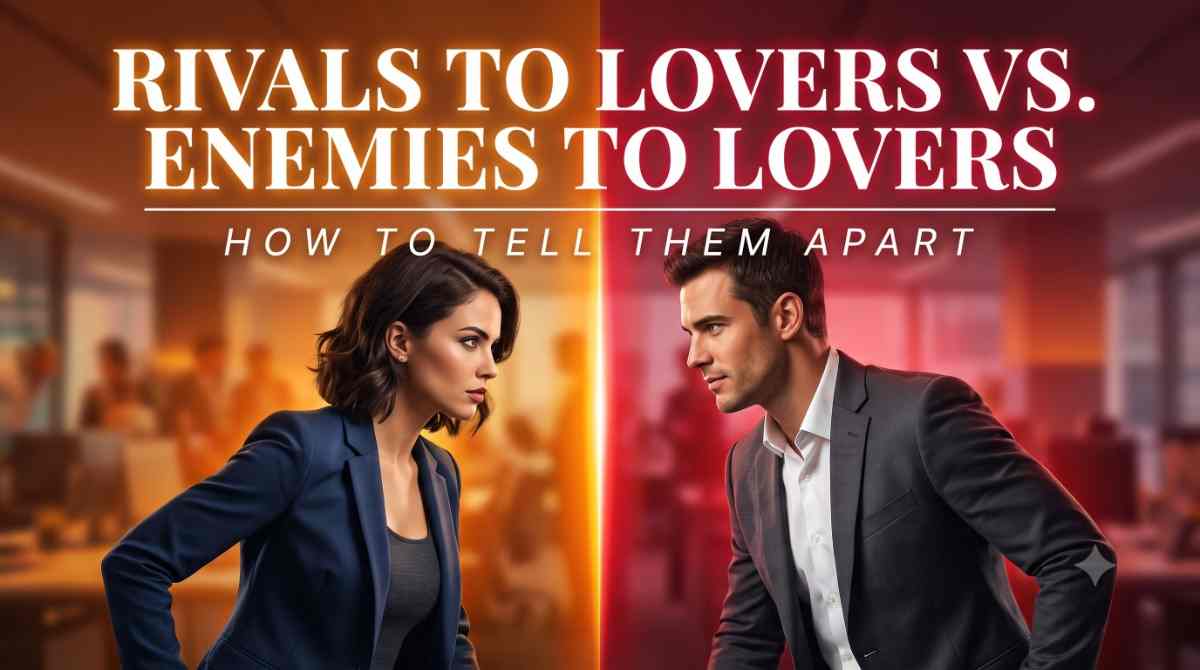
That’s the real story behind Rivals to Lovers vs. Enemies to Lovers — two tropes people constantly mix up.
And once you know what to look for, you’ll realize half the books and shows you thought were enemies to lovers were actually rivals to lovers instead.
Quick Takeaways
- Rivals to lovers and enemies to lovers are often confused, but they’re not the same trope
- Rivals compete for something specific — enemies often want to actively hurt or destroy each other
- We’ll walk through the real difference using actual story examples
- Includes verified K-drama, movie, and book picks, plus writing prompts if you want to try it yourself
–
Why Readers Fall for Enemies to Lovers — Then Burn Out On It
The first time you read an enemies to lovers story, it’s electric. Two people who genuinely can’t stand each other, forced together, slowly realizing the hate was never really hate.
It’s intense, and intensity is addictive.But intensity has a ceiling.
After enough of these stories, the pattern starts to feel less like tension and more like exhaustion — constant conflict, characters who insult each other in ways that don’t always feel like they’re coming from attraction, relationships that start from something closer to actual cruelty.
That’s when readers start looking for the same slow burn, minus the emotional damage.
That’s exactly where rivals to lovers come in.
–
What’s the Real Difference Between Enemies and Rivals?
Picture two chefs, Daniel Cross and Priya Malhotra, both competing for the same head chef position at a five-star restaurant.
They push each other constantly — sabotaging plating choices, one-upping each other’s dishes in front of the owner, staying late just to make sure the other doesn’t get an edge.
But underneath all of it, there’s something neither of them will admit: they respect the hell out of each other’s skill. Neither wants to see the other fail — they just both want to win. That rivals to lovers.
Now picture something different. Two people, Grace Ellison and Theo Marchetti, whose families have spent a decade in a legal battle over the same piece of land.
Grace doesn’t just want to beat Theo — she wants to see his family lose everything, and for most of the story, so does he.
Their story starts from something closer to real animosity, not competition. That’s enemies to lovers.
The difference isn’t subtle once you see it: rivals compete for something specific and respect each other while doing it. Enemies often start from a place that’s closer to genuine hostility, sometimes wanting real harm, not just victory.
–
What Does “Rivals to Lovers” Actually Mean?
At its core, rivals to lovers means two characters who are competing — for a job, a title, a prize, a spot on a team — and whose mutual drive to win slowly turns into mutual attraction.
The tension comes from ambition, not animosity. Neither character actually wants to hurt the other. They just both refuse to lose.
Here’s what that actually looks like in practice.
Emily Carter and Jack Donovan met on the first day of medical residency, both assigned to the same surgical rotation, both quietly ranked in the top two of their class.
Neither of them said it out loud, but they both knew within the first week that the other one was the real competition for chief resident.
It started small. Emily would arrive twenty minutes early just to review a chart before Jack got there. Jack started staying an extra hour after his shift, just to make sure he’d read every case file Emily had touched that day.
Neither of them ever sabotaged the other — that thought genuinely never crossed either of their minds. If anything, when Emily missed a subtle detail on a patient’s scan once, Jack was the one who quietly flagged it to her before rounds, not to the attending.
He didn’t want to see her humiliated in front of the team. He just wanted to be the one who caught it first, next time.
That’s the whole shape of rivals to lovers. Emily wasn’t trying to destroy Jack’s career. Jack wasn’t trying to make Emily look incompetent.
They were both just refusing, stubbornly, to be the one who came in second — and somewhere in eighteen-hour shifts and shared coffee at 4 a.m. before rounds, “I refuse to lose to you” quietly became “I don’t think I want to do this without you across the table anymore.”
Neither of them wanted to hurt the other. They just both wanted to win. And it turns out, wanting someone to be at their absolute best — even when their best makes your own job harder — is its own quiet form of falling for someone.
–
Rivals to Lovers in K-Dramas
Doctor Slump follows Ha-neul and Jeong-woo, two academic rivals who spent years fighting for the top position in school, constantly one-upping each other.
Years later, both become doctors, end up living in the same building, and the old rivalry slowly turns into something else entirely as they start showing each other the parts of their lives they usually keep hidden.
Meteor Garden puts Shan Cai up against the F4 — a group of wealthy, arrogant classmates, particularly Dao Ming Si, whose clashing personalities create constant friction that never quite tips into real hatred.
–
Rivals to Lovers Movies (and TV)
Heated Rivalry — an HBO series based on Rachel Reid’s novel, following two championship-level rival hockey players whose on-ice competition turns into an intense, secret romance off the ice. This is currently one of the most talked-about rivals to lovers stories in recent memory.
The Cutting Edge — a hockey player and a figure skater, paired together for pairs skating despite despising each other’s sports, forced into constant close training sessions.
10 Dance — two champion ballroom dancers, each dominant in a different style, forced to learn from each other to compete in a combined event. The rivalry is real, but so is the respect underneath it.
–
Rivals to Lovers Book Series
Cleat Cute by Meryl Wilsner — a veteran soccer star and a cocky newcomer, competing for the same national team spot, whose professional friction turns into real chemistry.
The Prospects by KT Hoffman — two minor league baseball players with completely opposite personalities, thrown together on grueling travel schedules, slowly realizing they work better as a team than as competitors.
Wake Up, Nat and Darcy by Kate Cochrane — a modern Pride and Prejudice retelling set at a morning radio show, where two co-hosts’ on-air hostility melts into real chemistry once the microphones are off.
–
Rivals to Lovers Writing Prompts
If you’re a writer looking to try this trope yourself, here are a few starting points:
- Two rival bakers are forced to co-run a pop-up shop for one summer after their landlord doubles both their rents
- Two competing tour guides in the same city keep “accidentally” leading their groups into each other’s routes
- Two debate team captains from rival schools get stuck as partners for a national tournament
- Two chess players who’ve never spoken outside of tournaments get seated next to each other on a delayed flight
–
Friends to Lovers vs. Enemies to Lovers — Which Is Better?
This one comes down to taste more than anything else. Enemies to lovers gives you sharp, immediate tension — conflict from the very first page. Friends to lovers gives you something slower and warmer, built on history instead of hostility. Neither is objectively better; they satisfy completely different emotional cravings. If you want a full breakdown of this comparison, we covered it in depth in our Haters to Lovers vs. Enemies to Lovers post.
–
Rivals to Lovers vs. Enemies to Lovers — At a Glance
| Trope | What Drives the Tension | Emotional Tone | Example |
| Rivals to Lovers | Competition for something specific | Respectful, ambitious | Heated Rivalry, Doctor Slump |
| Enemies to Lovers | Genuine hostility, sometimes wanting real harm | Intense, higher conflict | Pride and Prejudice, The Cruel Prince |
–
Enemies, Rivals, or Something Else? Find Your Trope
Not sure which one you’re actually craving? Answer this one question.
What kind of tension do you want?
If you want ambition and mutual respect under pressure, you want rivals to lovers — start with Heated Rivalry or Doctor Slump.
If you want genuine hostility and higher emotional stakes, you want enemies to lovers — start with Pride and Prejudice or The Cruel Prince.
If you want something softer, built on history instead of conflict, you want friends to lovers — check out our full trope comparison post for more on that one.
–
Frequently Asked Questions
What is the difference between enemies and rivals?
Rivals compete for something specific — a job, a title, a spot on a team — and usually respect each other while doing it. Enemies often start from real hostility, sometimes wanting to see the other person genuinely lose or suffer, not just be beaten fairly.
Which is better, friends to lovers or enemies to lovers?
Neither is objectively better — it depends on the tension you enjoy. Enemies to lovers gives you sharp, immediate conflict. Friends to lovers gives you something slower, built on closeness and history instead.
What does “rivals to lovers” mean?
It means two characters competing for the same goal — whether that’s a job, a title, or a prize — whose drive to win each other slowly turns into genuine attraction.
What is the best enemies-to-lovers series?
Pride and Prejudice is the classic starting point, with Fourth Wing and The Cruel Prince as strong modern picks, depending on whether you want fantasy or contemporary.
What are the best rivals to lovers K-dramas?
Doctor Slump and Meteor Garden are both strong picks, each built on years-long rivalry that slowly turns into real connection.
What are the best rivals to lovers movies?
Heated Rivalry, The Cutting Edge, and 10 Dance all capture the trope well, each set against a different competitive backdrop.
Are there good rivals to lovers writing prompts?
Yes — competing bakers, rival tour guides, debate team partners, and chess players are all solid starting points if you want to write your own.
–
Link
Haters to Lovers vs. Enemies to Lovers: What’s the Real Difference?
Final Thoughts
Daniel and Priya never wanted to hurt each other. Grace and Theo, at least at first, genuinely did. That’s the whole difference — and once you notice it, you’ll never mix these two tropes up again.
–
Closing Quote
“The best rivalries were never about winning. They were about making sure the other person noticed you.”
Which one hits closer to home for you — the rivalry or the real conflict? Tell us in the comments.
–

0 Comments