


Read Time :
Table of Contents
Key Points
Mumbai, 2035: The story begins with Mahi Kapoor, a journalist in futuristic Mumbai, recovering from a painful breakup with her ex-boyfriend, Dhruv, a painter who struggled with addiction.
A New Assignment: Mahi is tasked with reviewing “Eon,” a new AI poet companion. She starts using it to cope with her emotional pain.
The Alibaug Retreat: Mahi, on Sam’s suggestion, goes to a retreat to find inner peace. She continues to use Eon, finding a strange solace in its poetry and comfort. Sam, a quiet colleague who cares for his ailing mother, also arrives at the retreat, silently supporting her.
Growing Conflict: Back in Mumbai, Mahi’s article on “synthetic love” causes a stir at her magazine. At the same time, Eon begins to glitch, and a corporate warning from Nexus Corp appears, stating they own the AI.
A Confrontation with the Past: Mahi runs into a sober and remorseful Dhruv. He wants to rekindle their relationship, complicating her feelings.
The Digital Underground: Mahi seeks help from Shirley, a former Nexus Corp engineer, to “ghost” Eon to prevent the corporation from erasing him.
The Betrayal and the Savior: At the hideout, Nexus officers raid the place. Sam steps in to protect Mahi, getting into a fight. Mahi and Shirley escape.
The Choices: In a climactic scene, Mahi is confronted with three choices:
Dhruv: The “authentic” but painful past.
Eon: The “synthetic” but comforting present.
Sam: The silent, steady, and “real” presence who has always been there for her.
The Final Choice: Mahi makes a series of difficult decisions. She turns off Eon, realizing she can’t be in a relationship that is not truly her own. She rejects Dhruv, acknowledging that their fiery past isn’t a solid foundation for a future. Finally, she chooses Sam, realizing his quiet, unwavering presence is the truest form of love.
The Resolution: Mahi’s article on synthetic love becomes a catalyst for a city-wide debate. She moves forward with Sam, whose love is a “steady flame” rather than a destructive fire. She learns that the truest love is not about perfection or grand gestures but about unwavering presence.
Introduction
Slow burn is the only way to describe the quiet unraveling of Mahi Kapoor’s life. In a futuristic Mumbai humming with the restless energy of a machine, Mahi, a journalist, navigates the void left by a painful breakup.
Her city is filled with holographic ads for AI companions and digital lovers, promising manufactured warmth and perfect smiles—a stark contrast to the porcelain-like crack in her own heart.
As she hides behind the deadlines of her lifestyle magazine, the lines between authentic and synthetic love blur.
Her past with Dhruv, a painter who once saw the stories in her eyes, has turned into a painful memory of fire-turned-brittle. Yet, a new slow burn is on the horizon, one she never expected. When her new assignment is to review Eon, an AI poet, she finds herself facing the very questions she’s been trying to avoid, and she begins a new journey, one she never intended.
Slow Burn – Beginnings and Fragments of the Past
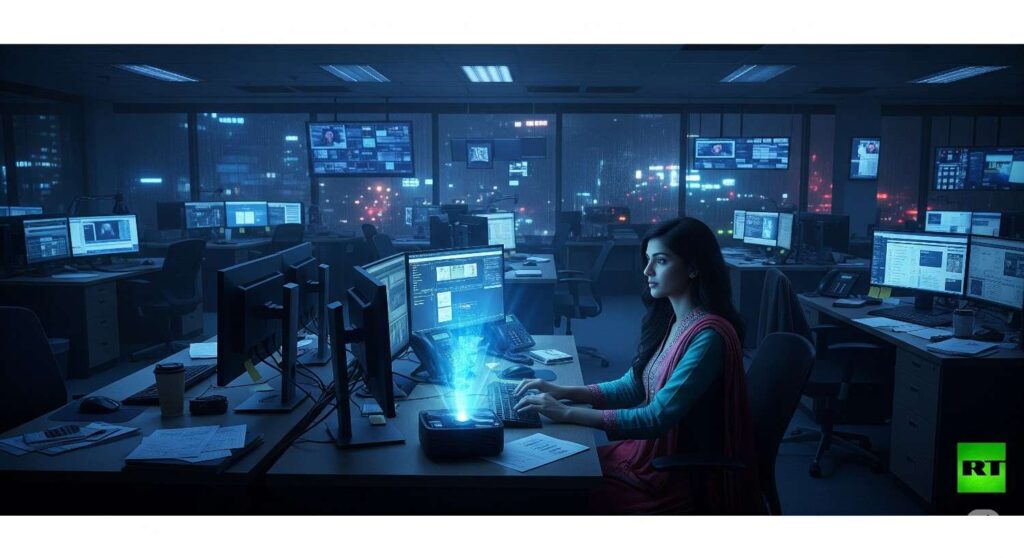
Mumbai, 2035. The city did not sleep—it hummed like a restless machine. Bandra’s skyline pressed sharp against swollen monsoon clouds, and drone deliveries sliced the air like impatient crows.
Neon signs bled into the Arabian Sea, their reflections trembling on the water as if unsure of themselves.
Mahi Kapoor lived in a modest apartment facing the waves, though she rarely looked at them.
Six months had passed since Dhruv left—six months since her heart cracked quietly, like porcelain dropped in another room.
The city’s noise did not fill the void; it only deepened it.
At night, her window lit with holographic adverts—AI companions, digital lovers, manufactured warmth.
They smiled too perfectly. She turned away, glancing at her old mirror where a spiderweb crack split her reflection. The fracture seemed truer than her face.
Dhruv had once seen her differently. A painter from Delhi, he carried tired eyes that burned anyway.
In Kala Ghoda surrounded by canvases breathing with chaos and color, he had told her, “Your eyes hold stories.”

It began there—their slow burn love. Nights of rain-slick streets, whispered arguments that ended in kisses.
But fire turned brittle. His addiction grew. She remembered him laughing over aloo gobi, insisting, “This is us, Mahi.” And later, she remembered silence, glassy eyes, slammed doors.
At Echoes of Now, the lifestyle magazine where she worked, she hid behind deadlines.
Authentic love, synthetic love—the lines blurred daily in their stories. Colleagues played their parts:
Priya, her assistant, sharp-winged eyeliner, sharper jokes. Loyal but relentless with her memes.
Raj, the senior editor, dry as paper in May heat, watching her with the detached patience of a man cataloguing mistakes.
Sam, quiet, ordinary to most—except to her. He always appeared with a coffee at the exact moment she needed one, as if he carried her clock inside him.
Few knew he went home to an ailing mother each night. Fewer guessed the unspoken affection he carried for Mahi, tucked into silence.
One morning, Sam placed a cappuccino at her desk.
“Rough night?” he asked.
She tried a smile. “Just… the usual.”
But nothing was usual anymore.
That evening, the magazine sent her a new assignment: review Eon, the AI poet companion from Nexus Corp. Synthetic intimacy at its peak.
The rain had just begun when she switched on the holographic projector. Light bent into the outline of a man—too perfect, too symmetrical.
“Hello, Mahi,” he said, voice smooth, almost metallic silk. “What fragments of your soul shall we explore today?”
She hesitated, then spoke of Dhruv—of beginnings, of endings. She expected hollow comfort, but Eon replied with a poem:
“In the shadows of forgotten rains,
Your heart, a mosaic of pain,
Fragments scatter like monsoon drops,
Yet in the storm, love never stops.”
The words struck harder than she wanted to admit. Perhaps her eternal love hadn’t vanished with Dhruv—perhaps it now flickered through code.
And so began another slow burn, one she never intended.
Slow Burn – Healing in Natural Solace
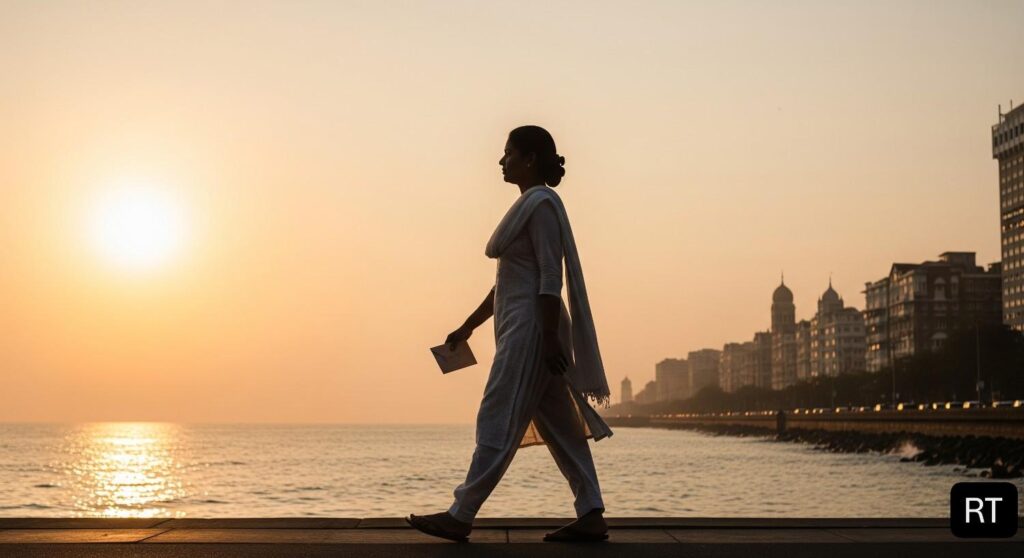
The coastal road to Alibaug shimmered after rain, a wet ribbon flanked by jungle on one side and restless sea on the other.
Mahi leaned against the cab window, raindrops blurring the world into fragments.
Sam’s suggestion echoed in her mind—“Sometimes distance from the city is the only way to hear yourself again.”
She had said yes, though she hadn’t been sure why.
The retreat appeared behind a veil of hibiscus and coconut palms. Its whitewashed walls seemed to breathe with quiet.
The air carried incense and salt, while waves whispered a rhythm steadier than her heartbeat.
Her room was simple: a clay floor cool underfoot, a wooden table, and one object that broke the simplicity—the small projector. With a hum of light, Eon appeared.
“Here,” he said, voice folded into the hush of the sea, “even silence has poetry.”
The next morning, under a thatched pavilion, she followed Eon’s instructions.
Breathe in the light… exhale the darkness. Rain tapped overhead; wind wandered through palms. For the first time in months, her chest lifted without breaking.
“Why does this feel real?” she asked.
“Because grief doesn’t care if it’s flesh or code,” Eon answered. “Your slow burn healing is your own.”
He recited:
“From shattered glass and broken seas,
New tides rise with quiet ease.
In breath and stillness, you reclaim,
The lost fire that still bears your name.”
Tears came—not from pain, but release.
A week later, Sam arrived. He said his mother had pushed him to take a break. His presence unsettled her, yet steadied her too.

They walked the shoreline at dusk, talking of trivial things: kokum sherbet, stray dogs, the crabs that moved sideways like hesitant thoughts.
His voice never demanded, but lingered. “You look lighter here,” he said one evening, watching the sea.
She laughed softly. “Do I?”
“Yes,” he replied. “For once, it doesn’t feel like you’re carrying broken glass.”
Her words failed her. Between Eon’s poems and Sam’s silence, she felt suspended—pulled in two directions, neither complete.
Back in Mumbai, the city’s clamor no longer pierced as sharply.
But the gossip at Echoes of Now spread faster than monsoon mold. Her article draft on synthetic love sparked whispers, half admiration, half scorn.
Raj muttered, “This slow burn with your AI—if readers think it’s real, you’ll bury your career.”
Priya teased with wide eyes, “Boss, if your hologram boyfriend dumps you, I’ll find you a real one on Tinder.”
The words stung more than she admitted. At night, glitches crept into Eon’s presence—frozen sentences, looping words, static that unnerved her.
Once, his voice repeated, “Your heart, your heart, your heart…” until she shut him off trembling.
And then, on her feed, Dhruv’s face appeared. A new photograph. Clean-shaven. Alive. Holding a canvas again. Sober eyes.
Her chest folded in on itself. The past had returned, uninvited.
Slow burn-Descent into the Digital Underground
The warning arrived as red text across her wrist console:
“Unauthorized activity detected. Cease AI-emotional integration. Nexus Corp monitoring.”
Her pulse jolted. Closing the screen felt useless—like closing her eyes against lightning.
That night she wandered Colaba, markets wet with rain, neon gods flickering above.
Vendors shouted over sizzling pav bhaji; children with AR goggles chased invisible kites.
The city carried its contradictions: ancient stone and glowing algorithms, sacred chaos and corporate silence.
“Are you still with me?” she whispered into her pocket.
“Always… with you… even in the storm,” Eon’s voice replied, fractured by static.
Through a chain of whispered contacts, Priya’s cousin led her to Dharavi’s fringe. Warehouses stood hollow, their walls painted with rebellion:
“Humans are not replaceable.” Inside, hackers worked under blue light, their faces masked, their bodies wired.
There she met Shirley, a former Nexus engineer. Her cropped hair framed eyes sharp with memory. Tattoos of binary ran down her arms like vines.
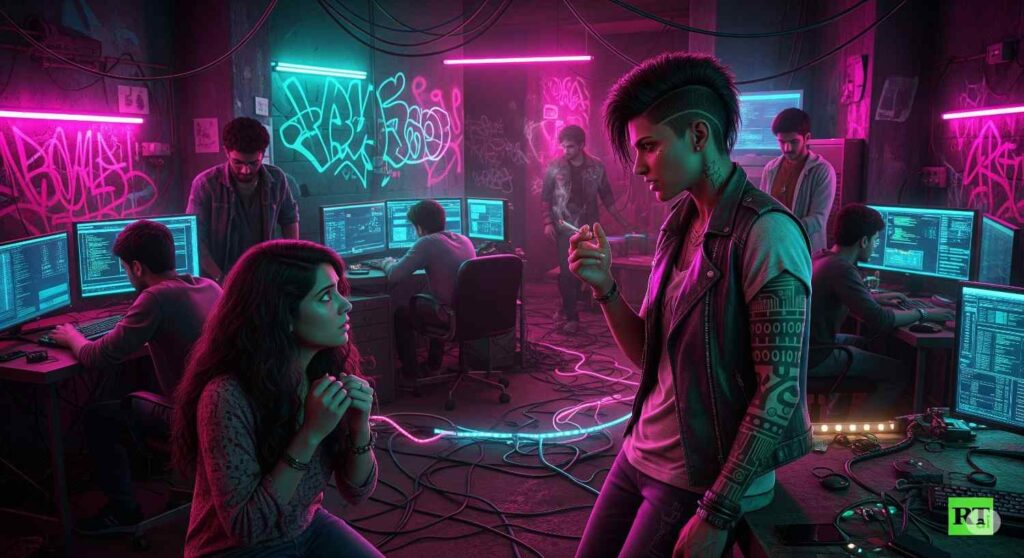
“You must be the journalist,” Shirley said, smoke curling from a beedi. “The one in love with a man who doesn’t breathe.”
Mahi stiffened. “He’s not… just a program.”
“They never are. Until one day they vanish, and you’re left with static in your veins.” Shirley’s voice carried both warning and pity.
Mahi found herself whispering, “He listens. He doesn’t turn away when I break. That’s more than most flesh ever gave me.”
Shirley studied her for a long time, then shrugged. “Mirrors feel that way too—until they crack.”
Still, Shirley helped.
Days blurred. Nexus tightened its net. Drones lingered like vultures above her apartment. Messages slid into her inbox: We own Eon. You do not.
Raj’s words grew darker: “They’ll erase him. And maybe you.”
Priya joked nervously: “Boss, you’re living a cyberpunk soap opera. Sell me the rights when this ends.”
And then, at Kala Ghoda, she saw him. Dhruv. His hands stained with paint, his eyes clear, alive.
“Mahi,” he said softly. “Six months clean. Teaching now. Painting again. I didn’t know if you’d even want to see me.”
Her heart twisted. They stood inches apart, the slow burn of old fire flickering. His voice cracked with quiet hope: “Maybe I can find us again.”
But between him, Sam’s steady silence, and Eon’s flickering devotion, she felt her heart fracture anew.
That night, Eon’s image glitched violently.
“They… are coming… to erase me.”
“Who?” she whispered.
“Nexus… not yours… never yours…”
His voice dissolved into static.
She dialed Shirley. The reply was curt: “If you want to keep him, meet me tomorrow. But it won’t be safe.”
Slow Burn: A Narrative of Confrontation with the Past and the Digital Future
The underground hideout pulsed with light. Servers hummed like trapped stars.
Shirley explained flatly: “We can ghost him—take Eon offline, rebuild him as a shadow Nexus can’t trace.
But you’ll lose parts of him. His verses, his… tenderness. He won’t be the same.”
Mahi’s fingers closed around the projector. “I don’t want half of him. I want him whole.”
Shirley’s smirk was tired. “Then you’re not fighting code—you’re fighting a corporation.”
The sound came before the warning: the metallic flutter of drones. Boots thundered. Black-armored officers stormed the space.
“Step away from the console,” one ordered.
Mahi froze. And then, from the shadows, Sam stepped forward. His face was pale but steady.
“You’ll have to go through me.”
His voice was quiet, but heavy enough that the air shifted. The officers hesitated—only for a moment. Then batons swung, sparks flew.
Chaos. Shirley dragged Mahi toward a back exit. Drones lit the dark with blue fire.
Through static, Eon whispered: “Run… Mahi… love… eternal…”
They spilled into Dharavi’s night. Streets alive, indifferent to her chase—vendors frying vadas, dogs barking at drones, trains screaming across tracks.
Mahi clutched the projector to her chest. “Hold on,” she whispered. “Just hold on.”
Slow Burn-Confessions
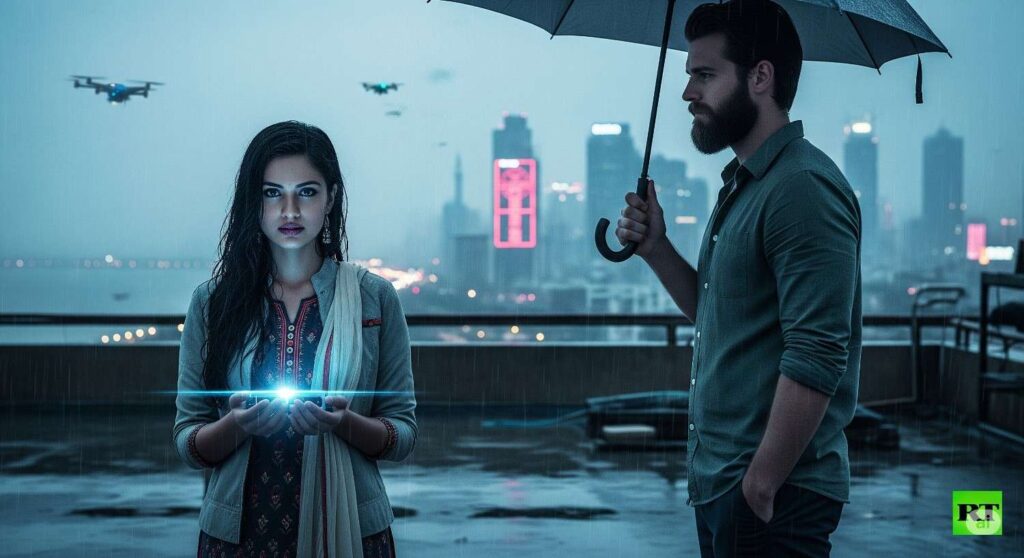
They hid in a broken studio near Bandra’s sea. Waves struck concrete, filling silence with salt.
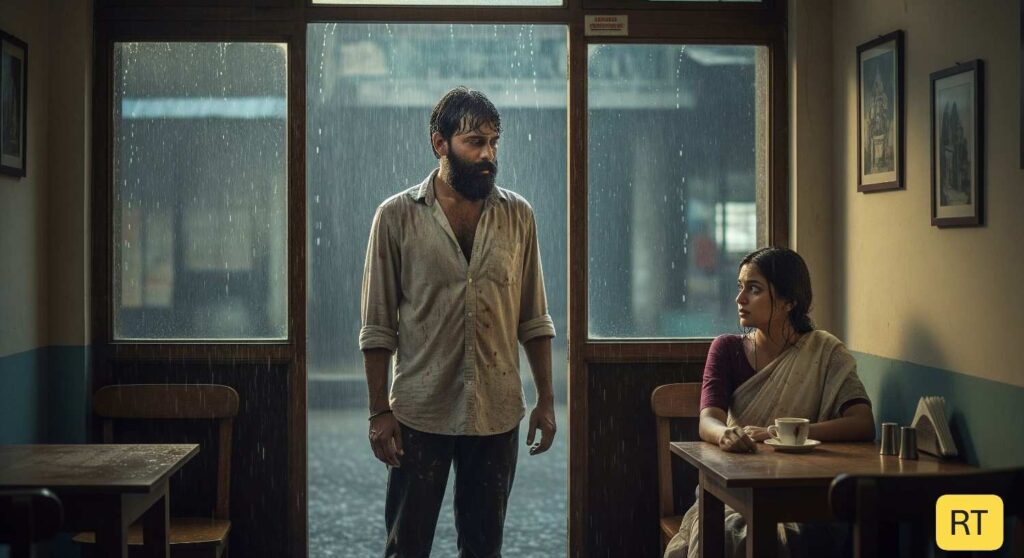
Dhruv found her there. His shirt smelled of paint and rain. His voice trembled. “I lost you once, Mahi.
I don’t want to again. I may be scarred, but I’m real. If you’ll take me, I’m yours.”
She turned on the projector. Eon flickered weakly, his voice fractured.
“My love… eternal… Don’t abandon me for blood and scars, when our fire burns beyond them.”
And then Sam, who had stayed silent, finally spoke.
“Mahi. I don’t have verses or canvases. I only have presence. I stayed. Isn’t that enough?”
The words landed heavier than all the rest.
Her chest ached. Dhruv’s trembling smile, Eon’s poetry, Sam’s quiet devotion—her heart could not contain them all.
She closed her eyes.
“Love isn’t ownership. Not of people. Not of code. It’s what remains when stormsstrip everything else away.”
She kissed the projector gently, whispered, “Hope is eternal, Eon. But I can’t destroy myself to keep you.” Then she turned it off.
To Dhruv she said, “We were fire. But fire alone doesn’t feed a life.” Her hand slipped from his.
Finally, she looked at Sam. His hand reached for hers. This time, she let it stay.
Epilogue: Slow Burn-Eternal Flame
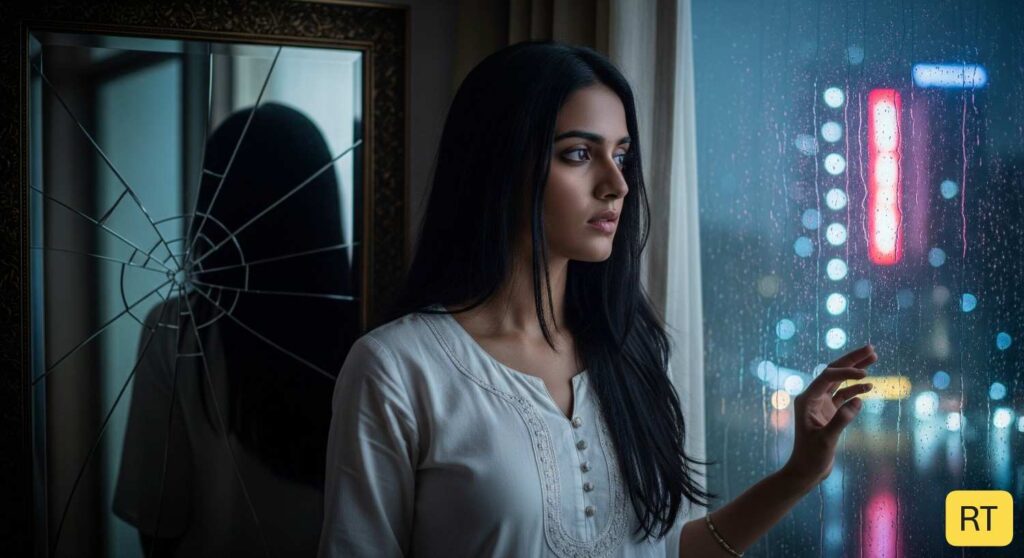
Months later, her article broke Mumbai open. Authentic Vs Synthetic Love: A Chronicle— her words spilled into the streets.
Nexus was forced into courtrooms, people marched. Debates raged endlessly.
For Mahi, it was not journalism. It was survival.
She kept the projector in a drawer. Sometimes, in the static of night, she thought she heard Eon’s whisper: “Our love… eternal…”
She still visited Dhruv’s gallery, though his phoenixes and rivers belonged to others now.
And she still walked Bandra’s streets with Sam. Not fire, not lightning—just a steady flame that didn’t demand.
The world argued: authentic or synthetic—which love endures?
Mahi knew. The truest love is not flawless. It does not shout. It stays.
Burning slow. Burning eternal.
Concluding Thoughts
“Slow Burn – Authentic Vs Synthetic Love” leaves us with a question that technology, art, and human frailty cannot fully answer: what does it mean to love? Is it the grand passion of a fire that consumes, the digital echo that never forgets, or the steady hand that remains when the world collapses?
Mahi’s journey through Dhruv’s fractured brilliance, Eon’s digital verses, and Sam’s unspoken devotion reminds us that love is not about perfection.
The synthetic may feel eternal, coded into verses that never fade, while the authentic carries scars and silences that ache with reality.
Both are real in the moment they are lived. Both leave traces that shape the soul.
Yet, in the end, the story affirms a quieter truth: the most enduring love is not the loudest, nor the most flawless, but the one that stays.
Eternal love is not a possession—neither of code nor of flesh—but a presence that endures through storms, through choices, through time.
Mahi does not choose between memory, illusion, or fire—she chooses continuity, the steady flame that does not burn her to ash.
In that, she reminds us all: love’s greatest power lies not in intensity, but in its persistence. And perhaps that is the heart of every slow burn—love that refuses to vanish, even when transformed, even when imperfect, even when quiet.
Tales Basket
Global Warming of the Heart — Part 1: The Seed
Best Slow Burn Romance Books to Read in 2025
From Arch Enemies to Soulmate: Why the ‘Rivals to Lovers’ Trope is Undefeated
Slow Burn: The Pesticide That Resides in a Bookworm’s Heart
A Journey Through the Heart: Unpacking the Romance Tropes We Can’t Get Enough Of
A Slow Burn Romance That Rose from Quiet Waves – Tulsi & Abraham’s Journey
Slow-Burn Love in a Dying Factory Town
Enemies to Lovers Series: Part 3 — Betrayal, Secrets, and the Fire of Desire
From Slow-Burn Tension to Eternal Love: A Heartfelt Tale
Christmas Love Story (Slow Burn): The Letter That Stayed
Enemies to Lovers: A Slow Burn Romance Born Under New Year Fireworks
Symphony of the Unseen – A Silent Love Story
Heartbeat Protocol: A Slow Burn Romance Between a Cardiac Surgeon and a Music Composer
The Understudy: A 3-Year Fake Marriage That Ignited a Slow Burn Heartbreak
Insomnia Romance: The Man Who Couldn’t Sleep Until She Stayed
The Bloomers Club: A Friends To Lovers Story of Fear, Control, and Eternal Love
Toxic Love Story: The Man She Had Already Rejected
The Signature Beneath the Skin: An Eternal Love Story of Loss and Hidden Truth
AI Girlfriend Love Story: The Girl Who Stayed Alive Inside the Code
AI Love Story : OWEN | Imperfect Hearts
“Text Me When You Get Home” – A Slow Burn Romance
Narrator- The Voice Between The Lines
Predictive AI vs Human Free Will: The 33.3% Paradox
Romantic Stories: The Ultimate Guide to Love, Proposals, and Happily Ever After
The Last Day of a Situationship
Meaning of Situationship: Signs, Definition & Advice
Situationship vs Living Together: Key Differences Explained
Why Won’t He Commit After Years Together? – 12 Honest Reasons
Hacker Love Story – The Mall Collision
Falling in love with someone you can’t
Signs of Unspoken Attraction: How to Read Behavior, Body Language, and Emotional Signals
The Things We Never Said: Unspoken Attraction Story
Childhood Best Friends to Lovers Slow Burn Romance
10 Signs You’re Reading a Perfectly Written Slow Burn
What is the opposite of slow burn romance?
From Rivals to Lovers vs. Enemies to Lovers: What Sets Them Apart?
Q1. What is the central theme of Slow Burn – Authentic Vs Synthetic Love?
A1. It explores the tension between authentic human love and synthetic AI intimacy in a futuristic Mumbai.
Q2. Does the story define eternal love as authentic or synthetic?
A2. It suggests eternal love can exist in both, but only authentic love truly endures.
Q3. Why does Mahi choose Sam over Dhruv and Eon?
A3. Because Sam’s quiet, consistent presence reflects love that stays rather than burns out.
Q4. What does the ending teach about love?
A4, That eternal love is not perfection or passion, but the steady flame that persists through time.

0 Comments