
By: Ranjan Sarkhell
–
Table of Contents
–
Introduction
Fake marriage for a green card is one of the most searched — and most misunderstood — topics in U.S. immigration. Every year, people wonder whether staging a fake marriage for a green card or entering a “marriage of convenience” could be a shortcut to permanent residency. The honest answer: it’s far riskier, far more detectable, and far more damaging than most people realize. Here’s what’s actually true.
–
Keypoint’s
- A fake marriage for a green card may look convincing on paper, but USCIS is specifically trained to detect exactly this pattern.
- Attempting a fake marriage for a green card puts both spouses at risk of criminal charges, not just the immigrant applicant.
- Search trends show many people ask if a fake marriage for a green card is “worth it” — but the financial and legal fallout almost always outweighs any benefit.
–
What Counts as “Marriage Fraud” Under U.S. Law
Under U.S. immigration law, a marriage entered solely to obtain immigration benefits — with no intention of building a life together — is considered fraudulent, even if the wedding is legally registered and looks real on paper. It doesn’t matter whether the couple lives together for a while, has a real ceremony, or even has genuine affection. What matters to USCIS is intent at the time of marriage.
This distinguishes fraud from a marriage that later fails. A couple who marries in good faith and later divorces hasn’t committed fraud. A couple who marries specifically to game the immigration system has — regardless of outcome.
Can You Marry Someone Just for a Green Card?
Legally, no. It’s a federal crime under 8 U.S.C. § 1325(c), and USCIS is specifically trained to screen for it. Practically speaking, people do attempt it, but the system is built around catching exactly this scenario, because it’s one of the most common fraud patterns immigration officers see.
How USCIS Actually Detects Fake Marriages
USCIS doesn’t rely on a single interview. Their process is layered:
- Separate interviews. In suspected cases, spouses are interviewed individually and asked detailed, sometimes oddly specific questions (which side of the bed, what’s in the medicine cabinet, who does the dishes). Answers are cross-checked for inconsistency.
- Site visits. Fraud investigators (from USCIS’s Office of Fraud Detection and National Security) can and do visit the home address unannounced.
- Document trail. Joint bank accounts, leases, insurance policies, tax returns, and utility bills opened months before filing look very different from ones opened the week of the application.
- Social and community evidence. Photos, messages, and statements from friends/family are compared against the timeline of the relationship.
- Financial arrangements. Payments between the parties (a common feature of paid marriage fraud) are a major red flag investigators actively look for.
- Informants. A significant share of fraud cases are reported by the U.S. citizen or resident spouse themselves, an ex-partner, a family member, or someone offered money to be a “fake witness.”
Why “Fake Marriage for a Green Card” Rarely Works Out
Searches like “fake marriage for green card price” or threads on forums suggest a transactional shortcut. In reality:
- The financial risk is high. People have reportedly paid anywhere from a few thousand to tens of thousands of dollars for these arrangements — money that offers no legal protection and is frequently lost even when the scheme fails.
- There’s no enforceable contract. You can’t sue someone for breach of a fraud agreement. Disputes over money, property, or the marriage itself have no legal remedy.
- One person can turn on the other. A falling-out, a jealous partner, an unpaid “fee,” or a guilty conscience is one of the most common ways these cases get reported.
- The penalties are severe, covered next.
The Real Consequences of Green Card Marriage Fraud
- For the immigrant: Permanent inadmissibility to the U.S. under INA § 204(c) — meaning no future family- or employment-based petition can ever be approved, even a legitimate one decades later. Removal (deportation) proceedings. Up to 5 years in federal prison and fines up to $250,000.
- For the U.S. citizen or resident spouse: The same criminal exposure — up to 5 years in prison and significant fines — plus potential conspiracy charges if money changed hands.
- For anyone who helped, including witnesses who signed false affidavits or notaries who knowingly processed fraudulent documents.
This is why “getting away with it” is the wrong framing. Even when fraud isn’t caught immediately, USCIS can reopen and revoke approvals years later if evidence surfaces — there’s no statute of limitations that fully protects an approved case.
Green Card Marriage Horror Stories
Immigration attorneys and forums are full of accounts that follow familiar patterns: a broker who disappears with the fee, a “spouse” who demands more money mid-process and threatens to report the other, a surprise home visit that exposes separate residences, or a citizen spouse who reports the arrangement after a breakup. These aren’t rare outliers — they’re common enough that fraud investigators actively watch for them.
How to Prove a Marriage Is Real for a Green Card
For genuinely married couples worried about scrutiny, USCIS looks for evidence built up naturally over time, including:
- Joint financial accounts, leases, or mortgages
- Shared health insurance or life insurance beneficiaries
- Birth certificates of children together, if applicable
- Photos and communications spanning the relationship, not just the recent past
- Affidavits from friends and family who’ve observed the relationship
- Consistent, detailed individual testimony in interviews
The key theme across all of it: real relationships tend to generate a paper trail organically, over time, without anyone trying to manufacture one.
How to Tell If Someone Is Marrying You for a Green Card
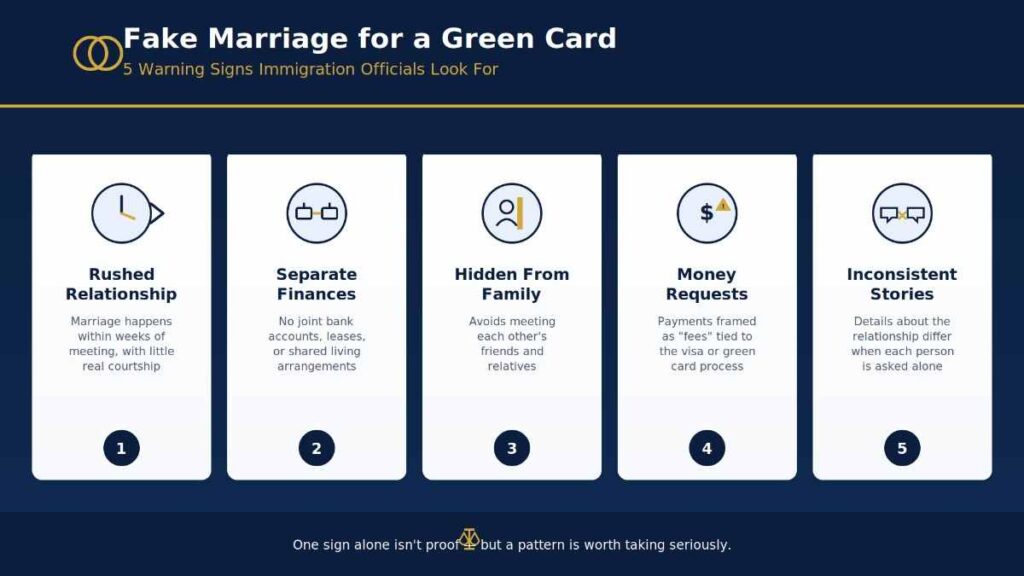
Common warning signs include: the relationship moving to marriage unusually fast, reluctance to combine finances or living arrangements, avoidance of meeting each other’s family and friends, requests for money tied to the immigration process, and inconsistent stories about shared history. None of these alone proves fraud, but a cluster of them is worth taking seriously — both emotionally and legally, since a U.S. citizen spouse can also face criminal liability.
Here’s that in table form:
| Warning Sign | What It Might Look Like |
| Relationship moves unusually fast | Marriage proposed or happens within weeks/a few months of meeting, with little courtship |
| Reluctance to combine finances or living arrangements | Avoids joint bank accounts, leases, or actually moving in together even after marriage |
| Avoidance of meeting family and friends | Partner is kept separate from your social circle, or you’re kept separate from theirs |
| Requests for money tied to the immigration process | Payments framed as “fees,” “help,” or “expenses” connected to the visa or green card process |
| Inconsistent stories about shared history | Details about how you met, your routines, or your relationship change depending on who’s asked |
Note: No single sign proves fraud on its own — but a cluster of them is worth taking seriously, both emotionally and legally, since the U.S. citizen or resident spouse can also face criminal liability in a marriage fraud case.
Bottom Line
“Getting away with” marriage fraud isn’t a real strategy — it’s a bet against a system specifically designed to catch this exact pattern, with penalties (prison, permanent bars, deportation) that far outweigh any benefit. Anyone facing a complicated but genuine immigration situation is almost always better served by consulting an immigration attorney about legitimate pathways than by taking on this level of legal and financial risk.
–
Link
Green Card Marriage Horror Stories: A Tale of Paper and Poison
Immigration Fake Marriage: How Marriage Fraud Actually Gets Investigated
–
FAQ
Is a fake marriage for a green card illegal?
Yes. A fake marriage for a green card is a federal crime under U.S. immigration law. Both the immigrant and the U.S. citizen or resident spouse can face criminal charges, fines, and — for the immigrant — permanent inadmissibility from future immigration benefits.
How does USCIS detect a fake marriage for a green card?
USCIS uses separate spousal interviews, unannounced home visits, and document review (joint finances, leases, photos, and timelines) to spot a fake marriage for a green card. Inconsistent answers, thin financial ties, and tip-offs from informants are the most common ways these cases are caught.
What happens if you get caught in a fake marriage for a green card?
Consequences of a fake marriage for a green card include denial or revocation of the green card, removal (deportation) proceedings, a permanent bar on future family-based petitions, and up to 5 years in federal prison with fines up to $250,000 for both spouses involved.
–

0 Comments