
By: Ranjan Sarkhell
–
Table of Contents
–
Introduction
Have you ever read a love story where two characters simply brushed shoulders and your heart skipped a beat?
What is that magic that makes the slow burn romance so powerful? The key to a slow-burn love story lies in hearts that have been bruised but survived and souls that have been tested but still remain.
Most writers seem to make the mistake of throwing roadblocks or using misunderstandings to keep the couple from finding each other for as long as possible
But a real slow-burn romance should focus on the fear that comes with opening your heart. By focusing on the psychology of a slow-burn romance, each word will pack the emotional punch of an earthquake.
–
Core Keypoints
- The Economy of Contact: Physical contact is so taboo that even an accidental brush makes one’s skin prickle with electricity.
- Asymmetrical Awareness: If One Lead Figures It Out First, They’ll Panic While the Other Carelessly Nuzzles Into Their Neck
- Subtextual Dialogue: All the characters’ petty bickering and banal domestic logistics are really just proxies for their deepest desires and fears
- False Domestic Safety: A de-escalation of their emotional armor during an intimate moment could make the characters reawaken their romantic feelings
- The High-Cost Confession: In order to remove all pretenses, the characters must risk their pride by confessing their feelings.
–
The Opening Quote: The Trap of Unspoken Restraint
“There are some people whom we would have loved us, but to whom we can never say so; and there are others who love us, to whom we can never say, ‘Do not love me.'”
— Thomas Hardy, Far from the Madding Crowd
Contextual Explanation:
This quote seems to perfectly capture the essence of the ongoing emotional dilemma between the characters in a slow-burn romance.
It uncovers the internal barriers and societal expectations that prevent people from expressing their feelings and the fear of rejection that often comes with it.
The chosen quote allows the readers to understand the context and motivations behind the ongoing romantic tension in the story.
By the virtue of being at the beginning of the article, this quote prepares the readers for the detailed analysis of the slow-burn romance ahead.
–
Many writers will tell you that to create a slow burn romance, you need to put roadblocks in the way of your MCs: missed phone calls, interruptions, misunderstandings.
This is not what makes up slow emotional tension. This is procrastination.
True slow burn is a feeling of doubt creeping in. It is the pressure of the unspoken truth hanging between two people who are both too afraid to acknowledge it.
To learn how to write slow burn romance, here is how to capture this emotion in your story, with practical examples and writing advice.
1. The Economy of Contact: Why Scarcity Creates Voltage
In fast-paced stories, touch happens early and often. In a slow burn romance, physical contact is treated like rare gold. When touch is rare, even the smallest brush of skin feels like a lightning bolt.
Story Example: The Economy of Contact (Marcus & Nora)
The Scene:
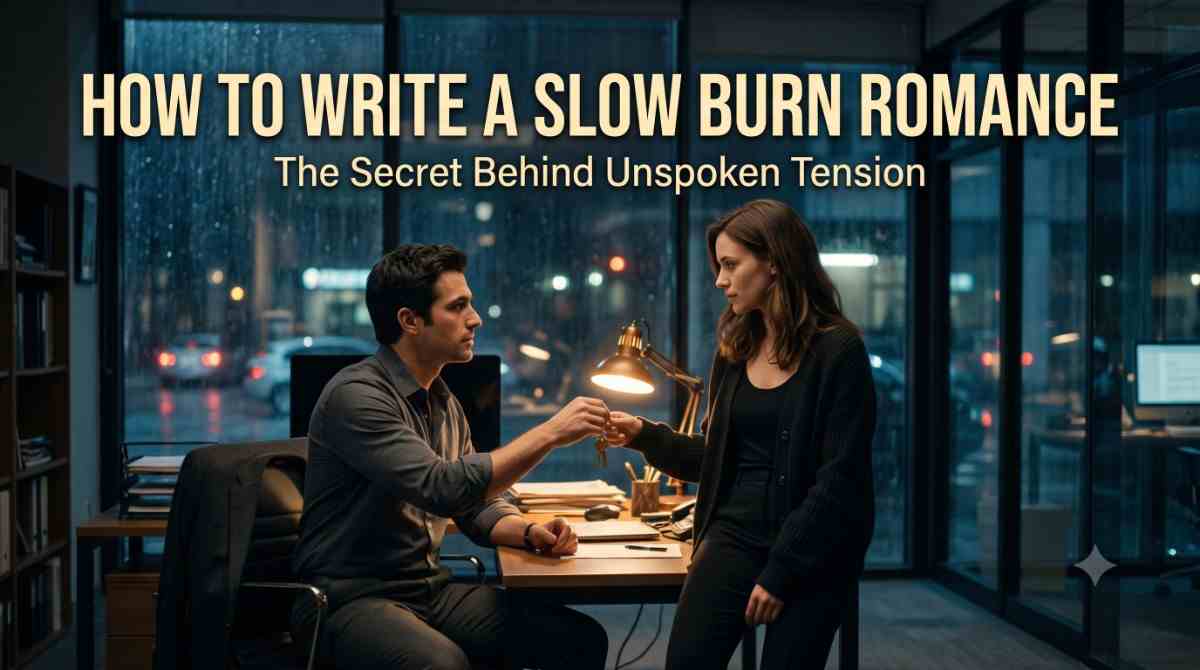
It is 9:30 on a rainy Thursday night. The open-plan office has been deserted for hours, leaving only the dull hum of the air conditioner and the steady click of Nora’s keyboard echoing across the floor.
Nora is hunched over her desk, squinting at the glowing financial spreadsheets on her dual monitors. Her hair is tied in an untidy bun, her coffee mug has long since gone cold, and her eyes ache from hours of reviewing data.
Across the aisle, Marcus shuts his laptop, packs his notebook, and pulls his coat over his shoulders. As the department lead, he is the last person to leave, holding the master key set to lock the glass double doors at the entrance.
The Micro-Touch:
He walks over to Nora’s cubicle, pausing by the low partition. He doesn’t offer a dramatic speech or lean over her chair to invade her personal space. He simply extends his right hand, dangling the heavy brass key ring toward her.
“You’ll need these to lock up the back corridor when you’re done,” Marcus says quietly, his voice low in the empty room.
Nora reaches up to take the keys. But as she wraps her fingers around the metal ring, the warm pad of Marcus’s index finger brushes firmly against the soft underside of her wrist for half a second.
Neither of them gasps. Neither of them pulls away abruptly.
It is a fraction of an inch of accidental contact—a tiny friction of skin against skin in the middle of a mundane chore. Yet in the absolute quiet of the empty office, the touch carries the weight of a physical shockwave. Marcus’s hand pauses for a single beat before his fingers release the keys.
“Goodnight, Nora,” he murmurs, stepping back into the shadow of the hallway without waiting for her reply.
The Lingering Aftershock:
Five minutes pass. The heavy click of the elevator doors has already signaled Marcus’s departure. The floor is silent once again.
But Nora hasn’t typed a single character.
The glowing spreadsheet blinks on her screen, untouched and unread. Instead of working, Nora is sitting completely still in her ergonomic chair, staring down at her upturned left wrist. The skin where Marcus’s finger brushed feels warm, heightened, and tingling, as if the room’s entire electric current had focused on that one square inch of flesh. She slowly curls her fingers into a fist, pressing the spot against her palm, unable to steady her breathing.
The Craft Breakdown:
This scene demonstrates how a strict economy of contact powers a slow burn romance:
- High Scarcity Equals High Value: Because Marcus and Nora have spent chapters maintaining strict professional distance, an ordinary brush of fingers feels just as explosive as an overt embrace.
- The Delayed Aftershock: The true tension of the scene lives in the five minutes after the touch. Showing Nora’s inability to focus reveals the deep emotional undercurrent without needing a single word of spoken dialogue.
- Preserving Narrative Pressure: By leaving the moment unacknowledged between the characters, the story keeps the romantic pressure cooker sealed tight for the chapters ahead.
The Jane Austen Technique:
In Pride and Prejudice, Jane Austen rarely allows Mr. Darcy and Elizabeth Bennet to touch. When Darcy helps Elizabeth into her carriage, the simple act of holding her hand without gloves is so shocking and electric that Darcy abruptly walks away to regain his composure.
–
2. How to Write a Slow Burn Romance Through Asymmetrical Awareness
Tension gets much stronger when one character realizes their feelings long before the other person does.
This creates dramatic irony—the reader and one character know the secret, while the second character remains completely oblivious.
Story Example: Asymmetrical Awareness (Leo & Maya)
The Scene:
Leo and Maya have known each other since the third grade. For years, their routine on open Saturday afternoons has been effortless and comfortable: an old truck parked in the gravel driveway, classic rock playing low from a portable speaker, and grease smudged across their forearms as they fix whatever engine part has broken down.
On this particular afternoon, they are leaning shoulder-to-shoulder over the open hood of Leo’s 1998 pickup, debating the timing belt. Maya pushes her hair back with the back of her wrist, leaving a black streak of motor oil across her cheekbone. When she laughs at a dry joke, her entire face lights up in the afternoon sunlight.
As she reaches out to hand him a half-inch socket wrench, their fingers brush against the cold chrome tool.
In that split second, something shifts violently in Leo’s chest. It isn’t a slow realization—it hits him like a freight train. He isn’t looking at his childhood buddy anymore; he is looking at the only person he wants to spend the rest of his life with. The warmth of her hand, the curve of her smile, and years of unspoken fondness suddenly crystallize into one undeniable fact: he is completely, hopelessly in love with her.
The Panic & Defense:
The realization terrifies him. If he lets it show, twelve years of easy friendship could shatter in a single conversation. In immediate self-defense, Leo takes a sharp step backward, turning his back toward the radiator and abruptly wiping his hands on a clean rag. His shoulders go rigid, and the comfortable banter instantly dies in his throat.
The Boundary Breach:
Maya, entirely unaware of the emotional storm inside him, tilts her head in confusion. Because they have been friends forever, she has zero hesitation about crossing his physical boundaries. She steps straight into his personal space, close enough that the scent of her vanilla shampoo cuts clean through the smell of gasoline and hot metal.
“Hey,” she says softly, her eyes searching his. Before he can dodge, she lifts her cool, clean palm and presses the back of her hand firmly against his forehead. “Are you feeling okay? You went pale all of a sudden. Did the heat get to you?”
Leo freezes entirely. He doesn’t dare swallow, exhale, or pull away. Her skin is cool against his burning forehead, her thumb resting dangerously close to his temple. He is trapped in place, holding his breath, terrified that the frantic, thumping rhythm of his pulse will echo straight through his skull and give his secret away.
The Craft Breakdown:
This scene demonstrates why asymmetrical awareness is one of the most powerful tools in a slow burn romance:
- Dramatic Irony: The reader feels the intense heat of the moment because they know Leo’s secret, while Maya’s innocent gesture unintentionally tortures him.
- The Physical Risk: The physical touch isn’t romantic to Maya—it is friendly care. To Leo, it feels like standing next to an open flame with no armor.
- The Sustained Tension: By having Leo swallow his feelings rather than confess, you heighten the stakes for future chapters, making every subsequent touch even more dangerous.
The Kazuo Ishiguro Technique:
In the classic novel The Remains of the Day, Nobel Prize winner Kazuo Ishiguro builds an entire story around this dynamic. Miss Kenton slowly realizes the deep bond between her and the butler, Mr. Stevens. Stevens, however, hides behind his professional duty, creating unbearable heartbreak every time she tries to step closer.
–
3. Subtextual Dialogue: Speaking in Code
Characters in love rarely say what they actually mean right away. Instead, they use everyday logistics and small arguments to hide their true emotions.
Story Example:
The Scene:
Ethan and Sienna have spent three years competing for the same senior project lead position at their firm. When a sudden blizzard cuts off the mountain highway on their way back from a regional conference, they are forced to take refuge in an unheated, drafty roadside cabin with only a failing kerosene heater between them.
Neither is willing to wave the white flag or show the slightest hint of emotional vulnerability. But as the temperature plunges and the wind rattles the single-pane windows, the frosty dynamic begins to shift beneath the surface.
Sienna sits shivering on an old wooden bench, her arms wrapped tightly around her thin sweater as she pretends to review her laptop notes. Ethan watches her from across the room for two silent minutes. He doesn’t offer a tender gesture or an open confession. Instead, he unzips his heavy wool parka, strides over, and drops it squarely across her lap with a sharp frown.
“Put on your jacket,” Ethan says, his tone clipped and irritated. “You always forget to pack properly for the weather, and I don’t want to hear you coughing all day tomorrow during our morning client pitch.”
Sienna looks up, ready to fire back a sarcastic remark about not needing his charity. But as she pulls the warm fabric around her shoulders, catching the faint scent of cedar and rain on the collar, she catches the look in his eyes before he turns away to fiddle with the dead thermostat.
The Subtext Breakdown:
On the surface, the conversation sounds like two stubborn rivals bickering over practical logistics and office priorities. But the reader easily translates the dual-track dialogue:
- Surface Spoken Words: “You’re being careless, and you’re going to ruin my workday.”
- Unspoken Emotional Truth: “I cannot stand the thought of you freezing while I have warmth to give, and I would rather freeze myself than watch you suffer.”
The Ernest Hemingway “Iceberg Theory”:
The great author Ernest Hemingway famously argued that a writer should only show one-eighth of a story above water; the other seven-eighths should be felt underneath. In romance, simple logistical chatter on the surface hides an ocean of unspoken devotion underneath.
–
4. The Illusion of Safety: Lowering the Guard Before the Spark
If two characters are stressed and arguing in every single scene, the reader gets tired. To make romantic tension hit harder, you must first give your leads a moment where they feel completely safe.
Story Example: The Illusion of Safety (Gabriel & Clara)
The Scene:
Gabriel and Clara have spent the last seven days working sixteen-hour shifts to launch a community art exhibit. After a week of chaotic phone calls, missing supplies, and frayed nerves, the opening night is finally over, and the frantic adrenaline has drained away into sheer exhaustion.
It is midnight. They are sitting side by side on the creaking wooden steps of Clara’s front porch, their backs resting against the porch railings. The street is completely quiet, lit only by a warm amber porch light and the faint glow of the distant city skyline. Between them sits a brown paper bag of spicy takeout noodles and two pairs of wooden chopsticks.
In this low-stakes environment, the constant professional walls they keep between each other naturally crumble. There are no deadlines to meet, no colleagues watching, and no reason to perform. For the first time in months, they are simply two people sharing a quiet meal in the cool night breeze.
The Accidental Intimacy:
As Gabriel recounts how the gallery director dropped a tray of champagne glasses, Clara throws her head back and laughs—a genuine, uninhibited laugh that she usually reserves only for old home videos.
“Hold on,” Clara says between giggles, leaning across the narrow step. Without a second thought, she reaches out her thumb and gently wipes away a stray smudge of chili sauce from the corner of Gabriel’s lower lip.
It is an entirely casual, domestic gesture—the kind of thoughtless movement people only share when their guard is completely down.
The Sudden Freeze:
But the moment her skin touches his, the casual atmosphere instantly evaporates.
Clara’s thumb lingers on his lip. Gabriel’s laughter cuts off mid-breath.
The quiet chirping of crickets in the yard suddenly feels deafening. In the dim yellow light, Gabriel’s dark eyes lock onto hers, completely unshielded by his usual professional humor. The distance between their faces is barely four inches. Clara can feel the warmth radiating from his jawline, and her hand freezes against his cheek, suddenly aware that she has crossed an invisible line with no easy way back.
For four agonizing seconds, neither moves. Neither breathes. The safe, cozy bubble of eating midnight noodles has vanished, replaced by an electric, breathless realization: they are no longer just friends sharing takeout on a porch step.
With a shaky breath, Clara slowly lowers her hand back to her lap, her fingers curling tight against the fabric of her jeans. Gabriel clears his throat, staring down at his noodles as if trying to remember how chopsticks work, his pulse visibly thumping at the base of his throat.
The Craft Breakdown:
This scene demonstrates how false domestic safety deepens tension in a slow burn romance:
- The Power of Contrast: High-tension moments hit twice as hard when they are preceded by relaxed, ordinary routines. The shift from easy laughter to breathless silence creates an emotional spike for the reader.
- Unconscious Vulnerability: The touch happens because Clara forgot to be careful. When characters drop their defenses unconsciously, they accidentally reveal their natural attraction.
- The Lingering Aftermath: Instead of leading to an immediate kiss, the moment ends with both characters retreating into quiet shock, leaving the reader craving the moment they finally cross that boundary for good.
The Charlotte Brontë Technique:
In Jane Eyre, Rochester and Jane share quiet, fireside conversations late in the evening. Because these talks feel like intellectual, safe debates, Jane lets down her guard—only to find herself completely swept away by the sudden intimacy of the room.
–
5. The Inevitable Ignition: Earning the Payoff
When the burn finally ends, the climax cannot simply be a convenient conversation. All external excuses must be stripped away so the characters have nowhere left to hide except behind their own truth.
Expanded Story Example: The Inevitable Ignition (Julian & Elena)
The Scene:
It is nearly 2:00 AM. The final architectural blueprint for the city library project has been submitted, the deadline met, and the emergency generator’s hum has finally died down. Outside, the torrential downpour that trapped them inside the design firm all night has softened into a faint, rhythmic mist.
The chaotic noise of the day—ringing desk phones, flapping paper prints, and thunder shaking the glass—is completely gone.
Julian and Elena stand facing each other in the center of the dimly lit, polished concrete hallway. Their coats are folded over their arms, and their work bags are zipped shut. Every external crisis has been solved. There is no looming deadline, no boss walking through the double doors, and no logistical fire left to put out.
For the first time in ten months of working late, there is not a single excuse left between them.
The Confrontation:
Elena leans her shoulder against the cool drywall, watching Julian adjust the strap of his messenger bag. She can see the exhaustion in the slight dip of his shoulders, but his eyes remain locked on hers with a quiet, unrelenting intensity.
She tries to maintain her usual lighthearted tone, but her voice comes out quiet, stripped of its usual armor.
“Your car was parked in the covered garage,” Elena says, her gaze searching his face. “You finished your structural calculations by eight o’clock, well before the storm flooded the lower roads. Why didn’t you leave earlier?”
The Surrender:
In earlier chapters, Julian would have had a quick, deflective answer ready—a joke about preferring the office coffee, a complaint about the traffic, or a dry remark about double-checking the calculations.
This time, he doesn’t deflect. He doesn’t smile. He takes one slow, deliberate step forward, closing the safe gap between them until the faint scent of rain and woodsmoke on his coat fills the space around her.
The silence stretches between them, heavy and suffocating. When he finally speaks, his voice is low, rough, and stripped entirely of his carefully guarded pride.
“Because you were here.”
Three words. No clever excuses. No safety net.
Elena’s breath catches in her throat. For months, they had danced around polite professionalism and subtle glances, but with that single confession, Julian places his entire heart on the line, leaving no room to step backward.
The Craft Breakdown:
This scene demonstrates how to execute the emotional climax of a slow burn romance:
- Stripping the Armor: The climax works because you remove all external plot distractions (the storm, the deadline, other coworkers). When there is nothing left to fix, the characters are forced to face each other.
- The Cost of Vulnerability: The confession does not rely on a lengthy, flowery speech. It lands with immense power because a proud, reserved character willingly surrenders their emotional defenses.
- Earning the Payoff: Because the reader watched the tension build across hundreds of pages through tiny glances and subtle subtext, this direct truth feels like a long-awaited, deeply earned release of pressure.
The E.M. Forster Technique:
In A Room with a View, E.M. Forster strips away high-society decorum by placing his characters in a quiet, sunlit field of violets.
With no social rules left to shield them, the unspoken tension finally breaks into an earned, unforgettable confession.
A memorable slow burn romance does not depend on keeping characters apart with artificial tricks.
It works because the emotional stakes are so high that every glance, shared chore, and lingering silence feels like an event the reader cannot look away from.
–
The Ending Quote: The Journey Over the Destination
“The wait is the story. The fire is just the punctuation.”
— Ranjan Sarkhell
Contextual Explanation:
This quote gives a brilliant philosophy on how to write slow-burn romance.
Many beginner writers tend to jump to the point of the story where the protagonists finally express their feelings or become physically intimate (fire). They often miss the build-up and the feelings of frustration, which their protagonists have to endure waiting for the moment when their feelings become obvious (the wait).
Therefore, the last line of the quotation is a vital note of advice to writers and readers. The quotation helps the reader to remember the importance of the wait and the gradual unfolding of feelings in slow-burn romance stories.
End
–
Links
What Is a Slow Burn Romance? A Complete Guide for Readers and Writers
How Long Is a Slow Burn Romance? The Real Measurement
–
FAQ
What is the 72-Hour Intimacy Rule?

The 72-hour intimacy rule is a relationship guideline suggesting that partners should not go more than 72 hours (three consecutive days) without engaging in deliberate physical touch or deep emotional connection.
In real life and in fiction, this kind of emotional distance can lead to the creation of emotional barriers.
In a slow-burn romance, this dynamic can be explored in the way that two guarded individuals struggle (and fail) to resist closing that three-day gap, resulting in an irresistible tension as the unspoken need to reconnect reaches a breaking point.
How do you prevent the middle chapters of a slow burn romance from feeling like filler?
The middle of the story is only filler if the relationship has stalled. In a good slow burn romance, the characters should be in constant flux emotionally.
Even if they are not touching or confessing love, every scene should switch the balance of power between the two.
How to maintain the slow-burn effect in the middle:
Increase the emotional stakes: if Chapter 5 makes them share an umbrella, Chapter 10 should make them share a piece of their soul and Chapter 15 should make them sacrifice something for the other person
Let the silences do the talking: every scene should affect how they see each other in some way. If a scene ends with their emotions in the same place as they were at the beginning, it’s filler. If their barriers were reduced by even 1%, it’s a burn.
What do you do with the story after the characters finally kiss or confess?
The largest pitfall of a slow burn romance is the anti-climax of a story that loses all steam at the point of friction, losing everything by going past the point of no return.
To prevent an anti-climax:
Bring in the terror of reality, where moving from the tease to the touch is terrifying for the guarded characters. New tension should come from the difficulty of staying together and unveiling themselves in front of each other instead of keeping their guarded silences.
Connect the confession to the climax of an external story so that the characters have to meet the story’s final challenge as people who have just admitted their feelings for each other instead of simply coasting into an easy conclusion.
–

0 Comments