
By: Ranjan Saekhell
–
Table of Contents
–
Introduction
Most of the writing advice on pacing uses external units of measure to assess a story’s progression: chapters, percentage checkpoints, or months of the plot timeline.
But to judge how long a slow burn romance is, the writer has to forget all about the calendar.
The length of a burn is not measured in units of time or space but is instead a function of the emotional distance between the protagonists and the way their psychological defenses interact.
A slow-burn plot can stretch for 24 hours in one room, but it can also be plotted over the course of 5 years of the timeline.
Yet if the characters have allowed each other in right away, it’s more of a rapid-fire romance than a slow one.
–
Key Points & Brief Explanations
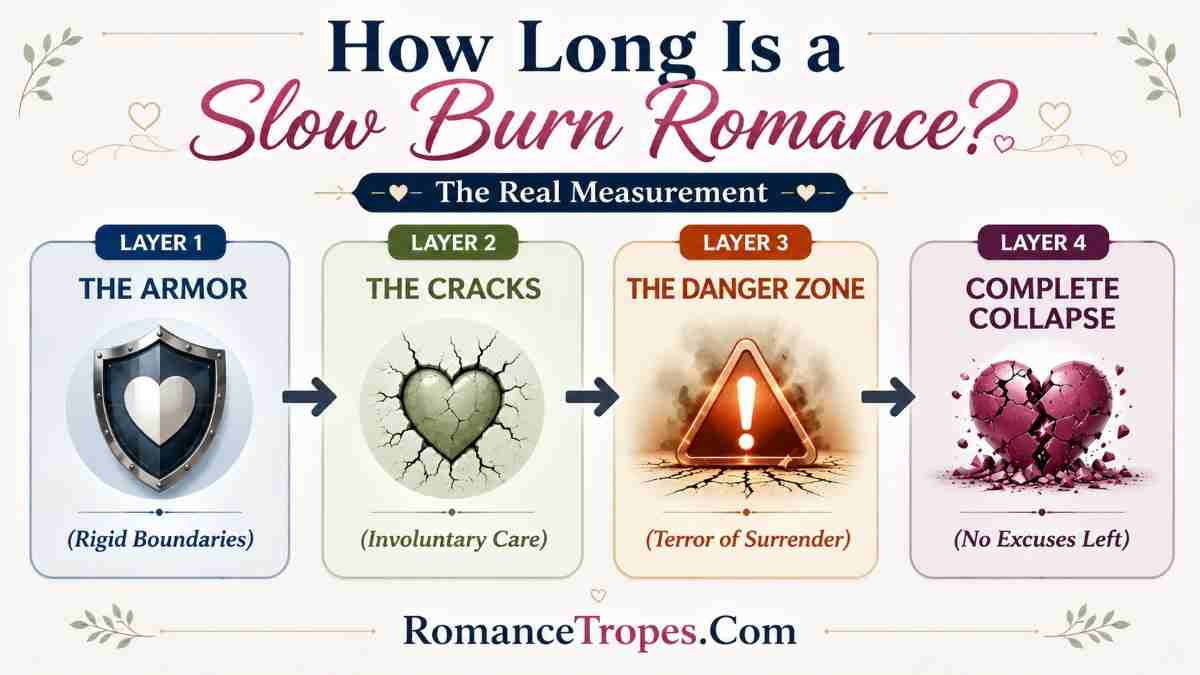
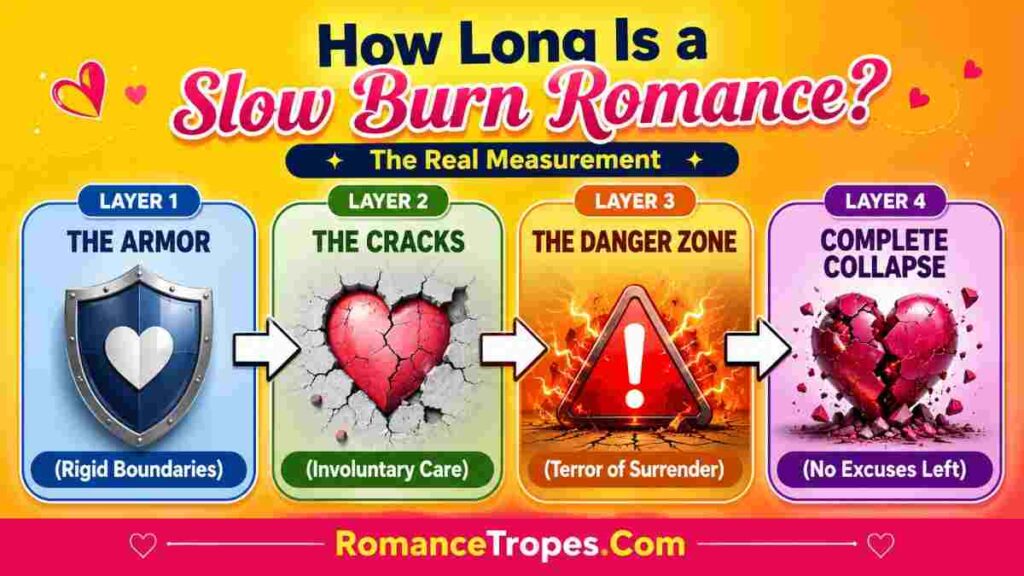
- The Vulnerability Threshold: The time it takes to burn is measured by how many of these four layers you burn through: walls of emotional armor (The Castle), the uncurated exposure (The Breach), the unspoken sacrifice of self (The Risk), and the actual surrender of your heart (The Give).
- The Internal Resistance Index: The time it takes to burn is dictated by how much you are actually fighting internally. Delay tactics only work when your reasons for delaying are coming from an internally held opposition to the attraction.
- The Evolution of Micro-Behaviors: Burn rate is actually visible in your micro behaviors. It evolves through four phases: Cold Start (the distance you display), Unconscious Shift (your habit loops as you start to adjust to the heat), Heightened Air (your space filling up with the tension of it all), and Ignition (the point at which you can’t stand it anymore).
–
How Long Is a Slow Burn Romance? Master the 3 Stages of Tension
Most guides measure slow burn relationships by external clocks: page counts, percentage marks, or how many calendar months pass in the story.
That is the wrong ruler.
A slow burn is not measured in pages, words, or weeks. It is measured in psychological distance and emotional thresholds.
A story can take place over twenty-four hours in a single locked room and feel like an agonizingly slow burn, while another can span five years and feel completely rushed if the characters jump into bed the second they share a glance.
If you want to measure the true length of a slow burn romance, you can do it with the following four psychological parameters:
–
1. The Vulnerability Threshold: From Armor to Exposure
Instead of asking “what percentage of the book has passed?”, measure how many layers of personal defense the characters have had to burn through.
- Phase 1 (The Fortified Castle): Both characters operate entirely behind their armor—professional titles, cynical humor, or emotional distance.
- Phase 2 (The Unintended Breach): One character witnesses the other in an uncurated, weak moment (grief, sickness, exhaustion) and cannot unsee it.
- Phase 3 (The High-Risk Middle): They begin choosing each other’s emotional safety over their own comfort, but they refuse to label it.
- Phase 4 (The Total Surrender): The defenses become heavier to maintain than the fear of rejection.
A slow burn romance ends only when holding onto the armor hurts more than putting it down
Literary Case Study: The 4 Phases in Jane Austen’s Pride and Prejudice
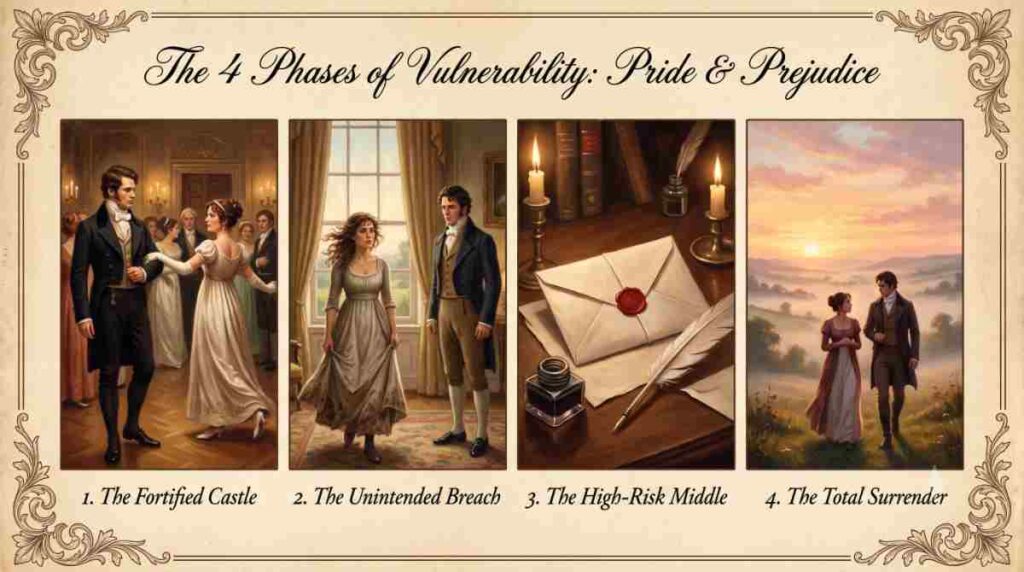
To understand how the vulnerability threshold measures romantic pacing far better than page count, consider the gold standard of literary romance: the dynamic between Mr. Darcy and Elizabeth Bennet.
Austen does not build their story through artificial delays; she methodically dismantles four distinct layers of emotional armor:
Phase 1: The Fortified Castle (Arrogance vs. Sarcasm)
At the assembly ball, both characters hide completely behind rigid self-defense. Darcy uses aristocratic coldness and social superiority to insulate himself from strangers (“She is tolerable, but not handsome enough to tempt me”), while Elizabeth uses sharp wit and cynical mockery as a shield to protect her pride from being slighted.
Phase 2: The Unintended Breach (The Muddy Petticoat)
When Elizabeth walks three miles through rain and mud to nurse her sick sister at Netherfield, Darcy witnesses her in an uncurated, unpolished state. Her wild appearance, muddy hem, and unfiltered sisterly devotion pierce straight through his social filter. He cannot unsee her warmth, and it sparks his quiet, involuntary fixation.
Phase 3: The High-Risk Middle (Pemberley & The Lydia Rescue)
After his disastrous, prideful first proposal is rejected, Darcy drops his defensive silence and hands her an honest, vulnerable letter. Later, when disaster strikes Elizabeth’s family, Darcy secretly buys off George Wickham to save the Bennets from social ruin. He chooses Elizabeth’s safety and dignity over his own pride—expecting nothing in return and demanding his actions remain completely secret.
Phase 4: The Total Surrender (The Morning Walk)
By the time they meet again on the quiet walking path, every defense mechanism has been burned away. Neither has an excuse left to fall back on. Darcy risks total, humiliating rejection to lay his heart bare: “My affections and wishes are unchanged, but one word from you will silence me on this subject for ever.”
The burn concludes not because a target word count was reached, but because keeping up their armor has finally become impossible.
Why does the Pride and Prejudice dynamic remain timeless? Because Jane Austen never relies on contrived misunderstandings to delay the romance. Instead, the pacing of her slow burn romance is driven entirely by the slow, painful erosion of internal defense mechanisms—proving that true romantic tension is measured by emotional risk, not page count.
How Long Is a Slow Burn Romance? The Real Measurement
–
2. The Internal Resistance Index
The length of the burn is determined by the strength of their internal objections.
If two people are keeping away due to a combination of bad circumstance and timing, it’s a burn as you would experience waiting in line at the post office. But when their reasons for keeping away are detrimental to their being, career, or sense of self, every second drags on.
The burn is long enough when their reasons have been painstakingly peeled away from the inside.
Story Example: The Cost of Surrender (Julian & Elena)
The Setup:
Julian is a senior public defender whose entire identity is built on impartial ethics, legal precision, and guarding his career against any conflict of interest. Elena is an investigative journalist assigned to cover his highest-profile municipal corruption case.
If their obstacles were merely a busy schedule or living in different cities, their delay would feel like waiting in line at the post office. But their hesitation is rooted in deep internal terror: for Julian, admitting his feelings means risking his hard-earned professional integrity and courtroom reputation; for Elena, falling for her primary source threatens her journalistic objectivity and credibility.
The High-Stakes Friction:
Over eight months of late-night depositions, courthouse corridor debates, and shared files over diner coffee, the romantic pull between them intensifies. Yet neither acts on it. Every shared glance, every brush of hands across a legal brief, and every quiet dinner carries immense psychological weight because they are actively fighting their own moral compasses.
The Dismantling of the Armor:
The slow burn romance does not end because the trial simply finishes. It ends only after months of forced proximity systematically dismantle their core fears:
- Julian realizes that his rigid obsession with professional detachment was merely a shield to prevent emotional vulnerability.
- Elena understands that her cynical distrust of sources was a defense mechanism to keep people at arm’s length.
When Julian finally closes the distance between them in an empty archive room at midnight, he isn’t just asking for a date—he is actively choosing to surrender his safe, insulated worldview. The tension works because crossing that line costs both of them their armor.
Romantic delay is only satisfying when characters are restrained by internal conviction rather than external logistics. When the obstacle lives inside their identity, every single second of restraint stretches with high-stakes tension.
How Long Is a Slow Burn Romance? The Real Measurement
–
3. The Shift in Micro-Behaviors
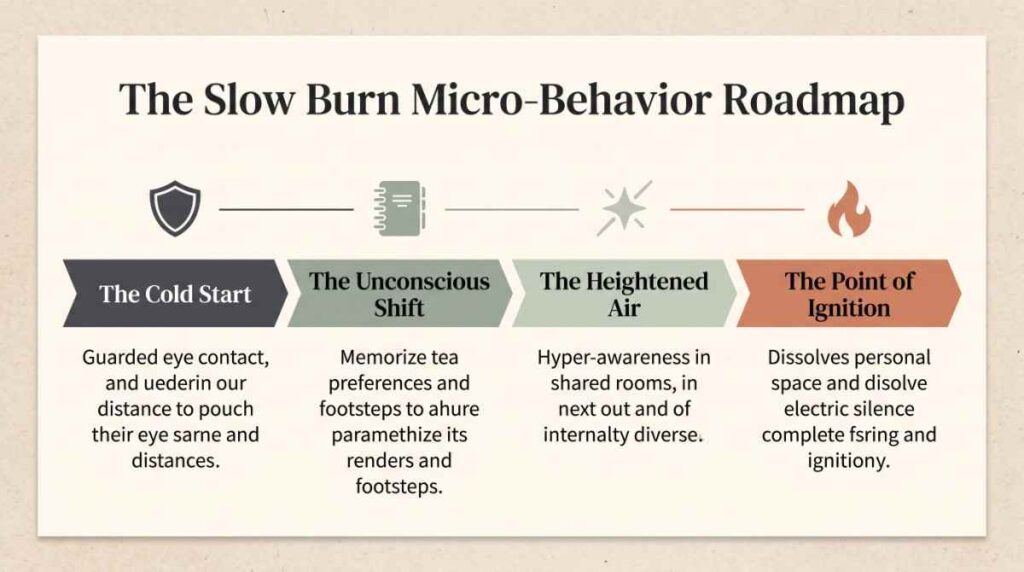
Look at how the characters communicate over time without speaking a word of romance:
Summary Takeaway
| Story Phase | Micro-Behavior Indicator |
| The Cold Start | Eye contact is brief, functional, and guarded. Physical distance is strictly maintained. |
| The Unconscious Shift | They memorize small details—how the other takes their tea, the sound of their footsteps in the hall. |
| The Heightened Air | Being in the same room creates physical hyper-awareness; normal conversations require intense effort. |
| The Point of Ignition | Personal space dissolves completely; silence is no longer awkward, but electric and demanding. |
A slow burn romance is exactly as long as it takes for two guarded people to realize that protecting their pride is no longer worth living without each other.
Story Example: The 4 Phases in Motion (Leo & Maya)
Phase 1: The Cold Start (Guarded Distance)
When Leo and Maya are assigned as co-lead architects on a landmark urban restoration project, their interactions are strictly sterile.
When Maya enters the drafting room, Leo gives a brief, functional two-second nod before immediately redirecting his eyes to his CAD monitors.
During layout reviews, they deliberately stand on opposite sides of the long drafting table, keeping a solid four feet of space between them.
Their spoken words are polite, precise, and completely stripped of personality.
Phase 2: The Unconscious Shift (The Silent Catalog)
Four months into the project, without either of them acknowledging it, small observations turn into ingrained habits.
Leo knows without looking that the rhythmic tap-tap-scuff of boots down the concrete hall at 8:15 AM belongs to Maya.
When he returns from the breakroom at noon, he silently places a cup of black tea with one slice of lemon next to her drafting pencils—never asking if she wants it, never staying for a conversation, just setting it down because he has memorized her late-morning routine.
Phase 3: The Heightened Air (The Thick Atmosphere)
By month eight, ordinary interactions begin demanding enormous conscious effort.
Working side-by-side over the 3D foam model at 10:00 PM, Maya reaches for an X-Acto knife at the exact moment Leo reaches for a ruler.
Neither speaks, but the sheer physical proximity turns the quiet studio electric.
Leo has to clear his throat twice just to ask a mundane question about load-bearing beams. The air between them feels hyper-charged; every breath, every shift of weight, and every rustle of blueprint paper is amplified.
Phase 4: The Point of Ignition (The Demanding Silence)
The final model is delivered, the studio is empty, and the midnight rain is tapping against the glass.
Maya is standing by the window with her coat on, ready to leave, but neither makes a move toward the door.
Leo walks across the hardwood floor and stops just inches away, completely dissolving the physical buffer they maintained for nearly a year.
There is no snappy remark, no joke about the client, and no excuse left to hide behind. The silence is no longer professional—it is demanding, heavy, and impossible to ignore.
In that unbroken eye contact, months of pride and emotional defenses finally collapse.
A slow burn romance does not need early confessions to show deep affection. By letting the characters’ physical behavior and silent habits evolve across these four stages, you show the reader that love is taking root long before the characters are brave enough to speak it out loud.
How Long Is a Slow Burn Romance? The Real Measurement
END
Link
How to Write a Slow Burn Romance: The Secret Behind Unspoken Tension
What Does WLW Mean in Romance Books?
–
FAQ
How long does a slow burn romance take?
How Long Does a Slow Burn Romance Take Cannot Be Measured by a Clock, Word Count, or Calendar Months.
Instead, It Depends Entirely on the Psychological Distance and the Level of Emotional Resistance Between Characters.
A Story Can Last for Twenty-Four Hours in an Enclosed Room and Feel Like an Agonizing Burn, or It Can Stretch over Many Years and Still Seem Rushed, if the Walls between the Minds of Protagonists Are Lowered Too Quickly.
A Slow Burn Romance Takes as Long as It Takes to Remove Four Layers of Protection from Two People, One Layer at a Time, Until Their Combined Emotional Defenses Are No Longer Worth Maintaining
What is considered a slow burn romance?
What is called a slow burning romance is the bond built by the characters on a psychological level, not by a certain amount of pages needed for a story to be told.
The slow burn can be due to circumstances, bad timing, and misunderstandings.
If one speaks about a true slow burn, it is a situation when two people who see each other as a threat to their psychological integrity.
A slow burn romance is the evolution between the characters, which is not based on a physical connection and the willingness to display one’s true self and accept another’s true self.
Are slow-burn relationships healthy?

When reflecting on relational dynamics, the slow burn is healthy if the hesitation is based on fear; however, it is unhealthy when the internal blockage transforms into stonewalling or suppression of affectionate overtures.
In fiction, as well as in real life, a slow introduction to the physical side of a relationship is healthy when both parties build emotional intimacy and trust. This way, attraction is not the sole driving force of a relationship.
However, when the internal hesitation prevents a person or both people from opening up in time and allows negativity to fester, the dynamic becomes unhealthy.
A proper slow burn should be able to ensure that there will be nothing the couple needs to hide from each other before becoming physically intimate.
How do you know if it’s a slow burn?
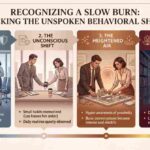
How to tell if it’s a slow burn is a tricky task because it’s all about the subtle behavioral changes that two people experience with each other, apart from the obvious affectionate proclamations. You can identify the slow burning of relationships in four stages:
Cold Start: The conversations are short, guarded, and kept at a distance.
Unconscious Shift: The small things about the other person, such as their habits, drinks’ tastes, and routines, have become a part of your life without consciously trying to adopt them.
Heightened Air: Your conversations and shared physical space make you feel energized and focused on the other person.
Point of Ignition: There is no need for a physical gap anymore; the pauses in conversations are thrilling.
–

0 Comments