
By: Ranjan sarkhell
–
Table of Contents
–
From Fierce Rivals to Late-Night Butterflies
Picture this: Maya is having the worst semester of her life. She is running for student council president, and her only real competition is Chloe—the sharp, overly confident girl who has beaten her at mock trial, debate, and track since freshman year.
They glare across the hallway. They trade sarcastic remarks in the cafeteria.
Then, their advisor forces them to organize the end-of-year spring carnival together.
Late one night in an empty classroom, surrounded by half-painted banner signs and cold pizza boxes, Maya catches Chloe laughing at one of her silly jokes—a real, unguarded laugh, completely free of smugness.
Maya’s chest tightens.
For the first time, she doesn’t want to beat Chloe. She wants Chloe to lean across the desk and kiss her.
That electric shift is the heartbeat of a WLW romance.
“When you understand what WLW means in romance books, you stop looking for rigid labels and start reading for the unspoken longing, shared smiles, and the freedom to love on your own terms.”
What WLW Mean in Romance Books?
–
What WLW Actually Means
WLW simply stands for “women loving women.”
When you see WLW on a book cover, a Goodreads review, or a Wattpad tag, it means the main love story is between two women.
You get all the fluttery stomach feelings, late-night text messages, mutual pining, and big romantic payoffs you expect from any great love story—just centered on two girls finding each other.
WLW vs. Lesbian Romance: A Classroom Example
People often wonder: If two girls are falling in love, isn’t that just a lesbian romance?
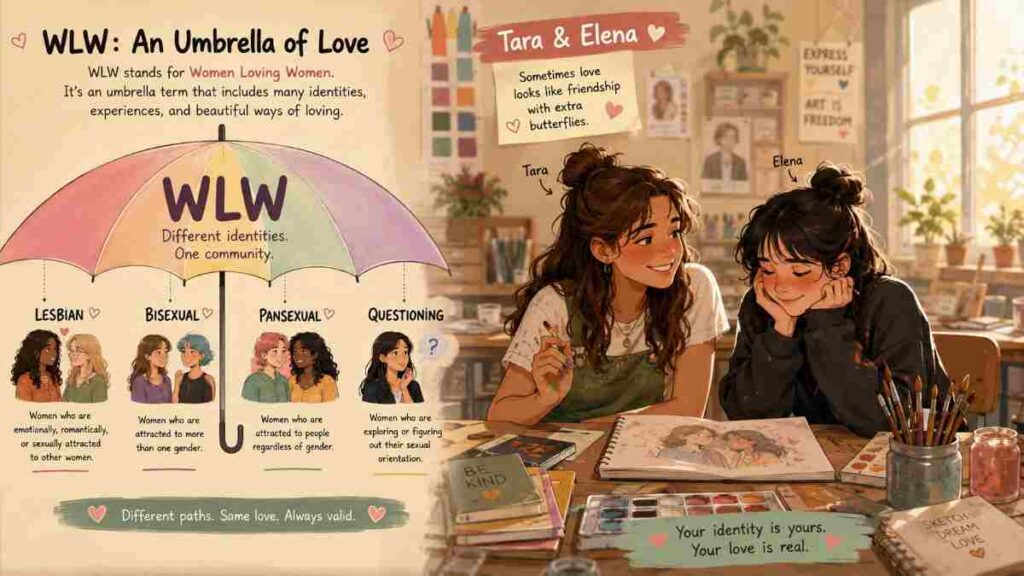
Sometimes, yes. But WLW works like a giant umbrella, and here is how:
Imagine a story about Tara and Elena. Tara has known she was a lesbian since middle school, came out to her parents, and is confident in her identity. Elena has only ever dated boys and always considered herself straight—until she meets Tara in art class and realizes her intense feelings go way beyond friendship.
- Calling the book strictly a lesbian romance might feel slightly inaccurate to Elena, who later realizes she is bisexual.
- But calling it a WLW romance fits perfectly! It celebrates the connection between them without forcing either character into a rigid box before the final chapter.
WLW includes:
- Two lesbian leads
- A bisexual girl and a lesbian girl
- Pansexual characters
- Anyone figuring out their attraction to women along the way
–
Classic Tropes, Told Through a WLW Lens
The best part about WLW fiction is taking the classic romance tropes everyone loves and turning them loose with high emotional stakes:
1. The “Fake Dating” Dilemma: A Story of Rules Meant to Be Broken
Nina is dreading the weekend of her older sister’s extravagant destination wedding.
Her family means well, but their relentless interrogations about her career, her love life, and why she is “still painfully single” are enough to make her want to fake a passport loss at the airport.
Desperate for a shield, she knocks on the apartment door across the hall.
Enter Sam: Nina’s motorcycle-riding neighbor who exudes effortless cool in a vintage leather jacket and worn combat boots. Sam agrees to play the role of the devoted plus-one under three strict conditions: unlimited access to the open dessert bar, no small talk before morning coffee, and a clear set of ground rules to ensure things don’t get messy.
The strategy starts out smooth. When Nina’s aunt begins prodding about her future at Friday’s rehearsal dinner, Sam casually rests a hand over Nina’s, offering an easy, disarming smile that charms the entire table. Nina tells herself it is just top-tier acting. But the pretend routine quickly starts blurring at the edges.
During the reception on Saturday night, the live band shifts into a slow acoustic melody. As golden fairy lights flicker above the crowded dance floor, Sam extends a hand and pulls Nina into the center of the room. With Nina’s fingers interlaced behind Sam’s neck and Sam’s hand resting gently against Nina’s waist, the manufactured performance evaporates. The playful glances turn into steady, electric eye contact, and the noise of the room completely fades away.
By the time the final chorus echoes through the ballroom, neither woman remembers the rules they wrote down—because neither one of them is pretending anymore. That heart-racing transition from staged convenience to undeniable reality is what makes fake dating one of the absolute sweetest setups in any WLW romance.
–
2. The Best Friends-to-Lovers Realization: When Friendship Blurs into Something More
Jess and Priya are practically an institution at their high school. Since middle school, they have shared a locker stuffed with matching keychains, traded indie pop playlists every Monday morning, and mastered the art of having entire conversations across a crowded room using only eyebrow twitches. Jess had always assumed their rhythm was etched in stone: comfortable, predictable, and entirely platonic.
Everything shatters on a mundane Tuesday afternoon by the athletic bleachers.
Jess is sitting cross-legged on the cool grass, waiting for Priya to pack up her bag, when Marcus—the star striker of the varsity soccer team—jogs over, flashing an easy grin. When he leans against the fence, stammers out a compliment, and asks Priya out to the upcoming weekend bonfire, Priya blushes. A soft, flattered pink flushes across her cheeks, and she tucks a loose strand of hair behind her ear.
Standing a few feet away, Jess is hit by a sudden, suffocating wave in her chest.
It isn’t the familiar, petty fear of losing a best friend to someone new or having to spend a Saturday evening alone. It is far more visceral and entirely unexpected. Jess finds herself staring not at Marcus, but at Priya’s smiling face, with her own pulse racing uncontrollably against her ribs. In that split second, the comfortable haze of their childhood bond dissolves: Jess doesn’t want Priya to say yes to Marcus, because the only hand Jess can bear the thought of Priya holding around that bonfire is her own.
That terrifying, breathtaking moment of realization—where years of comfortable companionship suddenly turn into unspoken desire and secret longing—captures the pure magic of a friends to lovers WLW romance.
–
3. The Slow Burn: When Sun-Drenched Days Turn into Late-Night Sparks
All season long, Jordan and Riley were fierce enemies on the basketball court, trading aggressive defensive stops, elbow checks, and ice-cold stares across the paint during the district finals. So when both girls show up on the first Monday of summer break to discover they have been assigned matching red whistles and identical lifeguard rotations at the town’s sweltering community pool, the silence between them is thick enough to choke on.
For the first three weeks of June, they operate like clockwork strangers. They keep their eyes glued to the water, swap out elevated wooden guard chairs without making eye contact, and communicate strictly through sharp head nods and short safety announcements.
Then, July arrives, bringing suffocating heat and quiet lulls between afternoon open-swim rushes.
The icy standoff begins melting away in tiny, quiet increments. It starts with a shared bottle of coconut sunscreen tossed without thinking across the guard room table. Then, it turns into Riley silently saving Jordan the last lemon popsicle from the breakroom freezer. By early August, their shifts no longer feel like a summer sentence; they stay behind on the pool deck long after closing time, dangling bare feet in the cool water and trading childhood fears, family pressure, and college dreams as the sky turns rich shades of peach and violet.
Jordan starts noticing every subtle detail: the spray of freckles across Riley’s nose, the gentle way Riley’s laugh crinkles her eyes, and how her own breath hitches whenever their shoulders brush while rolling up the blue lane dividers. Yet, neither girl dares cross the line. The mutual longing simmers under the surface, stretching out across endless sunny afternoons filled with lingering glances, hesitations, and words left unsaid.
The dam finally breaks at the end of August during a sudden, violent summer thunderstorm. While racing across the slippery deck to drag heavy sun umbrellas inside, their hands collide around the same metal latch. Lightning cracks across the slate-gray sky, rain plasters their hair to their foreheads, and the weight of three months of agonizing restraint completely gives way.
Standing soaked in the pouring rain, Jordan stops running, turns around, and confesses everything she has been desperately hiding since June—earning a kiss that makes every single moment of quiet waiting entirely worth it.
That delicious, heart-aching anticipation—where every brush of a hand feels like lightning and the buildup spans an entire season—is the exquisite art of a slow burn WLW romance.
–
How to Find Your Next Favorite WLW Story
If you want to read stories like these, searching is simple:
On Wattpad and Archive of Our Own (AO3), type WLW into the search bar alongside your favorite trope, like WLW enemies to lovers or WLW fake dating.
On Goodreads and Amazon Kindle, look up sapphic romance or WLW romance to find community-made lists packed with recommendations.
On BookTok, readers share short video roundups of their favorite queer reads every day using the hashtag #WLWBooks.
Whenever you see that WLW tag, you know you are getting a story where the girls get the grand gestures, the drama, and most importantly, the happy ending they deserve.
“When you understand what WLW means in romance books, you stop looking for rigid labels and start reading for the unspoken longing, shared smiles, and the freedom to love on your own terms.”
What WLW Mean in Romance Books?
An Author’s Note: Culture, Tradition, and the Right to Choose Essay
When writing love stories, one has to take into consideration the worldview of people from all kinds of cultures. When discussing WLW romance, it becomes evident that the topic is multi-faceted and complex, often raising questions of cultural relativism.
In the “universal” context of North America, Western Europe, and to some degree, Latin America, and the Asia-Pacific region, the matter is largely closed — same-sex relationships are tolerated, and in most cases, outright encouraged. The media portrays them in a positive light, and people are free to express their feelings without judgment. I appreciate the privilege of being able to do that, and recognize the good that comes from normalizing such relationships in cultures that accept them.
As someone who grew up in a different cultural and traditional background, similar tolerance and encouragement cannot be said about where I am from. My native land, as well as many countries in Asia, Eastern Europe, Africa, and the Middle East, has a rich and diverse heritage that often prioritizes tradition over individual desires. Men and women are largely expected to follow a specific path of life, and to deviate from it is to invite condemnation from one’s family and society at large.
Regardless of my cultural background, I believe that it is important for people to have the freedom to choose the path of their life.
Regardless of where they are from, I think that every person deserves the right to make their own decision and follow their own heart, regardless of cultural expectations. WLW fiction, in all its colorful variety, be it friends to lovers or enemies to lovers, is a reflection of that belief. Portraying same-sex relationships in books and other media is an act of empathy — a desire to understand how other people feel, where one does not come from. After all, while rules and borders shape our reality, they are only a frame that separates our perceptions of the world. But the feelings of love and acceptance within are universal.
Perspectives on Romance Categories: The Art of Identity and Emotion
Literary scholars, pioneering mangaka, and cultural critics have frequently explored the rise and cultural significance of romance classifications like BL (Boys’ Love), GL (Girls’ Love), and the traditional male-female romantic paradigm. Here is how key figures interpret these storytelling categories:
Keiko Takemiya (Pioneering Manga Artist & Pioneer of the Year 24 Group)
“When depicting deep emotional bonds and internal conflict, writing between male characters offered a canvas completely free from traditional domestic roles. In BL, romance becomes an exploration of pure spiritual and psychological connection.”
As one of the earliest creators to establish the roots of Boys’ Love with works like Kaze to Ki no Uta, Takemiya noted that shifting romance away from standard heterosexual scripts allowed artists to depict intense, equal-footing psychological drama without confining characters to conventional gender expectations.
Dr. James Welker (Professor of Cultural Studies & Queer Media Scholar)
“Genres like GL and BL are not just niche reading tags; they represent vital spaces where audiences renegotiate intimacy, desire, and agency away from rigid heteronormative formulas.”
Dr. Welker, an authority on gender representation in Asian pop culture, highlights that the growth of Girls’ Love and Boys’ Love gave global audiences alternative emotional landscapes, creating room for complex queer affection that standard male-female romance tropes often bypassed.
Yukari Fujimoto (Manga Critic & Associate Professor at Meiji University)
“Categorizations like BL or GL flourish because they dismantle the assumption that male-female romance is the singular default. Readers turn to these genres to find emotional vulnerability and equality that mainstream traditional romance historically struggled to provide.”
Fujimoto’s cultural commentary emphasizes that the evolution away from rigid tags like NL toward rich queer narratives allows modern storytelling to celebrate human vulnerability, mutual respect, and authentic connection above all else.
–
Link
How Long Is a Slow Burn Romance? The Real Measurement
10 Signs You’re Reading a Perfectly Written Slow Burn
–
FAQ
What is WLW and GL?
While both terms celebrate love between women, they speak to entirely different worlds—one is a real-life identity umbrella, while the other is a beloved storytelling genre.
WLW (Women Loving Women): The Identity Umbrella
Born out of online queer culture, WLW is an inclusive real-world label.
It covers anyone who identifies as a woman and feels romantic or sexual attraction toward other women—including lesbians, bisexuals, pansexuals, and queer or questioning folks.
You’ll hear it used in daily life, community advocacy, and personal bios just as often as in book tags. It’s all about who you are and who you love.
GL (Girls’ Love): The Pop Culture Genre
Originating in Japanese pop culture (closely tied to Yuri), GL specifically describes a genre of media.
You see it on webtoons, anime, manga, and Asian streaming dramas to signal that the central romance is between two female leads.
While WLW describes people and relationships, GL is the shelf label you browse when hunting down your next binge-worthy comic or TV show.
Put simply: WLW defines the people living and celebrating the romance, while GL is the genre tag on the stories they love to watch and read.
What is BL vs GL?
If you browse Asian dramas, manga, or webtoons, you have likely run into the tags BL and GL. Both are massive storytelling categories built around same-sex romance, but they focus on two different sides of love on screen and page.
BL (Boys’ Love): Romance Between Men
BL spotlights the emotional pull and romantic chemistry between two male leads. Born decades ago in Japanese manga, it has grown into a billion-dollar global empire of live-action dramas, novels, and digital comics.
GL (Girls’ Love): Romance Between Women
GL spotlights the spark and deep emotional bond between two female leads (often called yuri in Japan). While it has deep roots in comics, GL live-action series and mainstream books are having an explosive boom right now across world audiences.
The Big Differences at a Glance
The Core Couple: BL is all about men falling for men. GL is all about women falling for women.
The Playing Field: BL is a seasoned veteran with thousands of shows, huge budgets, and massive worldwide fan clubs. GL is younger in the mainstream drama space, but its fanbase is growing at lightning speed as readers and viewers demand more stories about women.
The Audience Roots: BL was originally built by female artists primarily for young female readers who loved intense, emotional fiction. GL has blossomed into a vital creative space for anyone craving authentic female connection, self-discovery, and queer representation.
In short: BL delivers the romance between boys, GL delivers the romance between girls, and both are completely changing how modern romance gets told.
What is BL, GL, and NL? What does it mean in Romance Webtoons and Manga?
When diving into manga, anime, and digital webtoons, you will quickly spot tags like BL, GL, and NL. These two-letter acronyms work like a roadmap for readers, instantly signaling the gender pairing and romantic dynamic of the main couple.
The Three Main Tags Explained
BL (Boys’ Love)
BL spotlights romantic feelings, deep affection, and emotional tension between two male characters. Originating decades ago in Japan and flourishing across Asian dramas and webcomics, this category ranges from lighthearted high school crushes to dramatic, slow-burning sagas.
GL (Girls’ Love)
GL centers on romance and meaningful connections between two female characters. Often connected with the term yuri, GL stories focus on tender moments, self-discovery, and genuine emotional chemistry, making it a favorite for readers seeking heartfelt queer representation.
NL (Normal Love) / BG (Boy-Girl)
NL is an older community tag used to describe heterosexual romance between a male and a female character. While you will still find it on vintage forums and older archive tags, modern platforms and fan groups increasingly prefer BG (Boy/Girl) or HL (Hetero Love).
Why Are Readers Moving Away from the Term “NL”?
Language in online reading communities evolves quickly. In recent years, many readers and platforms have pushed back against the label NL (Normal Love) because using the word “normal” suggests that straight couples are the default standard, while BL and GL stories are somehow abnormal or unusual.
To create a more inclusive, neutral space for every kind of love story, most modern readers and publishing sites now rely on BG or standard genre tags like Hetero Romance.
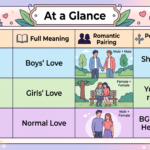
TagS At a Glance
BL Boys’ Love Male + Male Shounen-ai, Yaoi
GL Girls’ Love Female + Female Yuri, WLW romance
NL Normal Love Male + Female
BG (Boy/Girl), Hetero Love
Whether you are craving the high-voltage chemistry of BL, the emotional warmth of GL, or the classic charm of a BG dynamic, these labels help you find the exact love story you want to read next.
–

0 Comments